Japan Earthquake | Page 1526
 Me too. Are you able to help me post on the Simply Info site? I have been given access, but never done it before.by carabnr 6/7/2011 2:56:48 AM
- I have completed a couple of papers on heat stress and want to post the short one on our blog site.by carabnr 6/7/2011 2:59:20 AM
 Definately here ...but on mobile ...no avatarby smoss 6/7/2011 3:03:26 AM
- I lost my AV a while ago too. I think I'll think about publishing another day.by carabnr 6/7/2011 3:05:46 AM

www.sail-world.com
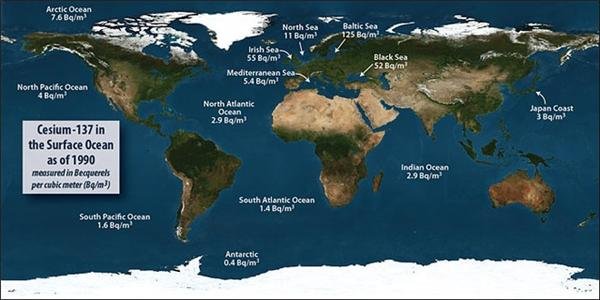
The background level of radiation in oceans and seas varies around the globe. Measured in atomic disintegrations per second (Becquerels) of cesium-137 in a cubic meter of water, this variation becomes readily apparent. The primary source of cesium-137 has been nuclear weapons testing in the Pacific Ocean, but some regions have experienced additional inputs. The Irish Sea in 1990 showed elevated levels compared to large ocean basins as a result of radioactive releases from the Sellafield reprocessing facility at Seacastle, U.K. Levels in the Baltic and Black Seas are elevated due to fallout from the 1986 explosion and fire at the Chernobyl nuclear reactor. By comparison, EPA drinking water standard for cesium-137 is 3,700 Bq/m3. (Courtesy Coastal Ocean Institute, Woods Hole Oceanographic Institution) www.whoi.eduby Reed via Sail-world 6/7/2011 3:06:23 AM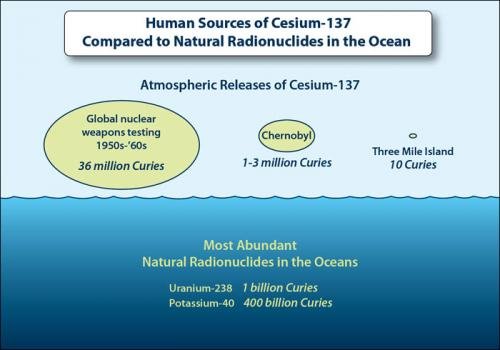
anpron.eu
Human sources of radiation released into the atmosphere over the past 60 years, although serious, pale in comparison to the radionuclides already naturally present in the ocean. One of the most prevalent substances released through nuclear weapons testing, the accidents at Chernobyl and Three Mile Island, and now Fukushima, is cesium-137 (137Cs). Total releases from Fukushima are currently above those at Three Mile Island, but below Chernobyl levels. Among the dozens of radioactive substances naturally present in seawater (of which cesium-137 is one), uranium-238 and potassium-40 are the ones present in the greatest abundance.
Note: Ovals are not to scale. 1 Curie = 37 billion Becquerels. (Illustration by Jack Cook, courtesy Coastal Ocean Institute, Woods Hole Oceanographic Institution) www.whoi.eduby Reed via Anpron.eu 6/7/2011 3:07:41 AM- @elainekirk Are you the person looking for info on MOX shipments?by ch 6/7/2011 3:17:18 AM
- Radiation levels likely exceed safety standard outside evacuation zone
2011/06/07
Residents outside the planned evacuation zone near the Fukushima No. 1 nuclear power plant are trying to lead normal lives, but radiation levels exceeding the safety standard are posing an increasing threat.
A report released June 3 by the science ministry said annual accumulated radiation levels are estimated at 20.1, 20.8, 23.8 millisieverts in the Ishida and Kamioguni areas of the Ryozen-machi district in Date city, and the Ohara area of the Hara-machi district of Minami-Soma, respectively.
The government's safety standard is 20 millisieverts of annual accumulated radiation.
These areas lie beyond the planned evacuation zone, which is just outside the off-limits area within a 20-kilometer radius of the plant.
The ministry's calculation assumes current radiation accumulation rates will remain static over one year.
The central government and the Date city government held meetings June 5. About 80 local residents attended the one held in the Ishida area and asked for supplies of feed for their livestock. But they also expressed concerns about the possible effects of radiation on expectant mothers.
Government officials in charge of nuclear disaster control measures tried to reassure the residents by telling them that the standard of 20 millisieverts is among the lowest in the world.
But when asked by residents to present specific measures to lower the radiation levels, the officials only repeated that they would continue to monitor the situation...
www.asahi.comby estacion 6/7/2011 3:19:33 AM  @ch I think elaine and nancy are!by Angie 6/7/2011 3:20:44 AM
- @Angie I've been looking too was wondering if they had been deep into NRC or not.by ch 6/7/2011 3:25:01 AM
- @ch I am sorry I couldnt tell you that! I am not sure where they have been. Elaine should be on in about 4-5hrs.by Angie 6/7/2011 3:26:50 AM
- @Angie OK ty If I'm still awake I'll be looking for her. Had a couple of questions for her too.by ch 6/7/2011 3:28:27 AM
- @ch No worries I will tell her you are looking for her if I see her first.by Angie 6/7/2011 3:29:14 AM
- @Angie tyby ch 6/7/2011 3:30:01 AM
- TEPCO backs off cause of explosion at nuclear plant2011/06/07
Contrary to what it said last week, Tokyo Electric Power Co. (TEPCO) now believes that it is unlikely that the March 12 hydrogen explosion at the No. 1 reactor building of the Fukushima No. 1 nuclear power plant was caused by the reverse flow of hydrogen gas from the containment vessel into the reactor building.
The utility said that on June 4, it found records saying that one of two valves in an exhaust pipe was designed to shut down automatically when a power source was lost, and probably did close. That would have prevented the flow of hydrogen from the containment vessel into the reactor building.
TEPCO has yet to confirm whether the valve actually shut down automatically, company officials said.
When the Great East Japan Earthquake and subsequent tsunami hit the nuclear power plant on March 11, all power was cut off.
In the No. 1 reactor building, the exhaust pipes from the reactor building and the containment vessel were joined into a single pipe that then vented all exhaust gases from both to the outer atmosphere.
On March 12, authorities attempted to release hydrogen gas that had built up inside the containment vessel to prevent an explosion. The gas was supposed to be released to the outer atmosphere.
Earlier, TEPCO officials theorized that hydrogen gas from the containment vessel had instead flowed down the pipe into the reactor building through two open valves. As a result, hydrogen would have accumulated inside the reactor building, leading to the explosion.
On June 3, the utility reported that theory to the Nuclear and Industrial Safety Agency (NISA) of the Ministry of Economy, Trade and Industry (METI).
On June 4, however, TEPCO officials rechecked their records from last year's regular inspections. They discovered then that one of the two valves was designed to seal itself automatically when power was lost.
As it is contained in a simple automatic system, officials think it likely that the valve shut down properly.
TEPCO is continuing its investigation into the cause of the explosion.
www.asahi.comby estacion 6/7/2011 3:36:49 AM  I feel this is very well written and worth reading. "Is Anyone Paying Attention?" riverjournal.comby Panserbjorne9 6/7/2011 3:40:08 AM
- Japan to send medical officer to U.N. nuclear watchdog
TOKYO (Kyodo) -- A medical officer of Japan's Ground Self-Defense Force will be sent to the International Atomic Energy Agency to instruct doctors on how to treat radiation victims and analyze information on radiation incidents, the GSDF said.
Lt. Col. Tetsuo Yamamoto, 41, will work at the Department of Nuclear Safety and Security at the Vienna-based agency for around two years from Wednesday as the first member of the Self-Defense Forces to be dispatched to the agency.
Yamamoto was involved in the health care of SDF personnel tasked with handling the disaster at the crippled Fukushima No. 1 Nuclear Power Plant. mdn.mainichi.jpby Panserbjorne9 6/7/2011 3:41:20 AM - Disaster victims manning front lines in struggle to tame Fukushima nuclear crisis ...One such worker is a man in his 40s whose home and employer's office both lie inside the 20-kilometer exclusion zone. An employee of a subcontractor working at the plant, when he leaves the evacuation center where he and his family now live, he tells his little boy he's going to "clean up some bad stuff." The 4-year-old, still too young to understand anything of fuel rods, meltdowns or radiation, replies, "Do your best, Daddy!" mdn.mainichi.jpby Panserbjorne9 6/7/2011 3:43:56 AM
 @all Saying Hello!by smoss 6/7/2011 3:52:18 AM
- Sorry @Smoss those gremlins like to get you every time!by Angie 6/7/2011 3:52:44 AM
- @Angie No worries :-)by smoss 6/7/2011 4:01:46 AM
- @smoss Hello!by Reed 6/7/2011 4:02:47 AM
- Japan seeks enhanced cooperation in response to nuclear accidents
BUDAPEST (Kyodo) -- Foreign Minister Takeaki Matsumoto has called for enhanced international cooperation in responding to nuclear accidents and strengthening nuclear safety standards at a foreign ministerial session of the Asia-Europe Meeting in Hungary.
In a speech after the opening ceremony of the meeting, Matsumoto also expressed Japan's resolve to share data regarding the accident at the Fukushima nuclear power plant, triggered by the March earthquake and tsunami disaster, with the international community in a fully transparent manner. (my edit:......."eventually".) mdn.mainichi.jpby Panserbjorne9 6/7/2011 4:08:45 AM - @Reed Hello to you as well!by smoss 6/7/2011 4:08:48 AM
 Hi @all. Hope all are well.by Mid Valley 6/7/2011 4:12:12 AM
- Fukushima strategy creates 'bigger mess' Water used to cool the plant forms pools of radioactivity IN FOCUS: JAPAN'S NUCLEAR CRISIS. Tepco's problem "resembles a board game with 16 squares and one empty spot," said David Lochbaum, a nuclear engineer who directs the Nuclear Safety Project of the Union of Concerned Scientists.
www.pressherald.comby Panserbjorne9 6/7/2011 4:17:12 AM - Fukushima aftermath: G20 to discuss nuclear safety www.bbc.co.ukby Reed 6/7/2011 4:20:01 AM
- @all Most interesting find of the night: Final Report-Focused Workshop on Antineutrino Detection for Safeguards Applications www.lefigaro.frby smoss 6/7/2011 4:59:22 AM
- @all Bye for now!by smoss 6/7/2011 4:59:44 AM
- @smoss That IAEA report was a very cool evening's discovery! TY for sharing.by Reed 6/7/2011 5:20:10 AM
- Sometime thye results precede the reports. www.slideshare.netby Ralph Unger 6/7/2011 5:44:46 AM
 @Reed Fukushima aftermath: G20 to discuss nuclear safety www.bbc.co.uk
by Reed at 9:20 PM The G7 nations will hold an emergency telephone meeting of finance ministers and central bank governors to discuss the economic impact of Japan's on-going disaster and possible ways to offer aid.
French Finance Minister Christine Lagarde announced the plan at a news conference on Wednesday.
The meeting, to be held as early as Wednesday, is expected to focus on the possible impact of the crisis on global economic growth and financial markets. The disaster has triggered plunges in stock markets worldwide and sharp appreciation of the Japanese yen.
During the meeting, Japan is expected to explain the scale of the disaster and their coping measures.
At a cabinet meeting on the same day, France's President Nicolas Sarkozy also called for a special G20 meeting of energy ministers to be held in several weeks to discuss future energy options for the world.
His call came in response to growing anxiety in the international community over the safety of nuclear power generation, sparked by Japan's nuclear power plant crisis.
French Ecology and Energy Minister Nathalie Kosciusko-Morizet told NHK that her government is concerned about the risk the disaster could pose to the country.
Thursday, March 17, 2011 05:35 +0900 (JST)by Tenzing 6/7/2011 5:45:44 AM@Reed
by Tenzing 6/7/2011 5:46:14 AM- @Ralph Unger Excellent find!
I highly suggest reading smoss' find of the Nutrino Detection Systems...very cool tech, and I'd love to have the readouts from one about 3Daiichi reactors right now! :)by Reed 6/7/2011 5:50:40 AM - @Tenzing Thank you for the YT vid! Why does 'Fukushima' sound better when Mme Kosciusko-Morizet says the word? :)by Reed 6/7/2011 5:53:02 AM
- Client List
MetaPower has effectively provided business process solutions and implemented systems to a vast clientele in the US and Canada. Listed below are MetaPower's current and previous clients:
We have developed the ground breaking Noble Production Product Suite that combine’s information technology, business process expertise and culture reform that enables plant manages to get the performance levels their stakeholders demand.
www.metapower.comby Tenzing 6/7/2011 5:58:50 AM  When is the G20 meeting?by FradyKat 6/7/2011 6:28:44 AM
- Did not that already happen?by Ralph Unger 6/7/2011 6:34:51 AM
- Fukushima aftermath: G20 to discuss nuclear safety "G20 energy ministers are set to meet in Paris to discuss nuclear safety in the wake Japan's Fukushima disaster." www.bbc.co.ukby Ralph Unger 6/7/2011 6:36:20 AM
 Well that is G20 for you always on the button , inviting the bankers along this whole episode would just be plain silly if it werent so serious....by elainekirk 6/7/2011 7:18:26 AM
- G20, why don't they just call it the top 1 per center? That is who they work for.by Ralph Unger 6/7/2011 7:23:49 AM
- Their parents knew that all people making a lot of money was a good thing, Their kids think they can get something for nothing. Rich are richer and poor get poorer, who cares? And the fed says they are right, but it cannot last. QE1, QE2,QE3? Of course .by Ralph Unger 6/7/2011 7:39:28 AM
- Japan's nuclear crisis: Fukushima strategy creates 'bigger mess'
Water used to cool the plant forms pools of radioactivity.
www.pressherald.com
"Under normal circumstances, Areva's system can decontaminate 50 tons of water per hour. But experts admit that it is hard to predict just how efficiently the system will handle water that contains not only radioactivity but also debris, oil and salt. Water might need to be treated numerous times before it can be dumped into the ocean.
"Normally the processing is done at small volumes, and you have carefully controlled chemistry," said Barrett, the nuclear engineer. "Here you have massive volumes and a very heterogeneous chemistry."
"Honestly, it's hard to say how it will work," said Patricia Marie, an Areva spokeswoman. "We hope everything will be fine."by Reed 6/7/2011 7:51:49 AM - If it isnt designed for lotsa debris then the filters are goin to need lotsa replacing. Tepco are great at putting all their eggs in one basket (usually the most photogenic one) not a great policyby elainekirk 6/7/2011 7:57:00 AM
- Japanese Government Admits "Melt-Through" in Reactors 1, 2 and 3
www.yomiuri.co.jp
"...the Japanese government will now admit in the report to IAEA that the "melt-through" may have taken place in the Reactors 1, 2 and 3 at Fukushima I Nuke Plant.
According to Yomiuri, "melt-through" happens when the melted fuel leaked from the Reactor Pressure Vessel and deposits at the bottom of the Containment Vessel, and is considered worse than "melt down".
ex-skf.blogspot.comby Reed 6/7/2011 8:00:17 AM


Japan Earthquake | Page 1526
- Who's Blogging
-
 hudebnik
 alblee
 UKVal
UKVal Jonathan Keebler
 Oliver (ScribbleLive)
 kaykodh
 Markfm
- Angie
 Mid Valley
 Matt (ScribbleLive)
 George Gibb
- elainekirk
 PKelley
 lillymunster
 dean
dean bo
bo Edano
Edano Deb
Deb- Pedro Jesus
 IanGoddard