Japan Earthquake | Page 1745
 @Edano That was not my point. My point was it actually resulted in an "increase on the death rate from E.coli infection because it led people to think they were safe as long as they avoided cucumber". The fact that a lot of small cucumber producers won't have money to pay their bills and to feed their families until the EU makes it up for them is besides the point. Call it a collateral damage irrelevant to the global community if you will... but the deaths are not irrelevant.by Pedro Jesus 6/24/2011 4:46:58 PM
 @Pedro Jesus : no, that's not true. they said to avoid any raw salad here. the people here in germany understood very well what was meant.by Edano 6/24/2011 4:49:56 PM
 @elainekirk This is generally an up-to-date radiation map haruto.s334.xrea.com 0.06 is nonsense.by Bobby1 6/24/2011 4:54:27 PM
 @bobby is the safecast one not good then?by elainekirk 6/24/2011 4:55:09 PM
- @elainekirk Lots of their readings are in cpm or becquerels, it's easier to see everything in the same metric, sieverts.by Bobby1 6/24/2011 4:56:42 PM
 @Edano radiation is the solution to E.Coli and Fuku compared with E.Coli... This is somewhat tounge in cheek www.engineeringnews.co.zaby RBeaner 6/24/2011 4:56:42 PM
- @Edano That was later on in the crisis, as far as the Portuguese media reported it. It all started with the cucumber and even the WHO advised the German health organization to be more cautious. E.coli wasn't accurately traced in different seeds until a few days later. And in the mean time another 30 people died.by Pedro Jesus 6/24/2011 4:58:12 PM
- @RBeaner ooooooh, this guy is cinical. LOLby Edano 6/24/2011 5:02:01 PM
- Fifth person in US confirmed ill with E. coli www.myfox8.comby Bobby1 6/24/2011 5:02:27 PM
- @RBeaner : if you give this guy a soup from fukushima and a bowl of e coli sprouts, he will just mix them together and eat both. :)by Edano 6/24/2011 5:05:03 PM
- @Veenie Come back and talk, let's solve the problem.by RBeaner 6/24/2011 5:11:46 PM
- @Edano Back in the 80's, I was in the navy in the Med and we got Irradiated Milk (parma something) and Ultra high heat treated milk. I think they were good for like 60 days each. The ultra hi heat stuff was horrible and the irradiated milk tasted great,. just an anecdotal opinion.by RBeaner 6/24/2011 5:16:24 PM
- @RBeaner Parmalat?by Pedro Jesus 6/24/2011 5:16:59 PM
- @Pedro Jesus something like that, 2 different types. Supposedly there weren't enough cows to support the USN under Reagan LOL so we got two types of milk, maybe from Italy and some from greece. One type was UHT and the other type was irradiated. The UHT was undrinkable and the irradiated was good.by RBeaner 6/24/2011 5:21:34 PM
- @RBeaner : why in hell did they give you irradiated milk ?by Edano 6/24/2011 5:21:41 PM

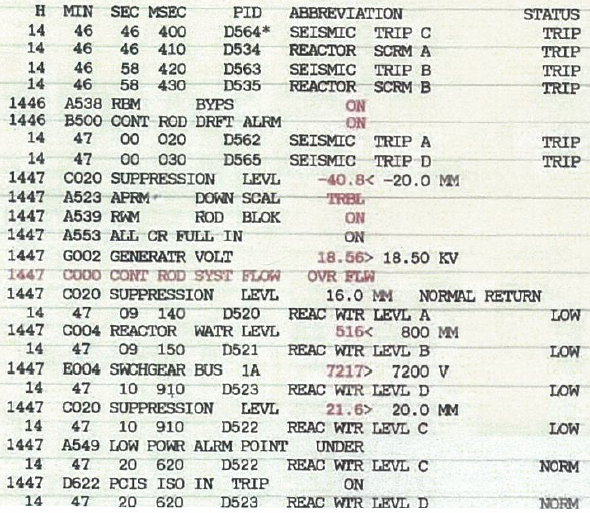
I just finished reading the NRC letter posted earlier this morning. Two statements caught my eye:
1) "All U.S. nuclear power plants are built to withstand external hazards, including earthquakes, flooding, and tsunamis, as appropriate."
How can we be certain that the measures implemented in the US are appropriate? We have not even yet fully uncovered the causes for the reactor accidents at Fukushima Daiichi nuclear power station.
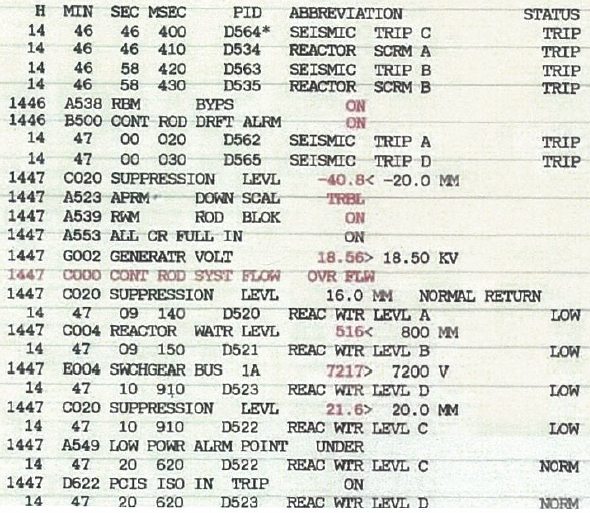
If we examine the excerpt of the seismic scram log published for unit 1 for example (posted by edano yesterday upload.wikimedia.org ), the shutdown of unit 1 proceeded as envisaged during the first minutes after the quake. According to Tepco, the situation turned to the worse, after the tsunami disabled the diesel generators depriving the reactor safety systems of AC power.
The diesels' failure may represent one major cause underlying the accident. However, the reactor safety systems of unit 1, as well as units 2 and 3, are supposedly designed such that the reactor can be cooled and its core covered with water for eight hours, using DC battery power and decay heat alone. Both were still available at Fukushima after the loss of AC power. Despite, lack of coolant caused fuel damage at unit 1 within four hours. How can the NRC claim that reactors of similar design are safe in the US, considering that we do not fully understand the causes instrumental to the catastrophic reactor failures at Fukushima?
2) "The NRC believes that it is highly unlikely that a similar combination of events such as those which occurred in Japan could occur in the United States..."
Since a different combination of similar events cannot be ruled out, this belief seems unwarranted.
US reactors of similar design as at Fukushima Daiichi nuclear power station should operate only at 70 percent of their full electrical power output, until a clear understanding of the causes for the three catastrophic reactor failures is reached, most notably because each failure was anticipated to occur only once in ten-thousand years or less.by Peter Melzer via Upload.wikimedia.org 6/24/2011 5:23:44 PM- @Edano the shelf life was around 60 days. All the bacteria is killed by the irradiation. Sometimes we were at sea for extended periods, but in this case it was either just in case we were going to be at sea for an extended period, or local supplies of fresh milk were insufficient for the fleet at the time.by RBeaner 6/24/2011 5:24:04 PM
- @RBeaner so they puposely give their soldiers irradiated milk ? and then they still wonder about the golf syndrome ?by Edano 6/24/2011 5:25:57 PM
- mabe you mix it up. you can sterilize milk by gamma rays. but that doesn't mean it's irradiated. ;)by Edano 6/24/2011 5:27:59 PM
- @Edano prehaps you are unaware of your food.. ""Because of the "Single Market" of the EC, any food – even if irradiated – must be allowed to be marketed in any other Member State even if a general ban of food irradiation prevails, under the condition that the food has been irradiated legally in the state of origin. Furthermore, imports into the EC are possible from third countries if the irradiation facility had been inspected and licensed by the EC and the treatment is legal within the EC or some Member state."" en.wikipedia.orgby RBeaner 6/24/2011 5:28:22 PM
- @RBeaner : yes gamma sterilization, that's a different thing. i thought you mean chernobyl like milk.by Edano 6/24/2011 5:29:40 PM
- @Edano irradiated, to me, means treated with radiation (gamma usually), not Activated (like neutron) ....understand the language confusion..ROFLMAO... We wern't trying to make incredible hulks..by RBeaner 6/24/2011 5:30:50 PM
- @RBeaner :) LOL who knows. "jacob's ladder", you know that ?by Edano 6/24/2011 5:31:39 PM
- @RBeaner Parmalat is the world leading producer of UHT milk after surviving what is known as Europe's biggest fraudulent bankruptcy up to date, according to Wiki. They don't mention irradiated milk as one of their products though. I never liked any of their products, to be honest. I don't remember ever seeing irradiated milk in our market but I used to drink only Portuguese milk. But they irradiate milk with UVR, it has nothing to do with radioactive isotopes. The process is used to convert 7-dehydrocholesterol to vitamin D.by Pedro Jesus 6/24/2011 5:32:48 PM
- @Edano the ladder to "heaven"? or the toy that repeats over and over?by RBeaner 6/24/2011 5:33:12 PM
- @RBeaner : it is a drug, MDMA like that (rumor !!!) supposedly was given to some soldiers in vietnam, for testing purposes. it turned them into killing mashines.by Edano 6/24/2011 5:35:32 PM
- @Peter Melzer well written. it's a real shame. a loss of external power can happen in many ways.
do we know why the batteries did not work ?by Edano 6/24/2011 5:37:15 PM  @Peter Melzer Many thanks. Truth is we really don't know that any of these plants are safe, and indeed it appears we have mounting evidence to the contrary. The 'all is absolutely fine' stance sickens me.by es 6/24/2011 5:38:29 PM
- @you : ah, maybe the diesels deprived the dc power ???by Edano edited by Edano 6/24/2011 5:38:56 PM
- @Peter Melzer I understand that all failure points of fuku are not fully understood, but what would be the purpose of taking all fuku era bwr's to 70%?by RBeaner 6/24/2011 5:47:42 PM
- @RBeaner : i think it needs far less time to cool them down.by Edano 6/24/2011 5:52:24 PM
- @Edano what 3% decay heat vs 5-6% as a starting point?by RBeaner 6/24/2011 5:54:59 PM
- @RBeaner : half the time for cold shutdown ?by Edano 6/24/2011 5:56:00 PM
- @RBeaner , as much as I understood Dean at the time he proposed a measure like that, working at reduced power would facilitate a safer emergency shutdown. In addition, Dean posted the explanations of David Lochbaum here: www.ucsusa.orgby Peter Melzer 6/24/2011 5:56:25 PM
- @Edano I'm not a plant engineer, but it seems the same steps would be required for cold shutdown. Continuos cycling of cooling water. I see no significant benefit to 70% vs. 100% except the volume of water flow.by RBeaner 6/24/2011 5:58:12 PM
- Sorry, the return button again. Lochbaum believes that damaged safety relief valves remaining in the open-position may have caused the loss of coolant at Fukushima. I saw in other NRC assessments that these valves are exposed to great pressures and are prone to fail open after excessively engaged. Running the reactors at lower than max. might be easier on the wear of these valves. I myself would prefer a moratorium, but believe that proposal would not stand a chance.by Peter Melzer 6/24/2011 6:02:36 PM
- @Peter Melzer I understand for a plant with a specific threat. Driving a car at 70 MPH, fog creeeps in I slow down. Cooper and some others should slow down, to give a little more reaction time. I can also understand shutting down plants deemed unsafe. But limiting all or a class of reactors to some arbitrary % capability should have good reasoning.by RBeaner 6/24/2011 6:02:54 PM
- @RBeaner , well I attempted to explain. The measure seems to put less stress on the valves. Let's ask Dean.by Peter Melzer 6/24/2011 6:04:25 PM
- One of the things I don't understand in the nuclear industry is why don't they upgrade the systems that are found to be unreliable such as those valves? Why are the safety standards in the nuclear industry so carelessly regulated and inspected as compared to, for example, the automotive industry? Do the regulators base their evaluation of the safety of the NPPs solely on statistical evidence instead of scientific evidence?by Pedro Jesus 6/24/2011 6:09:57 PM
- @Peter Melzer Yeah, maybe Dean (later) can explain the 70% power thing. I looked at that lochbaum article, and it looks like the Safety Relief Valves did what they were supposed to. Although I do recall that the SRV's were the cause of total failure at TMI.by RBeaner 6/24/2011 6:10:00 PM
- @Pedro Jesus I started to get into this with someone the other day, I irritated them (surprise) and they stopped talking. In my Opinion, it is all about public interest. There is no conspiracy by the main stream media or the various governments to cover up fuku. People understand loss of breaks or inadvertant acceleration in a car, and they become outraged. They can't understand nuclear power, loss of coolant, back up systems etc... Since they can't understand it, they ignore it. The reason MSM isn't talking about it isn't because of gov censorip, it's because 98% of people outside Fuku do not care.by RBeaner 6/24/2011 6:15:53 PM
- @Edano , I imagine that DC power may have been available, but that wires to the valves and pumps may have shortened out, rendering them inoperable. Regardless, when you read the manuals posted here, most huge safety valves actuate with autonomous feedback on pressures measured somewhere else in the cycle. There are always more than one valve that can effect the same outcome, and multiple systems that can effect the same outcome. Once the reactor scrams and the Main Steam Line Valves are closed the reactor safety systems should be able to take the reactor to cold shutdown with minimal human intervention. The implementation is so stringent that some valves revert to their supposed position, should a person crank them the other way. I read that there are 13 ways to inject water into the reactor. Yet, nothing could prevent three melt-downs in a row. If I were the NRC, that would scare me.by Peter Melzer 6/24/2011 6:19:34 PM
 @RBeaner I don't agree with your assessment of news media. The media only has to be sealed at the top. You're right, that the "average" newsman out in American these days does AP rip-and-read news in effect. If the top of the chain doesn't report on, say, Fukushima, there IS no news for the average reporter to report, given the sate of newsrooms across America.
It's owned, lock stock and barrel at the top. The news wipe on Fukushima is an astonishing display of power over the press.by RadioGuy 6/24/2011 6:24:43 PM- @RBeaner I see, I haven't seen evidence of cover-up either, in Fukushima, only a painstaking inability to convey information in an ordered, consistent, clear and speedy way. My doubts are about the whole nuclear community and the organisms that are supposed to regulate and inspect safety regulations and procedures. It seems like the nuclear industry stopped in time (back in the 70s) and there seems to be no concern in scientifically assessing NPPs overall safety. And this strikes me as being highly negligent considering the potential hazard to our modern society and public health. I see the automotive industry pushing forward towards safety and sustainability but I don't see the nuclear industry taking any steps towards the same common goal.by Pedro Jesus 6/24/2011 6:25:41 PM
- @Pedro Jesus , valid questions. They are totally willing to revamp an old jalopy to run on mox fuel, but an improved safety valve is out of the question. I found this on hydrogen recombiners that were deemed to be too expensive, just confirms the point: pbadupws.nrc.govby Peter Melzer 6/24/2011 6:26:16 PM
Japan Earthquake | Page 1745
- Who's Blogging
-
 hudebnik
 alblee
 UKVal
UKVal Jonathan Keebler
 Oliver (ScribbleLive)
 kaykodh
 Markfm
 Angie
Angie Mid Valley
 Matt (ScribbleLive)
 George Gibb
- elainekirk
 PKelley
 lillymunster
 dean
dean bo
bo Edano
Edano Deb
Deb Pedro Jesus
 IanGoddard