
Pedro.. one interesting point is to say.. where is the boundary for when they have to do a leak test on the containment...
by dean 7/11/2011 2:46:08 PM
we know that there are double sealed doors with air locks to separate those areas.. the ones that fuku opened..
by dean 7/11/2011 2:46:42 PM
that's what's called the GAS TIGHT boundary..
by dean 7/11/2011 2:46:55 PM

@dean and all the gasses are now quietly dispersing and will be for the foreseeable future
by elainekirk 7/11/2011 2:47:52 PM
there are outer rooms etc outside that gas tight boundary that has instrumentation, equipment etc.. and.. in the USA workers can go into those areas to perform maintenance work while the reactor is operating.. thus alot of work is done while the reactor is operating.. and that shortens the outage time to refuel.... in JAPAN.. they took the other approach.. no work while the reactor is running in there and they have longer outages..
by dean 7/11/2011 2:48:37 PM
US utilities want to make money and they only make it when they are pumping out electricity so their mindset is... move as much work to while operating,, minimize the outage time to get back up and make money
by dean 7/11/2011 2:49:19 PM
plus is a US utility gets behind schedule in an outage.. they just start pumping millions of dollars to get it fixed and back up running...
by dean 7/11/2011 2:49:59 PM
back in the day when they built the older plants they didn't have the state of the art safety systems like they have not... many us plants upgraded to a plant protective system that uses 2:3 logic... ie: 3 channels of same paramater so that one channel can be taken out and still have 2:2 logic... that allows them to do maintenance while operating... .the older reactors in japan probably haven't upgraded and they are stuck with the old logic... which is too risky to work on at operating conditions so they wait...
by dean 7/11/2011 2:52:04 PM
@dean thankks for description will you be putting it on the sites bwr page that lilly has started ?
by elainekirk 7/11/2011 2:52:33 PM
would you capture it elaine please
by dean 7/11/2011 2:53:05 PM
@dean @Pedro Jesus is this doc any use to you
www.iaea.org by elainekirk 7/11/2011 2:53:13 PM
@dean yes dean just got to cut grass then I will
by elainekirk 7/11/2011 2:53:35 PM
your exactly right Pedro... it's the door that crosses that gas tight boundary
by dean 7/11/2011 2:53:55 PM
gas tight boundary is a good term to use to understand containments.. because the primary containment must pass pressure testing to several psi..
by dean 7/11/2011 2:54:49 PM
@dean so with the doors open the containment is no more? does this mean that explosion risk has gone?
by elainekirk 7/11/2011 2:57:13 PM
@Pedro Jesus the paper is a bit beyond me without a dumbing down thats why deans explanation helps so much I am coming to it with no prior knowledge :) your picture is good too I can understand visuals to a greater degree than science papers
by elainekirk 7/11/2011 2:59:16 PM
right back as soon as garden lawn is deforested
by elainekirk 7/11/2011 2:59:56 PM

ooh god, i am so glad:
Expert: contaminated beef poses no problemAn expert on nuclear medicine says eating meat contaminated with the radioactive substance cesium on a few occasions will not cause health problems.
Keigo Endo is the president of Kyoto College of Medical Science.
He says Japan's safety limit for cesium is stricter than in the United States or Europe where a large amount of meat is consumed.
Endo says eating 500 grams of meat containing the safety limit of cesium for at least 200 days would add up to 1 millisievert of radiation.
However, he says the government should work out measures immediately to prevent beef containing cesium above the safety limit from reaching the market including stepping up checks.
Monday, July 11, 2011 21:31 +0900 (JST)
www3.nhk.or.jpthey have experts for every occasion.
by Edano 7/11/2011 3:01:20 PM
elaine.. they close the doors when they are performing the startup checks for the reactor... once the door is closed then they go on and start the reactor after all checks are done... it stays closed the duration of operation.. 'if" they loose the gas tight boundary .. the reactor would shutdown...
by dean 7/11/2011 3:01:35 PM
the position of the doors @ elaine isn't tied to the HYDROGEN source,, but,,, if the doors were opened and there was hydrogen gas inside it would have a path out... but it's not something they would do to mitigate or stop an explosion because they depend on that containment to contain the radiation and activity in the event of an accident..
by dean 7/11/2011 3:03:39 PM
@Edano I wondered where the uk government came into this and now I know they are teaching Japan how to select experts who can lie without their noses growing too long
by elainekirk 7/11/2011 3:03:48 PM
hi Edano.. hi bo.. welcome
by dean 7/11/2011 3:03:50 PM
@elainekirk @dean my connectio is so bad i can hardly follow..... :(
by Edano 7/11/2011 3:07:06 PM
sorry to hear Edano...
by dean 7/11/2011 3:07:54 PM
Fukui still opposed to restarting reactorsAn official from the prefecture with the most reactors in Japan says he cannot yet comment on the central government's disclosure on Monday.
The head of Fukui prefecture's environmental safety division, Hakuei Ishizuka, told reporters the central government will release details of the stress tests and their schedule on a later date.
He said the government has still not responded to the prefecture's demand for information about the extent of damage at the disabled Fukushima Daiichi nuclear power plant. He said another question not answered is whether the age of the crippled reactors was a factor in the crisis.
Ishizuka said unless the government gives Fukui a reply, the prefecture will not reactivate its reactors.
Ishizuka said the prefecture will keep a close watch on developments and will see whether the planned stress tests provide answers to its questions.
Monday, July 11, 2011 19:35 +0900 (JST)
www3.nhk.or.jp by Edano 7/11/2011 3:09:31 PM

So us has a higher cesium linit. Because we are not dropping like flies then contaminated beef in japan is ok. That is some twisted logic.
by lillymunster 7/11/2011 3:18:58 PM
Edano: Safety tests should be given priorityJapan's Chief Cabinet Secretary Yukio Edano says nuclear safety tests should be conducted regardless of the outlook for the electricity supply.
Edano was speaking to reporters on Monday about the government's recent decision to carry out safety checks of all Japan's nuclear reactors.
Edano stressed that nuclear safety should be given priority over the issue of whether there will be enough electricity to meet the demand.
He earlier apologized for the government's unclear policy on restarting nuclear reactors, which has confused municipalities hosting the nuclear facilities.
He said the government will not set a deadline for completing the safety tests but they should be completed as soon as possible. He said the Nuclear Safety Commission, an independent body, and the Nuclear and Industrial Safety Agency will conduct the tests.
He said as long as the facilities are technically safe, a well thought-out plan could avert the possibility of shutting down all 54 reactors at the same time.
Edano said utilities are drafting plans based on scenarios in which all reactors currently stopped for maintenance cannot be restarted.
He said government offices will work with the utilities to ensure stable power supplies in the coming months.
Monday, July 11, 2011 15:10 +0900 (JST)
www3.nhk.or.jp by Edano 7/11/2011 3:23:02 PM
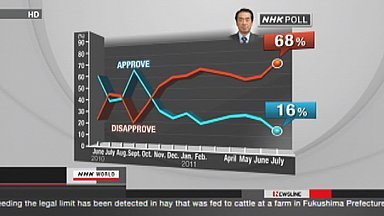
Kan support rate falls to 16%A recent NHK poll shows the support rate for Prime Minister Naoto Kan's Cabinet has dropped to 16 percent, the lowest since the Democratic Party took power 2 years ago.
Some 1,100 people responded to the survey, conducted last weekend.
The support rate for the Kan Cabinet fell by 9 percentage points from last month. The disapproval rate has risen 11 percentage points to 68 percent.
Forty-two percent of the respondents supporting the Kan Cabinet said it looks better than any other potential ruling bloc. Equally 42 percent of respondents not supporting the cabinet said it lacks the power to carry out policies.
Asked when Kan should step down as prime minister, 38 percent said he should do so immediately. Twenty-eight percent said they want him to step down by the end of August, when the current session of the Diet ends. Fourteen percent said between autumn and year-end, while 10 percent said next year or later.
Asked what should be done regarding the nation's nuclear power plants, 2 percent said more nuclear plants should be built. Twenty-five percent said they are in favor of the status-quo, while 42 percent said the number of plants should be reduced. Twenty-one percent said all nuclear power plants should be eliminated.The approval rate for the Democratic Party stands at 13.6 percent, down nearly 7 percentage points from last month and the lowest since May 2007.
The approval rates for the other main political parties are as follows:
Liberal Democratic Party, 23.4 percent; New Komeito party, 3.4 percent; Your Party, 2.8 percent; Communist Party, 2.2 percent; Social Democratic Party, 1 percent; People's New Party, 0.1 percent. The rate of respondents not supporting any party was 46.2 percent, the highest since this type of poll began.
Monday, July 11, 2011 19:45 +0900 (JST)
www3.nhk.or.jp by Edano 7/11/2011 3:25:04 PM
@Edano @lillymunster that 1msv needs adding to all the other msv too they fail to mention that
by elainekirk 7/11/2011 3:29:23 PM
Minami-soma starts internal radiation checksMinami-soma City in Fukushima Prefecture has begun checking the internal radiation levels of its residents.
Two locations in the city have measured radiation of 20 millisieverts or higher per year, a level that prompts the authorities to recommend the evacuation of nearby residents.
State and prefectural authorities are continuing their monitoring with the aim of designating the areas as radioactive hotspots, despite being outside the government-designated evacuation zone around the Fukushima Daiichi nuclear plant.
The residents who were examined at the city-run general hospital on Monday are living near these 2 areas.
After completing a questionnaire, the residents were checked for radiation with a whole body counter.
A 20-year-old man says he's very concerned about the outcome of the tests.
Minami-soma City says it will give priority to checking children as well as adults in the highly contaminated areas.
About 7,000 people will undergo the checks by the end of next March. [wow, this is really fast !]
Monday, July 11, 2011 15:10 +0900 (JST)
www3.nhk.or.jp by Edano 7/11/2011 3:29:35 PM
@bo a bit better now standing on my balcony :)
by Edano 7/11/2011 3:30:01 PM
www.collapsenet.com to complement pedros post
by dean 7/11/2011 3:31:42 PM
I was hoping that there would be an english tweet on this I will have to ask unless someone here in Japan can enlighten us
translation -
hga02104 日垣隆(T-Higaki)
by chottoiino
Delete command is also a Twitter name TBS. No freedom of speech. RT @ bachimaguro @ sumatannews suppression of free speech by the media. Newspapers tie his freedom of expression. RT: nagaoka1969 "the 10 million" notice on the Prohibition of the Yomiuri Shimbun reporter Twitter. Not even if anonymous # sumatan
by elainekirk 7/11/2011 3:32:35 PM
High-level cesium detected at waste disposal facilities in ChibaCHIBA, Japan, July 11, Kyodo
High levels of radioactive cesium have been detected in incinerated ashes at waste disposal facilities in Kashiwa, Chiba Prefecture, in apparent effects from the nuclear crisis at the Fukushima Daiichi power plant, the local municipal office said Monday.
At one waste disposal center in Kashiwa, up to 70,800 becquerels of radioactive cesium per kilogram were detected from ashes collected on June 24 and more than 60,000 becquerels were observed from ashes collected on July 1 and 2, the city office said.
Up to 48,900 becquerels of radioactive cesium were also detected at a facility for burying the ashes from waste disposal centers in the city, while a maximum of 9,780 becquerels were observed at another waste disposal center, the office said.
english.kyodonews.jp by Edano 7/11/2011 3:33:54 PM
new LOGIC.. if you discontinue breathing
it reduces the risks to ZERO.of getting cancers from exposures to NUCLEAR FALLOUT...
by dean 7/11/2011 3:34:37 PM
Daiichi contaminated water could breech breakwater (
like it hasnt done already)
translate.google.comby elainekirk 7/11/2011 3:36:26 PM
@ Peter.. they will probably find a host of modifications that are needed and then use the old standard "GRADED APPROACH" alittle paper pushing now to say it's ok to operate on the bet that actually modifications will begin to be completed alittle as they go
by dean 7/11/2011 3:37:52 PM
 @dean Got question. That has been my doubt until I found that image that is pinned above. I guess the double sealed doors with air locks they mention seal the inside of the Primary Containment from the outside of it. If you look carefully to the right end side of the Primary Containment vessel (in yellow) there is a tiny massive air tight door that separates the inside structure of the Primary Containment from the rest of the building. Let me know if you can't see it so I can try and explain better.by Pedro Jesus 7/11/2011 2:52:32 PM
 Hi folks, late night, just checking inby bo 7/11/2011 3:03:37 PM
 by Edano via Www3.nhk.or.jp 7/11/2011 3:25:58 PM
 @Edano , the safety tests, as I understand them, are nothing more than probabilistic safety assessments with enhanced requirements, a bit like the stress tests of European banks, ;) The interesting part will be the enforcement of necessary improvements that the tests indicate. I hope the government will be hard-nosed enough to insist on the implementation of plant modifications, before the operators are allowed to restart the reactors.by Peter Melzer 7/11/2011 3:35:48 PM
 hudebnik
 alblee
 UKVal
UKVal Jonathan Keebler
 Oliver (ScribbleLive)
 kaykodh
 Markfm
 Angie
Angie Mid Valley
 Matt (ScribbleLive)
 George Gibb
 PKelley
 bo
bo Deb
Deb Pedro Jesus
 IanGoddard