Japan Earthquake | Page 1887
 @Jo the link isnt working for meby Elaine Kirk 7/11/2011 12:15:32 AM
 @Peter Melzer yesterday they stated that the spent fuel pools will be emptied beginning in 3 years.by Edano 7/11/2011 12:17:09 AM
 @Edano I'm having trouble envisioning SFP 4 still standing in 3 months, let alone 3 years.by RadioGuy 7/11/2011 12:20:58 AM
 @Elaine Kirk , sorry I will try and figure it out. It was my first attempt at copy past from an I pad?by Jo 7/11/2011 12:21:09 AM
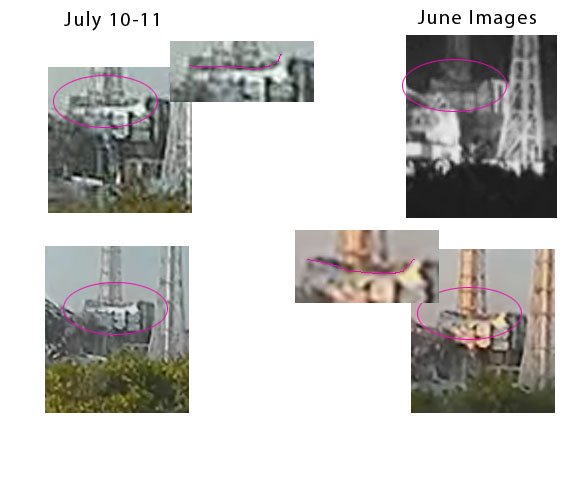
End of unit 4 post July quake vs. June
by lillymunster 7/11/2011 12:22:15 AM- @lillymunster thank you !! it crashed down. you can now see more of the venting tower behind !by Edano 7/11/2011 12:23:13 AM
- The left end of the wall panels along the top that were pushed in seems to have fallen in. I also posted earlier that the overhead crane on 4 was slightly skewed now also.by lillymunster 7/11/2011 12:23:29 AM
- @Edano so far I can't see more tower via the TEPCO cam but I am just on my laptop and the TEPCO image is pretty low quality.by lillymunster 7/11/2011 12:25:52 AM
- @Edano @lillymunster thats greatby Elaine Kirk 7/11/2011 12:26:49 AM
- i can tell you the exact time of the crash. i was alone here with mona :)
Sunday July 10 2011, 05:14:33 UTC 18 hours ago off the east coast of Honshu, Japan 4.7 25.0 quakes.globalincidentmap.com
it happened on this aftershock (just for the record).by Edano 7/11/2011 12:28:54 AM - @Edano so you saw something fall?by lillymunster 7/11/2011 12:29:25 AM
 @Lilly Thanks! I wasn't sure before, but now I'm convinced.by LM 7/11/2011 12:29:45 AM
- @Elaine Kirk , My son said he is not entirely sure but it might not work for everyone because it is a xls file.by Jo 7/11/2011 12:30:41 AM
- @lillymunster : i saw something had changed. but there was no dust. i had to look several times, but i noted the time.by Edano 7/11/2011 12:31:01 AM
 @Edano , @lilly, I found a slide show that documents how fuel is ordinarily transferred: www.brc.gov . Seems immensely involved. Regardless, it must be possible to devise a solution with a smaller footprint.by Peter Melzer 7/11/2011 12:32:27 AM
- @all TBS cam is starting to come back into view. Hopefully it will clear some more.by LM 7/11/2011 12:38:39 AM
- @LM the tbs cam will not show the damage. i checked it earlier.by Edano 7/11/2011 12:39:43 AM
- cool:
Japan's reactor 'stress tests' should be shorter than EU's: Okada
OFUNATO, Japan, July 10, Kyodo
Democratic Party of Japan Secretary General Katsuya Okada indicated Sunday that Japan's safety assessment to be conducted on nuclear reactors before restarting them following suspension for regular checks should be shorter than the European Union's version of ''stress tests'' on which it will be based.
''A long-term test similar to the European Union's would have an impact on industries and people's daily lives,'' Okada told reporters while on a visit to Ofunato, Iwate Prefecture. ''The point is how to create Japan's version of the test.''
Although Okada had been reluctant to make the stress tests a precondition for resuming operations of reactors suspended for regular maintenance, he said, ''We have come to a point where we cannot gain people's understanding under current standards. We have no choice but to take the path of restarting them after they clear the stress tests.''
english.kyodonews.jpby Edano 7/11/2011 12:40:44 AM - ''We have come to a point where we cannot gain people's understanding under current standards. We have no choice but to take the path of restarting them after they clear the stress tests.''
Well they do have a choice, he just doesn't want to. Japan has been functioning for 4 months without those reactors. There are some pains to industry but it was also noted that the electric companies were not at capacity but were holding back to make the shortage seem more severe.by lillymunster 7/11/2011 12:44:38 AM - @edano That makes sense. It's just nice having another view..especially when we normally have to rely on Tepco!by LM 7/11/2011 12:45:12 AM
- @Peter Melzer what about a smaller version of an onsite transfer cask? I think the big concern would be finding room to get anything into the pool with a crane and also the added weight of a cask. Both cranes are over the SFP. The refueling crane may be blocking access from the open end of the building.by lillymunster 7/11/2011 12:47:12 AM
- @all 4.6 earthquake right under Fuku 56 min ago. Did anyone notice the Tepco cam shake? I didn't. quakes.globalincidentmap.comby LM 7/11/2011 12:53:16 AM
 Good morning all. Here is my new article on the social impact up at Japan Focus: japanfocus.orgby bo 7/11/2011 12:56:07 AM
- I just thought of something reading these BWR containment documents. If a reactor has the RPV that is metal, the second bulb containment that is also metal but then the outer square (or round) building is the last line of containment in place of the concrete bulb they have at fuku what happens in a meltdown? If the outer shell of the building is your final containment nobody is getting inside to get at gauges, do nitrogen injection, get up to the SFP.by lillymunster 7/11/2011 12:56:11 AM
- 4.8 2011/07/10 20:19:05 38.046 143.966 10.0 OFF THE EAST COAST OF HONSHU, JAPAN Pretty small.by Ralph Unger 7/11/2011 12:56:41 AM
- @bo I am just reading:)by Elaine Kirk 7/11/2011 12:58:12 AM
- @Ralph That one was pretty far off the coast. The 4.6 was under Honshu centered 41 miles SSE of Fuku city.by LM 7/11/2011 1:02:13 AM
 backby dean 7/11/2011 1:05:11 AM
- gm boby dean 7/11/2011 1:06:31 AM
- Hi deanby bo 7/11/2011 1:06:44 AM
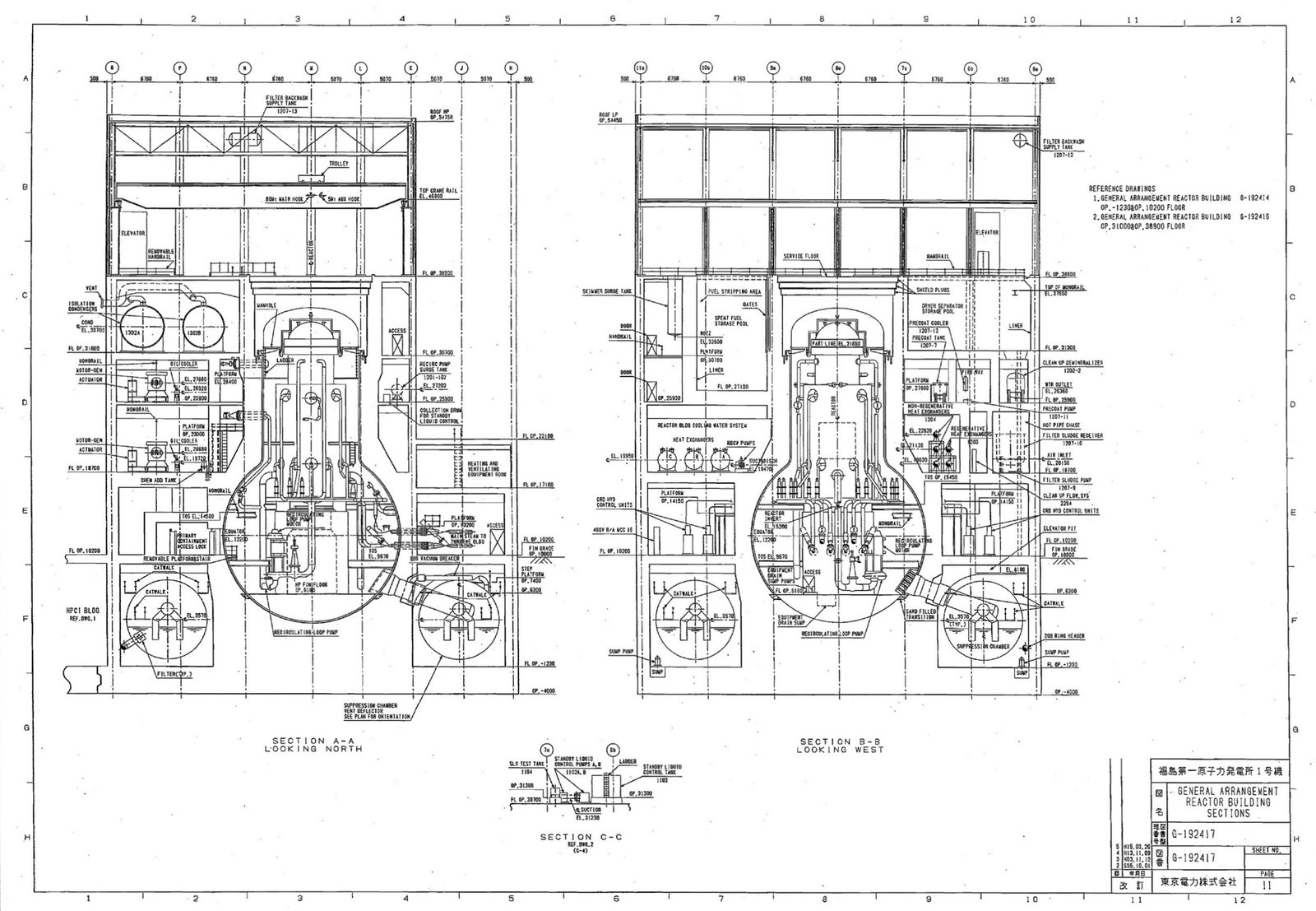
- @ lilly, where is that copy of the fuku print that we had way back some time ago? the cross section of the building.. I'm going to compare some notes on it versus the ones on that doc that was posted..by dean 7/11/2011 1:09:17 AM
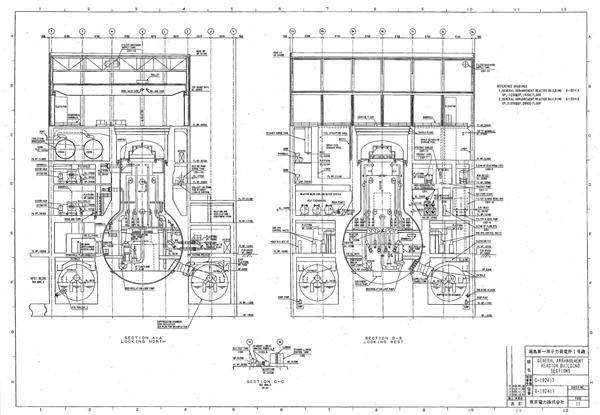
@dean reactor elevation drawings www.houseoffoust.com
by lillymunster via Houseoffoust 7/11/2011 1:12:55 AM- @Bo, very well done.by lillymunster 7/11/2011 1:12:59 AM
- Thanks lillymunster. I have many people here to thank for finding most of those sources originally.by bo 7/11/2011 1:14:09 AM
- @bo, I really liked the article.by Jo 7/11/2011 1:14:55 AM
- Thanks @Jo. Now some breakfast for me. Back in a bit.by bo 7/11/2011 1:15:51 AM
- @bo that article is really good :)by Elaine Kirk 7/11/2011 1:16:56 AM
- Four of the Illinois reactors have the same design and manufacturer as the first reactor to fail Saturday at the Fukushima Dai-ichi plant northeast of Tokyo, said the Nuclear Energy Institute, the U.S. trade group for the industry.by dean 7/11/2011 1:22:21 AM
- Those reactors, produced by General Electric Co. and with the model name Mark I, also are in place at Exelon’s two reactors at Dresden, near Joliet, and at its two Quad Cities reactors.by dean 7/11/2011 1:22:46 AM
- The purpose of a reactor containment system is to create a barrier against the release of radioactivity generated during nuclear power operations from certain "design basis" accidents, such as increased pressure from a single pipe break. It is important to understand that nuclear power plants are not required by the Nuclear Regulatory Commission (NRC) to remain intact as a barrier to all possible accidents or "non-design basis" accidents, such as the melting of reactor fuel. All nuclear reactors can have accidents which can exceed the design basis of their containment.
But even basic questions about the the GE containment design remain unanswered and its integrity in serious doubt. For example, 23 of these BWRs use a smaller GE Mark I pressure suppression containment conceived as a cost-saving alternative to the larger reinforced concrete containments marketed by competitors. A large inverted light-bulb-shaped steel structure called "the drywell" is constructed of a steel liner and a concrete drywell shield wall enclosing the reactor vessel--this is considered the "primary" containment.. The atmosphere of the drywell is connected through large diameter pipes to a large hollow doughnut-shaped pressure suppression pool called "the torus", or wetwell, which is half-filled with water. In the event of a loss-of-coolant-accident (LOCA), steam would be released into the drywell and directed underwater in the torus where it is supposed to condense, thus suppressing a pressure buildup in the containment.
The outer concrete building is the "secondary" containment and is smaller and less robust (and thus cheaper to build) than the containment buildings used at most reactors.by dean 7/11/2011 1:30:54 AM  @all Hello again!by smoss 7/11/2011 1:32:45 AM
- An NRC analysis of the potential failure of the Mark I under accident conditions concluded in a 1985 report that Mark I failure within the first few hours following core melt would appear rather likely."
In 1986, Harold Denton, then the NRC's top safety official, told an industry trade group that the "Mark I containment, especially being smaller with lower design pressure, in spite of the suppression pool, if you look at the WASH 1400 safety study, you'll find something like a 90% probability of that containment failing." In order to protect the Mark I containment from a total rupture it was determined necessary to vent any high pressure buildup. As a result, an industry workgroup designed and installed the "direct torus vent system" at all Mark I reactors. Operated from the control room, the vent is a reinforced pipe installed in the torus and designed to release radioactive high pressure steam generated in a severe accident by allowing the unfiltered release directly to the atmosphere through the 300 foot vent stack. Reactor operators now have the option by direct action to expose the public and the environment to unknown amounts of harmful radiation in order to "save containment." As a result of GE's design deficiency, the original idea for a passive containment system has been dangerously compromised and given over to human control with all its associated risks of error and technical failure.by dean 7/11/2011 1:33:53 AM - HI SMOSSby dean 7/11/2011 1:33:56 AM
- @lillymunster , back, that is why the first thing on my mind would be cleaning up the service floor, getting all these broken things off that are in the way right now. In any new event like quakes etc., having the floor cleared of loose parts that may fall down helps. They could start at the far end. I do not know what holds them back, the radiation?by Peter Melzer 7/11/2011 1:35:08 AM
- @dean Hi! Just a bit of an FYI...the google translated MOX Doc pinned is my translation (albet not complete yet, I'm hoping to mirror it with a Babel Fish translation) :-)by smoss 7/11/2011 1:36:36 AM
Japan Earthquake | Page 1887
- Who's Blogging
-
 hudebnik
 alblee
 UKVal
UKVal Jonathan Keebler
 Oliver (ScribbleLive)
 kaykodh
 Markfm
 Angie
Angie Mid Valley
 Matt (ScribbleLive)
 George Gibb
 elainekirk
 PKelley
- lillymunster
- dean
 bo
bo- Edano
 Deb
Deb- Pedro Jesus
 IanGoddard