Japan Earthquake | Page 2079
 @lillymunster i don'think this will work. you need to exhaust the steam.by Edano 8/4/2011 2:11:46 PM
- Nuke plant hosts call for quick end to crisis
Local communities hosting nuclear power plants in Japan have urged the government to thoroughly investigate the Fukushima accident to determine its cause.
An association of 25-member municipalities held its annual meeting in Tokyo on Thursday.
Many community heads complained that they cannot explain to their constituents the need for nuclear plants while the government's energy policies remain unsettled. They also urged the government to quickly end the problems at the Fukushima Daiichi nuclear station.
Others called on the government to set up a professional nuclear watchdog, after separating the current Nuclear and Industrial Safety Agency from the industry ministry.
Industry minister Banri Kaieda apologized for the enormous trouble that the crisis in Fukushima has caused to other municipalities with nuclear power plants.
He said the government is determined to pour all its efforts into handling the accident.
Thursday, August 04, 2011 21:21 +0900 (JST)
www3.nhk.or.jpby Edano 8/4/2011 2:13:23 PM  @lillymunster Here's the latest roadmap status, goals and accomplishments, that I found. It is older 7/19 but informative www.tepco.co.jp I think they gave up on repairing the lower containment levels due to radiation complications, at least for now. They just want to reuse water instead of adding new and get the stuff cooled down. I think they gave up on true "closed Loop" cooling (fully contained) and are striving instead just for reprocessing and reuse.by RBeaner 8/4/2011 2:13:48 PM
- @lillymunster Radioactivity does not have any magical movement ability. It is like fine dirt or dust. If the water is relatively cool, even if highly radioactive, it won't release radioactivity to the outside (like air for example). Steam, on the other hand has the ability to carry radioactivity up out of the water.by RBeaner 8/4/2011 2:16:31 PM
- @dean how hot is the corium in Sv ?by Edano 8/4/2011 2:20:13 PM
- @dean Hi dean, long time. Any comments on those hotspots. What do you think they read at 6 feet? Background for the area? Why wasn't it seen earlier, was it conspiracy, stupidity or the nature of radiation surveys? Put some reality on it cause people don't seem to believe what I said.by RBeaner 8/4/2011 2:21:32 PM
 by Edano via Upload.wikimedia.org 8/4/2011 2:23:05 PM
 @RBeaner the problem is that the water is continuing to leak out of the plantby lillymunster 8/4/2011 2:29:59 PM
- @lillymunster sure, leaking underground at this point and moving slowly. In the big picture of the disaster, this is a small problem (to me), compared with the air releases ongoing do to steam.by RBeaner 8/4/2011 2:32:19 PM
- @RBeaner no it is still leaking into the sea.by lillymunster 8/4/2011 2:32:43 PM
 @ Edano sorry I stepped away.. wow .. how hot is the corium I would say in thousands of Sv'Sby dean 8/4/2011 2:34:28 PM
- HEY Rbeaner it has been some time... I will have to get updated on what HOT SPOTS we're talking aboutby dean 8/4/2011 2:35:35 PM
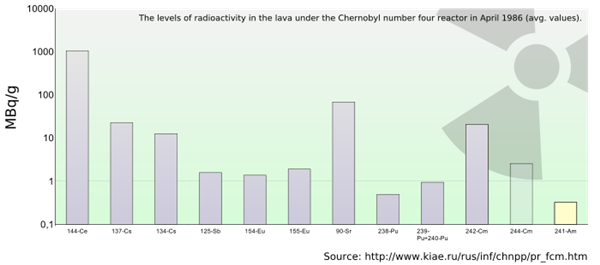
- @Edano How hot is the corium seems like an easy question, but the results on google tell me it isn't answered. The closest I came for the Chernobyl Elephants foot was the room with 10,000 Rads per hour, which is ~ 100 Sievert/hrby RBeaner 8/4/2011 2:37:40 PM
- @lillymunster "still leaking into the sea", I see no evidence of that. If it rains in the area, I'm sure water and radioactivity from the ground and trees make it down to the ocean. This is the plated stuff, not the high rad liquid in the basements and storage. Things are getting better:):) slowly but ugly.by RBeaner 8/4/2011 2:40:31 PM
- CHECKING into the rad level of the corium nowby dean 8/4/2011 2:41:31 PM
- @dean The particular hot spot of (my) interest is the > 10 Sv/hr (maxed meter) at the elbow on the vent stack between units 1 and 2. That is a buttload of rad, but you might not detect it until you get close. Did you survey or were you an RO?by RBeaner 8/4/2011 2:43:33 PM
- @RBeaner they are still detecting leaks at the intakes even with the concrete slabs they put in placeby lillymunster 8/4/2011 2:47:30 PM
- @Dean, There is the 10 Svh in the vent stack and a 5 Svh in the air conditioning room that they state is connected to the vent pipe. There is also a hot spot near the administration building where they previously identified americium at.by lillymunster 8/4/2011 2:49:00 PM
- let me finish up on the MAX GUESS ON RAD LEVEL OF CORIUM then I'll hit the HOT spot... we talked some about that stack pipe.. brbby dean 8/4/2011 2:50:15 PM
- @lillymunster Those intakes would also be the low points where rainwater would naturally flow towards. The entire site has contamination on it (like dust) and will flow when it rains. This is nothing (rad wise) compared with the radioactivity in the basement of unit 1 for example. I'm not trying to minimize the cluster...., but they (TEPCO) are making progress!by RBeaner 8/4/2011 2:50:37 PM
- The plant map with the high rads by administration news.discovery.com
video of inside 1 where they found 5 svh www.youtube.com
Gamma Camera pic of the vent stack hot spots houseoffoust.comby lillymunster 8/4/2011 2:50:37 PM - @ RBeaner I have done surveys but I was in operations as a supervisor and plant managerby dean 8/4/2011 2:51:02 PM
- @RBeaner I didn't say they were not making progress. TEPCO is admitting they still have leaks but they have slowed them considerably. They really need to get after building the sea wall to block in the harbor.by lillymunster 8/4/2011 2:52:05 PM
- @dean I was Rad Controls, Thrown out of RO, so I did and taught alot of surveys. Understand the variation with distance in rad levels. I know that 1 ft from a source can mean 10% of the dose. On a meter or a dosimeter. I don't know how to describe it in common terms, but you can take 1 step with a survey meter, and suddenly get 5 or 10 times less or more dose. It all depends on the physical size of the source of exposure. How do you explain that to the average person?by RBeaner 8/4/2011 2:55:48 PM
 @RBeaner It also depends on the type of source. If it is a beta emitter (emitting over 80% of beta radiation as compared to gamma) that can be the case. If it is a gamma emitter, on the other hand, intensity doesn't change much over distance.by Pedro Jesus 8/4/2011 3:00:13 PM
- @ Rbeaner I just followed the standard definition of time distance and shielding and showed an example of the distance example by using simple distances from a source... also I explaned a point source and plane sourceby dean 8/4/2011 3:00:51 PM
- I was trying to find the report on the FIRST grab sample of material from the TMI core because it has very interesting information on the CORIUM that was there...by dean 8/4/2011 3:03:29 PM
- well shoot.. my lap top is running slow on this server.. dang it..by dean 8/4/2011 3:05:38 PM
- my estimate is that the FUKUSHIMA corium, at this point would be higher than that value on the chernobyl @ RBeanerby dean 8/4/2011 3:06:55 PM
- www.libraries.psu.edu this is a technical plan for the clean up of TMIby dean 8/4/2011 3:08:01 PM
- @Pedro Jesus @lillymunster I don't agree that TEPCO has admitted they still have leaks, or that there are leaks. However, you are more tuned in than I. Please provide a link where TEPCO admits current leaks or rad survey/analysis where leaks are indicated. The seawall is a long term project. I agree that it should be an afterthought. Rad moves slowly through soil. An article I read said 2-3 inches per year migrationby RBeaner 8/4/2011 3:08:23 PM
- @Pedro Jesus For a gamma emmitter, double the distance, quarter the dose. We didn't worry about Beta till it got Extremely High, and became an eye issue.by RBeaner 8/4/2011 3:09:45 PM
- @Pedro Jesus I grant that I never dealt with high exposure levels outside of a containment, but a glovebag, protective suit or air mask stops most beta. Distance is a wonderful inhibitor of gamma radiation.by RBeaner 8/4/2011 3:13:06 PM
- Does this help? It is the map of the 5 svh hot spot and how high the doses were are various distances as they approached it. www.tepco.co.jpby lillymunster 8/4/2011 3:15:03 PM
 The great lesson of Fukushima for France in Dominqiue Leglu's blog: with translate google translate.google.frby Olivier 8/4/2011 3:16:01 PM
- @All Todays and tommorrows goal should be to operate the processing system enough to slightly lower the water levels in the plant (and buildings) and cool ALL temps to well below 100 C. In addition recirc all fuel pools to maintain low temps. I believe only unit 1 fuel pool is not temp controlled.by RBeaner 8/4/2011 3:21:22 PM
- @dean The Elephants foot at that point was glass vitrified. I have no dought fuku corium is higher rad. I don't believe it is critical, but some of the us labs should have some concept of what the actual rad levels for a corium mass would be. I couldn't even find rad levels for an unshielded used fuel would be?by RBeaner 8/4/2011 3:25:38 PM
- MY INPUT on the hot spots, hot spots are going to continue to be discovered as more and more entries into the facilities are made, for those systems which are flowing water, hot particles can be transported to different parts of the appropriate systems and hot spots usually occur in low spots where they can settle or within system components like pumps or heat exchanges or filters. .by dean 8/4/2011 3:28:02 PM
- hot spots in the ducting could be from a variety of reasons one of which is called plateout where the particles adhere to the surface of the pipingby dean 8/4/2011 3:28:39 PM

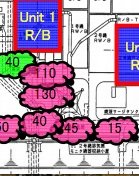
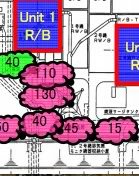
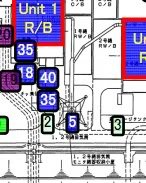
Seems tepco did not survey the spot at the stack between Units 1 and 2 in their earlier surveys. Here is one from Mar 23 i1214.photobucket.com and one from Apr. 23 i1214.photobucket.com Though the steel of the pipe provides some shielding, I suspect that if hardened venting after the scram had deposited all radioactivity in the pipe, the early surveys should have indicated higher levels even at a distance. I suppose effluent is still ejected through the stack. Tepco must know this from the readings of the stack monitors.
by Peter Melzer via I1214.photobucket 8/4/2011 3:28:51 PM- at this point it's also possible that the explosions may have resulted in projectiles which penetrated some of the ducting or piping for HVAC'sby dean 8/4/2011 3:29:12 PM
- good point Peterby dean 8/4/2011 3:29:53 PM
- @dean The hot spot on the ventilation system was probably generated on the late 1th or early 12th of march, it's not new. The question alot of people have is how could it go unnoticed? Please explain this in your way. I think this is important. Look at my comments around 9 AM (2.5 hrs ago).by RBeaner 8/4/2011 3:32:18 PM
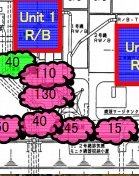
@dean, gm, my post does not show the maps. Here is the one from Mar 23: i1214.photobucket.com
by Peter Melzer via I1214.photobucket 8/4/2011 3:33:00 PM- @RBeaner I wasn't thinking straight. The Inverse-square law... I should get more sleep.
What I meant was, beta radiation is easy to shield. Gamma radiation is a lot more tough to shield and it usually requires thick and dense protective barriers to shield from. Those suits they're wearing down there won't do much against gamma radiation.by Pedro Jesus 8/4/2011 3:34:02 PM

Japan Earthquake | Page 2079
- Who's Blogging
-
 hudebnik
 alblee
 UKVal
UKVal Oliver (ScribbleLive)
 Jonathan Keebler
 kaykodh
 PKelley
 Markfm
 Angie
Angie Deb
Deb Mid Valley
- Pedro Jesus
 Matt (ScribbleLive)
 George Gibb
 elainekirk
- lillymunster
- dean
 bo
bo- Edano
 IanGoddard