Japan Earthquake | Page 2192
 I'm quite certain of that Edano, unless the movement basically dislodges the instrument and damages the unit from being smashed etc or severing the cablingby dean 8/20/2011 1:08:45 PM
- the detectors would have design specs for EQ movement and since they are safety grade instruments would be robust for thatby dean 8/20/2011 1:09:23 PM
 @dean i agree.by Edano 8/20/2011 1:11:07 PM
- maybe we found a problem that nobody thought of before. that continuous trembling prevents corium from solidifying. there were no quakes in chernobyl and tmi.by Edano 8/20/2011 1:12:43 PM
- that is exactly what I thought @ Edano on the chernobyl, fuku is a totally different problem and one that will be directly linked to the EQ'sby dean 8/20/2011 1:15:19 PM
- i am sure this was never a subject of studies.by Edano 8/20/2011 1:15:47 PM
- I would think it's complex because the EQ's can cause building movements/failures which interact with the corium and the corium can relocated or shift and then interact with/weaken the local structure of the buildingby dean 8/20/2011 1:16:43 PM
- agree.. this is like "beyond corium melt" accidentby dean 8/20/2011 1:17:39 PM
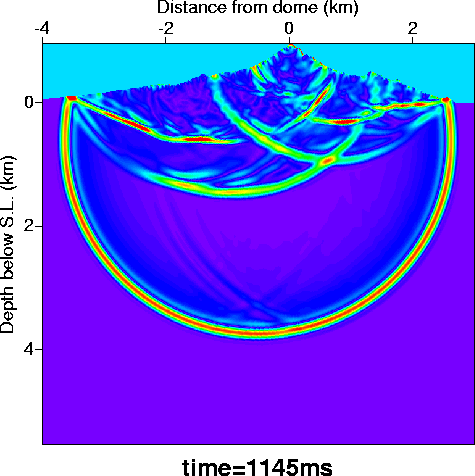
- thinking of resonance effects in the corium. it is a liquid inside a crust, so every shake will cause waves and resonance. the liquid will move more and longer than the earthquake lasts. it is like a slime pudding or a water balloon.by Edano 8/20/2011 1:20:00 PM
- www.nrc.gov @ lilly.. this is a link to the chapters on the SAFETY ANALYSIS REPORT and useful to save.. hopefully it will shed light on radiation instrumenationby dean 8/20/2011 1:20:37 PM
- @ Edano, maybe we can get some research on hits like corium behaviorby dean 8/20/2011 1:22:01 PM
 @dean thanks. I have to leave in a bit. Saved the NRC link for my afternoon reading. :-) I sent an email to the photographer that snuck into the plant. Hoping maybe he will let me see some of his other photos of the buildings.by lillymunster 8/20/2011 1:25:40 PM
- www.nrc.gov @ lilly.. see if you can open the rev 3 on section 12.3 - 12.4 on this pageby dean 8/20/2011 1:26:56 PM
- "The destructive powers of mechanical resonance are well-known, with perhaps one of the most famous events being the Tacoma Narrows Bridge collapse." kwc.orgby Edano 8/20/2011 1:27:42 PM
- @dean Have it open now.by lillymunster 8/20/2011 1:31:52 PM
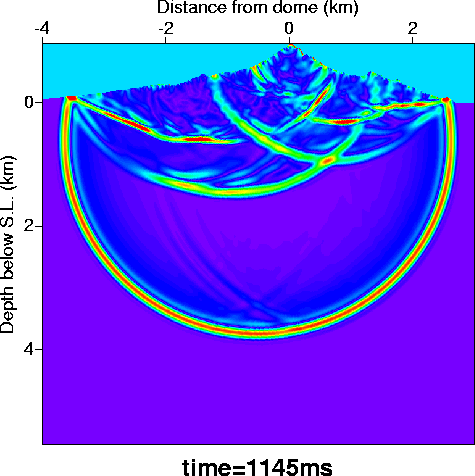
earth.leeds.ac.uk
"conduit resonance": lava shows resonance. earth.leeds.ac.ukby Edano via Earth.leeds.ac.uk 8/20/2011 1:34:12 PM- I couldn't get it to open @ lilly.. I was hoping it may have some descriptions on rad instrument locationsby dean 8/20/2011 1:35:41 PM
- @Edano, I saw that accident on video when I was studying engineering class on structuralby dean 8/20/2011 1:36:35 PM
- @dean It talks in detail about establishing the standard of location of the various instruments as part of knowledge for accidents or decommissioning. I am still reading so if it doesn't contain said info. it will probably tell us what document has it.by lillymunster 8/20/2011 1:38:07 PM
- worldwidescience.org some good reading on corium behavior I just foundby dean 8/20/2011 1:38:44 PM
- Regulatory Guide 1.32, as it relates to assumptions used in evaluating gaseous
concentrations of radionuclides in containment and plant systems following a
loss-of-coolant accident for boiling-water reactors (BWRs).
The description of the fixed area radiation and continuous airborne radioactivity
monitoring instrumentation for normal operation, anticipated operational
occurrences, and accident conditions, including the criteria for placement, called
for in Section 12.3.4 of Regulatory Guide 1.70 (CP PSAR and updates in the OL
FSAR) or RG 1.206 (DC FSAR or COL FSAR to the extent that they are not
addressed in a referenced certified design)
The illustrative examples of facility design features of the equipment,
components, and systems, including clearly readable scaled layout and
arrangement drawings of the facility showing all source locations and the other
design details, requested in Section 12.3.1 of Regulatory Guide (RG) 1.70
(CP PSAR and updates in the OL FSAR) or RG 1.206 (DC FSAR or COL FSAR
to the extent that they are not addressed in a referenced certified design);
specification of shield wall thicknesses for all shielded spaces on the drawings
or in separate tablesby lillymunster 8/20/2011 1:41:07 PM - by Edano 8/20/2011 1:44:07 PM
- These might be what we are looking for? I think it says these are the GE specific documents related to the NRC documentation project
NUREG-1433, as it relates to radiation protection considerations in the applicability,
format, and implementation of the General Electric Technical Specification package.
16. NUREG-1434, as it relates to radiation protection considerations in the applicability,
format, and implementation of the General Electric Technical Specification packageby lillymunster 8/20/2011 1:44:29 PM - hope that leads to some help @ lillyby dean 8/20/2011 1:45:15 PM
- Hmm. I wonder if fuku has something like this or if it was destroyed in all the units:
Air should be sampled at normally occupied locations where airborne
radioactivity may exist, such as solid waste handling areas, spent fuel
pools, reactor operating floors, and BWR turbine buildings. The
monitoring system should be capable of detecting 10 DAC-hours of
particulate and iodine radioactivity from any compartment that has a
possibility of containing airborne radioactivity and that normally may be
occupied by personnel, taking into account dilution in the ventilation
system. Continuous monitoring of air being exhausted from locations
within the facility during normal operation is an acceptable method.
Noble gas monitors should be calibrated such that, when monitoring for
133Xe, the instrument response will determine concentrations accurately.by lillymunster 8/20/2011 1:47:50 PM - so far my word search for seismic on any of the corium documents have proven nothingby dean 8/20/2011 1:48:23 PM
- I'm sure they do lillyby dean 8/20/2011 1:48:56 PM
- Radioactive decontamination unit to be set up in Fukushima
FUKUSHIMA, Japan, Aug. 20, Kyodo
Nuclear disaster minister Goshi Hosono said Saturday that the government will set up a task force to promote radioactive decontamination in areas surrounding the crippled Fukushima Daiichi nuclear power plant probably next week.
The central government will also establish a decontamination promotion unit in Fukushima Prefecture to initially commence the process in the city of Date, Hosono said during a meeting with Fukushima Gov. Yuhei Sato at the prefectural government office.
In response, Sato told Hosono that the central government should take the initiative in the decontamination work.
english.kyodonews.jpby Edano 8/20/2011 1:49:34 PM - constant air monitoring systems are typically tied to interlocks with safety systems and HVAC systems to isolate areas upon increasing air activity levelsby dean 8/20/2011 1:49:40 PM
- This is the document we need NUREG-1433by lillymunster 8/20/2011 1:51:57 PM
- @lillymunster have you published anything about possible corium crust cracking on earthquakes ? i would like to hear more opinions on that issue.by Edano 8/20/2011 1:53:16 PM
- by lillymunster 8/20/2011 1:54:40 PM
- @Edano yes, I put it in the report posted last nightby lillymunster 8/20/2011 1:54:59 PM
- The contact of molten corium with water, referred to as fuel-coolant
interaction, can occur both in-vessel and ex-vessel. If the interaction is
energetic inside the reactor vessel, it may generate missiles and a rapid
pressurization (steam explosion) of the primary system. Early containment
failure associated with in-vessel steam explosions is generally considered
to be of low enough likelihood to not warrant additional consideration
(NUREG-1116). However, smaller, less energetic in-vessel steam explosions
are not unlikely and their influence on fission product release and
hydrogen generation are still under investigation. If the fuel-coolant
interaction occurs ex-vessel, as might happen if molten fuel fell into a
water-filled cavity upon vessel meltthrough, it may disperse the corium and
lead to rapid pressurization (steam spike) of the containment. In any
case, at one extreme, abundant presence of water would favor quenching of
the corium mass and the continued dissipation of the decay heat by steaming
would lead to containment pressurization. Clearly in the absence of
external cooling, the containment will eventually overpressurize and fail,
although the presence of extensive, passive heat sinks (structures)
within the containment volume would delay the occurrence of such an event.
Fuel-coolant interactions can also yield a chemical reaction between steam
and the metallic component of the melt, producing hydrogen and the
consequent potential for burns and/or explosionsby dean 8/20/2011 1:56:34 PM - @dean i just read that corium should be preferably cooled dry...by Edano 8/20/2011 1:58:18 PM
- @ Edano.. I think this information validates in part your observations... look at the comments on rapid pressurization of containment pressure... etcby dean 8/20/2011 1:58:29 PM
- @lillymunster have a linky ? ;)by Edano 8/20/2011 1:58:32 PM
- These documents have tons of details about the BWR4 systems. Instrumentation is in section 3.3. This may take a while to find specifics.by lillymunster 8/20/2011 1:58:38 PM
- @Edano report on the group website houseoffoust.comby lillymunster 8/20/2011 1:59:10 PM
- @ Edano, i think in a steady state system the coolability is predictable but with the additional variable of seismic motions I've not seen any assumed reactions mentioned yet for the corium if it's shaken apart something happensby dean 8/20/2011 2:00:09 PM
- This is what is considered post accident monitoring equipment. So far still have not found location information:by lillymunster 8/20/2011 2:16:24 PM
1. Reactor Steam Dome Pressure 2 E
2. Reactor Vessel Water Level 2 E
3. Suppression Pool Water Level 2 E
4. Drywell Pressure 2 E
5. Primary Containment Area Radiation 2 [F]
[6. Drywell Sump Level 2 E]
(7. Drywell Drain Sump Level 2 El
8. Penetration Flow Path PCIV Position 2 per penetration flow E
path(a) lb)
9. Wide Range Neutron Flux 2 E
10. Primary Containment Pressure 2 E
11. [Relief Valve Discharge Location] Suppression Pool 2(c) E
Water Temperaturby lillymunster 8/20/2011 2:16:25 PM- Have to go, will finish reading when I get backby lillymunster 8/20/2011 2:17:01 PM
- ty lilly.. I"m out for a bit but will return also...by dean 8/20/2011 2:18:16 PM
 There's also some info re containment radiation monitoring requirements in NUREG-0737, Item II. F.1, Attachment 3, available here: www.nrc.gov
"Clarification
(1) Provide two radiation monitor systems in containment which are documented to meet the requirements of Table II.F.1-3.
(2) The specification of 108 rad/hr in the above position was based on a calculation of postaccident containment radiation levels that included both particulate (beta) and photon (gamma) radiation. A radiation detector that responds to both beta and gamma radiation cannot be qualified to post-LOCA (loss-of-coolant accident) containment environments but gammasensitive instruments can be so qualified. In order to follow the course of an accident, a containment monitor that measures only gamma radiation is adequate. The requirement was revised in the October.30, 1979 letter to provide for a photon-only measurement with an upper range of 107 R/hi.
(3) The monitors shall be located in containment(s) in a manner as to provide a reasonable assessment of area radiation conditions inside containment. The monitors shall be widely separated so as to provide independent measurements and shall "view" a large fraction of the containment volume. Monitors should not be placed in areas which are protected by massive shielding and should be reasonably accessible for replacement, maintenance, or calibration. Placement high in a reactor building dome is not recommended because of potential maintenance difficulties.
(4) For BWR Mark III containments, two such monitoring systems should be inside both the primary containment (drywell) and the secondary containment.
(5) The monitors are required to respond to gamma photons with energies as low as 60 keV and to provide an essentially flat response for gamma
energies between 100 keV and 3 MeV, as specified in Table II.F.1-3.
Monitors that use thick shielding to increase the upper range will underestimate postaccident radation levels in containment by several orders of magnitude because of their insensitivity to low energy gammas and are not acceptable."by es 8/20/2011 2:23:07 PM
Japan Earthquake | Page 2192
- Who's Blogging
-
 hudebnik
 alblee
 UKVal
UKVal Oliver (ScribbleLive)
 Jonathan Keebler
 kaykodh
 PKelley
 Markfm
 Angie
Angie Deb
Deb Mid Valley
 Pedro Jesus
 Matt (ScribbleLive)
 George Gibb
 elainekirk
- lillymunster
- dean
 bo
bo- Edano
 IanGoddard