
I think many geigers were made to find low levels in every day life. so the high levels post disaster are higher than I might find checking rocks outside my house?
by lillymunster 8/21/2011 11:18:41 PM

@RadioGuy @ikrockhopper do you think then that as safecast are covering most areas they can be asked if they could look at peoples counters if they met them at least they could say if they reading high or low
by elainekirk 8/21/2011 11:19:34 PM
On old school geiger counters (the kind with the box and wand no computer parts) they can be calibrated by checking against a known source.
by lillymunster 8/21/2011 11:20:43 PM
@RadioGuy Peter might know something about that
by lillymunster 8/21/2011 11:21:01 PM
@ikrockhopper yes please do
by elainekirk 8/21/2011 11:21:50 PM
@ikrockhopper the radiation med institute who are they ? they sound honest !!
by elainekirk 8/21/2011 11:27:17 PM
@ikrockhopper ty I will go browse
by elainekirk 8/21/2011 11:36:16 PM

74% of Japan's nuclear plants to halt this monthTokyo Electric Power Company plans to shut down a reactor in Niigata Prefecture, central Japan, for a regular inspection this month. This means 74% of Japan's nuclear reactors will be out of service.
If TEPCO shuts down the No. 7 reactor of the Kashiwazaki-kariwa nuclear power plant, 40 out of 54 nuclear reactors in Japan will be inactive.
11 reactors are scheduled to finish their regular checkups this month. But it is not likely utility operators will be able to restart the reactors immediately.
The utilities must first conduct stress tests and get approvals from local communities to restart.
Another 14 reactors will be down for regular checks by next spring.
If no reactor is allowed to resume operations after regular checks, then all 54 nuclear reactors in Japan will be out of service in the spring.
Monday, August 22, 2011 06:28 +0900 (JST)
www3.nhk.or.jp by Edano 8/21/2011 11:36:28 PM
Neighbor calls helped escape from tsunamiA survey showed many people who had evacuated immediately after the March 11th earthquake, left because of the actions of their families or neighbors.
Japan's Cabinet Office asked 870 survivors in the disaster-hit Iwate, Miyagi and Fukushima prefectures how they escaped from the tsunami.
Asked whether they evacuated immediately after the earthquake, 57% answered they fled right after the earthquake, while 43% said not immediately, or didn't evacuate at all.
Then the survey asked what triggered their departure.
48% said they were afraid of tsunami, 20% said family member or neighbors called, and 15% said they followed their neighbors.
Yoshiaki Kawata, the leader of the government's research team which is drawing up plans against disasters, says it is important for people to yell in order to clearly show others that they are evacuating. He explains the action will apparently cause others to join the evacuation.
Monday, August 22, 2011 06:28 +0900 (JST)
www3.nhk.or.jp by Edano 8/21/2011 11:38:06 PM
@ikrockhopper oh yes I have much to ask lots
by elainekirk 8/21/2011 11:38:07 PM
@ikrockhopper I will email as it may be rumour
by elainekirk 8/21/2011 11:39:01 PM
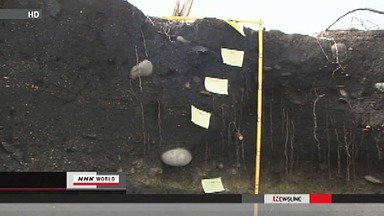
Traces of old tsunamis discovered in TohokuA Japanese professor has discovered traces of old tsunamis in the area of the March disaster. He suspects major earthquakes rocked the region every 1,000 years, based on his findings.
Professor Kazuomi Hirakawa of Hokkaido University studied geological layers along the Sanriku coast, which runs between Iwate and Miyagi prefectures.
He found that 5 layers on the coast of Miyagi Prefecture consist of a massive amount of rounded stones, which are believed to have been carried there by tsunamis.
The layers are situated above a 5,400 year old volcanic ash layer and were likely to have been gradually formed up until the present.
He also discovered 6 layers of the same kind in Iwate Prefecture, and believes the latest one was created by a tsunami caused by an earthquake 115 years ago.
Traces of a huge tsunamis caused by what is known in Japan as the Jogan Earthquake, which struck over 1,000 years ago, have been found inland in Miyagi and Fukushima Prefectures.
Based on these finings, Hirakawa believes tsunamis of a magnitude of the same level as the March earthquake have happened once every 1,000 years.
Hirakawa says that as a scientist studying old tsunamis, he regrets that he couldn't live up to his responsibility before the disaster.
He is expected to submit a report on his findings to the government's Earthquake Research Committee.
Monday, August 22, 2011 06:28 +0900 (JST)
www3.nhk.or.jp by Edano 8/21/2011 11:39:29 PM
@Vivre nite! :-)
by lillymunster 8/21/2011 11:43:58 PM
@Edano damned good evidence that
by elainekirk 8/21/2011 11:48:06 PM
M4.5 quake jolts Fukushima's coastal areaTOKYO, Aug. 22, Kyodo
english.kyodonews.jp by Edano 8/22/2011 12:04:21 AM
 @elainekirk yeah it would be great :) quality check! I did online search and many's default are 0.3 microSvby ikrockhopper 8/21/2011 11:17:37 PM
 Or maybe 100... who knows... that's a pretty good range he laid out there.by RadioGuy 8/21/2011 11:17:53 PM
 @ikrockhopper Nice to meet you too . thank You for all the posts.by Majj 8/21/2011 11:18:36 PM
 by Vivre 8/21/2011 11:23:35 PM
 by Edano via Www3.nhk.or.jp 8/21/2011 11:39:51 PM
 hudebnik
 alblee
 UKVal
UKVal Oliver (ScribbleLive)
 Jonathan Keebler
 kaykodh
 PKelley
 Markfm
 Angie
Angie Deb
Deb Mid Valley
 Pedro Jesus
 Matt (ScribbleLive)
 George Gibb
 dean
dean bo
bo IanGoddard