Japan Earthquake | Page 2269
 @RadioGuy I have no idea how good google translate is but I have read that zip was left open after using toilet we will have to wait for more information but considering updates on the workers who were standing in radioactive water in March merely say that when they were checked second week of april they had not developed symptoms I suppose we could be waiting a long timeby elainekirk 8/29/2011 4:29:10 PM
 @Peter Melzer : of course not. :) max. is 20 km. i looked it up in german regulations, they follow IAEA and ICRP recommendations.by Edano 8/29/2011 4:32:06 PM
 Good morning. Here's another translation site. Crowd sourced, I believe. Gives options of what the meaning could be.by Cyptococcus 8/29/2011 4:32:12 PM
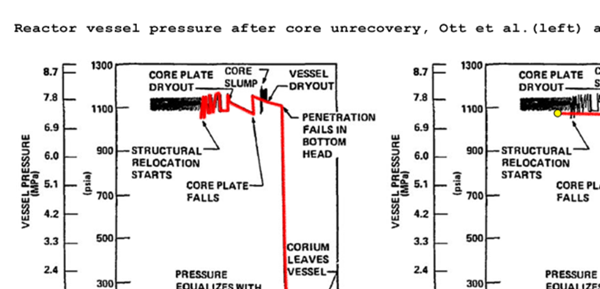
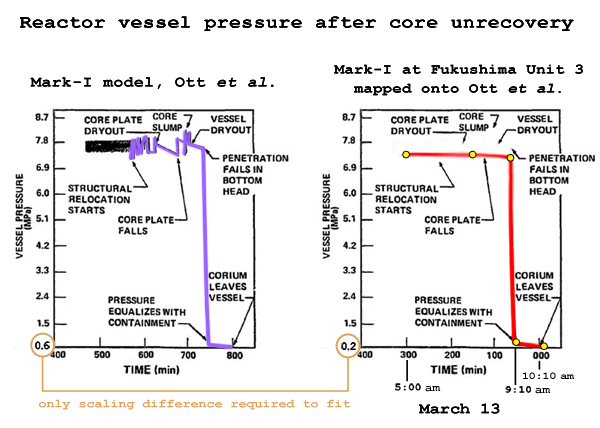
iangoddard.com This is still rough, but I've mapped Unit 3 core pressure onto Ott el al (Figure 4) www.osti.gov For the moment I only included only a few data points (yellow dots) as those before the sudden fall are similar. They're scaled to the minutes along the x axis (bottom) such that 100 minutes on the scale corresponds closely to the yellow data points for Unit 3. But 800 does not correspond to 800 minutes after station black. Not sure how I should adjust that, the important points is to preserve 100-minute increments. Thoughts?
by Ian via Iangoddard 8/29/2011 4:38:04 PM- @Ian the timeline of #3 fits to the model ?by Edano 8/29/2011 4:44:17 PM
- @you no, it is faster, isn't it ?by Edano 8/29/2011 4:45:25 PM
- no, it's slower. :)by Edano 8/29/2011 4:46:41 PM
 @Edano , thanks. Interesting that an Ambassador can hand out recommendations that do not comply with the regulations valid in her/his home country.by Peter Melzer 8/29/2011 4:47:17 PM
- @Peter Melzer i think the amount of people to be evacuated makes the difference. it is easier to move some 100 from tokyo than some million from minneapolis. :)by Edano 8/29/2011 4:49:02 PM
- the meltdown model of ott et al predicts 800 minutes to core breach, in reality in #3 it lasted about 3000 minutes.by Edano 8/29/2011 4:52:50 PM
- @Edano , good point. I will check whether the radii recommended in the U.S. vary with population density.by Peter Melzer 8/29/2011 4:53:25 PM
- @Edano, I believe the yellow dots fit to Ott's time scale. I resolved how to restate the scale, make melt-through time 0 and counting backwards therefrom.by Ian 8/29/2011 4:55:01 PM
- @Ian ah, cool idea.by Edano 8/29/2011 4:55:36 PM
- @Edano , there is another aspect to the Ambassador's recommendation. If the evacuation radii depend on radioactivity released, did the US know more the gov. of Japan?by Peter Melzer 8/29/2011 4:56:13 PM
- @edano should read "....more than the gov. of Japan?"by Peter Melzer 8/29/2011 4:57:33 PM
- @Edano, do you have a theory about why there was a big fall in #3-core pressure and then rise back up, then stable, then the final big fall? Did the core get vented? Maybe the seals did fail first then when less pressure resealed, but then the final fall was the fatal core penetration. ??by Ian 8/29/2011 4:57:46 PM
- @Peter Melzer the us army made a lot of air measurings. maybe they kept the information secret.by Edano 8/29/2011 4:58:33 PM
- @Edano , yep, and they were considering pulling back their service members as well.by Peter Melzer 8/29/2011 4:59:45 PM
- @Ian it is hard to believe that a depressurized vessel regains pressure so fast. i would blame instrument failure until i have a better idea. instrument failure is always a good explanation. ;)by Edano 8/29/2011 5:01:45 PM
- @Edano, right, a self-healing core isn't too likely, lol.by Ian 8/29/2011 5:03:08 PM
 @Peter Melzer The US Navy ships were there, and reportedly monitoring closely, and when they found themselves in the plume they scooted right out of there. I bet those numbers were substantial.by RadioGuy 8/29/2011 5:03:09 PM
- @Ian the first big drop from 7MPa to<1 MPa and back to 7 in the night from 12 to 13 march must be an artifact.by Edano 8/29/2011 5:05:21 PM
- we discussed earlier that half molten corium might be able to tap leakages temporarily in the rpv bottom, but this is a weak theory.by Edano 8/29/2011 5:07:35 PM
- @Edano, given the data in those comparative graphs, I think the case is stronger for melt-through on the morning of the 13th than NISA's late night on the 14th, unless they know something else. My reading of Ott is that the sudden fall entails penetration of the core by corium, and the 50-minute later "corium leaves" is the time from the hole and gas shooting out to the first corium load falling out.
by Ian 8/29/2011 5:08:23 PM - The corium-burned hole is small at first, but not to small to stop gas for exiting.by Ian 8/29/2011 5:10:18 PM
- Ott et al states that the beginning of the sudden pressure drop is "Penetration failure," and they describe this period thusly : "The debris then reheats, eventually failing a bottom head penetration at 734 mins. This causes the vessel to depressurize (Fig. 4) until the vessel pressure equalizes with the drywell pressure (Fig. 5). At this point, the corium is still solid; it is assumed to leave the vessel when it reaches a liquid state at 2200 K (35OO°F)." www.osti.govby Ian 8/29/2011 5:16:22 PM
- @Ian you may be right, but i also think there must be more data that they can analyze and we won't know.by Edano 8/29/2011 5:16:41 PM
- Verbatim excerpt from the Ambassador's Message:
"The United States Nuclear Regulatory Commission (NRC), the Department of Energy and other technical experts in the U.S. Government have reviewed the scientific and technical information they have collected from assets in country, as well as what the Government of Japan has disseminated, in response to the deteriorating situation at the Fukushima Nuclear Power Plant. Consistent with the NRC guidelines that apply to such a situation in the United States, we are recommending, as a precaution, that American citizens who live within 50 miles (80 kilometers) of the Fukushima Nuclear Power Plant evacuate the area or to take shelter indoors if safe evacuation is not practical."by Peter Melzer 8/29/2011 5:16:57 PM - @Edano, I think the ultimate data that confirms melt-through before the night of the 14th is the massive mushroom cloud of dirty steam that blew out of Unit 3 on the morning of the 14th, that surely was the seawater that had been injected and leaked from the core, leading to a steam explosion as molten fuel fell into seawater pooled under the core
.by Ian 8/29/2011 5:20:14 PM - @Ian , what complicates matters that the corium might have accomplished these steps partially. Parts may remain in the rpv, others in the containment and another bit may be smoldering on the base mat or in the torus, which may explain the conflicting readings we note.by Peter Melzer 8/29/2011 5:22:07 PM
 back... hi @peter, Edano, Ianby dean 8/29/2011 5:22:40 PM
- hi Dean , so let's find out what rad levels determine evacuation radii in the U.S.by Peter Melzer 8/29/2011 5:24:04 PM
- @Peter, it's complicated,,, I think it depends on the reactor power levels in relation to where it is etc.. I'll pull up something for us to readby dean 8/29/2011 5:25:44 PM
- Generally, the plume exposure pathway EPZ for nuclear power plants shall consist of an area about 10 miles (16 km) in radius and the ingestion pathway EPZ shall consist of an area about 50 miles (80 km) in radius. The exact size and configuration of the EPZs surrounding a particular nuclear power reactor shall be determined in relation to local emergency response needs and capabilities as they are affected by such conditions as demography, topography, land characteristics, access routes, and jurisdictional boundaries. The size of the EPZs also may be determined on a case-by-case basis for gas-cooled nuclear reactors and for reactors with an authorized power level less than 250 MW thermal. The plans for the ingestion pathway shall focus on such actions as are appropriate to protect the food ingestion pathway.by dean 8/29/2011 5:26:24 PM
- by dean 8/29/2011 5:26:37 PM
- by dean 8/29/2011 5:30:56 PM
- www.dailyfreeman.com @ Peter here is one where the local body, in this case the Westchester Board of Legislators wants NRC to change the current 10 mile radius to a 50 mile radius for around Indian Pointby dean 8/29/2011 5:31:37 PM
- The desire among Westchester leaders to widen Indian Point’s evacuation zone is based, in part, on the Nuclear Regulator Commission’s suggestion that all Americans within 50 miles of Japan’s crippled the Fukushima Dai-ichi nuclear plant evacuate. That plant, however, has three hobbled reactors, while there is only one reactor at Indian Point.by dean 8/29/2011 5:31:59 PM
- NRC Chairman Greg Jackzo has come under some heavy attacks for doing
what he did in Japan and not changing anything in Japanby dean 8/29/2011 5:34:07 PM - @dean , thanks Dean, you are so fast. This question bubbled up in my mind, because I remembered the U.S. Ambassador's recommendation in japan and the diplomatic upheaval this caused. Last week North Anna NPP came on the radar screen with the earthquake. We and roughly 35,000 Univ. of Virginia students live within the fifty mile radius of North Anna. I checked the UVa Critical Incident Management Plan and found just about every contingency I could think of from terrorist attacks to gun-slinging lunatics, but no mention of a possible nuclear power plant accident. That got me thinking.by Peter Melzer 8/29/2011 5:34:35 PM
- Also, the federal agency noted it had to issue its Japan advisory based on “limited data and conservative assumptions.”by dean 8/29/2011 5:34:45 PM
- by dean 8/29/2011 5:38:04 PM
- @ Peter I think I looked that one up and there was something about nuclear, not in the sense on what to do, but who to go to ....by dean 8/29/2011 5:39:21 PM
- @dean , you mean the UVa plan? Nuclear was mentioned only in context with a terrorist threat. I am certain their is planning in conjunction with state and local responders. I wrote the person in charge a letter, stating that I could not find anything addressing the specific contingency of an npp accident.by Peter Melzer 8/29/2011 5:44:47 PM
- @you , their = there ,:)by Peter Melzer 8/29/2011 5:45:34 PM
Japan Earthquake | Page 2269
- Who's Blogging
-
 hudebnik
 alblee
 UKVal
UKVal Oliver (ScribbleLive)
 Jonathan Keebler
 kaykodh
 PKelley
 Markfm
 Angie
Angie Deb
Deb Mid Valley
- Pedro Jesus
 Matt (ScribbleLive)
 George Gibb
- elainekirk
 lillymunster
- dean
 bo
bo- Edano
 IanGoddard