Japan Earthquake | Page 2262
 the pressure from the blast would also tend to take the path of least resistance and I'd think the SGTS would be higher resistance...by dean 8/28/2011 2:20:37 PM
- will returnby dean 8/28/2011 2:20:40 PM
 Questions that came to my mind are if and when electric power was restored to unit 4. I have no idea.by Peter Melzer 8/28/2011 2:24:55 PM
- One would assume that there is a device that prevents back flow from the stack direction.by Peter Melzer 8/28/2011 2:28:06 PM
 @Peter Melzer the same time as the others or likely last of the 4 since it was not in meltdown. It took them days to get offsite power connected.by lillymunster 8/28/2011 2:30:27 PM
- The NRC document talks about diagrams but none are in the PDF?by lillymunster 8/28/2011 2:31:43 PM
 @Peter Mezler To back-track a little... In your article on the enigma of Unit 4 you state that:
"according to the first TEPCO press release with the title "Damage to the Unit 4 Nuclear Reactor Building at Fukushima Dai-ichi Nuclear Power Station" dated Mar. 15 a loud explosion destroyed the superstructure of the reactor building on that day." brainmindinst.blogspot.com
The wording of the TEPCO Press Release is:
"At approximately 6:00am, a loud explosion was heard from within the power station. Afterwards, it was confirmed that the 4th floor rooftop area of the Unit 4 Nuclear Reactor Building had sustained damage." www.tepco.co.jp
I have to wonder whether the explosive sound TEPCO are referring to here wasn't from somewhere else in the power station, perhaps it was even the one from Unit 2 SC which they didn't hesitate to report that morning. Can we rule out that they are simply [re-]confirming AN explosion at the plant in the Unit 4 press release, whilst at the same time reporting the extensive [fire?] damage to Unit 4's 4th floor rooftop area*? Gilligan's Telegraph Report on the 27th March intrigued me too ("A ghastly boom was heard in the suppression chamber of reactor 4”) but, considering the other officially reported sounds from the direction of Unit 2 suppression pool, I concluded there must have been some confusion in the reporting of a single event here, rather than there having been two distinct SP booms at two different reactor buildings.
*Was it the 4th floor rooftop area that was damaged or the 5th floor, reports seem to vary? ;)by es 8/28/2011 2:36:57 PM- Hydrogen monitors are installed in reactor buildings. One fatal mistake in the design may have been that the monitors were not independently backup powered, e.g. by batteries.by Peter Melzer 8/28/2011 2:38:52 PM
- @es If the hydrogen back flowed into 4. It could have built up in the supression chamber. But that diagram from TEPCO shows like it went into the building through some sort of environmental air handling system. The gas treatment system does in part create the negative pressure in the building but would this really explain the hydrogen path?
I am having a hard time believing all of what TEPCO is claimingby lillymunster 8/28/2011 2:45:32 PM - @es , good observations. The info on unit 2's suppression chamber explosion has only been discussed after I posted this story. The floor confusion may stem rom different conventions. For example, the first floor in Germany is the ground floor, perhaps similar in Japan. The damage to the floors under the service aka refueling floor seems more extensive at unit 4 than at unit 1. Note pictures from the fuel loading docks of the reactor buildings at street level. That one at unit 1 shows little damage. That at unit 4 is devastated. These reactor buildings were designed to funnel an explosion's force downward into the building and out of the loading dock. That is exactly what have seemed to happen at unit 4.by Peter Melzer 8/28/2011 2:51:03 PM
- @lillymunster , under normal operational conditions, the SBGT system is supposed to kick in only when the rad levels rise above set points in the primary (dry well) and the secondary containment (building). It is a system set up parallel to the regular air AC/air filter system that provides the negative pressure and services the containments when the radiation is under threshold. The hardened vent lines tepco used to vent the wet wells are supposed to bypass the SBGT and exhaust directly into the stack. Apparently that part went very wrong, and a good deal of the vented effluent filled the buildings through backflow via the SBGT.by Peter Melzer 8/28/2011 3:00:24 PM
- Looking back, the suppression chamber may have cracked, because hardened venting did not progress all together smoothly. Tepco had to send out crew repeatedly to manually reopen valves that automatically closed thereafter. These are the guys about whose health I am actually most concerned. We never heard of the doses they were exposed to on these missions.by Peter Melzer 8/28/2011 3:06:31 PM

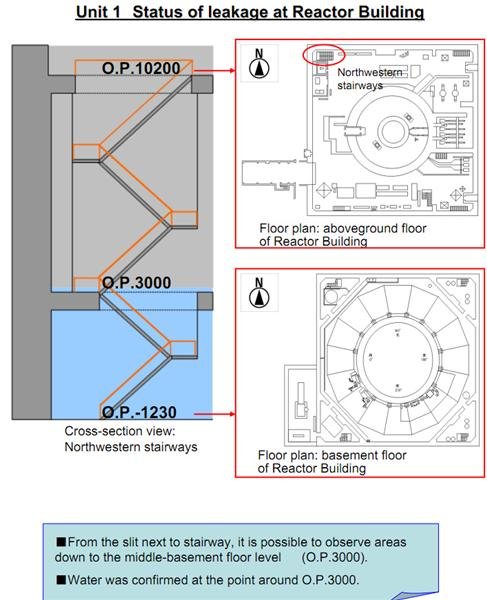 by elainekirk 8/28/2011 3:12:06 PM
- @Peter Melzer Thank you. I hadn't considered that differing cultural conventions might explain the 4th/5th floor discrepancies :)
@lillymunster The damage to the lower decks is indeed extensive and it would certainly be good to know the state of Unit 4 suppression chamber. Peter's explanation of the buiding's design, i.e. "to funnel an explosion's force downward into the building and out of the loading dock" might also explain what we see. Note there were holes [made?] in the south side panels of the reactor building, so I wouldn't have thought hydrogen build-up there would have been such a major concern (think Unit 2). As for the backflow from #3 and a gradual buildup of hydrogen in the pipes, I haven't spent much time pondering this and anyway can't claim to understand those busy diagrams (am always grateful to Peter for his decoding!)... but I think I would've expected to see more visible evidence of this route, including any resulting blast damage to the external pipes at 4?by es 8/28/2011 3:14:18 PM 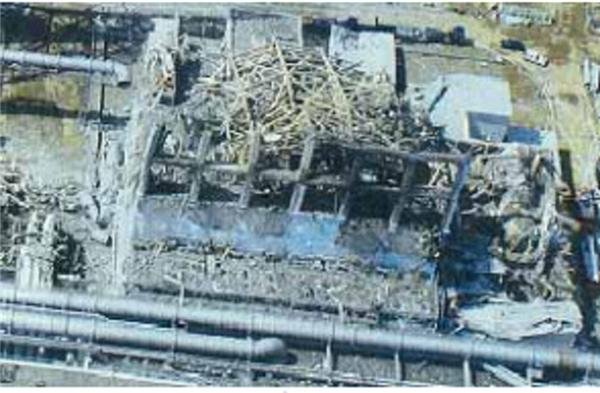
I was looking for @lillymunster an English doc when I came across this seismic report www.tepco.co.jp this is the east side of 3? and is that not a crack in the ground ?
by elainekirk 8/28/2011 3:22:36 PM- @elainekirk where in the image?by lillymunster 8/28/2011 3:24:08 PM
- @es , exactly. I would have expected the annex housing the SBGT to blow apart. The only way to explain this lack of damage might be that the gas seeped slowly into the unit 4 over the days prior to the explosion at unit 3, reaching a level sufficient to blow in unit 4 (I still do not exactly grasp the correct terminology, from conflagration to detonation), triggered by some other event like a spark or a fire.by Peter Melzer 8/28/2011 3:24:26 PM
- to the left lillyby elainekirk 8/28/2011 3:24:32 PM
- @lillymunster oh wow there are all the floor plans in thereby elainekirk 8/28/2011 3:27:45 PM
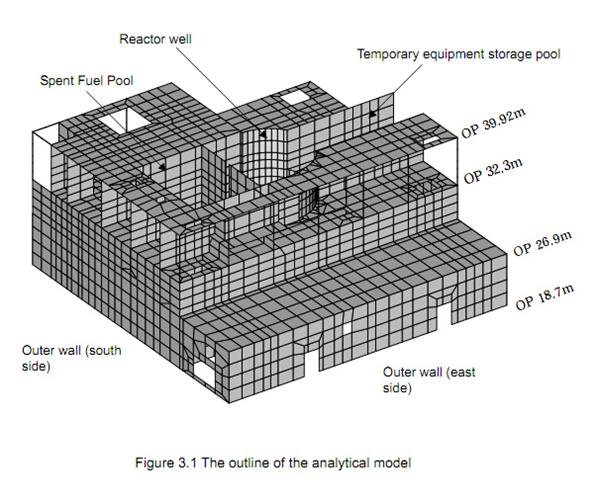
if unit 4 uses the same layout as three we now know where they stored the reactor lid etc it explains why steam didnt always seem to come from the sfp www.tepco.co.jp
by elainekirk 8/28/2011 3:31:46 PM- @elainekirk The vertical line next to the building or something else?
Will go through the tepco documents when I stop for coffee. Have to go install a light fixture. :-)by lillymunster 8/28/2011 3:32:24 PM - @Peter Melzer Yes, I agree. But was the Unit 4 reactor building really so air-tight that a slow hydrogen seepage via 3 could build up to such dangerous levels so quickly, and yet not be ignited at the time of 3's blast?by es 8/28/2011 3:32:45 PM
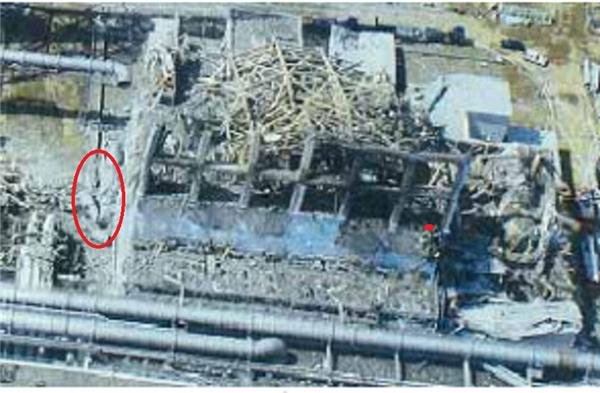
@lillymunster
by elainekirk 8/28/2011 3:37:45 PM
@es @PeterThis is another doc in the seismic survey and covers #4 if you scroll www.tepco.co.jp
by elainekirk 8/28/2011 3:46:41 PM- Elaine this is really good info. Did you notice if they have the images independent of the PDF? Some of these are new angles.by lillymunster 8/28/2011 5:13:53 PM
- Just to reiterate, if I may, as this is one of the basic problems I'm having with the official story around Unit 4's explosion. TEPCO reported the following re 'Damage to the Unit 4 Nuclear Reactor Building at Fukushima Dai-ichi Nuclear Power Station':
"At approximately 6:00am, a loud explosion was heard from within the power station. Afterwards, it was confirmed that the 4th floor rooftop area of the Unit 4 Nuclear Reactor Building had sustained damage." www.tepco.co.jp
Although it seems to have been widely accepted that this is when Unit 4 dramatically exploded and sustained the damage we now see, I've found no evidence that the explosive noise that was reported actually came from Unit 4 nor that this was the blast that caused the majority of the visible damage to the building. TEPCO certainly don't say so in this press release. Could they honestly have overlooked, and thus under-reported, the [extensive] damage to the building that morning of the 15th of March?by es 8/28/2011 5:17:18 PM - @es That has been a major problem still cited by just about everyone who has tried to analyze this. Even if it was under reported it does not make sense. If the 2nd explosion did this the 1st one would have provided an ignition for the hydrogen. At the point of #1 explosion #3 was done and could not send more hydrogen over. If #1 explosion did the massive damage why was nothing reported. A small fire and maybe roof damage does not equal a totally destroyed building.by lillymunster 8/28/2011 5:20:30 PM
- @lillymunster so far there are only that two docs but thinking there may be a way to source picsby elainekirk 8/28/2011 5:31:49 PM
- @lillymuster Yes, and any analysis that fails to account for these discrepancies will be fundamentally flawed. I have to assume the big blast at Unit 4 was a later event.by es 8/28/2011 5:33:20 PM
 ・ For Unit 3: Unusual pressure increase was identified (11:45 March 14)
・ For Unit 3: Explosion of the Reactor Building broke out similarly with Unit 1 (11:01 March 14
(4) Major Plant Parameters (19:30, March 14)
unit
Unit 1
Unit 2
Unit 3
Reactor Pressure
MPa
0.047 (A)
0.270 (B)
0.65
0.183 (A)
0.183(A)
PCV Pressure
KPa
Not available
Approx. 395
335
Reactor Water Level*
mm
Downscale(A)
Downscale(B)
Downscale(A)
Downscale(B)
-1900(A)
-2300(B)
Suppression Pool Water Temperature
℃
Not available
Under measuring
Not available
Suppression Pool Water Pressure
KPa
Not available
Not available
500
*: Distance from the top pellet
(5) Report concerning other malfunction
・ No fire report notified to NISA
・ TEPCO reported to NISA in accordance with Article 10 of the Act on Special Measures Concerning Nuclear Emergency Preparedness regarding Fukushima Dai-ichi, Units 1,2 and 3. (15:42 March 11)
・ TEPCO report to NISA the event in accordance with Article 15 of the Act for
by M.I.A. 8/28/2011 5:37:13 PM
I guess 'similarly' is the key word. If they mean at the same time, then huh? Could mean in the same fashion- but they were radically diferent events. idk
by M.I.A. 8/28/2011 5:40:23 PM

@lillymunster Images can be extracted from the PDF, but they extract at the same size and res you see them, mere figure illustrations at screen res.
by RadioGuy 8/28/2011 5:41:16 PM
@es I have been searching for more on 4 as soon as anything turns up I will tag you for it
by elainekirk 8/28/2011 5:46:28 PM
@RadioGuy thus why I was hoping for other copies that might be larger
by lillymunster 8/28/2011 5:49:05 PM
@es if the big explosion was after the initial fire how did the hydrogen not ignite?
by lillymunster 8/28/2011 5:50:15 PM
@elainekirk Thanks :) There are some good diagrams of the damage assessments for the various units in that last pdf you posted.
by es 8/28/2011 5:50:21 PM
@lillymuster What hydrogen?
by es 8/28/2011 5:51:04 PM
With unit 4 it has always bothered me. It is like the answer is on the tip of your tongue but you just can't find that bit.
@es, the supposed hydrogen from 3 that made 4 explode.
@es, the supposed hydrogen from 3 that made 4 explode.
by lillymunster 8/28/2011 5:51:57 PM
Throwing out this timeline to see what makes sense (or not)
1.After the unit 3 explosion in daylight we have an image of 2 panels knocked out on the corner near the SFP on 4 but a floor below.
2. Report of a fire with some roof damage at 4. This is during the dark. Some reports call it an explosion.
3. Another report of fire at 4. no other details. This was during dark.
IIRC, the first report of incidents at 4 was hours after 3 exploded, not days?
1.After the unit 3 explosion in daylight we have an image of 2 panels knocked out on the corner near the SFP on 4 but a floor below.
2. Report of a fire with some roof damage at 4. This is during the dark. Some reports call it an explosion.
3. Another report of fire at 4. no other details. This was during dark.
IIRC, the first report of incidents at 4 was hours after 3 exploded, not days?
by lillymunster 8/28/2011 5:55:13 PM
@lillymuster It doesn't add up. We knew there had been at least two separate fire incidents before we got to hear of the hydrogen blast at Unit 4.
by es 8/28/2011 5:55:40 PM
maybe this helps? cut and paste done months ago to clarify timeline in my mind: www.tepco.co.jp
www.tepco.co.jp
www.tepco.co.jp
www.tepco.co.jp
Unit 4At approximately 6:00 am, March 15th, an explosive sound occurred andthe damage in the 5th floor roof of Unit 4 reactor building was confirmed. At 9:38 am, the fire near the north-west part of 4th floor ofUnit 4 reactor building was confirmed. At approximately 11:00 am, TEPCO employee confirmed that the fire was off. At approximately 5:45 am, a TEPCO employee discovered a fire atthe northwest corner of the Nuclear Reactor Building. TEPCO immediatelyreported this incident to the fire department and the local governmentand proceeded with the extinction of fire. At approximately 6:15 am,TEPCO staff confirmed at the site that there are no signs ...
www.tepco.co.jp
www.tepco.co.jp
www.tepco.co.jp
Unit 4At approximately 6:00 am, March 15th, an explosive sound occurred andthe damage in the 5th floor roof of Unit 4 reactor building was confirmed. At 9:38 am, the fire near the north-west part of 4th floor ofUnit 4 reactor building was confirmed. At approximately 11:00 am, TEPCO employee confirmed that the fire was off. At approximately 5:45 am, a TEPCO employee discovered a fire atthe northwest corner of the Nuclear Reactor Building. TEPCO immediatelyreported this incident to the fire department and the local governmentand proceeded with the extinction of fire. At approximately 6:15 am,TEPCO staff confirmed at the site that there are no signs ...
by M.I.A. 8/28/2011 5:57:59 PM
I assumed the fires happened a day apart.
by M.I.A. 8/28/2011 5:58:55 PM
Another, later, report: www.tepco.co.jp
Unit 4 (shut down due to regular inspection)-Reactor has been shut down. However, we have confirmed the sustained damage around the 5th floor rooftop area of the Nuclear Reactor Building.-Afterwards, we confirmed the outbreak of fire at the northwestern part of Nuclear Reactor Building. We immediately reported this matter to the fire department and the related authorities.-However, at approximately 11:00am, when TEPCO employee arrived at the seen to confirm, the fire had already died down. At 5:45AM on March 16th, we confirmed the outbreak of the fire again but could not confirm it at 6:15AM. We will continue to monitor the situation carefully.
Unit 4 (shut down due to regular inspection)-Reactor has been shut down. However, we have confirmed the sustained damage around the 5th floor rooftop area of the Nuclear Reactor Building.-Afterwards, we confirmed the outbreak of fire at the northwestern part of Nuclear Reactor Building. We immediately reported this matter to the fire department and the related authorities.-However, at approximately 11:00am, when TEPCO employee arrived at the seen to confirm, the fire had already died down. At 5:45AM on March 16th, we confirmed the outbreak of the fire again but could not confirm it at 6:15AM. We will continue to monitor the situation carefully.
by M.I.A. 8/28/2011 6:02:16 PM
@M.I.A. Thanks. Interesting that these reports refer to the 5th floor rooftop area...
by es 8/28/2011 6:03:51 PM
unit 3 blew at 11:01am Mar 14, unit 4 explosion (sound) was noted at approx 6:00am Mar 15 [19 hrs. apart and before the two fires], and unit 2 'abnormal noise' and pressure decrease was approx. 6:00am Mar 16, fwiw
by M.I.A. 8/28/2011 6:28:51 PM
 hudebnik
 alblee
 UKVal
UKVal Oliver (ScribbleLive)
 Jonathan Keebler
 kaykodh
 PKelley
 Markfm
 Angie
Angie Deb
Deb Mid Valley
 Matt (ScribbleLive)
 George Gibb
 bo
bo Edano
Edano IanGoddard