Japan Earthquake | Page 2486
 (UPDATED) Strontium-90 Discovered in Yokohama City, 245 km from Fukushima I Nuke Plant
Details in the mail magazine by the independent journalist Yasumi Iwakami (paid subscription). I'm asking if I could translate and post it here.
The number is 195 becquerels/kg, more than 150 times more than the background (1.2 becquerels/kg).
This is probably the lower of the two samples; the other sample is currently being analyzed.
As far as the Ministry of Education is concerned, the southern most detection of strontium-90 was in Shirakawa City, 79 kilometers from the plant. The Ministry doesn't have a plan to test for strontium or plutonium outside the 80 kilometer radius.
On September 30, a government radiation expert appeared on NHK News to tell the viewers that strontium had not flown to the Tokyo Metropolitan area, and the only radionuclides people had to worry about were cesium-134 and cesium-137. In the video clip, the expert looks nervous, so does the male NHK announcer trying to wrap up his remarks. ex-skf.blogspot.comby Majj 10/10/2011 3:07:34 PM IAEA team continues observing decontamination
Experts from the International Atomic Energy Agency have observed the Japanese government's experimental decontamination of a farm in Iitate Village. The land is in Fukushima Prefecture, inside the government-designated evacuation zone.
The 12 experts on the IAEA team arrived in Fukushima on Sunday to give advice about effective methods to clear away radioactive substances.
They visited a rice paddy on Monday where the experimental decontamination is being carried out.
Government officials explained radiation levels were reduced by 75 percent per kilogram of soil after workers removed 4 centimeters of top soil. They also said the dose of radiation in unpolished rice was about 0.1 percent of that of soil.
IAEA experts say these radiation levels are low and pose no problem.
They also inspected a site that uses 400 degree Celsius heat to process plants containing radioactive substances.
Government officials said they contained radioactive cesium within the plants when they converted them into charcoal. They said this method could help reduce the weight of plants.
An IAEA member said it would be necessary to work out a plan to effectively burn massive amounts of plants.
The IAEA experts are meeting Fukushima Governor Yuhei Sato on Tuesday, their last day in the prefecture.
Monday, October 10, 2011 22:18 +0900 (JST)
www3.nhk.or.jpby Edano 10/10/2011 3:35:11 PM- Decontamination plan compiled
The Japanese Environment Ministry has come up with a revised plan to clear away radioactive substances from the crippled Fukushima Daiichi nuclear plant.
It announced details on Monday at a meeting of a panel of experts.
Ministry officials say decontamination will be carried out in areas where radiation levels are higher than 1 millisievert per year.
The ministry revised an earlier plan to only decontaminate places with more than 5 millisieverts per year. Municipalities in Fukushima Prefecture that have areas with less than 5 millisieverts argued they should be included in the cleanup.
The government will be responsible for the decontamination of no-entry zones and government-designated evacuation zones. Local governments will clean up the rest of the affected areas.
Areas with radiation levels higher than 20 millisieverts per year will be reduced stage by stage as soon as possible.
In areas with less than 20 millisieverts per year, radiation levels recorded at the end of August will be cut up to 60 per cent in the next 2 years.
Environment Ministry officials say the government will help prefectures that have a massive amount of radioactive waste.
The ministry's decontamination plan will be further discussed within the government before being adopted by the Cabinet as the basic national plan.
Monday, October 10, 2011 22:04 +0900 (JST)
www3.nhk.or.jpby Edano 10/10/2011 3:36:45 PM - IAEA team inspects elementary school after decontamination work
FUKUSHIMA, Japan, Oct. 10, Kyodo
A team of experts from the International Atomic Energy Agency visiting Japan to assist in the decontamination of areas near the radiation-leaking Fukushima Daiichi nuclear power plant inspected an elementary school Monday where work has already been done to remove radioactive substances.
Headed by Juan Carlos Lentijo, general director for radiation protection at Spain's nuclear regulatory authority, the 12-member team received explanations on the decontamination operation at the school in the city of Date from Mayor Shoji Nishida.
The mayor told the team that the amount of radiation at the school has been reduced to one-tenth after the removal of surface soil in the schoolyard. english.kyodonews.jpby Edano 10/10/2011 3:39:45 PM 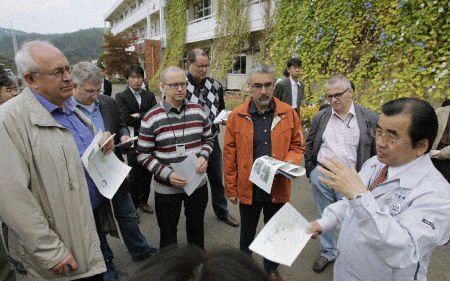
english.kyodonews.jp
IAEA team inspects elementary school
Date Mayor Shoji Nishida (far R) explains to a team of experts from the International Atomic Energy Agency about the decontamination work implemented at an elementary school in the Fukushima Prefecture city in the wake of the crisis at the Fukushima Daiichi nuclear power plant, in Date on Oct. 10, 2011. (Kyodo) english.kyodonews.jpby Edano via English.kyodonews.jp 10/10/2011 3:41:34 PM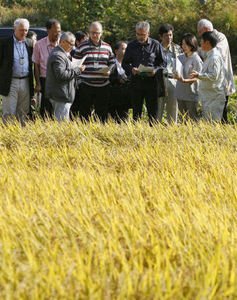
english.kyodonews.jp
IAEA team inspects elementary school
A team of experts from the International Atomic Energy Agency inspects rice fields in the village of Iitate in Fukushima Prefecture on Oct. 10, 2011. Demonstration tests are being conducted in the fields to remove radioactive substances in the wake of the crisis at the Fukushima Daiichi nuclear power plant. (Kyodo) english.kyodonews.jpby Edano via English.kyodonews.jp 10/10/2011 3:42:17 PM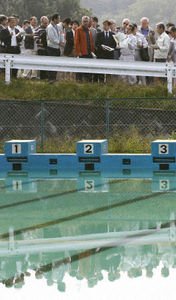
english.kyodonews.jp
IAEA team visits Fukushima Pref.
A team of experts from the International Atomic Energy Agency inspects the swimming school of an elementary school in the city of Date, Fukushima Prefecture on Oct. 10, 2011. Decontamination work has been done at the school to remove radioactive substances in the wake of the crisis at the Fukushima Daiichi nuclear power plant. (Kyodo) english.kyodonews.jpby Edano via English.kyodonews.jp 10/10/2011 3:43:03 PM- elderly people on sightseeing tour.by Edano 10/10/2011 3:44:21 PM
- Radiation dose, the task force estimated 40 percent reduction after two years without decontamination
Nuclear emergency response headquarters in 24 countries, together in the future method to predict the radiation dose by TEPCO Fukushima Daiichi nuclear power plant accident, the Nuclear Safety Commission. Without decontamination, the impact of wind and rain after two years they expect to reduce 40% of the dose estimates. The safety committee also note that a reference for determining the decontamination strategy for the future.
Currently, affecting the amount of radiation in the disaster area, but about 30 years and cesium 137 cesium 134 half-life of about two years from the nuclear scattering. Iodine-131 is a half-life of eight days, now reduced to below the detection limit. Also that strontium-90 is detected, the impact on a small dose.
Cesium 134 and 137 present in a ratio of almost 1:1, impact energy is higher dose of 134. In addition, the cesium-137 was accumulated in the nuclear fields in the past have shown that half-year results of 18.4 and the effects of wind and rain. translate.googleusercontent.comby Edano 10/10/2011 3:55:33 PM  What's really bad is I made a comment to fukushima-diary.com that simply asked "What university staff teaching engineering measured this Sr90?" and its approval was apparently rejected measured by the fact that comments posted after mine were approved, but mine does not appear. For me, that suggests that story could be a hoax.by Ian 10/10/2011 3:56:51 PM
 Early summer I wondered, why Teppycam changed position from the southwest to the northwest of Fuku. Now I know: from the NW it looks better, you can see the white new tent skin of #1. The chaos of exploded #3 an #4 can`t be seen behind the growing curtain of bushes more and more.by Puc 10/10/2011 3:56:52 PM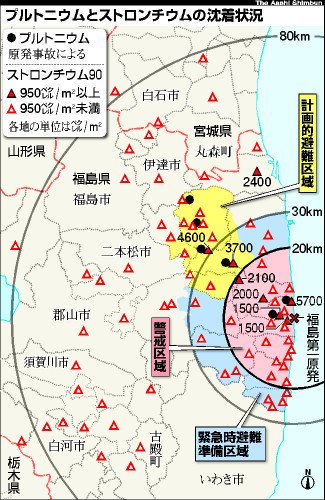
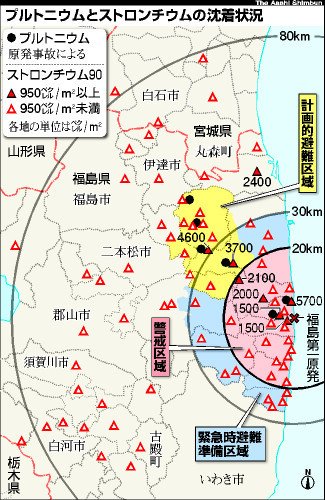
black is plutonium, red strontium. www.asahi.com www.asahi.com
by Edano via Asahi 10/10/2011 3:58:07 PM- @Liz, thanks Liz, there might be something to the rumor-law claim. As someone who had a video flagged by Fukushima Central Television, I know there's an effort to suppress.by Ian 10/10/2011 4:07:56 PM
 @Edano speechless... 7 months after the event they measure it!!by elainekirk 10/10/2011 4:10:48 PM
- @Edano, that's probably related to the article, and it speaks to Busby's supplement. But like I said, at best fukushima-diary.com does a good job of turning facts into rumors. Just take a true story and strip it of all references, real names, and sources and you turn those facts into rumors -- anti-journalism.by Ian 10/10/2011 4:10:51 PM
 Tokyo under illusion that things are normal while Fukushima remains a war zone mdn.mainichi.jp
Life after zero hour www.thedailybeast.comby lillymunster 10/10/2011 4:13:06 PM- @elainekirk I wonder if this is part of the slow admission of what a mess it really is.by lillymunster 10/10/2011 4:14:23 PM
- I posted this comment to fukushima-diary.com, even if he doesn't approve it, he'll see it.
#
It's great that you are reporting on Fukushima. But you really need to follow the basic 5 Ws of journalism by reporting : Who, What, When, Where, Why and with source-referencing links. Otherwise skeptical fact-demanding readers encounter true stories you're reporting but can think they're just rumors.
blog.journalistics.comby Ian 10/10/2011 4:19:49 PM - Radiation detectors: Cheap and accurate never go together
BY RYOMA KOMIYAMA STAFF WRITER
2011/10/09
The accident at the Fukushima No. 1 nuclear power plant has prompted a surge in sales of radiation detectors--and also an increase in inaccurate measurements.
The characteristics of such devices for ordinary citizens vary considerably in terms of accuracy, method of measuring and price.
The best-known radiation detector is the Geiger counter. But a Geiger counter cannot distinguish between different types of radiation nor can it accurately evaluate the toxic effects on human health. It can only count how many times it has detected radiation.
It would be like owning a device that counts the number of animals but does not differentiate the species, whether they are elephants, rabbits or mice.
The least penetrative type of radiation is the alpha ray, which can be stopped by even a sheet of paper. Alpha rays, emitted by plutonium and other substances, are clusters of two neutrons and two protons.
The beta ray can penetrate paper but can be blocked by thin aluminum or other metal plates. Beta rays, ejected by strontium, cesium and other radioactive substances, are in fact electrons.
The gamma ray can only be stopped by lead or thick iron plates. Emitted by cesium and other substances, gamma rays are not particles but are electromagnetic waves of extremely high energy.
Neutron beams are emitted during nuclear fission of uranium and other matter. Water or concrete can be used to block them.
Radiation crashing against a human body generates electrons that disrupt DNA, but the amount of electrons generated by the collision differs according to the type of radiation. The levels of toxicity, which are also different, are measured in units of sieverts across all radiation types.
The Geiger counter is a simple mechanism that is sensitive to low radiation levels. Its central component is a container called the Geiger-Mueller tube. When radiation hits gas particles contained within the tube, electrons are ejected, generating electric currents in a circuit that the device can detect.
Since only a very small number of electrons are ejected, a voltage is applied to the GM tube so that the electrons accelerate and hit other gas particles, creating a cascade of electron flows. This contraption makes it possible to detect very small doses of radiation.
Different numbers of electrons are generated by different types of radiation. The radiation type could be identified if the initial amount of electrons was known, but this is impossible after the electrons have been multiplied in the GM tube.
Therefore, the dose in sieverts indicated on the Geiger counter is a mere estimate. It's like estimating the total weight of all the animals counted under the assumption they were all rabbits.
"Geiger counters can be used to check if food or other products are contaminated or not, but they do not tell you how harmful they are," said Keiji Kusama, head of the radiation safety section of the Japan Radioisotope Association.
He said the public should not rely on products available for tens of thousands of yen (hundreds of dollars).
Using the animal-counting comparison, some products cannot even reliably count the number of creatures.
The performance of a Geiger counter depends on the size of the GM tube. A larger tube can hold more gas for electrons to be generated, resulting in a higher measurement capability.
Geiger counters sold at tens of thousands of yen, however, have GM tubes the size of a fingertip. Their measurements, spanning only several seconds, can produce estimates ranging from half to double the real values, Kusama said.
"Cheap products can detect radiation only several times a minute," said Kouichi Yamada, director of the measuring systems sales division at Hitachi Aloka Medical Ltd. "Errors are large because the calculations are based on scanty data."
Other types of detectors, including the ionization chamber, can distinguish between radiation types.
The ionization chamber takes measurements from electrons generated by radiation crashing into air particles. The ionization chamber resembles the Geiger counter in this sense, but the electrons are not multiplied to be counted.
It would be like summing up the weights of elephants, rabbits and mice measured individually and carefully. This enables a precise evaluation of the total weight of all animals, or the total level of toxicity of all types of radiation.
But to measure low radiation levels in a short time, the device must be so big that is no longer portable. And the prices for the larger ionization chambers can cost millions of yen. These devices are used at monitoring posts or fixed measurement stations.
Portable types of ionization chambers are available for hundreds of thousands of yen, but their sensitivity is so low that they cannot even measure radiation levels at a distance of 50 kilometers from the Fukushima No. 1 nuclear plant.
Municipal governments across Japan are introducing detectors of yet another type--scintillation survey meters--to locate radiation hot spots. These devices, which use crystals that emit light when they are irradiated, are not as accurate as ionization chambers, but they can still produce sievert estimates by distinguishing between different types of radiation. They have about a 15-percent margin of error and cost hundreds of thousands of yen.
Some detectors use semiconductors that generate electricity when they are irradiated. These devices also distinguish different radiation types, but products available for tens of thousands of yen have semiconductor chips only several millimeters in size.
A semiconductor detector can be used to measure total exposure to radiation if it is carried over an extended period of time. But it is not suited for measurements in short intervals.
Experts agree that there are no radiation detectors that are both cheap and accurate. The figures these products produce should be taken as rough estimates, they say.
www.asahi.comby Edano 10/10/2011 4:23:32 PM 
www.asahicom.jp
Children in Latin American costumes join the Cosquin en Japon festival in the town of Kawamata, Fukushima Prefecture, on Oct. 8. (Toshiyuki Takeya)
Town near nuclear plant holds Latin American music festival
BY MIKITO SODA STAFF WRITER
2011/10/09
KAWAMATA, Fukushima Prefecture -- About 1,000 people joined a parade in Kawamata, a town that lies partially within the no-entry zone of the Fukushima No. 1 nuclear power plant, to open a Latin American music festival on Oct. 8.
Kawamata officials had feared they would be forced to call off the Cosquin en Japon Festival this year because of the accident at the nuclear plant.
However, support from across Japan prompted the town to hold the annual folklore event, a Kawamata official said.
Some participants in the parade showed up in Latin American costumes while others played the traditional "quena" flute.
A Kawamata resident started the festival in 1975 after gaining the participation of 13 groups from around Japan. Now, about 160 groups take part in the event, including Latin American students studying in Japan and overseas organizations.
The town says the Cosquin en Japon Festival is the largest Latin American event held in Japan.
The name of the festival derives from Cosquin city in Argentina, where a 10-day Latin American folklore music festival is held in January every year.
The Kawamata festival will run through Oct. 10.
www.asahi.comby Edano via Asahicom.jp 10/10/2011 4:28:54 PM- i cannot believe my eyes !!! no-go-zone ?by Edano 10/10/2011 4:29:27 PM

Children in Latin costumes dance down a street of Kawamata, Fukushima Prefecture, on Oct. 8 as the three-day folklore festival Cosquin en Japan kicks off. (Toshiyuki Takeya)
by Edano via Asahicom.jp 10/10/2011 4:30:31 PM- 5,700 becquerels per square meter of strontium 90 in Futaba!! Crack out a case of Busby's magic pills! www.asahi.comby Ian 10/10/2011 4:35:14 PM
- Sometimes comments to bloggers pays off. I pointed out the error with this analysis, and the blogger addressed it immediately allegedlyapparent.wordpress.com He'll come up with an important comparison soon I'm sure, as he's pretty meticulous save one error, which we can all make.by Ian 10/10/2011 4:41:45 PM
- @Edano, Mext data www.nnistar.com shows doses in Kawamata ranging around 1 μSv/h at one meter height. That translates to 308,000 becquerels per square meter (Busby's Fukushima report has this important conversion www.llrc.org and online.unitconverterpro.com to convert megabecquerels Busby uses to becquerels).by Ian 10/10/2011 4:59:54 PM
- @Edano no go zone - speechlessby elainekirk 10/10/2011 5:00:32 PM
- partying on the edge of hell.by Edano 10/10/2011 5:01:46 PM
- @Edano isn't there any government willing to speak outby elainekirk 10/10/2011 5:06:51 PM
- by Edano via Dwqovw6qi0vie.cloudfront.net 10/10/2011 5:20:10 PM
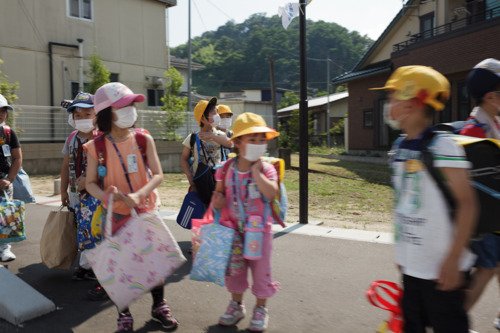
28.media.tumblr.com
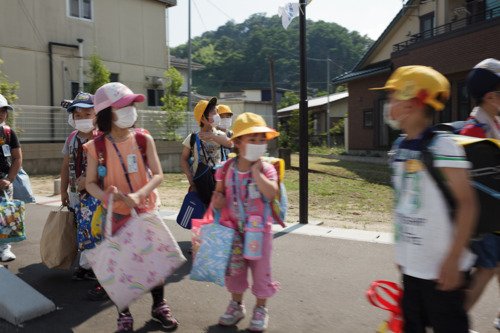
KAWAMATA, Japan - Children wear face masks to avoid breathing in radioactive dust while walking home from school near the 30 kilometer Fukushima evacuation zone. www.tumblr.comby Edano via 28.media.tumblr 10/10/2011 5:23:11 PM- @Edano these photo's may be meant to look jolly but they are just sadby elainekirk 10/10/2011 5:27:32 PM
- it's heart breaking, really, even for me.by Edano 10/10/2011 5:29:35 PM
- @Edano it's the fact they don't know what is waiting round the corner just innocent families believing the government want to make them all be happy when in reality it is an attempt to fool foriegners that all is well and they should come gawp at these colourful people and spent lots of moneyby elainekirk 10/10/2011 5:33:14 PM
- @elainekirk i am just investigating, the pics of asahi seem to be from 2010.by Edano 10/10/2011 5:34:42 PM
- @Edano oh so they seek to decieve too!
audi found this Japan \\times article that gives hope search.japantimes.co.jp
First, the tragic events of March 11 and the concomitant radiation contamination have catalyzed many young people. I sense it in the students at Tokyo Institute of Technology, where I teach, and at other tertiary institutions. Call it a renewed awareness in themselves and a belief that they should be doing something to redress the pain and ills their country is experiencing.
Second, I believe that many people in Japan today, by no means only young ones, feel sick of the lies fed to them by the captains of industry and their servants in the upper echelons of the government bureaucracy.by elainekirk 10/10/2011 5:37:07 PM - @elainekirk it is strange i find no second reference to the kawamata festival this year.by Edano 10/10/2011 5:39:41 PM
- but lots of references for 2010.by Edano 10/10/2011 5:44:56 PM
- True radiation decontamination still a long way away
Though the government last month lifted the "emergency evacuation preparation zone" designation of some areas greatly affected by the ongoing crisis at the Fukushima No. 1 Nuclear Power Plant, radiation decontamination efforts are still taking place in areas with high levels of radiation.
The three main decontamination methods that have been highly publicized through media reports are: the stripping away of surface soil from school playgrounds and athletic fields, the removal of mud accumulated in gutters, and the washing of roofs using high-pressure water cleaners. While the first method is considered effective, the remaining two have been found to be effective only to a certain point, and some especially warn against overestimating the effects of high-pressure water cleaners.
"It might make you feel like you're decontaminating, but there's a limit to the amount of radioactive cesium that's caked onto roofs that can be eliminated with high-pressure water cleaners," says Kunihiro Yamada, a professor of environmental science at Kyoto Seika University. "The water cleaners wash surface dirt off, but then that tainted water goes into sewers and can contaminate rivers, thereby affecting farm goods and seafood. If people in highly populated areas were to begin using water cleaners, we may end up finding people forcing tainted water onto each other."
.....
"The decontamination I've done is a type of emergency measure to protect children and pregnant women, and not true decontamination." He continued: "Permanent decontamination requires the knowledge and technology of experts and corporations, and a massive amount of funds. It must not become an interest-driven public project."
.....
"What residents want is not half the exposure to radiation," says Yamada. "What they want is for a return to levels that allow them to live with peace of mind. Massive amounts of radioactive materials have been spread across wide areas in the ongoing disaster, so we can't count on the weathering effect. There's also the possibility that radiation will not only spread, but will start to accumulate in large concentrations in certain places. The half life of cesium 137 is approximately 30 years, but that of cesium 134 is 2 years. What the government has said is the equivalent of saying that they won't engage in full-fledged decontamination activities.
Both Yamada and Yamauchi agree that children and pregnant women living in areas that have not been subject to evacuation orders but have nonetheless been found to have high levels of radiation -- like the cities of Fukushima and Koriyama -- should be evacuated temporarily, and that those areas be thoroughly decontaminated while those populations are away. Kodama also says that residents living in areas with yearly radiation exposure of 1 millisievert or higher who want to evacuate should be fully supported by the government and Tokyo Electric Power Co., the operator of the stricken power plant.
......
mdn.mainichi.jpby Edano 10/10/2011 5:46:38 PM - @Edano rockhopper says The second worker,seems so upset about corruption surrounding the on-site management.by elainekirk 10/10/2011 5:47:53 PM
- The last place I know of that published dynamic Fuku-fallout-forecast maps (up into September) deleted their page : www.senes.caby Ian 10/10/2011 5:56:32 PM
- @Ian I am going to put together something on the two videos of unit 3 by the pool gate. You mentioned the first video was actually Aug not Sept. Did you have any other notes on the two vids I should add? I have a pile of photo stills I took over the weekend.by lillymunster 10/10/2011 6:25:36 PM
- @lillymunster have you just done the one twet today to simply. Talking about those that tweet auto when you post on site I have found uk oneby elainekirk 10/10/2011 6:31:10 PM
- @lillymunster, one thing to consider is that the most-recent Unit 3 videos is showing a different spot by the equipment pit, but the handouts for it and the Sept 24 release seem to indicate that the same spot was used for both. The important point being that the new video does not therefore sow a lack of steam because it's not looking at the steam spot.by Ian 10/10/2011 6:37:45 PM
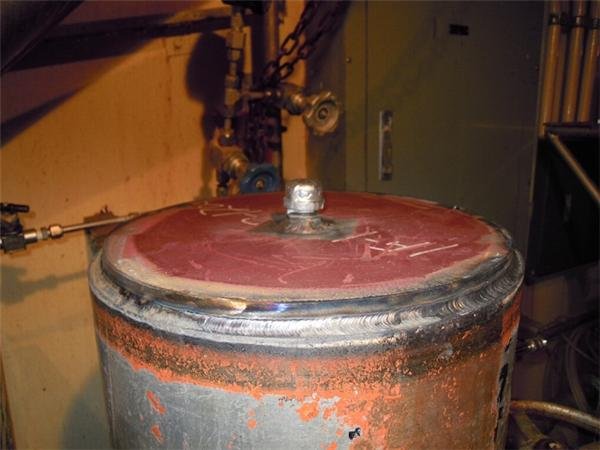
www.tepco.co.jp
The pics for the work on the rpv spray
pipe these are the sheets that go with them
www.tepco.co.jp
www.tepco.co.jp
and the hd pics are here
www.tepco.co.jpby elainekirk via Tepco.co.jp 10/10/2011 6:37:57 PM- My comment to this pro-nuclear-fallout blog asiancorrespondent.com
#
The fact that PET/CT scans are used in medicine doesn't mean radiation is safe per se. Lol! Almost all medicines carry risks and their use is a function of risk/benefit analyses for *ill patients*. And PET/CT scans carry the risks of well-known radiation harms. [1,2,3]
To translate risk/benefit analyses for patients with terminal illnesses to the healthy general population is a severe category error. By that logic we could justify dumping tons of FDA-approved medicines onto the general population on the basis that their benefits were determined to exceed their risks for ill patients. Anyone who did that would be criminally insane.
[1] archinte.ama-assn.org
[2] www.nejm.org
[3] www.cancer.govby Ian 10/10/2011 6:42:18 PM






Japan Earthquake | Page 2486
- Who's Blogging
-
 hudebnik
 alblee
 UKVal
UKVal Oliver (ScribbleLive)
 Jonathan Keebler
 kaykodh
 PKelley
 Markfm
 Angie
Angie Deb
Deb Mid Valley
 Pedro Jesus
 Matt (ScribbleLive)
 George Gibb
- elainekirk
- lillymunster
 dean
dean bo
bo- Edano
 IanGoddard