Japan Earthquake | Page 2564
 Solar panels on all new homes in Japan by 2030 www.telegraph.co.uk
Yokohama Smart city plan for new smart grid & small home solar
www.japantimes.co.jpby lillymunster 10/27/2011 11:45:11 PM- Off twitter Hiroshima Hibakusha speak at the UN general assembly question world reliance on nuclear power in light of problems with radiation in Japanby lillymunster 10/27/2011 11:49:05 PM
- NPO gives benches to temporary housing complex to foster community ajw.asahi.comby lillymunster 10/27/2011 11:51:25 PM
 @lillymunster shouldnt the benches have been part and parcel?by elainekirk 10/27/2011 11:56:57 PM
- I guess not. Sounds like a few asked for them and someone realized it would be a good ideaby lillymunster 10/27/2011 11:59:15 PM
- 30 years to decommission Fuku
Unit 1 to 4 of TEPCO Fukushima No. 1 nuclear power plant, Atomic Energy Commission of the Cabinet Office, the end of decommissioning, "takes more than 30 years," summarizes the draft report and incorporate long-term outlook for the first time. Expected to be submitted to the Special Committee of 28 days.
The reactor of Unit 1 to 3, as the molten core the book is about 1500 meters, the pool of nuclear fuel Units 1 to 4 and left the fuel assemblies of the book about 3100 meters, and decommissioning, which requires the recovery of these be.
The draft report, realized on a nuclear reactor to cold shutdown conditions this year, decontamination of the reactor building in 2012, and debris removal started. 27 years from nuclear fuel pools, and each is expected to start recovering fuel from nuclear reactors in 34 years, the completion of decommissioning has become since 1954 after 30 years. These tasks are "actively seek the advice of international experts" and promote the basic policy. sankei.jp.msn.comby lillymunster 10/28/2011 12:05:47 AM - @lillymunster omg it looks like a hotch potch knocked together without any real comprehension of the situationby elainekirk 10/28/2011 12:29:36 AM


s.glbimg.com Three EYES Fish - found near nuclear plant in Argentina
This three eye fish was found in a river near a nuclear plant in Embalse. www.treehugger.comby Majj via S.glbimg 10/28/2011 1:00:56 AM- @Edano o a Woipertinger!!!!!by Majj 10/28/2011 1:04:01 AM
 Gobs of radiation from Fukushima - cs-137 from sea to shining sea - I computed that US dirt samples have twice as much radioactivity per kg as bananas, so don't eat the dirt.
www.asianweek.comby artnuke 10/28/2011 1:58:06 AM- Yukio Hayakawa made a rather nifty radiation map. gunma.zamurai.jpby lillymunster 10/28/2011 2:22:47 AM

This blog : 2.bp.blogspot.com
by Majj via 2.bp.blogspot 10/28/2011 2:23:46 AM- Lifetime ***ulative Limit of Internal Radiation from Food to Be 100 Millisieverts in Japan
That's the formal recommendation of the experts on the government's Food Safety Commission.
External radiation is not counted in this number, as opposed to their draft plan in July which did include external radiation, and it is in addition to the natural radiation exposure (by which is meant pre-Fukushima natural).
The experts on the Commission didn't rule on the radiation limit for children, leaving the decision to the Ministry of Health and Labor as if the top-school career bureaucrats in the Ministry would know better.
Yomiuri and other MSMs are spinning it as "tightening" the existing provisional safety limits on food.
ex-skf.blogspot.com***ulative-limit-of-internal.html?utm_source=twitterfeed&utm_medium=twitterby Majj 10/28/2011 2:26:18 AM - Tokai seismic data used for the plant was input incorrectly when done. Reviewing all data again used to determine plant safety. www.nhk.or.jpby lillymunster 10/28/2011 2:30:06 AM
- Fukushima underground wall will only be on sea side of plant blog.livedoor.jpby lillymunster 10/28/2011 2:46:12 AM
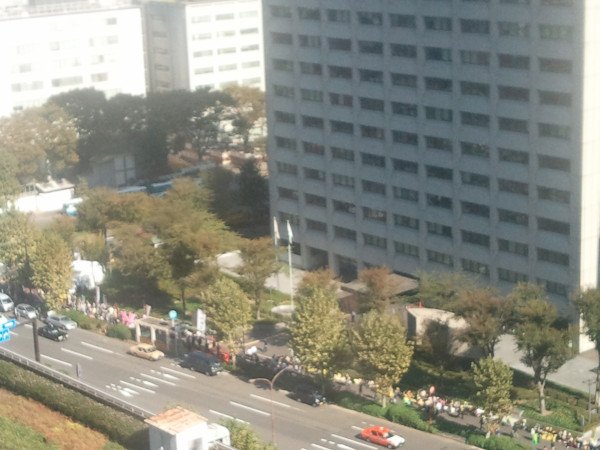
- "Knitting group" was formed at women's sit-in at METI. They want you to join to knit & sit-in :) @NoNukeArt onna100nin.seesaa.netby lillymunster 10/28/2011 2:49:59 AM
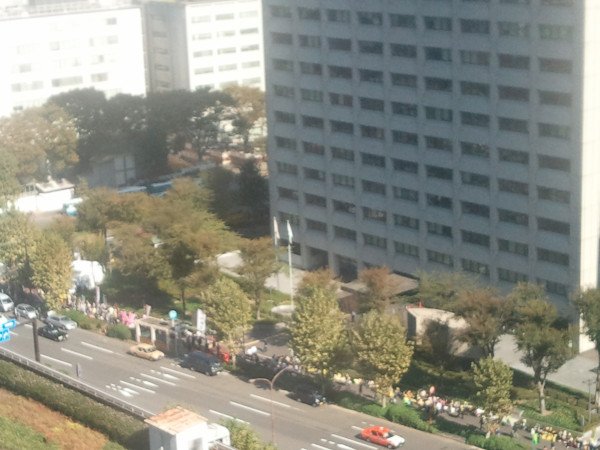
Women protest in front of METI s1-02.twitpicproxy.com
by lillymunster via S1-02.twitpicproxy 10/28/2011 2:53:54 AM- Nuclear promotion dropped from Japan's budget www.bloomberg.comby lillymunster 10/28/2011 4:07:22 AM
 by Ian 10/28/2011 5:59:53 AM
- NHK just flagged down a video posted 4 hr ago, fast! : www.youtube.comby Ian 10/28/2011 6:04:11 AM
Save Fukushima Animals : http://www.youtube.com/savefukushimaanimalsby Ian 10/28/2011 6:16:20 AM- by Ian 10/28/2011 6:18:38 AM
- g'morningby elainekirk 10/28/2011 9:20:43 AM
- Partner companies' worker found the crack at connection casing in driving
shaft of ceiling crane, which is used to deal with spent fuel casks and
located in the common spent fuel pool building, during its annual check
out. We will check carefully the situation of the connection casing in
greater detail. www.tepco.co.jpby elainekirk 10/28/2011 9:24:56 AM  In Japan, Provocative Case for Staying Nuclear
With public opinion sharply against nuclear power, one argument in favor of it rarely gets a public airing: Japan needs to maintain its technical ability to make nuclear bombs (needs a subscription). online.wsj.comby Peter 10/28/2011 10:32:53 AM- @Peter sometimes I think the bandwagon will just keep rollingby elainekirk 10/28/2011 10:43:06 AM
- @elainekirk , I believe that is, in good part, the reason why some nations do not want to wean themselves from this technology in as much as others aspire to own it. Angst inspires people to take any kind of risk. If you are against it, you are unpatriotic.by Peter 10/28/2011 10:48:11 AM
- @Peter madnessby elainekirk 10/28/2011 10:49:40 AM
 @Peter exactly. there is no PURE civil nuke usage. the political option is much heavier than admitted.by Edano 10/28/2011 10:59:43 AM
- it's hipocrisy. they should clearly say we need nuke plants to build nuke weapons, not because it's cheap and clean. this also means that a lot of states will never abandon nuke technology. :( this also explains that some states can easily renounce nukes, like germany, italy, switzerland, austria .... and japan, that is not allowed to have nuke weapons.by Edano 10/28/2011 11:08:14 AM
- the "cheap and clean" argument is wrong and only invented for the public acceptance of weapons of mass destruction. it has been hammered into the heads of the people so they believe blindly in this lie.by Edano 10/28/2011 11:11:31 AM
- we should remove this ugly mask.by Edano 10/28/2011 11:12:45 AM
- Japan eyes lowering annual cesium exposure limit to 1 millisievert
TOKYO, Oct. 28, Kyodo english.kyodonews.jpby Edano 10/28/2011 11:18:15 AM - Scrapping Fukushima reactors to take over 30 yrs: gov't panel
TOKYO, Oct. 28, Kyodo english.kyodonews.jpby Edano 10/28/2011 11:19:06 AM - Over 80% of Japan's reactors offline
Forty-four of Japan's 55 nuclear reactors are currently idle, mainly for safety inspections.
Eighteen of them are undergoing stress tests mandated by the government. But none are expected to resume operations soon because the nuclear plant accident in Fukushima has raised safety concerns among local authorities hosting nuclear plants.
Of the 10 reactors still running, 4 will be shut down for routine inspections by year-end. The rest are scheduled to go offline by early next year.
If none of the reactors restart, Japan will have no active nuclear power plants within several months.
Friday, October 28, 2011 16:39 +0900 (JST)
www3.nhk.or.jpby Edano 10/28/2011 11:20:31 AM - Govt to lower radioactive intake limits
Japan's health ministry is set to lower its radiation limits for food to one millisievert per year as early as April. The figure is one-fifth the current level.
The ministry set provisional radioactivity safety limits on foodstuffs at 5 millisieverts per year after the nuclear accident at the Fukushima Daiichi plant in March.
This would translate into 500 becquerels of radioactive cesium per kilogram in meat, fish, vegetables and cereals such as rice.
The tentative limits were based on the levels which are said to have no health effects even when a person consumes foods with radioactive materials for one year.
The ministry decided to lower the limits to match international standards as radioactive substances detected in foodstuffs have been falling since the accident.
On Thursday, Japan's Food Safety Commission recommended that cumulative internal radioactive exposure from food during a person's lifetime be limited to no more than 100 millisieverts.
The new safety limits would result in stricter standards for each food item, and are likely to fall within the levels recommended by the commission.
The ministry's panel is to start deliberating the issue next week to set standards for each food item.
Friday, October 28, 2011 08:09 +0900 (JST)
www3.nhk.or.jpby Edano 10/28/2011 11:21:41 AM - @Edano well thats a positive move I hopeby elainekirk 10/28/2011 11:23:15 AM
- Morning Edano - you look lonelyby lillymunster 10/28/2011 11:23:24 AM
- Japanese group develops handheld decontaminator
A group of Japanese researchers says it has developed a handheld device capable of removing radioactive substances using laser beams.
The machine was created by researchers from the Wakasa Wan Energy Research Center in Fukui Prefecture, central Japan.
The device uses laser beams moving at a high speed to scrape off radioactive substances attached to the surface of pipes and other objects at nuclear power plants. The dust is then collected inside the machine.
The researchers say that, since only the surface is scraped off, the machine generates one thousand times less radioactive waste than conventional methods.
The device is about 30 centimeters high and wide, and 40 centimeters long. The team says it is the world's first portable radiation decontaminator.
When the researchers began developing the machine 7 years ago, they meant it to be used to reduce radioactive waste from nuclear plants, and also in the decommissioning of a prototype test reactor in Fukui Prefecture, known as Fugen.
The device is expected to be used in the operations to remove radioactive substances from the Fukushima Daiichi nuclear plant, which was badly damaged in the March 11th tsunami.
Friday, October 28, 2011 10:51 +0900 (JST)
www3.nhk.or.jpby Edano 10/28/2011 11:24:17 AM - nonsense.by Edano 10/28/2011 11:25:27 AM
- Kansai Electric submits stress test results
Kansai Electric Power Company has submitted to the government the results of a computer-simulated safety test on one of its halted nuclear reactors.
The government mandated that so-called "stress tests" must be conducted before idle reactors across the country could be restarted. The utility is the first to report its results.
A Kansai Electric official, Masanori Kataoka, visited the government's Nuclear and Industrial Safety Agency on Friday to deliver the test results on its No.3 reactor at Ohi nuclear plant in Fukui Prefecture.
The utility says a reactor maker's simulation showed that the reactor could withstand an earthquake 1.8 times the intensity and a tsunami 4 times the height of the estimated maximums for the area.
80 percent of the nuclear reactors in Japan have been shut down since the March accident at the Fukushima Daiichi power plant.
Friday, October 28, 2011 13:19 +0900 (JST)
www3.nhk.or.jpby Edano 10/28/2011 11:26:35 AM - The discussion a bit earlier, I think it would be a useful tool to calculate the true cost of nuclear power but include everything. All the oversight costs, cost of IAEA activities, cost of payouts for injured workers, cost of accidents, costs of decommissioning, spent fuel storage (like Yucca mtn ) and all those other costs that many times society pays for not the power co.by lillymunster 10/28/2011 11:27:13 AM
- Director Wim Wenders talks to Fukushima residents
World-renowned German film director Wim Wenders has asked residents of Fukushima Prefecture to raise their voices to prevent another nuclear crisis.
Wenders has received global accolades for his films, especially his masterpiece "Wings of Desire". He is visiting Japan for the Tokyo International Film Festival which is premiering his new film Pina, an homage to the late contemporary dancer Pina Bausch.
On Thursday, Wenders spoke to fans at a cinema in Fukushima City. He asked what support he can give to people like them who are suffering.
The director said he visited Iitate village in the prefecture. The locale has been under an evacuation advisory since the accident at the nearby Fukushima Daiichi nuclear power plant.
Wenders compared the village's scenery to heaven, but radiation levels in the area are unbelievably high. He called on people to continue talks with him, saying he is willing to help.
Wenders plans to visit other areas hit by the March earthquake and tsunami to speak with disaster survivors.
Friday, October 28, 2011 06:47 +0900 (JST)
www3.nhk.or.jpby Edano 10/28/2011 11:28:12 AM - @lillymunster would be good, but how ???by Edano 10/28/2011 11:32:14 AM
- who even knows what a fuel rod costs ? :)by Edano 10/28/2011 11:33:33 AM


Japan Earthquake | Page 2564
- Who's Blogging
-
 hudebnik
 alblee
 UKVal
UKVal Oliver (ScribbleLive)
 Jonathan Keebler
 Matt (ScribbleLive)
 kaykodh
 PKelley
 Markfm
 dean
dean Angie
Angie- Edano
 Deb
Deb Mid Valley
- Pedro Jesus
 George Gibb
- elainekirk
- lillymunster
 bo
bo IanGoddard