Japan Earthquake | Page 2666
 This page has radiation information for the day for 3 cities. They have to have the info elsewhere. I am struggling to find it. www.mns.gov.uaby lillymunster 11/15/2011 6:26:01 PM
- @M.I.A. thanks, that could explain the oddity in Portugalby lillymunster 11/15/2011 6:26:24 PM
 or elvis was there.by Edano 11/15/2011 6:29:59 PM
 On November 14, 2011, an extremely long filament (about 466,000 miles) stemming from an eruption on the Sun snapped its tail. It was not directed towards Earth. The imagery was captured by NASA's Solar Dynamics Observatory and music by Atom Strange. www.space.comby M.I.A. 11/15/2011 6:32:34 PM
- No wonder people in Ukraine are rioting, their govt websites are a nightmareby lillymunster 11/15/2011 6:32:40 PM
- The press service of the Ministry of Emergency Situations announced this in a statement.
The ceremonial handover of the system and its launch took place on Monday, May 30, in the presence of the Minister of Emergency Situations Viktor Baloha and the head of the European Commission's Delegation to Ukraine, Jose Manuel Pinto Teixeira.The system is expected to significantly increase the possibility of continuous monitoring of the radiation condition in the exclusion zone, allowing prompt assessment of the impact of radiation on the environment.The European Commission financed the creation of the system under a project for international technical assistance to Ukraine.The Ukrainian corporation called Ukrainian Nuclear Devices and Systems implemented the project.Thanks to this system, information about the radio-ecological state in the Chornobyl exclusion zone and outside it can be obtained via the internet website srp.ecocentre.mns.gov.ua.by Liz edited by lillymunster 11/15/2011 6:42:38 PM 
iangoddard.com
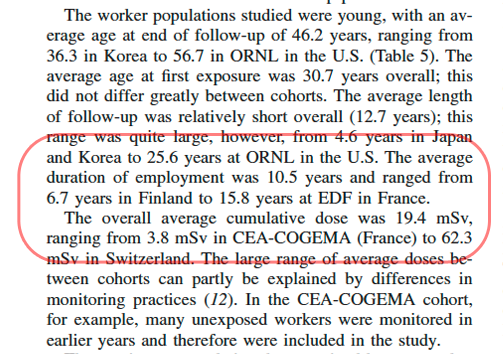
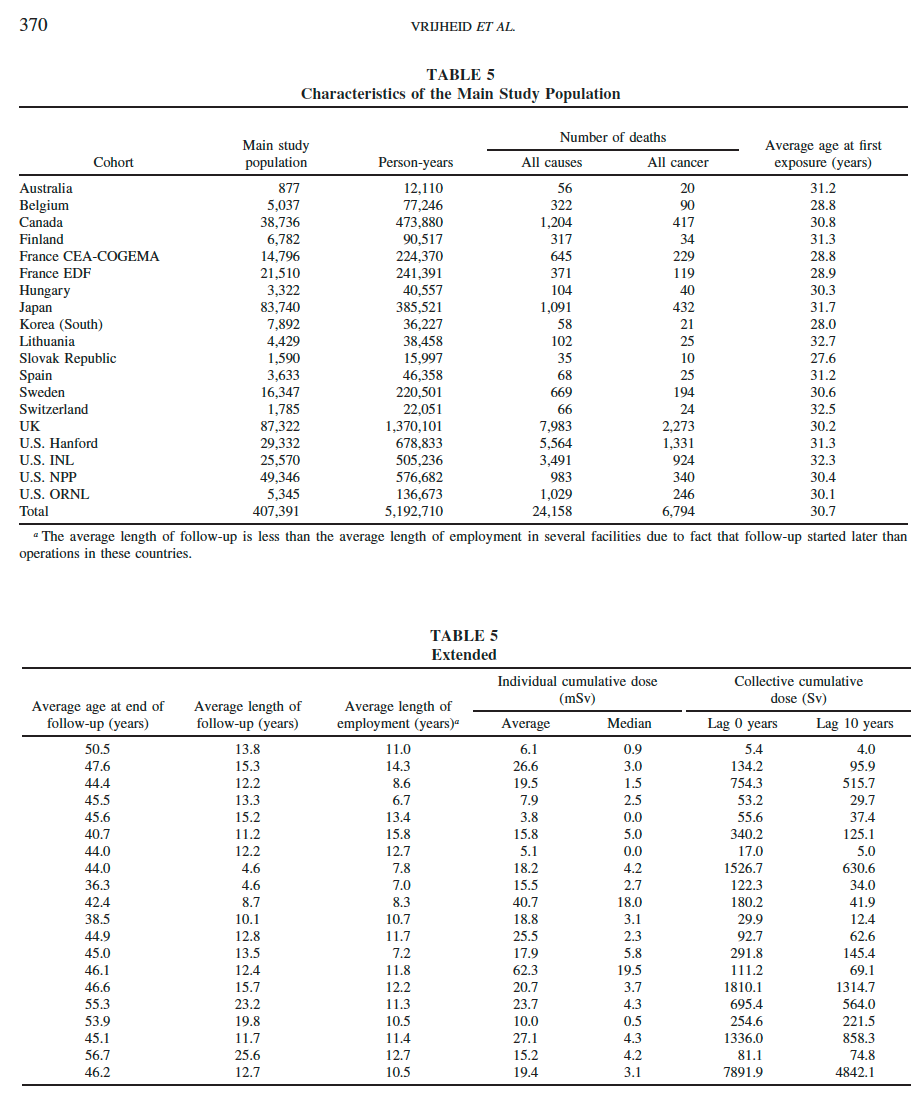
Question re this study : (Part 1) www.ncbi.nlm.nih.gov (Part 2) www.ncbi.nlm.nih.gov and its data shown above...
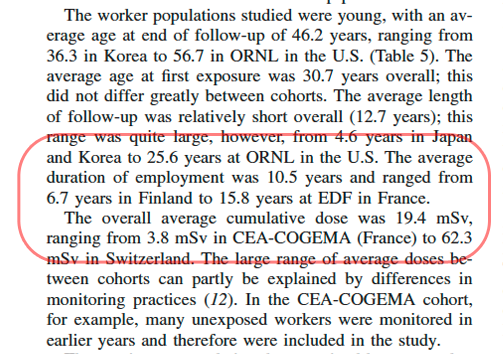
Given that the average cumulative dose of subjects was 19.4 mSv (accumulated over years of employment in the nuclear industry) and that the average years of employment was 10.5 years, is it not reasonable to infer that the average-annual exposure was:
19.4 mSv / 10.5 y = 1.8 mSv/y
?by Ian via Iangoddard 11/15/2011 6:43:58 PM- @Liz the link didn't work??by lillymunster 11/15/2011 6:54:20 PM
- It didnt work for me. I thought maybe you have more luck or maybe it works later? I dont know. lillymunsterby Liz 11/15/2011 7:00:25 PM
- @Ian , to obtain a representative value, you would have to calculate the dose rate for each country separately and would have to use the median of the results, if the distribution was not normal.by Peter 11/15/2011 7:09:45 PM
- @Liz where did you find it?by lillymunster 11/15/2011 7:22:39 PM
- Scroll down. Its on the left side. Its all russian. I used google translate. nuclearno.comby Liz 11/15/2011 7:26:39 PM
- @Peter, thanks! I had a feeling my proposal was too simplistic. Might one call it a 'rough approximation'? It seems they don't give the requisite detail of data, so we probably can't calculate the average annual dose rate from the published data.
I'm surprised the authors didn't calculate it themselves given that the focus was low-dose effects. The avg annual dose rate would seem to be the ultimate data point to pull out of the study. As we can see, the 'rough approximation' I suggest is frightfully low!by Ian 11/15/2011 7:35:12 PM - And the authors concluded : "A significant association was seen between radiation dose and all-cause mortality [excess relative risk (ERR) 0.42 per Sv, 90% CI 0.07, 0.79; 18,993 deaths]. This was mainly attributable to a dose-related increase in all cancer mortality (ERR/Sv 0.97, 90% CI 0.28, 1.77; 5233 deaths)." www.ncbi.nlm.nih.govby Ian 11/15/2011 7:37:51 PM
 Power plant chief details Fukushima nuclear disaster
mdn.mainichi.jp
Masao Yoshida, head of the crippled Fukushima No. 1 Nuclear Power Plant, meets the media at the plant in Okuma, Fukushima Prefecture, on Nov. 12.
OKUMA, Fukushima -- Masao Yoshida, head of the crippled Fukushima No. 1 Nuclear Power Plant, elaborated on the nuclear crisis triggered by the March 11 earthquake and tsunami, saying he and other plant workers thought at the outset of the disaster that they were going to die.by elainekirk 11/15/2011 7:46:08 PM- @Ian , seems your estimate is all that can be provided. The way the researchers describe this, I anticipate a huge spread in the data, even within a cohort from one country because each individual's exposure depends on the job and the jobs can vary greatly between, let us say, someone who mixed fuel for a living and someone who handled low level trash. Hence, the distribution for each cohort will probably be skewed and have a long tail toward higher doses.by Peter 11/15/2011 7:47:03 PM
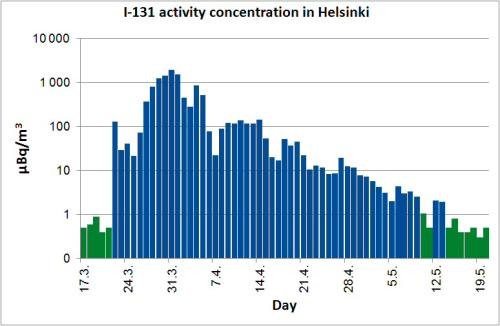
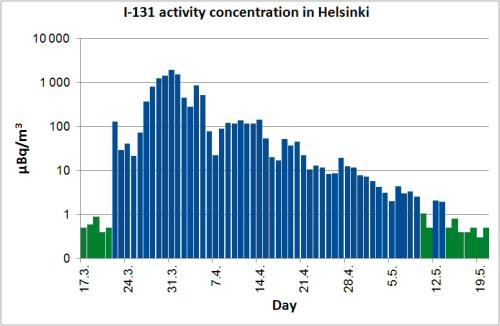
@Edano TY for info about xenon and iodine. Difficult stuff.. At the link is iodine in Helsinki, Finland, in March 2011. When the iodine was because of Fuku in March, it also may be from Fuku now – the fission going on there. The greatest nuclear accident is happening, iodine increase in MANY countries - and they suggest it come from radioactive treatment or submarine..! Or maybe like a commentator wrote on ENENEWS: “It means that there are radium bottles all over Europe.” Haha. Just love this nuke humour.
www.stuk.fiby Mona via Stuk.fi 11/15/2011 7:55:50 PM- @lillymunster, can you take a look at this site:http://srp.ecocentre.mns.gov.ua./MEDO-PS/ Is that a monitoring site?by Liz edited by lillymunster 11/15/2011 7:56:32 PM
- I think thats the site that wouldnt open before@lillymunsterby Liz 11/15/2011 7:58:17 PM
- Liz the new link worked. It looks to be just for the region around Chernobyl but this is what we needed! :-)by lillymunster 11/15/2011 8:17:10 PM
- ooops....by Edano 11/15/2011 8:32:29 PM
- Higher radiation detected downstream in Fukushima
Surveys by Japan's Environment Ministry show that downstream radiation levels have risen in some rivers in Fukushima Prefecture.
The ministry has been monitoring radiation levels in rivers near the Fukushima Daiichi nuclear power plant to assess the impact of the accident there.
Officials took sand samples from 2 rivers in September.
In northern Fukushima Prefecture, the upstream radioactive cesium levels were 3,200 becquerels per kilogram in the Niida River in a district of Iitate Village.
The downstream levels of the same river in an area of Soma City were 13,000 becquerels.
The upstream levels had fallen to one-fifth of those observed in May, but the downstream measurements had tripled.
Cesium levels near the mouth of the Mano River in another part of Soma City had doubled from May.
Kinki University Professor Hideo Yamazaki says radioactive substances in riverbed sands are probably moving downstream, and radiation levels should be monitored near river mouths.
Wednesday, November 16, 2011 03:17 +0900 (JST)
www3.nhk.or.jpby Edano 11/15/2011 8:32:42 PM - @Edano they may be able to contain the locals by financial and emotional ties but they cannot contain the radiation that is free to travelby elainekirk 11/15/2011 8:36:39 PM
- corium in groundwater.by Edano 11/15/2011 8:36:59 PM
- Got a break so I could go through the Ukraine stations. Buryakovka has over 3000 nSv/h I don't know yet if this is normal. It is 3x Pripyat by Chernobyl. I don't know if this is a hot spot from Chernobyl or not.by lillymunster 11/15/2011 9:08:18 PM
- well, no, too far away from the plants.by Edano 11/15/2011 9:08:23 PM
- possibly the "decontamination" efforts.by Edano 11/15/2011 9:09:01 PM
- @Peter, the authors have annual doses for all 400k+ workers! So they could calculate avg annual dose straight therefrom. They also note that the exposures where skewed toward the low end. Consider that 'low' is usually defined as < 100mSv.
They state: "The overall average cumulative recorded dose was 19.4 mSv. The distribution of recorded doses was very skewed: 90% of workers received cumulative doses below 50 mSv and less than 0.1% received cumulative doses greater than 500 mSv." (Page 403 www.ncbi.nlm.nih.gov )by Ian edited by Edano 11/15/2011 9:11:10 PM - Funny how scribble doesn't allow the word c u m ulative. Seems an easy bug to correct.by Ian 11/15/2011 9:12:51 PM
- cumulativeby Edano 11/15/2011 9:13:29 PM
- @Edano, it's probably that you have a high-level of account, trying again: ***ulativeby Ian 11/15/2011 9:14:35 PM
- ha! mods can!by Edano 11/15/2011 9:14:37 PM
- jap government try this !by Edano 11/15/2011 9:15:15 PM
- they censor "jap" as well.by Edano 11/15/2011 9:16:03 PM
- @Edano, I won't try that one. :)by Ian 11/15/2011 9:17:23 PM
- @Ian there are just levels of naughty words rather than the ability to add or remove from a list.by lillymunster 11/15/2011 9:22:00 PM
- @Peter, does the fact that "90% of workers received ***ulative doses below 50 mSv" give us an analytical foot-in-the-door? Given that we know (1) avg employment was 10.5 years, (2) avg dose was 19.4 mSv, and (3) 90% of the cohort received < 50 m Sv.by Ian 11/15/2011 9:22:46 PM
- @lillymunster, just odd that the screening program weeds bad sub-strings out of larger words.by Ian 11/15/2011 9:26:39 PM
- @Ian, do the authors tell us how they arrived at "overall average ***ulative recorded dose", that is do they use median or mean for the average?by Peter 11/15/2011 9:33:59 PM
- I have found hell and it is Ukranian computer programming. I have managed to sort of get into historical data on that site. I don't suggest it for the meek.by lillymunster 11/15/2011 9:34:39 PM

I found their IT department
agentontheloose.files.wordpress.comby lillymunster via Agentontheloose.files.wordpress 11/15/2011 9:35:32 PM- @Peter, oh wow! Table 5 gives average and median c u mulative doses for workers in each country! Alongside that data it gives the avg length of employment for each country! I think it gives everything needed. Folks, this is highly Fukushima-relevant wrt hazards of the 20 mSv/y limit.by Ian 11/15/2011 9:43:03 PM
- @Peter, I found this in the Part 2 of the study. It was published in 3 parts it's so large.by Ian 11/15/2011 9:45:14 PM
- @Ian , there you go, :)by Peter 11/15/2011 9:49:33 PM
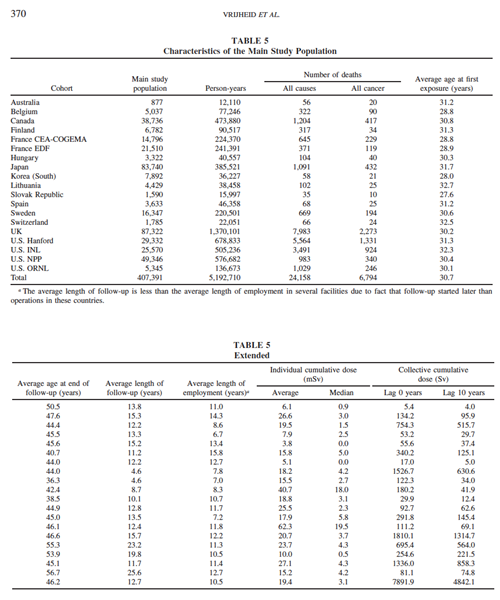
iangoddard.com
Source (p 370-71) : www.ncbi.nlm.nih.gov
@Peter, yes indeed! I'll follow you're instructions below. Though my recall of Stat 101 is fuzzy enough to not recall what it means if the distribution is not normal.by Ian via Iangoddard 11/15/2011 9:55:57 PM

Japan Earthquake | Page 2666
- Who's Blogging
-
 hudebnik
 alblee
 UKVal
UKVal Oliver (ScribbleLive)
 Jonathan Keebler
 Matt (ScribbleLive)
 kaykodh
 PKelley
 Markfm
 dean
dean Angie
Angie- Edano
 Deb
Deb Mid Valley
- Pedro Jesus
 George Gibb
- elainekirk
- lillymunster
 bo
bo IanGoddard