Japan Earthquake | Page 2667
 Err ... your ... Wish I could edit my posts. :(by Ian 11/15/2011 9:57:28 PM
- @lillymunster, lol, probably! And complete with new-fangled computers and phones! ;)by Ian 11/15/2011 10:00:58 PM
 @Ian Oh yes. I give some props to whomever tried to make that web interface is it really a mess. It looks like someone with non-web programming skills sort of hacked their way through it. I was able to pull all historical data for all stations into an excel spreadsheet. Date range Oct 1 to about Oct 16. It should be enough to spot something. I set it for Oct 1 to Nov 1 but only returned those two weeks without any other option but that is the time frame we really need.
I have to get a couple of things done here right now. If anyone wants to mess with the spread sheet right now let me know and I can copy it to an open google doc. Otherwise after dinner I am going to be crunching numbers. :-)by lillymunster 11/15/2011 10:04:12 PM- @Peter, so would do this for each country: divide avg c umulative dose / avg length of employment. Then find the avg of all those averages?by Ian 11/15/2011 10:14:58 PM
 Ian can you try that word againby elainekirk 11/15/2011 10:17:33 PM
- @lillymunster, 3000 nSv = 3 µSv, which is approx 30x background for most locations close to sea level, like most of Japan. It's unusually high.by Ian 11/15/2011 10:18:39 PM
- @elainekirk, yes... cumulative.by Ian 11/15/2011 10:18:55 PM
- Ah! Fixed. :)by Ian 11/15/2011 10:19:05 PM

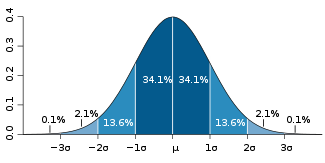
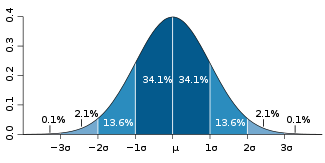
@Ian , seeing the table I suppose that average represents the arithmetic mean (you should check that though). If a distribution of values is normal, that is it conforms to the standard bell-shaped curve in which three standard deviations comprise 99.9 percent ( en.wikipedia.org ), the median equals the arithmetic mean. The table clearly shows that this is not the case for the data. Hence you need to use the medians. upload.wikimedia.org
by Peter via Upload.wikimedia.org 11/15/2011 10:23:57 PM- LOL. The national tragedy is over, we can type cumulative. It only took 9 months. :-) don't mind me I need sleep, coffee, sanity, :-)by lillymunster 11/15/2011 10:25:19 PM
 Might want to chick into this...I never cared for this site but...Godlike Productions site has a 'breaking':Radiation in Europe not from Japan. It is from Germany. Also when you click on the icon after the breaking announcement, another says it is from Dessel Belgum's Oct 4th incident at Belgoprocess nuclear waste processing facility. (Sorry I can't give godlike productions link, I'm not on my server)by MaryW 11/15/2011 10:25:52 PM
- Just checked German sites on the border close to Dessel Belgum no increases at all over those time periods or now.by lillymunster 11/15/2011 10:53:10 PM
- @Peter, thanks again!!! The authors give no hint if the Avg is the arithmetic mean. So do I divide each Median by the years for that country? But the Median values so much lower than the Avg values!by Ian 11/15/2011 11:00:16 PM
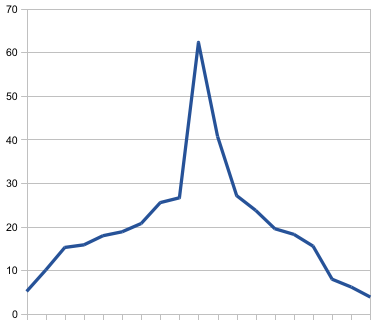
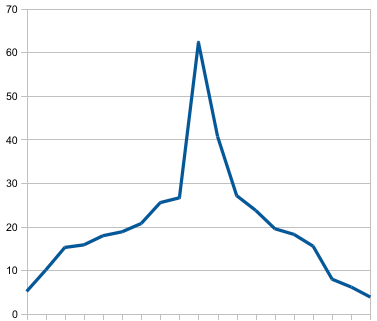
iangoddard.com @Peter, it plotted the Average cumulative doses with the highest in the center. It's skewed somewhat, but not as I can see severely. Isn't it close enough to normal? It worried me that the Medians are so low by contrast, it will skew the conclusion too low.
by Ian via Iangoddard 11/15/2011 11:03:42 PM- Arnie Gundersen radio interview: fairewinds.comby Ian 11/15/2011 11:08:41 PM
- Checked Belgium near Dessel for Oct 1 to Nov 1 and there was no spike. Oct 4th showed nothing. I checked various sites around it also. Not sure how whomever posted that at godlike came up with their theory. It also doesn't fit the known spikes and dates of said spikes.by lillymunster 11/15/2011 11:08:48 PM
- @Peter, calculating the avg annual dose per country, summing the avgs and dividing by their number (19, not 15 since US is divided into 4 facilities), gets an avg annual dose of 1.95 mSv/y. And that from a study www.ncbi.nlm.nih.gov that found a significant increase in cancer mortality. And yet Fukushiman's are being allowed 10X that does per year!!by Ian 11/15/2011 11:26:02 PM
- @Ian , in this case the medians represent the groups best. The means are lifted up because of a few people with extraordinary high doses that do not represent what most people accumulated. And, yes, the medians are low because only few people work exposed with highly radioactive material, accumulating the high doses. Using my analogy from before, only few guys mix the mox. Many more deal with low level waste.by Peter 11/15/2011 11:42:01 PM
- Loads of speculation out there! I thought the Germany one was interesting since they recently shut-down their nuke plants. I'm going to post some links I came across today. Didn't really get much time to check out these links myself. First one is: Stations of Monitoring of the Atmospheric Radioactivity and Watery Gerees by the CRIIRAD. 98.139.168.220 (hope link works, its very long)by MaryW 11/16/2011 12:03:06 AM
- @Peter, thanks for your help Peter! Is this significant or what? I've spent weeks scouring for studies and data and have found much, but this strikes me as the single most potent factoid contrary to the view that 20 mSv/y might be safe.
What's particularly important about this data is that the nuclear worker exposures are slow dose rates, whereas the National Academy of Sciences risk model is based mostly on the fast-dose exposure of atom-bomb survivors. So nuclear workers are a far better model of low-dose regional contamination.by Ian 11/16/2011 12:05:31 AM - @Ian , where I worked decades ago our average was about 1.25 mSv/y. One time permissible dose was 50 mSv/y. I never met anyone who managed to accumulate that much, but we did not mix mox, ;). I do not know what the selection criteria for the samples in the study were. Probably, the samples contain people who worked more exposed than we were. You should also calculate the dose rates with the medians for comparison.by Peter 11/16/2011 12:06:49 AM
- Criirad says no iodine or spikes in Rhone valley France. The article has lots of other info tidbits in it.by lillymunster 11/16/2011 12:11:38 AM
- The French blogger who posted this link, stated readings are occurring every night...only a few stations are publishing I-131 readings. blogeko.iljournal.itby MaryW edited by Edano 11/16/2011 12:29:39 AM
 RSOE EDIS finally added Austria to the MultiCountries event: Czech Republic, Poland, Austria, Slovakia, Hungary and France. still not germany or sweden. hisz.rsoe.hu map: hisz.rsoe.huby Edano 11/16/2011 12:34:41 AM
- @Edano Fish in streams around Fukushima were showing contaminated. So is it running off into the river or leeching into water? Wouldn't most things run towards the sea or lower elevation?by lillymunster 11/16/2011 12:49:49 AM
- European Iodine 131 Detections Indicative of Atmospheric Plutonium 239 Concentrations. Nov 14.2011 VIDEO=The Aurora Borealis' New Nuclear Sheen. pissinontheroses.blogspot.comby MaryW edited by Edano 11/16/2011 12:50:54 AM
- @lillymunster yes, but they say the contamination tripled. that is a lot.by Edano 11/16/2011 12:51:06 AM
- solar flares and plutonium ........by Edano 11/16/2011 12:56:33 AM
- Boy-oh-boy..no more link posting for me tonight. Can the bad links be replaced by the working linksby MaryW 11/16/2011 12:57:10 AM
- More on the riverbed contamination near FUku ex-skf.blogspot.comby lillymunster 11/16/2011 2:09:15 AM
- Working through the Ukraine radation data. Finding a few things that could be spikes, harder to tell working with numbers rather than graphs.by lillymunster 11/16/2011 2:50:10 AM
- A team of international researchers has found that levels of radioactive material in farmland in parts of northeastern Japan exceed safety standards.
The study, published in the Proceedings of the National Academy of Sciences journal, found that Fukushima prefecture was “highly contaminated” after the Fukushima Daiichi nuclear power plant was damaged in the March 11 earthquake and tsunami.
The level of radioactive material found in neighboring prefectures, such as Miyagi, Tochigi and Ibaraki, was lower but could still pose a threat to food production in some areas, the researchers said.
latimesblogs.latimes.comby M.I.A. 11/16/2011 3:20:14 AM - @M.I.A., thanks for the tip! Here's the PNAS study, it's Free : www.pnas.orgby Ian 11/16/2011 3:31:10 AM
- Calculate Your Radiation Dose www.epa.govby M.I.A. 11/16/2011 3:31:14 AM
- @Ian @Ian Hi. YW. I'm a fan of yours. Happy to feed your synapses :-0by M.I.A. 11/16/2011 3:32:41 AM
- Nuclear Power in Czech Republic Information www.world-nuclear.orgby MaryW 11/16/2011 3:36:15 AM
radiocialradiocial
#nuclear #radiation #geiger update @ Sun Nov 13 07:00:00 +0100 2011 in Sostanj,Slovenia: 131.0 nSv/hby M.I.A. 11/16/2011 3:37:16 AM- Crowd-sourced geiger counter readings radiocial.orgby M.I.A. 11/16/2011 3:41:52 AM
- I need to know for sure if there is any possibility of fission at Chernobyl. They do also have 2 other reactors that were shut down between the late 90's and 2000 and have spent fuel on site in pools in the buildings. I am not done yet with all the data points but I am seeing groupings of small spikes around Oct 3 and 4th at points closest to the plant and to the west of it. Points to the East and South are showing small spikes around the 8th or 9th. This fits with the slower speed/travel for the spikes found in the edge of Russia near the Ukraine. Once I have all the data gone through I will post the spreadsheet for others to review my work along with a detailed map of all these points so people can clearly check my work to assure it is making sense.by lillymunster 11/16/2011 3:52:39 AM
- Scientists have been able to estimate the amounts of radioactive fuel blown into the atmosphere and into the remains of the Unit No. 4, but they leave about 10 to 50 tons of reactor fuel unaccounted for. Three different scenarios have been raised to attempt to explain this mystery:
some or all of the missing fuel may have been released in the explosion
the missing fuel may have been spewed out in the fire that occurred after the explosion
or perhaps the missing fuel is buried deep under the rubble in the reactor, yet to be discovered
"Finding the missing fuel is an extremely important question for us - the nuclear safety of the [reactor] depends on it," says Edward Pazukhin, head of the ISTC's department of nuclear safety. Pazukhin says this because a growing pool of water in the bowels of the reactor may cause the remaining fuel to go critical.
library.thinkquest.orgby M.I.A. 11/16/2011 4:04:05 AM - @M.I.A. could fuel 25 years later still create fission?by lillymunster 11/16/2011 4:08:34 AM
- Hmm
It is thought that much of the missing fuel will be found in one of those rooms under the reactor. Scientists have drilled holes into the west wall of room number 307/2 through which probes measured heavy gamma radiation and a high neutron flux. They believe some of the missing fuel may be in that room.by lillymunster 11/16/2011 4:11:24 AM - Yes'm, I believe so. The 'natural'reactors don't get 'refueled' but keep going.by M.I.A. 11/16/2011 4:12:22 AM
- @M.I.A. so if it stops being molten and solidifies it can still fission in the right scenario?by lillymunster 11/16/2011 4:13:15 AM
- @lillymunster Think of uranium ore. It's solid but still gives off radiation. I doubt that the corium in Chernobyl can reach criticality, but it certainly 'glows'.by M.I.A. 11/16/2011 4:15:45 AM
Japan Earthquake | Page 2667
- Who's Blogging
-
 hudebnik
 alblee
 UKVal
UKVal Oliver (ScribbleLive)
 Jonathan Keebler
 Matt (ScribbleLive)
 kaykodh
 PKelley
 Markfm
 dean
dean Angie
Angie- Edano
 Deb
Deb Mid Valley
- Pedro Jesus
 George Gibb
- elainekirk
- lillymunster
 bo
bo IanGoddard