Japan Earthquake | Page 2906
 @lilly I'm sure they will be very much like the existing historical museums about the project. There will be an educational component, but they will essentially be sites of triumphal display and working hard to fix the narrative to the US vision. Key elements: the bomb ended the war, ending the war saved lives. They will also, like all American depictions of the bombings, be only about Americans (scientists, politicians, soldiers). The Japanese will only be present as a number, 70,000 dead, 100,000 by the end of the year. There will not be any actual Japanese person presented as a part of this history.by bo 1/25/2012 3:10:19 PM
 @bo This is what I am afraid of, that it would just end up being a crafted PR attempt rather than in depth facts.by lillymunster 1/25/2012 3:12:02 PM
- @lilly it will. That's a given. That said, this is very important history and it should be preserved. It should be preserved in a way that is honest and respectful of the truth, and the victims, but it should be maintained.by bo 1/25/2012 3:15:00 PM
- Japanese sell more solar power back to utilities www.reuters.comby lillymunster 1/25/2012 3:16:47 PM
 @bo Although the most determinant scientists of the Manhattan Project were not American born.by Pedro Jesus 1/25/2012 3:33:23 PM
 @Pedro Jesus , plenty Hungarian exiles were involved in the Manhattan Project.by Peter 1/25/2012 3:36:29 PM
 Exporter Japan eyes first trade deficit in 3 decades
www.reuters.comby Panserbjorne9 1/25/2012 3:38:18 PM- @bo , it would be helpful to examine more closely what the US President's motivations were and how he justified his actions.by Peter 1/25/2012 3:38:36 PM
- Japan, Ukraine to launch talks on nuclear cooperation this week mdn.mainichi.jpby Panserbjorne9 1/25/2012 3:39:07 PM
- @Peter And German and Austrian. A few Dutch, perhaps, I don't recall exactly.by Pedro Jesus 1/25/2012 3:39:14 PM
- TEPCO to shut down another reactor, to leave only 1 in service
mdn.mainichi.jpby Panserbjorne9 1/25/2012 3:40:10 PM - @Pedro Jesus , think of Enrico Fermi!by Peter 1/25/2012 3:40:38 PM
- Greg Mitchell has some very good articles and books on WWII. I can't remember the article/book but he has one on the history surrounding the end of WWII and the use of the bomb that questions the idea that it was necessary and that the reason had more to do with Russia than Japan. gregmitchellwriter.blogspot.comby lillymunster 1/25/2012 3:41:31 PM
- @Peter =)by Pedro Jesus 1/25/2012 3:42:08 PM
- I suppose the European exiles first and foremost hoped to stop the Nazi's with this weapon. They knew Heisenberg was working on it. Moreover, it is likely that Stalin knew about the weapon's development and first successful test earlier, and possibly more, than the US President himself at the time.by Peter 1/25/2012 3:50:21 PM
- "...Nazi's ambitions" that is, :(by Peter 1/25/2012 3:53:26 PM
- @Peter and @Pedro Jesus many of the senior scientists were foreign born, since physics in the US was very provincial before the Manhattan Project. Almost everyone had been trained in either Germany, the UK or Denmark. But the vast majority of scientists (including many senior scientists) were Americans. @Peter it would be good if the exhibits considered the President's motivations but they won't. They will paint it in triumphal terms. At most they will say, was it good or was it bad? But there will be no mention of the motivations around the Soviet Union. That would make the Americans mass murderers for political purposes. For example, there will be no mention of the fact that Truman had the schedule of the project accelerated so that he would know if the bomb worked (Trinity) before he sat down with Stalin at Potsdam.by bo 1/25/2012 4:19:18 PM
- All of the scientist assumed that the Nazis were ahead, not just because of Heisenberg, but because Germany was the world leader for physics. Stalin knew all about the Manhattan Project before the Trinity test.by bo 1/25/2012 4:20:25 PM
- @bo I read an amusing article about a cold war plane testing facility. They would put planes or models out for various tests and then scramble to put them back into hangars before the Russian satellites and planes were scheduled to be overhead.by lillymunster 1/25/2012 4:22:19 PM
- @lilly, there is a lot of dark humor in all of this. Kubrick picked up on this exquisitely. Well, off to bed campers. See you all tomorrow!by bo 1/25/2012 4:23:27 PM
 geiger counters in military surplus store. www.colemans.comby Cryptococcus 1/25/2012 5:00:28 PM
 the bomb was not made for japan. it was planned for germany. when the german forces surrendered, truman needed somewhere else to test it and demonstrate the us power. after the defeat of the germans, it was clear that the russians would be the future counterpart in europe. the bomb was essential for the americans because they thought the germans had already constructed one. and they already had the rockets for the bomb. we have the biggest uranium mine here in europe (in Wismut), and after the war, the (then east german) uranium was the only source for the russian bomb development.by Edano 1/25/2012 5:00:57 PM
- Oh maybe better source: re-calibrated radiation detectors and geiger counters. www.ki4u.comby Cryptococcus 1/25/2012 5:05:22 PM
- in reality, hitler never forced the atomic bomb construction. he was not able to forsee the implications. he was an old fashioned world-war-1 soldier and always stuck to the ground forces warfare, supported by air force. that was the only kind of war he could imagine. he even neglected the marine although the pacific battlefield was already dominated by airforce carriers. the sea was the mental barrier for his small brain.by Edano 1/25/2012 5:13:20 PM
- President Roosevelt died of a stroke April 12, 1945. President Truman was sworn into office the same day. He was informed of the first successful bomb test at the Potsdam Conference July 16. Three months to learn. Who knows how much he really understood. en.wikipedia.orgby Peter 1/25/2012 5:21:08 PM
- @Peter maybe he was driven by fear, badly influenced by his military.by Edano 1/25/2012 5:23:27 PM
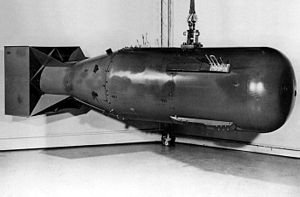
@Edano , there is a famed meeting in which der Fuehrer asked Heisenberg how big the new super weapon was going to be, and Heisenberg supposedly answered, "about the size of a pine apple, mein Fuehrer." That always sounded a little too small compared with the US versions upload.wikimedia.org . Perhaps, Heisenberg was not even close to the realization of this idea. I am just glad, he did not command the necessary ingredients (remember heavy water).
by Peter via Upload.wikimedia.org 1/25/2012 5:27:02 PM- @Peter can I borrow one of those for my health insurance company? :-)by lillymunster 1/25/2012 5:29:14 PM
- @Peter perhaps, heisenberg was not even willing to construct the hell mashine.by Edano 1/25/2012 5:32:09 PM
- @Edano , the story with Truman is, and you can find that in many accounts, that he and FDR despised each other. Truman as a career public servant and senator from a planes state who grew up on a farm detested the flamboyant New Englander from a wealthy and politically powerful family. FDR kept Truman at arm's length and did not let him in in many secrets the president was entitled to know about as Commander-in-Chief. Hence, Harry had to learn fast between April and July.by Peter 1/25/2012 5:35:41 PM
- @Edano , that is what Heisenberg wrote in his defense. Since the US forces blew his underground research installation in Bavaria up, the evidence is all gone. Who knows.by Peter 1/25/2012 5:38:16 PM
- @Peter this sounds like heisenberg was unwilling to build the bomb:
"Zu Beginn des Zweiten Weltkriegs wurden er und andere Physiker (zum Beispiel Otto Hahn und Carl Friedrich von Weizsäcker) in das Heereswaffenamt berufen. Ihre Aufgabe im Rahmen des Uranprojektes sollte sein, Einsatzmöglichkeiten der Kernspaltung zu finden. Heisenberg stieß zwar erst relativ spät zu dem Projekt, arbeitete jedoch intensiv daran und übernahm bald eine führende Rolle. Er und seine Kollegen kamen schon früh zu dem Schluss, dass die aufwändige Anreicherung des Spaltstoffes Uran 235 mit den allgemein zur Verfügung stehenden Ressourcen während der voraussichtlichen Restdauer des Krieges nicht zu machen war, und informierten dahingehend am 4. Juni 1942 Albert Speer. Allerdings verschwiegen sie (oder sprachen davon nur in Andeutungen) die Möglichkeit, eine Plutoniumbombe zu bauen, bei der die Trennung viel einfacher chemisch ablaufen konnte und für die nur ein Natururan-Reaktor mit Schwerwasser als Moderator erforderlich war (ähnlich wie zum Beispiel der heutige kanadische Candu-Reaktortyp, mit dessen Hilfe Indien in den Besitz von Kernwaffen kam). Auf die entscheidende Frage Speers, wie lange sie für eine Bombe bräuchten, gab er drei bis fünf Jahre an – womit das Projekt seine Priorität verlor."
"At the beginning of the Second World War, he and other physicists were called (for example, Otto Hahn and Carl Friedrich von Weizsäcker) in the Army Ordnance Department. Your task in the context of the uranium project should be to find possibilities of nuclear fission. Although Heisenberg came relatively late to the project, however intensively worked on it and soon took a leading role. He and his colleagues came to the conclusion early on that the elaborate enrichment of uranium-235 fission material resources with the generally available during the expected remaining duration of the war was not to make, and informed to the effect on 4 June 1942, Albert Speer. However, concealed them (or talked about only in hints) the possibility of building a plutonium bomb, in which the separation was much easier to run chemical and for only a natural uranium reactor using heavy water as moderator was required (like for example the current Canadian CANDU-type reactor, with the help of India came into the possession of nuclear weapons). On the crucial question Speers, how long they needed for a bomb, he had three to five years - by which the project lost its priority."
de.wikipedia.orgby Edano 1/25/2012 5:38:57 PM - India is producing power from solar cells more cheaply than by burning diesel, for the first time.
www.bloomberg.comby VesaVA 1/25/2012 5:41:04 PM - @Edano , one fact is that they did not possess enough schweres Wasser (D2O) to make this happen, even if they wanted to. This may have saved Heisenberg.by Peter 1/25/2012 5:42:36 PM
- @all, Isn't the proposal regarding the 3 new parks at Hanford, Oak Ridge, and Los Alamos about the control of the land and facilities. Haven't seen any plans for "parks". Anyone?by eyes 1/25/2012 5:44:43 PM
- @Peter That was the impression I had from reading things that Heisenberg was foot dragging after he saw the outcome possibility.by lillymunster 1/25/2012 5:47:28 PM
- @edano, there is a fabled incident in which Norwegian insurgents blew up a ferry in a Norway fjord on which the rail cars with the heavy water were supposedly transported. en.wikipedia.orgby Peter 1/25/2012 5:47:36 PM
- @eyes @eyes They are federal land, don't know if the park portion would change anything. I know I wouldn't want anything on the land at those 3 sites!by lillymunster 1/25/2012 5:48:15 PM
- hitler's aim was always to conquer ("Lebensraum"). an atomic bomb would be useless if you need the conquered land for settling.by Edano 1/25/2012 5:50:24 PM
- @Peter interesting story :)by Edano 1/25/2012 5:54:10 PM
- @Peter I was just going to say that about the Norwegian sabotage. It is a fact that they helped avoid the III Reich getting the bomb. That specific episode was determinant, a turning point. I remember seeing a good film (movie) about it a long time ago but I can't remember any specifics. It was in the eighties. I've seen that story told in different documentaries as well.by Pedro Jesus 1/25/2012 5:55:23 PM
- @lm, More to do with funding and regulatory oversight. @peter, Greenpeace-the prequelby eyes 1/25/2012 5:56:59 PM
- well the heavy water story sounds like an action movie, but i see no reason why the nazis should have been so dependant on a remote norwegian facility. if they really wanted they should have been able to produce it in germany.by Edano 1/25/2012 6:04:17 PM
- @edano, why only in Norway? There was a reason for this I have to research. Well, Adolf's slogan was "Volk ohne Raum", who knows where he was going to draw the line.by Peter 1/25/2012 6:08:14 PM
- One detail I do remember is that the process of separating the D2O was highly inefficient. It would have taken ages to collect the amount necessary for the bomb, and it is doubtful that those few rail cars, if they indeed had the stuff onboard, carried enough to make a serious difference.by Peter 1/25/2012 6:13:05 PM

Japan Earthquake | Page 2906
- Who's Blogging
-
 hudebnik
 alblee
 UKVal
UKVal Oliver (ScribbleLive)
 Jonathan Keebler
 kaykodh
 PKelley
 Markfm
 Angie
Angie Deb
Deb Mid Valley
- Pedro Jesus
 Matt (ScribbleLive)
 George Gibb
 elainekirk
- lillymunster
 dean
dean- bo
- Edano
 IanGoddard