Japan Earthquake | Page 2956
 good article @Ianby dean 2/7/2012 2:29:49 PM
- @lilly.. some times it's good to do a "units" review ie: when they sample for gases what are the units of measure and the same for contamination spread or levels in water... when I see the Bq/cm3 I think of contamination like taking a smear of the ground. It just looked strange to me. Still trying to find something TEPCO bases the recriticality level on with Bq/cm3by dean 2/7/2012 2:32:39 PM
 @dean the two samples taken this time one was taken out of the gas management system the other over time outside the knock out panel in 2. They didn't give details about how they collected. Water testing shows as bq/liter if that is what you were referring to? I can't remember what they consider the threshold for detection in water but we should be able to find recent water testing for around the plant if you think that would help?by lillymunster 2/7/2012 2:43:21 PM
- www.nisa.meti.go.jp I think this report is trying to establish a level of isotopes resulting from "spontaneous" fissions as opposed to those from criticality. Some fissions occur even when the reactor is subcritical .. that must be what they argueby dean 2/7/2012 2:49:08 PM
- @dean that report explains much about how they do concentration calculations. The boric acid being the "test" for criticality is interesting. I would have thought boric acid would kill off spontaneous fission also?by lillymunster 2/7/2012 3:01:31 PM
- @dean, sent you a gmail this morningby lillymunster 2/7/2012 3:01:45 PM
- will check it @lilly.. tyby dean 2/7/2012 3:05:05 PM
- @lilly.. I think the thought is the boric acid keeps the fuel "subcritical" and not capable of a sustained chain reaction.. but it does not stop the spontaneous fissionsby dean 2/7/2012 3:06:35 PM
- gmail returnby dean 2/7/2012 3:08:38 PM
- neutrons generated by the spontaneous fissions are absorbed by the boric acid... that's the theoryby dean 2/7/2012 3:09:22 PM
- time for breakfast.. be backby dean 2/7/2012 3:12:54 PM
 Reactor 2 may be over 90℃. The heat gauge is not enough, and it has error of 20℃, so they assume the temperature from the amount of smoke as well. but the gauge is actually showing over 85℃, and lot of smoke is coming up. They therefore seem to judge it’s over 95℃. fukushima-diary.comby Majj 2/7/2012 3:48:26 PM
 More Concerns Over San Onofre Safety. "Meanwhile, the Public Utilities Commission last week denied a request by Pacific Gas & Electric to bill customers $85 million for its attempt to extend the license of Diablo Canyon, California’s other active nuclear plant." www.sandiegoreader.comby Cryptococcus 2/7/2012 4:32:15 PM
- @Cryptococcus the newer tactic to force consumers to pay for everything really makes it sound like the operators can't financially run these plants. What you charge customers is supposed to cover overhead and expenses and your profit. It sounds to me like you can't deliver power at that rate your charging. We are now getting an added fee on our bills where we pay more to cover the costs of putting in a new power grid out here. I'm not happy but at least ours is charging for something people actually want.by lillymunster 2/7/2012 4:40:43 PM
- Europe is seeing iodine spikes in germany, poland, sweden, finland and Austria again. This seems like a repeat. So either they didn't fix the plant in Budapest or it wasn't the plant in Budapest.by lillymunster 2/7/2012 4:41:58 PM
- Vermont Yankee just had an unknown hazmat alert hisz.rsoe.huby lillymunster 2/7/2012 4:44:08 PM
 Florida senators rejects move to repeal 'nuclear tax Whatever the name, Florida legislators decided Monday they don't want to take it off the electricity bills of Progress Energy and Florida Power & Light customers -- even though the companies gave legislators no guarantees that they will build the nuclear plants the money is being collected to construct.
Read more here: www.bradenton.comby M.I.A. 2/7/2012 4:58:35 PM Stabilisation after Fukushima cooling change
07 February 2012
Cooling of Fukushima Daiichi unit 2 has been upset by a change in injection rates, leading to a rise in temperature that Tokyo Electric Power Company (Tepco) is working to gradually correct.
Tepco has been injecting water into the reactor since 14 March 2011, first using seawater and changing to fresh water 12 days later. Over time, the accumulated decay heat produced by the reactor core was gradually removed. By September 2011, Tepco had improved the water injection method to include core spray systems as well as feedwater injection, and temperatures fell below the landmark of 100ºC - and eventually to about 50ºC.
This stability of unit 2 was disturbed for a few days, however, when Tepco tried to improve cooling further by tuning the rates of water injection. On 2 February, feedwater injection was reduced by two cubic metres per hour and the core spray was stepped up by the same amount.
Water injection from the dark blue feedwater line was reduced, while the light blue core spray was increased by the same amount
Readings from the three sensors in the reactor vessel bottom head of Fukushima Daiichi 2 (Images: Tepco)
After making this change, Tepco noted a tendency for increasing temperature at the bottom of the reactor vessel. Within a matter of hours the company decided to reverse the change and restore the previous injection rates, but the temperature continued to slowly rise.
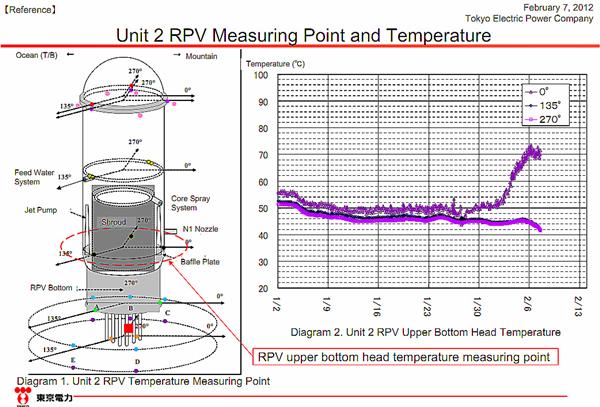
Two of the three temperature sensors at the bottom of the reactor vessel edged up by about 2ºC. The third, however, rose by around 20ºC to hit 72.2 degrees at 5.00am today. Tepco acted to stem this increase by injecting an extra cubic metre of water per hour through the feedwater line, and this stabilised the sensor at about 70ºC. It has since decreased to 68.5ºC, while the other two sensors were at a new low of around 41ºC.
Tepco was able to discount recriticality as a potential cause of the temperature rise after conducting an analysis of charcoal filters in the containment gas control system. These showed very low traces of fission products that were below the threshold that would indicate criticality. Nevertheless Tepco this morning injected boric acid into the reactor vessel as a precaution and increased the core spray injection rate by three cubic metres per hour.
The majorty of unit 2's core is thought to have melted and slumped to the bottom of the reactor vessel, but its configuration there is unknown. What Tepco's experience indicates is that one portion of the deformed core relies on a certain flow from the feedwater pipe for cooling. While the core spray complements feedwater input and was significant in the push to bring the temperature below 100ºC, the two are apparently not interchangeable for one specific area of unit 2's core. Tepco has modified injection rates at all three of the melted Fukushima Daiichi reactors several times in the past without experiencing warming effects such as this.
The current injection rates are 6.8 cubic metres per hour through the feedwater system, and 6.7 cubic metres per hour through the core spray. Tepco continues to report the status of the Fukushima Daiichi reactors every few hours, as they have done since the natural disasters of 11 March last year.' www.world-nuclear-news.orgby UKVal 2/7/2012 6:20:13 PM- The EPR nuclear reactor
A dangerous waste of time and money. February 6, 2012.
Greenpeace briefing on the EPR reactor .. (with a link this time, I hope)
(There is a link to a .pdf on that page too.)by VesaVA 2/7/2012 7:10:07 PM - here's a blast from the past. Found the old reuters live blog live.reuters.comby lillymunster 2/7/2012 7:10:37 PM
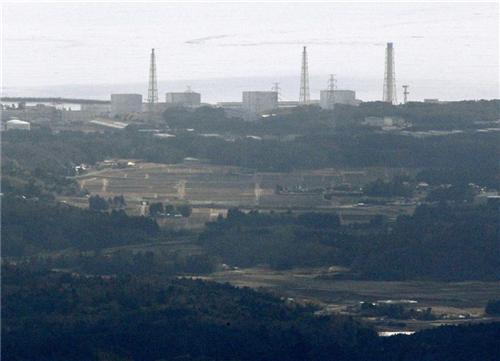
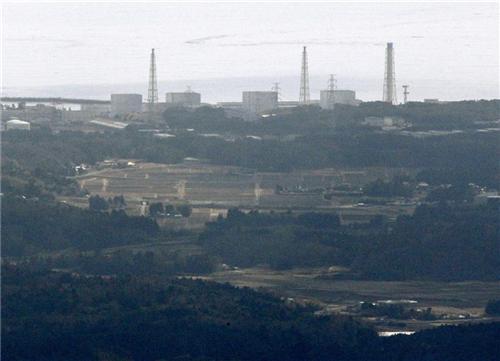
images.scribblelive.com March 12 Fukushima before the explosions started.
by lillymunster 2/7/2012 7:18:48 PM- The Reuters liveblog was the top blog at Scribble for 2011 blog.scribblelive.comby lillymunster 2/7/2012 7:20:06 PM
 number 2 temps to 5pm on 7th www.tepco.co.jpby elainekirk 2/7/2012 7:20:24 PM
- by elainekirk edited by lillymunster 2/7/2012 7:22:09 PM
- pressures higher in 2 than in 1 & 3 www.tepco.co.jpby elainekirk 2/7/2012 7:24:18 PM
- @elainekirk that graphic is interesting. If you look where the feed water sprayer is vs. the core spray that is lower and inside the shroud. The core spray seemed to be the effective method for cooling.by lillymunster 2/7/2012 7:25:08 PM
- @lillymunster have you read the World Nuclear news post below?by UKVal 2/7/2012 7:26:07 PM
- Soon You Could Detect Radiation With Your iPhone fukushima-diary.comby MaryW 2/7/2012 7:38:16 PM
- the temperature measured at the same spot on the vessel dropped to 69.0 C at 10 a.m. from 72.2 C logged at 5 a.m., Junichi Matsumoto, spokesman for plant operator Tokyo Electric Power Co. told a press conference, but added that the company needs more time to assess the effect of the latest step."It is difficult to judge whether the temperature is rising or dropping unless we monitor the development for about a day," Matsumoto said.' mdn.mainichi.jpby UKVal 2/7/2012 7:42:30 PM
- @UKVal thanks. So the "change back to original" actually didn't work and they fiddled with it until they got it working between feedwater and core.by lillymunster 2/7/2012 7:44:15 PM
- @lillymunster that about sums it up. But the point about the differences between the parts of the melted fuel reached by each system is interestingby UKVal 2/7/2012 7:46:15 PM
- ... from 0:19 am to 3:20 am on February 7 we injected boric
acid into the reactor as a safety countermeasures against the
re-criticality, and changed the amount of the core spray system
injection water from 3.7m3/h to 6.7m3/h* at 4:24 am (the amount of the
continuing feed water system injection is 6.8m3/h). Currently, the temperature is approx.69.6°C (as of 11 am on February 7). We will monitor the progress continuously.
As a result of the sampling for the Gas Control System of the Unit 2
which we conducted on February 7 to make sure there is no re-criticality state, we confirmed that the concentration of Xe-135 was below the detectible limit (1.0 x 10⁻¹ Bq/ cm3) at the system's entrance, meaning that it falls below the re-criticality criteria, or 1 Bq/cm3... www.tepco.co.jpby MaryW 2/7/2012 7:48:32 PM - @UKVal I was talking to Dean, he mentioned the large volume of water needed to cool something down.
From previous reports TEPCO had been trying to taper back water flow to slow down the amount of waste water. Obviously with unit 2 slowing down the water is a bad thing.by lillymunster 2/7/2012 7:51:51 PM - Lost pets of Fukushima
Pet rescue organizations work to save dogs and cats that were abandoned after last year's nuclear crisis from northern Japan's freezing winter weather. news.yahoo.comby MaryW 2/7/2012 8:00:20 PM - Tepco Injects Boric Acid Into Reactor as Temperatures Rise
February 07, 2012, 1:00 PM EST The temperature of the No. 2 reactor was 70.1 degrees Celsius (158 degrees Fahrenheit) as of 6 a.m. today, according to preliminary data, Akitsuka Kobayashi, a spokesman for the utility, said by phone. The reading fell from 72.2 degrees at 5 a.m. this morning, and is below the 93 degrees that’s used to define a cold shutdown, or safe state, of the reactorTepco increased the rate of cooling water being injected into the unit to 13.5 cubic meters per hour from 10.5 cubic meters per hour at 4:24 a.m. today, it said. www.businessweek.comby MaryW 2/7/2012 8:04:17 PM - greetings to every oneby dean 2/7/2012 8:06:25 PM
- @lillymunster I haven't looked at how the current water injection rate compares with earlier ones, but I'm sure they are trying to reduce the amount of leaked water they have to deal with.by UKVal 2/7/2012 8:08:09 PM
- .. it may be telling us something about the configuration of the melted fuel or the RPVby UKVal 2/7/2012 8:11:24 PM
- Cooling of Fukushima Daiichi unit 2 has been upset by a change in injection rates, leading to a rise in temperature that Tokyo Electric Power Company (Tepco) is working to gradually correct. ... This stability of unit 2 was disturbed for a few days, however, when Tepco tried to improve cooling further by tuning the rates of water injection. On 2 February, feedwater injection was reduced by two cubic metres per hour and the core spray was stepped up by the same amount. After making this change, Tepco noted a tendency for increasing temperature at the bottom of the reactor vessel. Within a matter of hours the company decided to reverse the change and restore the previous injection rates, but the temperature continued to slowly rise.... www.world-nuclear-news.orgby MaryW 2/7/2012 8:13:30 PM
- @lilly do you have a diagram of where the susposed water is injecting into the reactor... one a spray line which one would think mists the water and the other a feedwater line where it flows probably in a streamby dean 2/7/2012 8:14:21 PM
- So TEPCO messed with it and look what happen. Why the decision to decrease water rates?by MaryW 2/7/2012 8:14:31 PM
- @dean Elaine posted one down the page. Let me know if you can't see it and I can try to repost it if neededby lillymunster 2/7/2012 8:15:01 PM
- @dean there are some diagrams on the site I just postedby MaryW 2/7/2012 8:15:13 PM
- by lillymunster 2/7/2012 8:15:59 PM
- also.. 1 cubic meter of water contains about 264 gallons so is this saying the water rate is 264 gallons per hour? not much waterby dean 2/7/2012 8:16:05 PM
Japan Earthquake | Page 2956
- Who's Blogging
-
 hudebnik
 alblee
 UKVal
UKVal Oliver (ScribbleLive)
 Jonathan Keebler
 kaykodh
 PKelley
 Markfm
 Angie
Angie Deb
Deb Mid Valley
- Pedro Jesus
 Matt (ScribbleLive)
 George Gibb
- elainekirk
- lillymunster
- dean
 bo
bo Edano
Edano IanGoddard