Japan Earthquake | Page 683
 Radiation measurements taken on March 21ST. They went well into the mSv range. www.tepco.co.jpby Pedro Jesus 4/13/2011 5:36:38 PM
 @bojack I don't think they were fuel loading at time of quake (Fri afternoon). But it is slightly possible.by FradyKat 4/13/2011 5:37:21 PM
- Radiation measurements taken on March 20TH. www.tepco.co.jpby Pedro Jesus 4/13/2011 5:38:25 PM
 @Bobby1 I'm wondering venting from where then? The pressure didn't go down, it seemed to continue to climb.by radioguy 4/13/2011 5:38:53 PM
 Just a couple days ago they acknowledged that #1 was outputting radioactive steam plus nitrogen. That's why there's not been further drywell pressure increase -- it wouldn't hold above the 190 - 195 kPa range (I think of it as a leaky gasket, don't know what it really is).by Markfm 4/13/2011 5:39:02 PM
 @Markfm also was a significant rise in rad readings at 06:00Am on 07aApr in the suppresion pool, from 8.0Sv/h to 12.9Sv/h, a 61% increase. Most likely due to the EQby marie rich 4/13/2011 5:40:22 PM
- @bojack54 They were up to something with R4 SFP, but unsure what. They outloaded all the fuel for shroud repair, and there would have been the old load, but that total leaves about 200 assemblies in the SFP that are of uncertain origin or eventual disposition.by radioguy 4/13/2011 5:40:26 PM
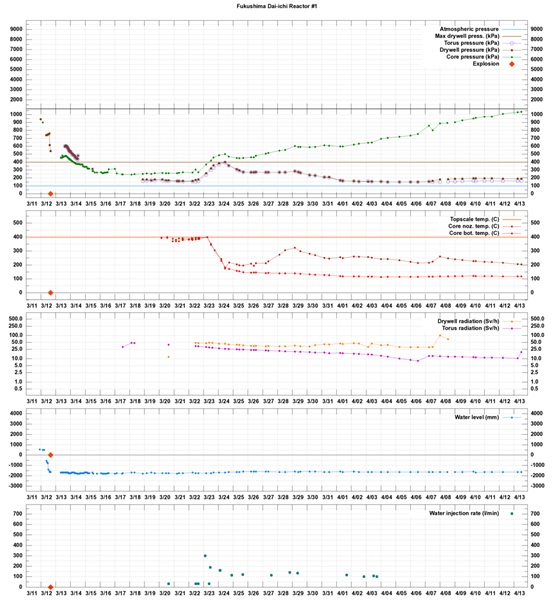
look on torus radiation: www.ic.unicamp.br
by xxx via Ic.unicamp.br 4/13/2011 5:41:45 PM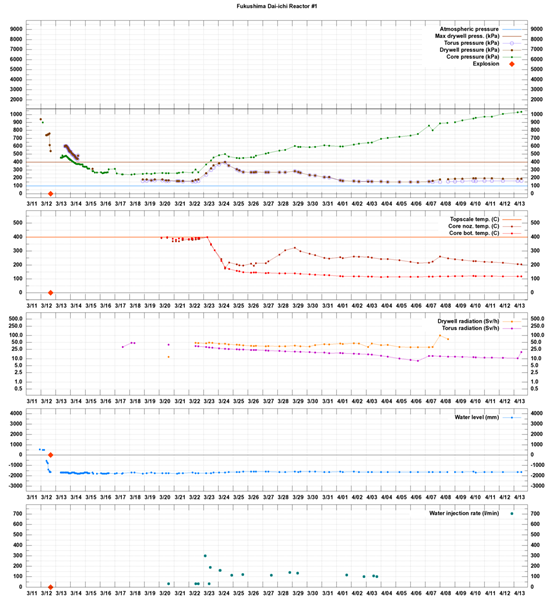
look on torus radiation: www.ic.unicamp.br
by xxx via Ic.unicamp.br 4/13/2011 5:41:52 PM- @xxx Yep, noticed that, too.by marie rich 4/13/2011 5:42:59 PM
- Here's an odd thing... unit 2 rad and press. readings show slow steady decline. But the nozzle temp has been rising for the last couple of days; 141C to 170Cby marie rich 4/13/2011 5:44:18 PM
- leaking ?by Kristian 4/13/2011 5:45:33 PM
- At least the core bottom (head) temp. reading is back- tthat's been missing since 30Mar. Hope that means theyby marie rich 4/13/2011 5:45:42 PM
- re fixing instrumentationby marie rich 4/13/2011 5:45:56 PM
 March 21 is when unit 3 drywell dropped 170 kPa pressure between 4 and noon.by markfm 4/13/2011 5:47:06 PM
- Question for any meteorologists & radiation experts here: Does the plant being on the coast pose any extra contamination potential for the local(ish) area?
In this instance, I was thinking maybe North-Easterly winds could form clouds as cool air hits the (warmer?) coast, rises quickly & presumably lifts up more contaminated material in the process, then subsequently drops it downwind as rainfall (i.e., in the example, over Tokyo etc.)
I guess the real question is whether inland plants are inherently safer than coastal ones in this respect (or vice versa!?), leaving aside Tsunamis for a moment.
Just curious btw! :)by Paul 4/13/2011 5:48:47 PM - No torus (or drywell for that matter) radiation reports from any of the 3 units on 21 March. All reports were 99999 for those parameters.by markfm 4/13/2011 5:49:52 PM
 @Paul Seabreezes along the coast cause temperature inversions, where contaminants are trapped in a low layer of the atmosphere. But inland, there might be issues with topography, so I can't say if it's worse or not.by Bobby1 4/13/2011 5:51:04 PM
- Nuc plants need massive amounts of water, that's a huge driver on siting. Think coastal, Great Lakes, or big rivers.by markfm 4/13/2011 5:51:19 PM
- @markfm here's the 'smoking gun' of the event on the 20th. If I were a lawyer for locals, I'd start here with negligence. At approximately 6:15AM on March 17th the pressure of the Suppression
Chamber has temporarily increased. We were preparing to implement a
measurement to reduce the pressure of the reactor containment vessel
(partial discharge of air containing radioactive material to outside)
in order to fully secure safety. However, at present, it is not a
situation to take a measure immediately to discharge air containing
radioactive material to outside now. We will continue to monitor the
status of the pressure of the reactor containment vessel.by marie rich 4/13/2011 5:56:31 PM - I'm still wondering how far they can afford to let number 1 RPV build pressure. Experience with the drywell leaking at < 200 kPa should be a huge red flag that things likely have significant structural degradation (undoubtedly part of why NISA ordered the earthquake resistance inspections).by markfm 4/13/2011 6:02:03 PM
- @Bobby1 Thanks. Yes, can understand it's all a complex model, with many varying factors. What started me thinking was that the clouds here in the UK often form on the coast then drop their load on us, only 10s of miles downwind. Now I'll be watching the Japan radar very closely too!by Paul 4/13/2011 6:02:57 PM
- Slight change, now it's late Sat to early Tues where the winds look unfavorable. www.tide-forecast.comby markfm 4/13/2011 6:04:33 PM
 @xxx: Where does the data come from ?
Last METI update say #1 torus radiation is 10.3 Sv/h 04/13 13:00 ... www.meti.go.jp
Can't see more recent data from METI or NISA since then. Did I miss them ?by Jocelyn Mayer 4/13/2011 6:06:21 PM- @Marie, the reason rad level in #2 are dropping is because it is being "flushed" out. All that water is leaking through the reactor vessel breaches and out into the environment. That's why the water levels don't ever get filled up, they are always in neg status.by wtm 4/13/2011 6:13:07 PM
- @Jocelyn Mayer latest plant parameters that I could find www.jaif.or.jpby marie rich 4/13/2011 6:14:51 PM
- @wtm ok. But why then is nozzle temp going up last couple of days?by marie rich 4/13/2011 6:15:23 PM
- That's whats nagging at me. less rad and more cooling should mean temp decrease, I thought. Jo? any ideas?by marie rich 4/13/2011 6:16:49 PM
- xxx is showing the graphs from the Brazil university. Last data they have is the 13 April 12 noon set. Status report 91 (N91) is the source. I expect a data error, it should be 1030 centisieverts/hr, not 1930 centisieverts/hr. (the meti 12:00 data in the sticky says 10.3 Sv/hr)by markfm 4/13/2011 6:19:43 PM
- @Marie, you still have a meltdown reaction going on in the RPV, the melted corium is still dripping into the PV and drywell areas. Your seeing the rad levels in the PV and drywell going down as the water from above (RPV breach) flushes it out of the reactor to someplace else outside ? But still have those rods in the RPV out of water (notice neg water level) which means they are still probably melting (hence high temps)by wtm 4/13/2011 6:21:50 PM
 @marie rich -not really, higher pressure differential from the RPV to taurus would increase velocity for the coolant, that results in less heat transfer or contact time with the coolant, the readings make sense to me. It still is a closed loop so until they can eject the heat to the secondary cooling system the net effect is a gain of heat.by Lethbridgean 4/13/2011 6:23:01 PM
- @Leth, Marie, the rad levels you are seeing are only for the Drywell (D/W) and the PV (S/C), they are not for the RPV (internal reactor vessel). The temp nozzle is in the RPV. You still have ameltdown going on in the RPV.by wtm 4/13/2011 6:25:12 PM
- @wtm but...just in last two days? The other thing that doesn't add up for me is the wide divergence in the rpv and s/c press. readings. An example of 'normal cold shut down' in Daini form meti: (2) Major plant parameters (As of 06:00 March 30th)
Unit Unit 1 Unit 2 Unit 3 Unit 4
Reactor
Pressure*1 MPa 0.15 0.13 0.10 0.14
Reactor water
temperature ℃ 27.0 27.6 35.0 27.5
Reactor water
level*2 mm 9,296 10,296 7,828 7,921
Suppression
pool water
temperature
℃ 24 25 27 27
Suppression
pool pressure
kPa
(abs) 106 106 103 102
Remarks cold
shutdown
cold
shutdown
cold
shutdown
cold
shutdown
*1: Converted from reading value to absolute pressure
*2: Distance from the top of fuel
(3) Report concerning other incidents
・TEPCO reported to NISA the event in accordance with the Article 10 of
the Act on Special Measures Concerningby marie rich 4/13/2011 6:25:48 PM  There's a relationship between pressure and temperature. (scratch head) can't remember exactly how to apply the formula. Ask Jo Lindien later when he's on? He seems to have a good grasp of that aspect.by Sky 4/13/2011 6:27:14 PM
- Compare the way rpv press and s/c press 'track' together in normal and then look at the huge diff. in #1. Seems like it should mean something, tho not sure whatby marie rich 4/13/2011 6:27:35 PM
- @wtm - yes, so what then. what is your point. The rad levels are the most inaccurate way to look at the operational parameters of the reactorby Lethbridgean 4/13/2011 6:27:50 PM
- Any way...just sayin'by marie rich 4/13/2011 6:28:34 PM
- @marie, 2 things that could be causing that, one, corium melt is cooling in and area and clogging the hole that it breached through, two, the massive amount of salt inside the unit now, we don't know how that is going to effect anything in there ?by wtm 4/13/2011 6:29:09 PM
 WASHINGTON (MarketWatch) -- The Japanese earthquake may be having more of an impact on the U.S. economy than previously believed, according to the Federal Reserve's latest Beige Book survey of current economic conditions released on Wednesday. A majority of the Fed's 12 regional districts reported "actual or expected disruptions to sales and production" as a result of the Japan earthquake. Overall, the Beige Book found that activity generally continued to improve since early March although some districts reported only moderate gains while others were more upbeat. The report found that more businesses were trying to pass along higher costs to consumers but were having mixed success. www.marketwatch.comby Sinthia Domina 4/13/2011 6:30:57 PM
- @marie rich - they are not operating this as per normal operations. 1 flow restrictor, ie valve, can explain this. so could the corium that wtm just stated.by Lethbridgean 4/13/2011 6:31:04 PM
- I just look for percieved (by me) anamolies, then let finer minds try to explain, or explain it away. :)by marie rich 4/13/2011 6:32:14 PM
- Japan Denies Withholding Evidence of Massive Radiation Release
Wednesday, April 13, 2011 www.globalsecuritynewswire.orgby Sinthia Domina 4/13/2011 6:33:11 PM - @Leth, I am just saying that we know that there are breaches on #2 & 3. The rad levels have bee3n slowly coming down in the PV and Drywell areas. We know that they can't seem to fill the RPV up in both, they continue to stay neg readings. We know they have massive amounts of water leaking out of the plant they can't figure where it came from, with lots of radioactivity in it. Possible conclusion, the PV and Drywells are being flushed out of both units through a crack in the concrete drywell area.by wtm 4/13/2011 6:33:19 PM
- But for #1, I think that there may be another factor in the mix we've identified. Wondering if a LOCA steam condensation phenomena could explain variance in rpv, s/c press. ....by marie rich 4/13/2011 6:35:06 PM
- Highly radioactive “lake” has built up in the depths of Fukushima enenews.comby ch 4/13/2011 6:35:46 PM

Japan Earthquake | Page 683
- Who's Blogging
-
 hudebnik
 alblee
 UKVal
UKVal Oliver (ScribbleLive)
 Jonathan Keebler
 kaykodh
 PKelley
 Markfm
 Angie
Angie Deb
Deb Mid Valley
- Pedro Jesus
 Matt (ScribbleLive)
 George Gibb
 elainekirk
 lillymunster
 dean
dean bo
bo Edano
Edano IanGoddard