Japan Earthquake | Page 862
 i love arnie's wig ! :Oby Edano 4/27/2011 11:15:32 AM
 S.&P. Downgrades Japan's Outlook to Negative
"Nearly seven weeks after a powerful earthquake and tsunami hit northeastern Japan, the Japanese economy is still struggling to return to normal, and the country faces reconstruction costs that could severely strain its already stretched public finances.
The latest warning about the country’s fiscal health came on Wednesday, when Standard & Poor’s lowered its outlook on Japan to negative, saying that the massive costs of rebuilding the devastated areas — which it estimated as high as ¥50 trillion, or $612.6 billion — could lead to a lower credit rating unless the government steps up its efforts to keep high government debt levels from rising much further.
The ratings agency kept its long-term rating for the Japanese economy, which it had downgraded in January, unchanged at AA-. But its now negative outlook highlighted the huge uncertainty that overshadows the country’s recovery from the March 11 disaster.
Nearly 26,000 people are missing or have died, tens of thousands of buildings were flattened and hundreds of thousands of cars destroyed. The flow of components and spare parts needed by manufacturers was thrown into disarray, and damage to the Fukushima Daiichi nuclear power station severely disrupted power supplies in key parts of the country."
www.nytimes.comby Reed 4/27/2011 11:27:48 AM- Report Urges Storing Spent Nuclear Fuel, Not Reprocessing It
"In a study to be released on Tuesday, engineers and scientists at the Massachusetts Institute of Technology therefore suggest that “the entire spent-fuel management system — on-site storage, consolidated long-term storage, geological disposal — is likely to be re-evaluated in a new light because of the Fukushima storage-pool experience.”
The accident in Japan has already generated calls for sending the fuel to factories where it would be mechanically chopped up and chemically dissolved to recover the plutonium that is made in routine reactor operations, as it frequently is in Europe and Japan. The plutonium could then be used as a substitute for uranium fuel at nuclear plants.
But in the M.I.T. report, experts argue that there is no reason to find a substitute for uranium because the existing global supply is plentiful. In fact, there is enough uranium available to fuel 10 times as many reactors as exist today, even if each of the new ones ran for 100 years, the study says. "
www.nytimes.comby Reed 4/27/2011 11:32:18 AM - After Quake in Japan, Toyota Slowly Regains Its Footing
"Still, Japan’s auto industry can go only so far toward meeting local demand while trying not to neglect its global customers. Toyota’s plants in Japan are now working at only 50 percent of normal production levels, and Honda’s factories are at similar levels. Nissan’s plants are producing at only 40 percent.
“Much of what we can produce, we are sending into the afflicted areas,” Shiro Nagai, a Nissan spokesman in Yokohama, said. “At the same time, we are trying to revive operations up and down the supply chain, from suppliers to dealers.”
Last week Toyota said it did not expect to return to normal production volumes before the end of the year. And on Tuesday, in a conference call with reporters, a Toyota executive said the company had only about two-and-a-half months’ worth of finished vehicles in its global inventory and remained hampered by a shortage of about 150 critical parts.
The “most critical” shortages include microprocessing units for computerized car controls, rubber items and paint additives."by Reed 4/27/2011 11:40:37 AM  I am skeptical about the fairewinds guy on the fact that he made his video on #3 now, with information that has been available all along.
Nothing wrong about having a scientific opinion, he is suggesting what was discussed here a few days ago about the SPF in #3. In one of his earlier videos he stated "I don't think tepco is lying, they are just not telling us everything they know" but the same applies to you Mr. Gundersen. I have to be skeptical about someone who seeks such tremendous publicity while the events are still unfolding, and I am talking about his appearances all over the media.by talisker 4/27/2011 11:40:38 AM- Fukushima Operator Starts Test-Drowning Damaged Reactor
"Tokyo Electric Power Company has increased the flow of water into the containment vessel of the damaged No.1 reactor to test whether the construction can withstand increased weight and to check for possible leaks.
If the test is successful, TEPCO will go on with its plan to drown fuel rods at the No.1 and No.3 reactors to make them cool down in a controlled manner, reports NHT TV channel. The current schedule would see the operation completed by July.
As more water is being pumped in, experts monitor temperature, pressure and radiation levels in the containment vessels via remotely operated robots.
The reactor is already partially drowned with water about six meters deep. Once TEPCO’s plan is fulfilled, the water will be 18.8 meters high and will completely cover the fuel rods. The operation was conceived specifically for the Fukushima disaster and had never been tried before, reports Itar-Tass news agency.
Fukushima-1 nuclear power plant was badly damaged due to the powerful earthquake and resulting tsunami which hit Japan in March. Two of its reactors, which were loaded with fuel at the time of disaster, went into partial meltdown.
The event is considered one of the worst-ever nuclear incidents, sparking public fears over the risks of nuclear energy throughout the world."
rt.comby Reed 4/27/2011 11:46:54 AM - Tokyo Increases Role in Crisis
Utility Cuts Executives' Pay as Government Says It Will Guide Plant's Recovery
"TOKYO—The Japanese government will shoulder much of the responsibility for a nine-month plan to bring the heavily damaged Fukushima Daiichi nuclear plant firmly under control, a top adviser to Japan's prime minister said Monday, as he added to criticism of the plant's embattled operator.
Amid such criticism, plant operator Tokyo Electric Power Co. pledged to cut the remuneration of its senior executives by half as it deals with the financial impact of the crisis, while its general staff would see 20% cuts in pay."
online.wsj.comby Reed 4/27/2011 11:51:38 AM - i am more skeptical of the goverments and tepco, wonder how many nano particals have found a home.by e123 4/27/2011 11:53:44 AM
- Radioactive material 'down to 1/100
"The amount of radioactive material emitted from the Fukushima No. 1 nuclear power plant has decreased to about one-hundredth of the level recorded earlier this month, the Cabinet Office's Nuclear Safety Commission has said.
The commission also said Monday the concentration of iodine-131 in seawater sampled near the plant had dropped to below the government-set limit for the first time since surveys started on March 21. However, the panel said high amounts of radioactive material were still being emitted by the plant run by Tokyo Electric Power Co., at about 10 billion becquerels per hour.
"We shouldn't take the figures for granted. We must continue to carefully observe the situation," a commission spokesperson said.
The commission calculates the volume of radioactive material discharged based on radiation measurements taken at several places around the plant. Radioactive emissions on April 5 were estimated at 1 trillion becquerels per hour.
"Radiation dosages around the plant are on a downward trend. Emissions of radioactive material have diminished to about one-hundredth [of levels earlier this month]," the commission told reporters Monday."
www.yomiuri.co.jpby Reed 4/27/2011 12:04:55 PM - TEPCO boss wanted use of SDF plane / Minister nixed March 11 plan to rush to HQ
"Tokyo Electric Power Co. President Masataka Shimizu tried to fly to Tokyo from Aichi Prefecture on an Air Self-Defense Force airplane on March 11 after the massive earthquake that struck that day, but his permission to use the aircraft was revoked shortly after it took off, it has been learned.
About 20 minutes after takeoff, the ASDF C-130 Hercules transport plane carrying Shimizu was ordered by Defense Minister Toshimi Kitazawa to change course and return to Komaki Air Base in the prefecture.
Shimizu's attempt to rush to TEPCO's Tokyo head office on the ASDF plane to help manage the response to the disaster had been authorized by the Cabinet's emergency response team, government sources said Tuesday.
The defense minister had not been informed of the plan, ministry officials admitted.
When Kitazawa learned of the plan, he said the aircraft should be kept available to use for disaster-relief efforts, and immediately revoked permission for Shimizu to use the plane, the sources said.
However, Kitazawa's order did not reach officers at Komaki Air Base until more than 10 minutes after the plane took off, according to the sources."
www.yomiuri.co.jpby Reed 4/27/2011 12:08:11 PM  @Reed do you know how to convert that into teraberquels?by Nancy 4/27/2011 12:14:41 PM
- @Edano I think Arnie uses the same wig shop as Donald Trump.by Nancy 4/27/2011 12:16:55 PM
- Edano are you still here?by Nancy 4/27/2011 12:18:33 PM
 @Reed , flawed MIT logic. Reprocessing was deemed necessary to reduce the waste that needs to go into end storage. Plutonium is supposed to be used as fuel not because of a shortage of uranium, but because of an abundance of plutonium. The MIT proposal is going to increase the volume of waste that needs to be stored and safe-guarded.by Peter Melzer 4/27/2011 12:32:38 PM
- The risk that the spent fuel pools could go into a chain reaction is low, as long as temperature indicators are accurate. But some more of the contaminated runoff may have to be dumped into the sea, if workers run out of space to store the water.
There is also a small risk of a corium steam explosion, particularly in the No.1 reactor, which is the plant's oldest and which is believed to have a weak spot.
If workers are unable to continue hosing operations, and if the nuclear fuel manages to melt through the bottom of the reactor and fall into a water pool below, this would result in a burst of high temperature and a sudden release of a huge amount of hydrogen explosion that could breach the containment vessel.
Should either worst-case scenario happen, high levels of radiation up to 20 km (12 miles) around the site could be dispersed, making it impossible to bring the reactors to a cold shutdown without great sacrifice.
www.reuters.comby Scilla 4/27/2011 12:46:02 PM  "Much higher readings in parts of Tokyo vs a few days ago" "Radiation in the #1 building is at highest levels since the crisis" falloutphilippines.blogspot.comby Bobby1 4/27/2011 12:53:14 PM
- @Nancy I believe that 10 billion Bq/hr = .01 Tera Bq/hr
@Peter Melzer I thought that reprosessing created a higher volume of waste due to having to store all of the liquid chemicals necessary to divide the solids.by Reed 4/27/2011 12:57:19 PM 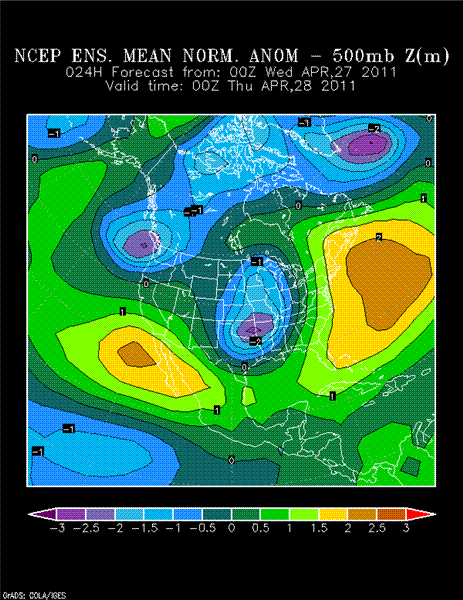
RADnet confirms high readings in Texas-Oklahoma-Arkansas area (for stations still working) www.esrl.noaa.gov
by Bobby1 via Esrl.noaa.gov 4/27/2011 1:08:52 PM- Japanese Retail Sales Slump Most in 13 Years After Quake, Nuclear Crisis
"Today’s report provides the first official retail-sales figures to reflect the impact of the quake last month.
Confidence among both merchants and households fell the most on record last month, a sign consumers may continue to cut back in the months ahead.
Meantime, Toyota Motor Corp. led a record drop in auto sales in March and domestic output plunged 63 percent after disruptions in its supply chains and factory closures."
www.bloomberg.comby Reed 4/27/2011 1:20:13 PM 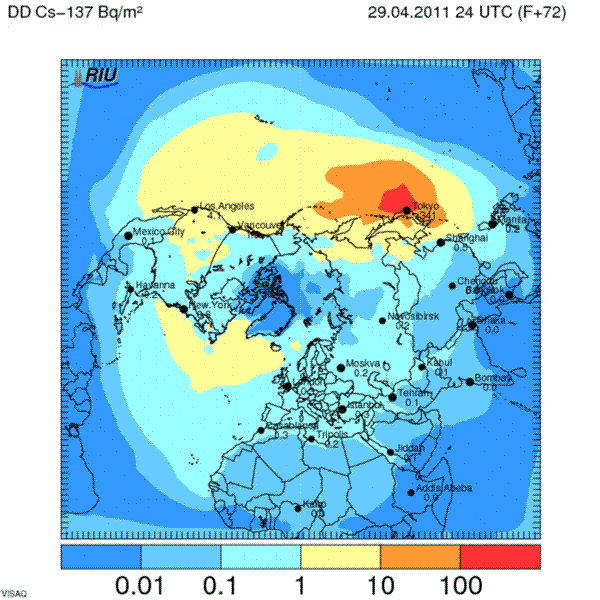
Dry deposition of Cesium-137. Grain belts of US and Canada starting to pile up, eastern Newfoundland, Iceland getting in on it. db.eurad.uni-koeln.de
by Bobby1 via Db.eurad.uni-koeln.de 4/27/2011 1:27:44 PM- Radiation Readings in Fukushima Reactor Rise to Highest Since Crisis Began
"Radiation readings at Japan’s Fukushima Dai-Ichi station rose to the highest since an earthquake and tsunami knocked out cooling systems, impeding efforts to contain the worst nuclear crisis since Chernobyl.
Two robots sent into the reactor No. 1 building at the plant yesterday took readings as high as 1,120 millisierverts of radiation per hour, Junichi Matsumoto, a general manager at Tokyo Electric Power Co., said today. That’s more than four times the annual dose permitted to nuclear workers at the stricken plant."
www.bloomberg.comby Reed 4/27/2011 1:42:29 PM - @Reed , I guess that is why Sellafield and Le Hague are on the sea.by Peter Melzer 4/27/2011 1:45:56 PM
- @Peter Melzer When will Man learn that the ocean is not a toilet for anything with a half-life longer than his own lifespan ? And speaking of the oceans, Greenpeace's Rainbow Warrior arrives today to start its analysis of the radionuclides. We may finally see more than I and Cs.by Reed 4/27/2011 1:53:55 PM
- @all. I have some inside info from a Japanese reporter that they shared with me. They state they talked to an industrial electrician and a govt. official in the industry. Below is what they shared:
Some updated information about the plant.(updated 26th April Japan Local time)
Source of the imformation below is electricity mechanic who has been
working in the plant, and Government Official realated to nuclear
development.
<<<< 1 >>>>
One of the electricity mechanic told me that it is almost impossible
to recover the original power bord in plant2. Half of the circuit
breaker is under water, and the water it self is highly contaminated.
<<<< 2 >>>>
For plant1, it has been decided that they are going to use air-cooling
heat exchange system, instead of water-cooling system.(Government
official)They say that they will have it ready by next month, and
begin cooling the plant as soon as it arrives.
<<<< 3>>>>
For plant4, though there is no nuclear fuel rod inside the plant,
there are used ones gathered in pool to be cooled douwn.
The problem is that the main frame of the building that sustains the
pool is badly damaged by fire, and if next quake strikes the plant,
they are not sure if it could hold.
To solve this problem,Tokyo Electric Company is planning to build an
iron frame column from the bottom of the pool to prevent it from
breaking up. They say that this could be done by the end of June.
Hope that no quake will strike until then....by Nancy 4/27/2011 1:54:34 PM - Trace sr-89 milk Hilo. blogs.forbes.comby Scilla 4/27/2011 1:56:47 PM
- @Reed, on a serious note, I believe the knell of death to the nuclear industry will be that nobody will be able to resolve the fuel cycle in a sustainable fashion. If the spent fuel is not reprocessed, the radionuclides with hundreds of thousands of years half life will be part of that waste in the dry casks forever. These casks may fix the current problems with overcrowding the SFPs, but do not constitute a long-term solution. The so much touted safer reactor designs do not address this question at all.by Peter Melzer 4/27/2011 2:00:50 PM
 @Nancy Anyone who wants to get information of out Japan is going to want to be Nancy's friend now. Go Fuku Nancy :)by Debra Beckham 4/27/2011 2:04:43 PM
- @Scilla That is the first strontium result published since March 18. A cursory look at gross beta radiation from Radnet suggests that it is a much bigger problem.by Bobby1 4/27/2011 2:06:34 PM
- Radioactive material 'down to 1/100 from www.yomiuri.co.jp and now "Radiation Readings in Fukushima Reactor Rise to Highest Since Crisis Began" from bloomberg.com below. Talk about inconsistency in reporting. IF radioactivity is highest in the reactor buildings how can radioactive material being emitted decrease?by Optim 4/27/2011 2:08:11 PM
- @Peter Melzer I think you're correct. I read here that the global renewable energy output surpassed the nuclear energy output for the first time this year. I hope that that trend continues until all waste is safely stored and no more is generated.by Reed 4/27/2011 2:09:08 PM
- @nancy very interesting... did he have any suggestions on getting stuff translated... also as everyone looks at drawings and controls... a vavle with a little box and a hash line feeding off the top of the valve box will (probably) be a solonid valve that would run automatic controled by remote or sensers.. except in some of the info below does not sound like they have any electric to the solonid component.... the same would be true with instrumentation.... can not read the japanese print... some of it could be compress air not electric, but the air system is probably not operational either... good moring all glad to see yaby fitter 4/27/2011 2:11:40 PM
- Does stronium 89 act in the same ways and with the same bad outcomes as stronium 90?by Nancy 4/27/2011 2:12:47 PM
- @Nancy Strontium-89 has a half-life of 50 days vs Sr-90's 29 years, but it has the same effects. It's just that there is way more of 89. Sr-90 is a long-term problem, when it decays it puts out this phenomenal burst of radiation for a few days.by Bobby1 4/27/2011 2:15:49 PM
- @fitter I am still working on trying to get a source to translate things. The report that #2 is likely not getting additional electricity working probably ever is of note. I didn't put much stock in TEPCO's claims that they could get back into the reactors and get core systems running again. What wasn't ruined by the earthquake has by now been ruined by the radioactive salt water. I noticed the news reports have removed #2 from their "fill them up" plan. I guess the fact that it is leaking like a screen door ruined that. So what will they do with #2? They seem to have no game plan.by Nancy 4/27/2011 2:16:39 PM
- @Optim. I wonder if the rubble that has been hauled to other site areas is possibly not being counted now. They hauled the 900 mSV cement block somewhere.by Scilla 4/27/2011 2:17:15 PM
- @Nancy Did you see the Tera Bq/hr conversion that you wanted ?
@Optim The level escaping the plant is supposedly down, but they're discovering higher and higher levels as they explore the interiors of the reactors.by Reed 4/27/2011 2:17:33 PM - Probably the one thing I have gotten out of the past couple of days of reading news reports, info out of TEPCO and other sources is that there is no plan B.
What if there is another quake? Are all these minor quakes weakening things? We never hear.
What if #1 ruptures when they fill it with water? What kind of releases are we talking about? Will it prevent humans from being in the area? How are they going to deal with #2, it is leaking water in a large way. What about #4? If they can't put supports under the SFP what will they do if it collapses? Some of these potentials sound pretty catastrophic.by Nancy 4/27/2011 2:20:06 PM  @Nancy That's the major difference much shorter half-life. Chemically no diff, of course.by Jim Carver 4/27/2011 2:21:48 PM
- @Scilla They hauled lots of debris away before they did their radiation map of the plant. Coincidence?
@Reed, yes that helps. I was trying to wrap my head around the new number. All agencies need to stop using interchangable measuring expressions. Citing it in tera bq would have made it relatible to previous reports.by Nancy 4/27/2011 2:21:56 PM - Is the rubble counted? :
The commission calculates the volume of radioactive material discharged based on radiation measurements taken at several places around the plant. Radioactive emissions on April 5 were estimated at 1 trillion becquerels per hour.
"Radiation dosages around the plant are on a downward trend. Emissions of radioactive material have diminished to about one-hundredth [of levels earlier this month]," the commission told reporters Monday.
www.yomiuri.co.jp
(Apr. 27, 2011)by Scilla 4/27/2011 2:22:29 PM - Strontium travels at a higher altitude than cesium, so less of it will be deposited in the ocean on its way across the Pacific. The ratio of strontium to cesium will be higher in the US than in Japan. It is likely to be just as bad on the US east coast as the west coast.by Bobby1 4/27/2011 2:24:12 PM
- Somebody took down Dean's pin for the decay calculator :(by Jim Carver 4/27/2011 2:25:10 PM
- @Nancy. The what-ifs sound so bad. I keep wondering what are the odds that none of them happen.by Scilla 4/27/2011 2:26:12 PM
 - We have been confirming the exposure dose of each worker during the
emergency work at Fukushima Daiichi Nuclear Power Station. On April
27th,2011, we have confirmed that the effective exposure dose from
January 1st, 2011 to March (Fourth quarter of the 2010 fiscal year) of a
female employee who has been in the restoration work after the
Tohoku-Chihou-Taiheiyou-Oki Earthquake is 17.55 mSv, which is an excess
of statutory dose limits (5 mSv / 3 months). With regard to the female
employee, we have confirmed that there is no impact on her health
according to medical diagnosis www.tepco.co.jp Another "no harm to human health"...by marie rich 4/27/2011 2:27:20 PM- Thou shalt not create any radioactive isotopes with a half-life longer than thine.by Scilla 4/27/2011 2:30:35 PM
Japan Earthquake | Page 862
- Who's Blogging
-
 hudebnik
 alblee
 UKVal
UKVal Oliver (ScribbleLive)
 Jonathan Keebler
 kaykodh
 PKelley
 Markfm
 Angie
Angie Deb
Deb Mid Valley
- Pedro Jesus
 Matt (ScribbleLive)
 George Gibb
 elainekirk
 lillymunster
 dean
dean bo
bo Edano
Edano IanGoddard