Japan Earthquake | Page 926
 agreed.by marie rich 5/1/2011 4:56:24 PM
 @marie rich That works! We should have the flexiblity to add new information like a local area "what to do". It will have normal web pages and also blog features.by Nancy 5/1/2011 4:56:37 PM
 @Nancy www.nature.com check out the timeline format on this site, I think you'll like it. might want to use something similar on website you and radioguy are developing.by Tenzing 5/1/2011 4:57:35 PM
- Yes, once we have the main ideas, we can segue. Washington state, Calif., etc.by marie rich 5/1/2011 4:57:48 PM
- And links are good and necessary, but the more, condensed info we can actually put on the page, the better, IMO. The way we do news articles with a bulllet statement, at least.by marie rich 5/1/2011 5:00:02 PM
- @Tenzing been meaning to do something like that but haven't had time. Makes understanding events easier.by Nancy 5/1/2011 5:00:15 PM
- @marie rich Yes. we can have in depth information where needed and also short basic information or "news" type info as things happen but all those then remain part of the siteby Nancy 5/1/2011 5:01:08 PM
- @Nancy if you have a minute: use the filpbook and look at the photo April 01 2011 of R3 building have we seen this photo?by Tenzing 5/1/2011 5:01:13 PM
- @Tenzing Yes. They just cut all the extra stuff out of the image. It is from when the fire dept was there spraying #3 with a fire truck.by Nancy 5/1/2011 5:02:31 PM

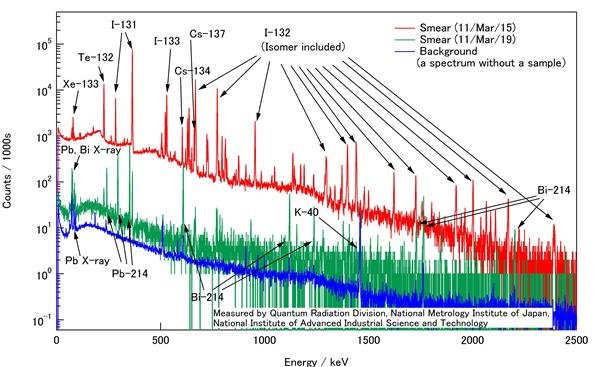
something about isotopes, energy and radiation .... www.aist.go.jp
by Edano via Aist.go.jp 5/1/2011 5:08:24 PM- While appreciating the steps that TEPCO has taken since the April 4th NISA reprimand, we recommend further rigor in isotopic measurement protocol and timely reporting of results. Otherwise, public trust in the important measurements that TEPCO is making will further erode. We therefore recommend that TEPCO take the following steps:
1) Release full spectra data (not just a number)
2) Release the time/date sample was taken
3) Release the time/date sample was measured including counting time and dead time
4) Repeat measurements at different times of the day
5) Please measure other isotopes of interest (such as Te-129, which was retracted by TEPCO on April 20th as well), even if they are below the detection limit
6) If retractions are necessary due to an honest mistake, please provide full explanation of the mistake 7) If third-party, independent analyses are done, please state the name of the analyst/lab that has cross-checked TEPCO's interpretation of the results
TEPCO/NISA and the Japanese government have a monumental task ahead of them and important decisions will be based on measurement results. Therefore, it is important that rigorous protocol be followed both in analysis and in communicating the results. F. Dalnoki-Veress admin.japanfocus.orgby Tenzing 5/1/2011 5:10:13 PM  Elaine ever get into the system?by Jim Carver 5/1/2011 5:10:26 PM
- by Tenzing 5/1/2011 5:11:17 PM
- @Tenzing what all of this has taught me, we need international standards on how rad data is reported. Each type of reading needs to be in the same expression ie: milk needs to be in bq/liter by anyone reporting it. People can't understand when the same concept is tossed at them in rads curies and berequels interchangebly.by Nancy 5/1/2011 5:13:38 PM
- Dying for TEPCO? Fukushima’s Nuclear Contract Workers Paul Jobin
While the Tokyo Electric Power Company (TEPCO) experiences difficulties in recruiting workers willing to go to Fukushima to clean up the damaged reactors, the WHO is planning to conduct an epidemiological survey on the catastrophe. This is the first of two reports by Paul Jobin offering a worker-centered analysis of the Fukushima nuclear disaster. japanfocus.orgby Tenzing 5/1/2011 5:14:17 PM - @Nancy I agreeby Tenzing 5/1/2011 5:14:50 PM
- @Nancy : and soil in Bq/m² and not in Bq/m³ !by Edano 5/1/2011 5:16:38 PM
- What really drives me nuts is when they change from giving it as a
volume i.e. Bq/cm3 to a surface area like Bq/m2by Jim Carver 5/1/2011 5:18:27 PM - <iframe frameborder="0" width="480" height="270" src="http://www.dailymotion.com/embed/video/xhphl5?theme=none&wmode=transparent"></iframe><br />原発解体(1) by LunaticEclipse-Nuclearby Tenzing 5/1/2011 5:18:28 PM
- @Edano and I were thinking alike.by Jim Carver 5/1/2011 5:21:25 PM
- @Jim Carver ;)by Edano 5/1/2011 5:22:10 PM
 @Jim Carver, this difference in units is procedural, I think: surfaces are swiped, gases are sampled by volume.by Peter Melzer 5/1/2011 5:22:21 PM
- @Peter Melzer Solid materials are given in volume also.by Jim Carver 5/1/2011 5:23:22 PM
- Well it makes sense either way but you can't corelate the two.by Jim Carver 5/1/2011 5:25:16 PM
 No it is not , data gathering methods may be different, but conclusions can be expressed in common terms.by Ralph Unger 5/1/2011 5:25:37 PM
- Unless your intent is to confuse people.by Ralph Unger 5/1/2011 5:26:21 PM
- @Jim Carver, no doubt, but I do not believe that they dig into the soil for surface sampling.by Peter Melzer 5/1/2011 5:26:26 PM
- I've gotta goby Jim Carver 5/1/2011 5:26:35 PM
- Cesium found in sludge www3.nhk.or.jp Koriyama is quite far from Fukushima (about 60 km west).cby Olivier edited by elainekirk 5/1/2011 5:26:53 PM
- www.dailymotion.com This site demands attention.by Tenzing 5/1/2011 5:28:17 PM
- What would be really useful on a handout is if we could draw intelligent "recommend" lines for dosage. For example: if the reading in microSeivets is (idk, just a number) 25/hr we recommend you take notice, as your exposure over the course of a year may approach blah. If the reading is 5 miliseiverts (5X1000 micros.) we recommend you take action. And down the line for Bq, Grays, etc. We don't have to worry too much about exactitude if parsed as a recommendation. We can incl. links for more explanation, which folks could look at if they desire.by marie rich 5/1/2011 5:42:34 PM
- @marie rich sounds like a good level of data for people. Then more if they want it.by Nancy 5/1/2011 5:44:55 PM
- @Nancy Is there a specific place I should email what I've got?by marie rich 5/1/2011 5:47:11 PM
- Japan Nuclear Safety Commission Submission Concerning its Approval of 20mSv/y for Fukushima Schools 2 May 2011
The following comprises the entirety of the official submission (by fax on 28 April 2011) of the Japan Nuclear Safety Commission of Japan explaining the scientific basis and the process undertaken by the NSC to arrive at the approval of the 20mSv/y standard for Fukushima schools. These contents are not on the NSC home page (date: 1 May 2011). No minutes exist of the process. fukushima.greenaction-japan.orgby Tenzing 5/1/2011 5:56:33 PM - Radiation adviser to Kan to quit over government nuke crisis response 30 April 2011 An adviser to Prime Minister Naoto Kan on the nuclear crisis at the Fukushima Daiichi power plant told the prime minister’s office Friday he will resign in protest over….. fukushima.greenaction-japan.orgby Tenzing 5/1/2011 5:58:29 PM
- www.enerwebwatch.eu
EnerWebWatch's Special
Nuclear Situation in Japan
Nuclear - Fukushima / Japan
JAIF - Japan Atomic Industrial Forum
• 01/05/2011 - Reactor Status and Major Events Update 117 - NPPs in Fukushima as of 12:00, May 1st (Estimated by JAIF) (part 1 - part 2)
METI - Ministry of Economy,Trade and Industry (Japan)
• 30/04/2011 - Regarding Collection of Reports involving the Implementation of the Measure to Fill the Primary Containment Vessel (PCV) of Unit 1 of Fukushima Dai-ichi Nuclear Power Station with Water up to the Level above the Reactor Fuel (document)
NISA - Nuclear and Industrial Safety Agency (Japan)
• 01/05/2011 - Seismic Damage Information (the 122nd Release)(As of 15:00 May 1st, 2011) (press release)
• 30/04/2011 - Seismic Damage Information (the 121st Release)(As of 12:00 April 30th, 2011) (press release - annex)
PSR - Physicians for Social Responsibility
• 29/04/2011 - PSR Statement on the Increase of Allowable Dose of Ionizing Radiation to Children in Fukushima Prefecture (press release)
TEPCO
• 01/05/2011 - Status of TEPCO's Facilities and its services after the Tohoku-Chihou-Taiheiyou-Oki Earthquake (as of 9:00AM, May 1) (press release - past progress)
• 01/05/2011 - Plant Status of Fukushima Daiichi Nuclear Power Station (as of 10:00 am, May 1) (press release)
• 01/05/2011 - Radiation dose measured in the Fukushima Daiichi Nuclear Power Station - as of 2:00 PM (table)
• 01/05/2011 - Improvement of the working environment inside the reactor building of Unit 1, Fukushima Daiichi Nuclear Power Station (press release)by Tenzing 5/1/2011 6:00:19 PM - Another female nuke worker exposed to radiation above limit
TOKYO, May 2, Kyodo
Tokyo Electric Power Co. said Sunday that a second female radiation worker at the crisis-hit Fukushima Daiichi nuclear power plant had been exposed to radiation exceeding the legal limit in the days after the crisis erupted March 11, after news of the first was reported earlier this week.
To have fuller access to the Kyodo News website, it is necessary to subscribe. We offer a broad range of subscription options depending on your needs. Learn more. english.kyodonews.jpby Tenzing 5/1/2011 6:02:06 PM - @marie rich hang on to it for now. We will do a call for articles/info when we have the web space ready to load info on it.by Nancy 5/1/2011 6:02:44 PM
- Another female worker at nuke plant exposed to radiation above limit
TOKYO (Kyodo) -- Tokyo Electric Power Co. said Sunday that a second female radiation worker at the crisis-hit Fukushima Daiichi nuclear power plant has been exposed to radiation exceeding the legal limit, after news of the first was reported Thursday.
The worker has no health problems so far and will be seen by a doctor on Monday, it added. The woman in her 40s has been exposed to a total of 7.49 millisieverts of radiation, against the legal limit for female workers of 5 millisieverts for a three-month period, when she was working at the six-reactor complex following the March 11 earthquake and ensuing tsunami which hit the plant, the utility operating the plant said.
Under Japanese law, nuclear plant workers cannot be exposed to more than 100 millisieverts over five years and more than 50 millisieverts in one year. However, the limit for female workers is set at 5 millisieverts for a three-month period, taking the chance of pregnancy into consideration.
The woman concerned was found to have suffered more internal than external radiation exposure, with the internal exposure reaching 6.71 millisieverts, while she was providing care to workers who had become sick, at a building on-site used as an operation center to deal with the crisis, the utility known as TEPCO said.
In this photo released by Nuclear and Industrial Safety Agency, Tokyo Electric Power Co. workers collect data in the control room for Unit 1 and Unit 2 at the tsunami-crippled Fukushima No. 1 Nuclear Power Plant in Okumamachi, Fukushima Prefecture, on March 23, 2011. (AP)
TEPCO said that the woman may have inhaled radioactive substances which had been attached to the clothing of other workers in the early days of the crisis because, for some time after the accident, workers were not wearing masks inside the building. The woman worked at the Fukushima plant until March 15, it added. mdn.mainichi.jpby Tenzing 5/1/2011 6:06:27 PM - Cabinet nuclear advisor resigns in protest over government response to plant crisis "It is quite rare for nuclear power plant workers dealing with radioactive materials to be exposed to 20 millisieverts of radiation per year. I cannot allow infants and children to be exposed to such high levels of radiation from an academic as well as humanitarian point of view."
He also pointed out that the government was slow in applying the System for Prediction of Environmental Emergency Dose Information (SPEEDI) and disclosing its data, even though nuclear safety guidelines stipulate the system be implemented immediately in an emergency. "The government has ignored the law and taken stopgap measures, failing to bring the crisis under control promptly," he said.
Seiki Soramoto, Democratic Party of Japan (DPJ) member of the House of Representatives, also attended the press conference and said, "I want to drive the situation in the right direction by telling my fellow lawmakers that it's a mistake that the government set the radiation exposure limit for children at 20 millisieverts per year." He's the head of the Nuclear Engineering Dept. at Tokyo University, the lab is named after him. We've been wanting to get him over here to chat...
Toshizo Kosako.
kosako@nuclear.jp
Here's his faculty page:
www.t.u-tokyo.ac.jp mdn.mainichi.jpby Tenzing 5/1/2011 6:12:17 PM - Contacts Database
For e-mail details of the contacts below please write to wnu@world-nuclear-university.org
JAPAN
Tokyo University
Professor Yoshiaki Oka
Tokyo Institute of Technology
Professor Yasuhiko Fujii
Other contacts:
Professor Masaki Saito, Tokyo Institute of Technology
Professor Toshizo Kosako, Tokyo University
Professor Hidekazu Yoshikawa, Kyoto University
Dr. Ishikawa Masayori, Tokyo University
Professor Toshikazu Takeda, Osaka University
Masao Takuma, Executive Managing Director, JAIF
Susumu Kawazoe, Leader, Asia Cooperation Center, JAIF
Masaharu Kobayashi, Gen. Manager, Project Planning & Promotion, JAIF
Takashi Nitta, Kansai
Satoshi Tomikura
Hajimu Maeda, Commissioner, Japan Atomic Energy Commission
Sueo Machi, Commissioner, Japan Atomic Energy Commission
Keiichiro Hori, Director, Washington Office, Japan Nuclear Cycle Development Institute 89.151.116.70 cache.daylife.com
by Tenzing 5/1/2011 6:15:55 PM - by Tenzing 5/1/2011 6:16:52 PM
Thank you Honorable Toshizo Kosako, you are a brave man.
by Tenzing 5/1/2011 6:19:49 PM back for a bit... hi to allby dean 5/1/2011 6:21:49 PM
 @hi dean you seen Nancy's new walk through it is pinned above youby elainekirk 5/1/2011 6:22:48 PM


Japan Earthquake | Page 926
- Who's Blogging
-
 hudebnik
 alblee
 UKVal
UKVal Oliver (ScribbleLive)
 Jonathan Keebler
 kaykodh
 PKelley
 Markfm
 Angie
Angie Deb
Deb Mid Valley
- Pedro Jesus
 Matt (ScribbleLive)
 George Gibb
- elainekirk
 lillymunster
 dean
dean bo
bo Edano
Edano IanGoddard