Japan Earthquake | Page 1181
 @Mart............sorry you are now on auto....The gremilins seemed to want to keep you in mod today lolby Angie 5/15/2011 3:58:17 AM
 Unless Metro Tokyo waterworks recycles its sewer and wastewater back to its consumer water supply, the 'clean' and the 'dirty' water circuits should be totally separate.by ALBLEE 5/15/2011 3:58:25 AM
 There has probably been corium in various percentages in the containment and buildings for all 3 reactors since the start. Malfunctioning water sensors, my eye.by Bobby1 5/15/2011 3:59:33 AM
 @Bobby1 I'm amazed that after the WSPEEDI findings were released that we've not seen any other coverage of the implications other than the OniOni blog entry.by Reed 5/15/2011 4:01:21 AM
 @Mart, have to understand about the BWR reactors, they already have "holes" through the bottom of them where the rods go up and down. What I am figuring is that from the article I read a month ago about the meltdown tests that they did on the BWR's, they stated that it would take about 28 days for corium to melt through the Drywell concrete to get to the bedrock underneath. I think we are starting to see that happening, and that time period will be up by the end of the month. It does not help that there are cracks through the drywell concrete from the quakes. Once it hits bedrock, there is a difference of opinion of what is going to happen. one is that it will make super steam (possible steam explosions) and the other that it will make hydrogem from the water (hydrogen explosions), either way is not good, not to mention that all that radioactivity will then be in the ground aquifier.
by wtm 5/15/2011 4:04:19 AM- Canopies. I don't know what to say.by Scilla 5/15/2011 4:04:26 AM
 @all Severe Accidents in Spent Fuel Pools
in Support of Generic Safety
Issue 82 ( Study done specific to US BWR, find it applicable to the current Fukushima situation, because of the similar location/design of the SFP.) " 2.2 Structural Failure of Pool
Because of the massive reinforced concrete structure of LWR spent fuel
storage pools, designed to Category I seismic criteria, initiating events that
would lead to a structural failure are extremely unlikely. On the other hand,
a structural failure that resulted in rapid and complete draining of water
from the pool would have serious consequences. " www.osti.govby smoss 5/15/2011 4:04:50 AM- No problemo, @Angie, you guys do a great job and have your hands full. My fumble fingered point was, that TEPCO deliberately fudges the science, and a deluge of 'facts' isn't the same thing as knowledgeable interpretation, which is what we count on the experts and those responsible to do, only they aren't. If you read the histories of Chernobyl and of TMI and what they learned about the RPV breaching and the flow of corium, you can see it's a very complicated, very dangerous process. Cooled layers on the top can keep water from reaching the lower parts, scale and slag form and break off and clog things further. Very much etc. They know this and yet they continue to act as though things are true or possible that just plain aren't. I don't know what one does about this except the ideas presented here, especially Nancy's (or Lilly, I'm never clear who is who:-) idea that only shame and a spotlight being brought forth are left to try, since human decency seems to be failing.by Mart 5/15/2011 4:05:53 AM
- @Scilla, not canopies, "PR" tents !!!by wtm 5/15/2011 4:06:05 AM
- @Reed The Japanese version of OniOni, maybe the English one too, also had CTBTO data I never saw before. I-135 and Pm-152 (IIRC). Don't know where he got it.by Bobby1 5/15/2011 4:06:08 AM
- @wtm Thank you "stated that it would take about 28 days for corium to melt through the Drywell concrete to get to the bedrock underneath. " I said something about 28days the other day regarding melting through..........I couldnt remember where the 28days cam from! thanks again!by Angie 5/15/2011 4:07:11 AM
 @Mart Same person, dual logins. :-)by Nancy 5/15/2011 4:07:31 AM
 @all, talked to an activist friend of mine here and asked about Japanese independent journalists who are coving the temp worker issue. She directed me to a few journalists and websites. They currently do not have reporting posted there, but are apparently working on the issue and will report when ready. Text and links to follow:by bo 5/15/2011 4:08:09 AM
- @Bobby1 It did. I think that it was stated that the data was from the Univ. of Tokyo. ? I'll check.by Reed 5/15/2011 4:08:29 AM
- @Angie, not quite sure exactly where I saw it so many docs by now, but it was an agency that was responsible to do emergency tests on the reactors.by wtm 5/15/2011 4:08:48 AM
- From the mailing lists and web news, at least Mr.Taku Morisumi and Mr.Sousuke Yamamoto from JVJA (Japan Visual Journalist Association - an independent jounalist group) and Peoples' Plan Study Group (Non-government institute) have been working on from early on with such temp workers in Fukushima Daiichi nuclear crisis since March... I think there are other journalists and NGOs working on this issue or concerned this issue. .
Supplementary to my previous message, there are the websites (homepages) of
- JVJA (Japan Visual Journalist Association) www.jvja.net (only in Japanese language, so far)
- Peoples' Plan Study Group (English website-> ) www.ppjaponesia.org
.by bo 5/15/2011 4:09:01 AM - @bo Good to know someone there is trying to do something about it.by Nancy 5/15/2011 4:13:05 AM
- @Nancy there are a lot of activists here, and independent journalists, but I don't think that there work often crosses over into English. The JVJA folks cited below are the ones who drove into the exclusion zone early on and documented the high readings and people left behind in the hospital in the video that probably most here saw back in late March.by bo 5/15/2011 4:16:27 AM
- @all Request for Additional Information from Areva reguarding potential cladding defects 2.1 NRC RAI Question
The following additional question was received from the NRC on March 9, 2011:
REQUEST FOR ADDITIONAL INFORMATION
BRUNSWICK STEAM ELECTRIC PLANT UNITS 1 AND 2
REQUEST FOR LICENSE AMENDMENTS
ADDITION OF ANALYTICAL METHODOLOGY TOPICAL REPORTS
TO TS 5.6.5, CORE OPERATING LIMITS REPORT
(ME3858 and ME3859)
"Localized cladding defects (e.g., spallation, hydride blisters) could significantly
impact fuel rod stress and strain calculations and ultimately the ability to accurately
predict cladding failure. In responding to the Nuclear Regulatory Commission
(NRC) staff's RAI, the licensee indicated that [ ] were
observed at [ ] microns oxidation level. pbadupws.nrc.govby smoss 5/15/2011 4:18:38 AM - @wtm Yes, I understand that there are already holes for gauges and pipes etc, but the point of the research articles is that corium once it gets to flowing makes any hole bigger, and new holes in weak or pooling places, and that once it gets to moving it does odd things, and whatever theory is right about what happens on water or cement or bedrock, it isn't, as you said, good, and that their unwillingness to acknowledge or deal with probable corium flow in #1, #2, and #3, as well as from any melting if any in the pool in #4, makes their roadmap a fantasy built for the public and the media and for foreign countries, but it doesn't in any way deal with the reality of the actual physical situation on the ground. The famous physicist Richard Feynman said "For a successful technology, reality must take precedence over public relations, for nature cannot be fooled." I think TEPCO is trying to fool nature and it's not working. He also said "Science is a way of trying not to fool yourself. The first principle is that you must not fool yourself, and you are the easiest person to fool." I think they're trying to fool themselves, as well as us.by Mart 5/15/2011 4:19:18 AM
- @smoss There was an issue with an initial order of MOX. I can't remember if it was from Areva or a supplier in Japan. Whomever made it there were flaws and IIRC cladding issues.by Nancy 5/15/2011 4:20:04 AM
- @Bobby1 Are you referring to these 2 reports mentioned in the Japanese version : translate.googleusercontent.com ?by Reed 5/15/2011 4:21:17 AM
- Current high cesium reading in my y
ard: .35 Bq/cm(2)by bo 5/15/2011 4:22:59 AM - @Nancy My digging has shown me the same thing. Supplier was Belgonucleaire (working jointly with Areva). Evidently Areva was still being called to task on cladding issues 2 days before the earthquake hit.by smoss 5/15/2011 4:23:57 AM
- @NancyLilly Thanks! I kept thinking gee, those gals are very alike, I wonder if they know each other!by Mart 5/15/2011 4:24:36 AM
- @bo At first I thought, well that is really low..but there shouldn't be any cesium at all. Sigh.by Nancy 5/15/2011 4:24:57 AM
- @bo Does your guage compensate for "background" radiation ?by Reed 5/15/2011 4:24:58 AM
- @Reed Yes, that's it. 370,000,000 Bq/m^2 of I-135.by Bobby1 5/15/2011 4:25:14 AM
- @Reed yes it does, although I did not calibrate it for that this time. I should read again.by bo 5/15/2011 4:25:30 AM
- @Reed whoops 370 million uBq. The "iodine pit".by Bobby1 5/15/2011 4:26:16 AM
- @Bobby1 God help them...that's a shocking number.by Reed 5/15/2011 4:28:02 AM
- @Mart, I think that you are right in the fact that the corium is still burning through. And the leaks the water is coming out have to be higher than the bottom, or the corium seeping through those cracks would seal the water leakage. I think that it is the Japanese arrogance that is keeping the situation from getting better. They can not lose face !!!! Yet they do not have control over the situation, it has control over them, they can not admit that, or admit that they have made some mistakes. I think that the PR people (and lawyers) are running the show up there at TEPCO, not the technical people. People die under those situations.
by wtm 5/15/2011 4:32:25 AM - @all (This is me bouncing between cladding and SFPs) "The U.S. Nuclear Regulatory Commission (NRC) has estimated the probability
of a loss of coolant from a spent-fuel storage pool to be so small (about 10¡6
per pool-year) that design requirements to mitigate the consequences have not
been required.1 As a result, the NRC continues to permit pools to move from
open-rack configurations, for which natural-convection air cooling would have
been effective, to “dense-pack” configurations that eventually fill pools almost
wall to wall. A 1979 study done for the NRC by the Sandia National Laboratory
showed that, in case of a sudden loss of all the water in a pool, dense-packed
spent fuel, even a year after discharge, would likely heat up to the point where
its zircaloy cladding would burst and then catch fire.2 This would result in the
airborne release of massive quantities of fission products." www.irss-usa.orgby smoss 5/15/2011 4:33:23 AM - @Smoss, so it has come to pass !!by wtm 5/15/2011 4:34:32 AM
- @Reed It has a half-life of 6.7 hours, it decays to Xenon-135. But it can wreak havoc in its short life.by Bobby1 5/15/2011 4:35:07 AM
- @Smoss, what is the NRC going to say after building #4 falls over and dumps all those fuel rods onto the ground ??by wtm 5/15/2011 4:36:12 AM
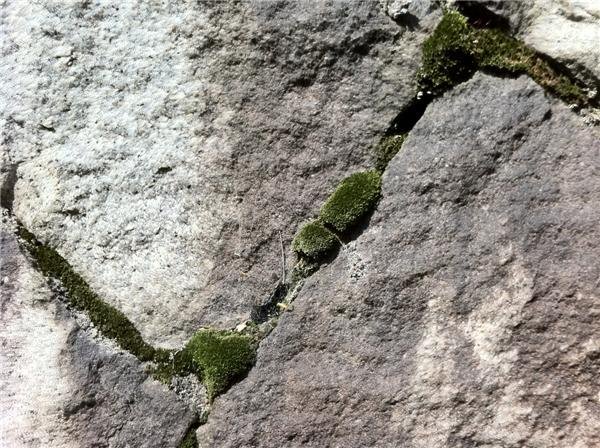
OK, calibrated for background and did new readings. Now my highest for cesium 137 was .70 Bq/cm(2). These higher readings all came off of lichen growing out between the stones on the wall of the hillside in front of my house, as seen in this pic.
by bo 5/15/2011 4:36:42 AM- @Bobby1 Yes, without a doubt, a vicious Daughter of the Family U.by Reed 5/15/2011 4:37:02 AM
- @Bo, Doh !!! a crack !!!by wtm 5/15/2011 4:37:33 AM
- @bo. serious side...how far away are you from the plant ? Do you think the radiation is being picked up from the air or from the water table under the plant life ?by wtm 5/15/2011 4:39:33 AM
- @all Cs-137 In Spent Fuel Storage Pools (from the same link as below) "The spent-fuel pools adjacent to most power reactors contain much larger inventories
of 137Cs than the 2 MegaCuries (MCi) that were released from the core
of Chernobyl 1000-Megawatt electric (MWe) unit #418 or the approximately
5 MCi in the core of a 1000-MWe light-water reactor. A typical 1000-MWe pressurized
water reactor (PWR) core contains about 80 metric tons of uranium in
its fuel, while a typical U.S. spent fuel pool today contains about 400 tons of
spent fuel (see Figure 3). (In this article, wherever tons are referred to, metric
tons are meant.) Furthermore, since the concentration of 137Cs builds up almost
linearly with burnup, there is on average about twice as much in a ton of spent
fuel as in a ton of fuel in the reactor core." www.irss-usa.orgby smoss 5/15/2011 4:40:23 AM - @wtm I am putting the monitor right up to the plants. In the air and on the ground I was getting readings more like .35 up to .50. I'm not sure what I am reading, plant, water seeping through the hill, soil, rock?by bo 5/15/2011 4:40:58 AM
- Although I was also getting readings at .05by bo 5/15/2011 4:41:18 AM
- @bo Many areas of the US probably have higher Cs-137 readings than you. Los Angeles is probably pushing 500-1000 Bq/m^2.by Bobby1 5/15/2011 4:41:29 AM
- @Bobby1 thanks. But I'm still gonna pour a drink.by bo 5/15/2011 4:41:56 AM
Japan Earthquake | Page 1181
- Who's Blogging
-
 hudebnik
 alblee
 UKVal
UKVal Jonathan Keebler
 Oliver (ScribbleLive)
 kaykodh
 Markfm
- Angie
 Mid Valley
 Matt (ScribbleLive)
 George Gibb
 elainekirk
 PKelley
 lillymunster
 dean
dean- bo
 Edano
Edano Deb
Deb- Pedro Jesus
 IanGoddard