Japan Earthquake | Page 1255
 @Nancy : yes there are lots of possibilities. corium is hot, dense, radioactive. it should be possible to lokalize it. either they are doing it and knowing or they do not have the facilities.by Edano 5/19/2011 12:37:21 AM
 @Nancy I was thinking more of the remote construction equipment. But it certainly won't be easy.
The should be able to drill down to an access tunnel, or more likely there's an existing shaft.by Rob in SF 5/19/2011 12:39:07 AM- i am thinking of ultrasonic.by Edano 5/19/2011 12:39:56 AM
 Not sure if edano was describing corium, or tepcoby Markfm 5/19/2011 12:40:18 AM
 LOL hot, dense, radioactive - Be back in about 20min. have to get some garden work done before the storm gets hereby Nancy 5/19/2011 12:42:24 AM
 Uhhm.... SAY WHAT??.....hope this is new
Release of radioactive water made at request of U.S.: Cabinet adviser
Kyodo
SEOUL — Japanese playwright Oriza Hirata, who serves as a special adviser to the Cabinet, claimed in a recent lecture given in Seoul that the dumping of low-level radioactive water into the Pacific Ocean followed a "strong request" from the United States, a person who attended the lecture said Wednesday.
News photo
Oriza Hirata
The release of the water from the Fukushima No. 1 nuclear power plant last month generated anxiety about the possible spread of radioactive contamination from the seaside power station.
The Japanese government had apparently given its permission for the release of the water after receiving a report from plant operator Tokyo Electric Power Co.
Hirata's remarks, made Tuesday, that the release was not carried out based on Tokyo's independent judgment but rather on a request from Washington is likely to ignite a debate.
South Korea and other neighboring countries have protested the lack of prior notification of the discharge.
Hirata's lecture in Seoul was titled "Earthquakes and the Revitalization of Japan." In response to a question at the venue, he called Japan's failure to give advance notification a communication error.
While acknowledging that the release of the water caused concern in South Korea, he said the thousands of tons of water were not highly radioactive.by Veenie 5/19/2011 12:43:30 AM- tecpc☢ is not that active.by Edano 5/19/2011 12:43:32 AM
 @Edano, yeah true, like the imaging methods used in diagnostic nuclear medicine. It is possible to enhance localization with collimators mounted in front of crystal scintillation detectors and triangulate the source from outside the building.by Peter Melzer 5/19/2011 12:44:37 AM
- @Peter Melzer ah, i got something for you.by Edano 5/19/2011 12:45:33 AM
- @Nancy Yeah, but GE, Areva, and others who should know what they're doing are there as well, so I think it's more of a FUBAR scenario.by Rob in SF 5/19/2011 12:45:50 AM
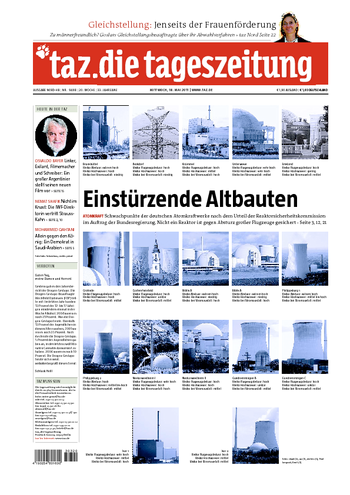
@Peter Melzer www.taz.de i think this newspaper follows our blog...
by Edano via Taz.de 5/19/2011 12:46:24 AM- @Peter Melzer : yes triangulation of corium with its very special characteristics should be possible.by Edano 5/19/2011 12:51:32 AM
- @Edano, jup, heh, heh, we must have got many followers out there! At least the reactors in Germany are hidden under these eggshells. Looking at the roof construction in Fukushima, I wonder whether they were intentionally built impact-friendly.by Peter Melzer 5/19/2011 12:51:38 AM
- @Peter Melzer : lol "impact-friendly" :)by Edano 5/19/2011 12:52:36 AM
 Kan calls for more independence for Japan's nuclear regulators
www.japantoday.com
"Kan suggested that Japan should spin off the Nuclear and Industrial Safety Agency from the Ministry of Economy, Trade and Industry, which was actively promoting atomic energy until the crisis at the Fukushima Daiichi power plant"
‘‘I believe that the manner in which the country’s nuclear power has been administrated over the years must be fundamentally reviewed,’’ Kan told a news conference."by Reed 5/19/2011 12:55:47 AM- @Edano, re triangulation, one could move such a detector on a circle around the building and pin down the source inside. This totally feasible. Reconstruction algorithms for the origin of the gamma-rays are well known in tomography.by Peter Melzer 5/19/2011 12:55:48 AM
- @Peter Melzer : you're in medical business ?by Edano 5/19/2011 12:57:16 AM
- @Edano, I used to be in another life, development and testing of diagnostic radiopharmaceuticals.by Peter Melzer 5/19/2011 12:58:43 AM
- "Impact Friendly" reactor design... Old Q&A on Seabrook:
Events such as an object falling into the pool
could displace the water that is there to cover the spent rods. If an accident with
loss of containment occurred from a heavy aircraft impact, the site would
immediately be contaminated and access would be precluded over a period of
several days. It would take an heroic effort to replace the water. The spent fuel
pool would boil dry and the rods would catch fire. If this happened at Seabrook
we could have an accident 10 times greater than the Chernobyl accident. As years
go by the accident would be proportionately worse because of the increased spent
fuel in the pool. www.c-10.orgby Rob in SF 5/19/2011 12:59:20 AM - @Nancy you back yet ?by wtm 5/19/2011 12:59:32 AM
- the mining industry probably has triangulation and tomographic facilities.by Edano 5/19/2011 1:00:00 AM
- Radioactive material dispersal prediction system proves useless
www.japantoday.com
"Data from the System for Prediction of Environmental Emergency Dose Information, or SPEEDI, were released only twice in the first six weeks after March 11, when the massive earthquake and tsunami crippled the nuclear plant in northeastern Japan.
In sharp contrast, some overseas research institutes made their own estimates public, although with the proviso that as the amount of radioactive materials spewed from the plant was unknown, the actual diffusive concentrations could be different.
The commission thought a massive amount of radioactive materials was emitted when the power plant’s No. 2 reactor’s container vessel was damaged March 15 by a hydrogen explosion. It then estimated the following day the amount of released radioactive materials based on the meteorological data on the day of the explosion. But this information was not made public immediately.
Although an exact diffusion prediction could not be made, the system calculated an accurate trend—to some extent—for the spread of radioactive materials by carrying out an estimate based on hypothetical conditions, according to the commission."by Reed 5/19/2011 1:02:15 AM - @Edano, they use industrial x-ray scanners to test welds on pipelines, a bit like a CT scan.by Peter Melzer 5/19/2011 1:02:26 AM
- @Rob, Edano, I finally figured out what that picture was of the workers on top of a sqyare platform they were building next to the tower. It is a cover to go over the SFP area, so they can then work on pulling the debris out of the reactor area without having something drop on the rods and damage them.by wtm 5/19/2011 1:02:58 AM
- @wtm just got back inby Nancy 5/19/2011 1:07:37 AM
 Hi guys I have just walked in the door! Anything new?by Angie 5/19/2011 1:08:44 AM
- @Nancy, take a look at the TBS cam, does the tower look like it is leaning to the right more than double what it was a day or so ago?by wtm 5/19/2011 1:11:17 AM
- @Angie TEPCO is hot, dense and radioactive as usual! :-) Discussing locating the corium so they quit playing marco polo with their employees in the reactor buildings. #6 has 6ft of water in the turbine building and would lose cooling if it leaks into the reactor.by Nancy 5/19/2011 1:12:08 AM
- @wtm Nope, looks about the same to me. There is a crane at the left corner of the building at a steep angle.by Nancy 5/19/2011 1:13:10 AM
- @Nancy roflamo! Oh my 6ft of water???? What reason are they giving for this one??by Angie 5/19/2011 1:14:32 AM
- @Nancy, your monitor is better than mine then, I can't see the crane ?by wtm 5/19/2011 1:14:52 AM
- @Angie contaminated ground water, at the part that is far away from the other reactors and up higher.by Nancy 5/19/2011 1:15:02 AM
- @wtm Even on full screen?by Nancy 5/19/2011 1:15:19 AM
- @Nancy, what they are not saying is the quake may have cracked something at #5 & 6 ??by wtm 5/19/2011 1:15:47 AM
- @Nancy *sigh* I thought you may of said that..........so now they have water running uphill??? Tepco never fails to deliver!by Angie 5/19/2011 1:16:33 AM
- @Nancy, nope can't see the crane on full screen, got to get a better monitor, it's an old one, don't really use it for graphics, just business stuff.by wtm 5/19/2011 1:16:51 AM
- TEPCO needs to stop ignoring the 'inconvenient' www.asahi.com
"The government should listen to experts who are critical of nuclear power plants. It should not shift the blame to TEPCO, just by saying, "TEPCO's approach to containment has been too insufficient," while letting it ignore what is inconvenient in the crisis.
TEPCO needs to prepare a timetable that is based on the correct perception of the current situation.
Otherwise, the residents in the evacuation areas and the people of Japan will really be kept in the dark." Go Asahi Shimbun!by Reed 5/19/2011 1:17:20 AM  @Nancy - Meretisa sent you an email.by Maureen Burke 5/19/2011 1:21:22 AM
- DO you guys remember weeks ago watching NHK and the guy with the pointer was pointing at #5 and #6 and talking about cracks after Tepco mentioned about it in passing at a press conference?? I would assume that these cracks have been leaking since the start.............
by Angie 5/19/2011 1:23:43 AM - Radiation tests lacking / Nuclear plant workers unsure of internal exposure levels
www.yomiuri.co.jp
"My measured value [of radioactive exposure] exceeded the standard value by a double-digit factor. That's never happened before," said a plant worker in his 20s, recalling the time he saw the results of a test he took outside Fukushima Prefecture in early May.
The man, an employee of a company that works with TEPCO, installed power cables near a reactor building at the plant for a month beginning at the end of March.
The test is conducted by a device called a "whole-body counter."
While a normal internal radiation level would range from several hundred cpm to 1,000 cpm, he was told his level was 30,000 cpm."by Reed 5/19/2011 1:23:51 AM  @Reed I hope the Japanese version of that article is as strongly wordedby UKVal 5/19/2011 1:24:33 AM
- @Reed So how exponentially bad is 30k cpm. That sounds really high.by Nancy 5/19/2011 1:25:18 AM
- @Angie was that a vid of a CNIC person shown on NHK?by UKVal 5/19/2011 1:25:51 AM
- @UKVal I am not sure I think it was the "experts" Nhk had in there that went through everything after the tepco press conferences.......... back in the first month when NHK had heaps of coverage of it and live translations.by Angie 5/19/2011 1:28:15 AM
- @Peter Melzer They use those pipe x-ray rigs quite a bit at NPPs. My brother did a bit of that work at Indian Point.by Rob in SF 5/19/2011 1:29:14 AM

Japan Earthquake | Page 1255
- Who's Blogging
-
 hudebnik
 alblee
 UKVal
UKVal Jonathan Keebler
 Oliver (ScribbleLive)
 kaykodh
 Markfm
- Angie
 Mid Valley
 Matt (ScribbleLive)
 George Gibb
 elainekirk
 PKelley
 lillymunster
 dean
dean bo
bo Edano
Edano Deb
Deb- Pedro Jesus
 IanGoddard