Japan Earthquake | Page 1361
 @Rob in SF if you can figure out the gauges app we could embed that into one of the pages.by lillymunster 5/24/2011 1:38:46 PM
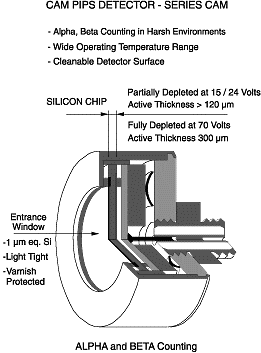
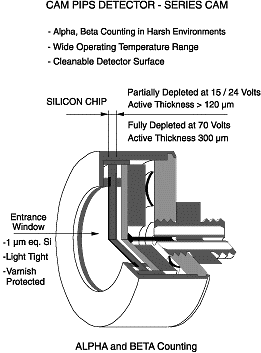
@dean Very interesting.
www.canberra.comby Rob in SF via Canberra 5/24/2011 1:38:49 PM- @lillymunster Yeah, need someone who knows how to get the TEPCO CSV feed to auto-fill the spreadsheet.by Rob in SF 5/24/2011 1:39:39 PM
- @Rob in SF Jo was good at that, Radioguy might know. I could probably muck my way through it and get it to work. Can you email me the location of the CSV feed?by lillymunster 5/24/2011 1:41:18 PM
 thunder,, I would think it depends on relative volume or mass of corium and then the water volume.. some say if the ratio is right it would cause a steam explosion, or boiling of around around the quenched corium, also the thought that if conditons are right the corium disolves in the water.. so many variables
by dean 5/24/2011 1:42:59 PM- gm lillyby dean 5/24/2011 1:43:07 PM
- on cams.. I just read from physics forum "I suspect they use a beta-gamma detector, and it has to be rated for the temperature limit in the containment. That precludes several scintillation detectors. Perhaps they use compensated "GM detectors.by dean 5/24/2011 1:45:58 PM
- @lillymunster hudebnik said, "the data is available on the Tepco data page in CSV form"
I believe somewhere on here:
translate.google.comby Rob in SF 5/24/2011 1:46:25 PM  @Dean....I always thought out of the box on the scenario, lava=lava, so if by watching lava flows into the ocean I came to that little theory....no doubt flawed as it maybe! I was thinking along the lines of dripping small amounts into a flowing body of water say the size of a ping pong ball??? I have to go anyways, @All Good night!by Thunder 5/24/2011 1:48:31 PM
- @lillymunster Yes under Plant Related Parameters, but it's by each unit... Here's #1 Temp...
www.tepco.co.jp
(Someone is probably already porting the CSV data to Google Docs I betcha'...)by Rob in SF 5/24/2011 1:49:01 PM - be safe thunder... good points tyby dean 5/24/2011 1:49:31 PM
- notes I just read... In an older operating plant which uses Mk I containment - "During CAM system operation, containment atmosphere is withdrawn through piping connected to primary containment penetrations for obtaining both a drywell and suppression chamber air sample. Hydrogen and oxygen concentration are measured outside the primary containment (evaluated with the primary containment structure) and the sample returned to the primary containment. The sample withdrawal lines in both cases are heat traced to prevent condensation in the sample lines which would cause measurement inaccuracies. A check valve is installed in the return discharge line for primary containment. In addition, a check valve is installed in each reagent and calibration gas line for primary containment. The containment atmosphere monitoring system consists of oxygen and hydrogen analyzer process instrumentation and various indication and annunciation instruments, primary containment monitoring panels, and gross gamma detector channels (from detector to annunciator and computer points). The system is automatically activated upon the occurrence of a LOCA, or manually by an operator. The system initiates a primary containment group 2 isolation on high radiation."
From - www.nrc.gov - see page 246 of 965. In the pdf, search on 'Containment Atmosphere Monitoring System'.
So it appears that the CAM radiation detectors are gamma only.by dean 5/24/2011 1:56:12 PM - CAMS needs power to operate so maybe it came on after some power restoration during that period and was saturatedby dean 5/24/2011 1:57:02 PM
- brb.. need to prepare for the day ..by dean 5/24/2011 1:57:34 PM
- by Rob in SF 5/24/2011 2:18:18 PM
- FukuCoreCam?
Application of X-Ray Computer Tomography for Observing the Central Void Formations and the Fuel Pin Deformations of Irradiated FBR Fuel Assemblies
ABSTRACT
In order to observe the structural change in the interior of irradiated fuel assemblies, a non-destructive post-irradiation examination (PIE) technique using X-ray computer tomography (X-ray CT) was developed. This X-ray CT technique was applied to observe the central void formations and fuel pin deformations of fuel assemblies which had been irradiated at high linear heat rating. The central void sizes in all fuel pins were measured on five cross sections of the core fuel column as a parameter for evaluating fuel thermal performance. In addition, the fuel pin deformations were analyzed from X-ray CT images obtained along the axial direction of a fuel assembly at the same separation interval. A dependence of void size on the linear heat rating was seen in the fuel assembly irradiated at high linear heat rating. In addition, significant undulations of the fuel pin were observed along the axial direction, coinciding with the wrapping wire pitch in the core fuel column. Application of the developed technique should provide enhanced resolution of measurements and simplify fuel PIEs.
ieeexplore.ieee.orgby Rob in SF 5/24/2011 2:30:11 PM  @All Hello! Been lurking on and off- between chasing my just-arrived g'kids. Saw the vid of the Mysterious Bright Flash (MBF). WOW. Tepco says instrument malfunction? Well, yeah...if you think of the whole plant as an 'instrument'. Sorta like a car crash that is an 'operator error'.by marierich 5/24/2011 2:36:25 PM
 Oh my darling you are very lucky I still hadnt turned off yet the gremlin had you!!! Glad your daughter arrived safe! xoby Angie 5/24/2011 2:37:27 PM
 ex-skf has picked up on the Japanese children picking tea leaves in the rain story, that was posted here a few days ago ex-skf.blogspot.comby Bobby1 5/24/2011 2:41:37 PM
 @marierich Where's the MBF vid?by radioguy 5/24/2011 2:47:13 PM
 @marie - congrats!by hudebnik 5/24/2011 2:48:24 PM
- @Rob in SF We have the feed CSV?by radioguy 5/24/2011 2:48:26 PM
- @radioguy - fukushimafaq.wikispaces.comby hudebnik 5/24/2011 2:48:31 PM
- @hudebnik tnxby radioguy 5/24/2011 2:48:44 PM
- @radioguy use this page www.tepco.co.jp to access csv under 'Status of Fukushima Daiichi Nuclear Power Station' (try to avoind the 'road accidents' on the way...by hudebnik 5/24/2011 2:50:14 PM
 Meltdowns also at No.2 and No.3 reactors www3.nhk.or.jp "The utility said on Tuesday that data analysis shows the No.2 reactor may have lost its cooling system shortly after 1:00 PM on March 14th, 3 days after the quake.
If all the fuel rods were exposed, they would have started melting at around 8:00 PM that day. By 8:00 PM on March 15th --- some 101 hours after the quake --- much of the fuel would have melted and collected at the bottom of the reactor pressure vessel.
The No.3 reactor likely lost its cooling system at around 2:00 AM on March 13th. Fuel would have begun melting at around 9:00 AM that day, and most of it would have dropped to the bottom of the vessel by 3:00 AM on March 14th --- about 60 hours after the quake."by Markfm 5/24/2011 2:53:49 PM- Parents from Fukushima protest upper limit for children's exposure to radiation mdn.mainichi.jpby Markfm 5/24/2011 2:55:41 PM
- 800kg of hydrogen generated in unit 1 prior to explosion (Japanese) www.yomiuri.co.jpby Bobby1 5/24/2011 2:57:07 PM
- @markfm - have a look at the stuff here www.houseoffoust.com especially the 'level pr data' ones - they are from the very beginning of the crisis (and were withdrawn by Tepco when they realised they shouldn't have put them up.by hudebnik 5/24/2011 2:58:04 PM
- 18 no-entry zone holdouts stay put www.yomiuri.co.jpby Markfm 5/24/2011 2:58:26 PM
- No surprises, just that it's nice to see TEPCO catching up on what happened at their plant.by Markfm 5/24/2011 3:00:15 PM
i55.tinypic.com
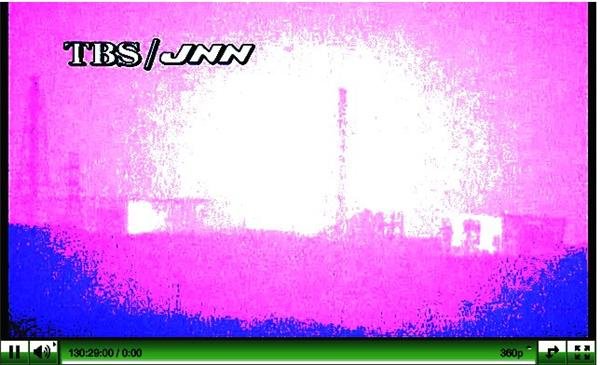
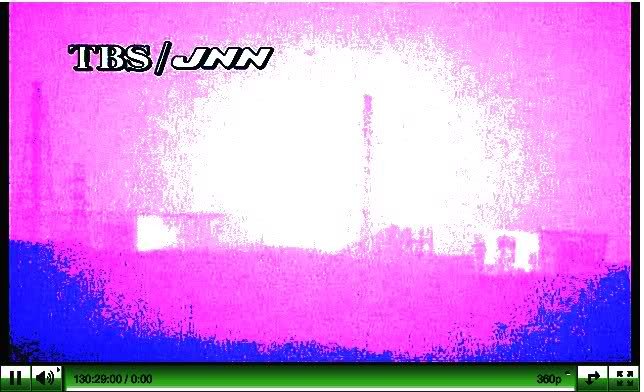
@hudebnik OK, thanks... I'll take a look. Meanwhile, here's the 15 sec MBF frame equalized. Note. This is a false color image. Its only purpose here is to take a tiny range of colours and spread them over the entire spectrum so you can discern between them. This is only to see what's happening a bit better.
Equalization definition: "Basically equalization means that you take a look at the overall impression of the image (its histogram) and accordingly change the values of the pixels so that there is an equal distribution of values across the entire range. For example, if a grayscale image is predominantly gray with no highlights and deep shadows, equalizing will change the image so that there is an equal amount of shadow, midtone and highlight. It is obvious that this in its simplicity is a crude operation that can both ruin or improve a picture. "by radioguy via I55.tinypic 5/24/2011 3:01:30 PM @all Is anybody watching livecam? Do you see orange flames on 3 and 4? Looks like repeat of yesterday morning. Any opinions? Wish I knew how to get screen shots.by ch 5/24/2011 3:04:42 PM
- use your printscreen keyby radioguy 5/24/2011 3:05:22 PM
- @radioguy tyby ch 5/24/2011 3:06:10 PM
- backby dean 5/24/2011 3:06:19 PM
- @radioguy @hudebnik The light source in the still below is the sunrise.by jt 5/24/2011 3:15:05 PM

anyone see this video from May 13 2011 and what changes (if any) were there in the plant parameter info released by TEPCo during this time?
by Tenzing 5/24/2011 3:19:06 PM- @hudebnik Here we go: spreadsheets.google.com
GoogleDocced Fukushima plant status. Straight ahead, unprettied. We could include ranges to get rid of gibberish and put in out own column labels, but here's the data. If anyone wants editor status to make those changes, let me know via gmail at my worldradioman moniker.by radioguy 5/24/2011 3:25:31 PM - 7 spreadsheets drawing live data, so the load takes a minute.by radioguy 5/24/2011 3:26:46 PM
- @jt Behind the camera? This is sunset.by radioguy 5/24/2011 3:28:58 PM
- @radioguy Well if it is Deb's video, it is sunrise. If it is a night your light source is the suntset. In either case, this your the light source that is lighting what you are viewing. It is almost horizontal at those times of day.by jt 5/24/2011 3:31:41 PM
- @jt Look at hudebrnks fukufaq link below for the photo sequence. You can see from the lighting on the reactors that it's sunset.by radioguy 5/24/2011 3:33:08 PM
- @ hudebnik In either case it is the near horizontal light of the sun that is the light source for what you are viewing. It is lighting the things you are viewing.by jt 5/24/2011 3:35:08 PM
No, wait... that's wrong. Those are the standard work lights, but there's no sunrise behind them in the followingf pics.by radioguy 5/24/2011 3:35:20 PM
Japan Earthquake | Page 1361
- Who's Blogging
-
 hudebnik
 alblee
 UKVal
UKVal Jonathan Keebler
 Oliver (ScribbleLive)
 kaykodh
 Markfm
- Angie
 Mid Valley
 Matt (ScribbleLive)
 George Gibb
 elainekirk
 PKelley
- lillymunster
- dean
 bo
bo Edano
Edano Deb
Deb- Pedro Jesus
 IanGoddard