Japan Earthquake | Page 1449
 @Lurking I have just pinned your post so every one can use it! It will be very popular today! lolby Angie 5/31/2011 2:06:21 AM
 Well at least TEPCO is honest about intending to shut off them camera when they do something unflattering to their image. I sure hope TBS keeps their camera on.by Nancy 5/31/2011 2:09:00 AM
 @Angie. Thanks! The more eyes watching them the better. I still think this whole situation is a crime against humanity. Not the earthquake and Tsunami part, just everything they did after that.by Lurking 5/31/2011 2:09:18 AM
- @Lurking I fully agree!!!by Angie 5/31/2011 2:09:49 AM
- TEPCO studies workers' iodine consumption
The operator of the damaged Fukushima Daiichi nuclear plant says 2 workers believed to be contaminated with radiation took iodine tablets just once, 2 days after the quake.
The Tokyo Electric Power Company, or TEPCO, found that the pair may have been exposed to radiation exceeding the safety limit of 250 millisieverts set for emergency situations by the government.
TEPCO said the men, one in his 30s and the other in his 40s, worked in the control rooms of the Numbers 3 and 4 reactors after the accident.
Radiology experts who examined the workers have questioned whether the timing and level of iodine dosage was appropriate.
TEPCO says it is checking how often other workers took the tablets.
Tuesday, May 31, 2011 09:59 +0900 (JST)
www3.nhk.or.jpby estacion 5/31/2011 2:10:42 AM - I really hope TBS keeps their camera up, it would be nice to have both views for comparison.by Lurking 5/31/2011 2:13:41 AM
 In Japan, a Culture That Promotes Nuclear Dependency
www.nytimes.com
"Experts and some residents say this dependency helps explain why, despite the legacy of Hiroshima and Nagasaki, and the accidents at the Three Mile Island and Chernobyl nuclear plants, Japan never faced the levels of popular opposition to nuclear power seen in the United States and Europe — and is less likely than the United States to stop building new plants. Towns become enmeshed in the same circle — which includes politicians, bureaucrats, judges and nuclear industry executives — that has relentlessly promoted the expansion of nuclear power over safety concerns.
“They call it a nuclear power plant, but it should actually be called a political power plant...”
“We absolutely need it,” Yoshifumi Matsuyama, the chairman of Oma’s Chamber of Commerce, said of the plant. “Nothing other than a nuclear plant will bring money here. That’s for sure. What else can an isolated town like this do except host a nuclear plant?” "by Reed 5/31/2011 2:17:28 AM @ Angie where'd that post about plutonium go?by carabnr 5/31/2011 2:17:32 AM
- @carabnr @Panserbjorne9 posted it its just down the page......by Angie 5/31/2011 2:18:37 AM
- @UKVal Regarding the word rumour, it does seem a bit strange. However the Japanese word we keep hearing is 'fuhyohigai' (I cannot add the diacritics here), which is indeed best translated as rumour I would say.by Will 5/31/2011 2:19:26 AM
- @ Angie I guess I need to reload TYby carabnr 5/31/2011 2:19:55 AM
- Arthur Hu sent me a translated article from Lemonde. The dosed workers were found to have the high levels in their thyroids. "After an initial examination, the two workers suffered more extensive testing under the control of the Government Agency for Atomic Energy. "The thyroid glands of two men show high levels of radiation (iodine 131)," said TEPCO, based on a report of this organization. Levels of 9760 and 7690 Bq of iodine 131 were detected, ten times more than other workers in Fukushima." I am in the process of putting the whole article online.by Nancy 5/31/2011 2:21:22 AM
 @Nancy , the plant workers should have their thyroids measured with a scintillation detector once a week. The procedure does not need a whole body counter and takes only five minutes.by Peter Melzer 5/31/2011 2:25:47 AM
- full article houseoffoust.comby Nancy 5/31/2011 2:25:58 AM
- @Peter Melzer Do they need isolation from background radiation to do that test?by Nancy 5/31/2011 2:26:31 AM
- @Nancy , not really. You must subtract the background. Of course, it helps when the background is low.by Peter Melzer 5/31/2011 2:28:45 AM
- @Peter Melzer wondering since they full body scanner needed no or limited background radiation. That was the reason for not doing them over at Daini. I guess they were taking workers offsite in batches to start doing the whole body scans. I have not heard any mention of TEPCO doing they thyroid scans before.by Nancy 5/31/2011 2:35:26 AM
- With a whole body counter inside a lead castle you can detect much smaller amounts. This one is another such enigmatic story. If the two had incorporated the iodine in March, that is almost ten half-lives ago, the incorporated radioactivity would have been 1,000 times higher than at present, I suppose in the microCurie range. I thought the workers must go through monitors at the end of the shift. Those monitors should have rung out alarms at these doses.by Peter Melzer 5/31/2011 2:38:49 AM
- @ Nancy Nice job posting that translated Pu article it seems important, and it's heavy is deadly. That stuff has gamma rads right if you ingest it you're toast. I sent the page to Steve wing and asked him some questions in advance of our interview. I think I'll send him our posting too incase he has trouble with the google translate.by carabnr 5/31/2011 2:41:43 AM
- @Peter Melzer Not sure what they are doing. The employee areas at Daiichi are toast. I don't know if they are using the ones at Daini (locker rooms, laundry, monitor check in/out) or not. I may have to ask around.by Nancy 5/31/2011 2:42:21 AM
- Does any one remember a discussion about heavy particles in the ocean staying put?by carabnr 5/31/2011 2:43:18 AM
- @carabnr are you sure that was me? I think Bobbi posted the PU article. I put up one a bit ago on the workers with the big thyroid doses, that was a translation also. Did you see a copy on the group website? Radioguy might have put it up.
I hadn't read the PU article but the concept that there might be PU further than just in the plant area or moving is really concerning.by Nancy 5/31/2011 2:44:51 AM - Doh, I think the Pu article panser posted would do well on the website, radioguy just added some to but I'm confused. I thinkI need to go to bed.by carabnr 5/31/2011 2:48:46 AM
- @Will , according to Tepco procedures, the amounts of Pu-238, Pu-239 and Pu-240 are determined in a sample. If the ratio of Pu-238 to Pu-239 and Pu-240 is greater than 0.026, which is the ratio resulting from past above-ground nuclear tests, the plutonium is deemed originating from a plant.by Peter Melzer 5/31/2011 2:49:18 AM
 Hi all! Just saw workers on cam in Tepco live feed.by LM 5/31/2011 2:53:46 AM
- TBS cam starting to clear just a tad...can see the really big surf.by LM 5/31/2011 2:56:48 AM

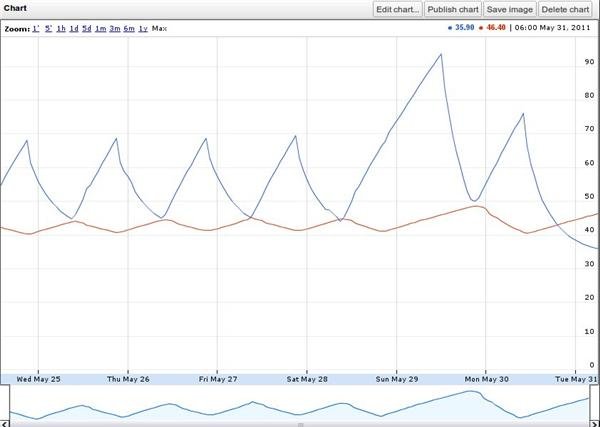
i56.tinypic.com
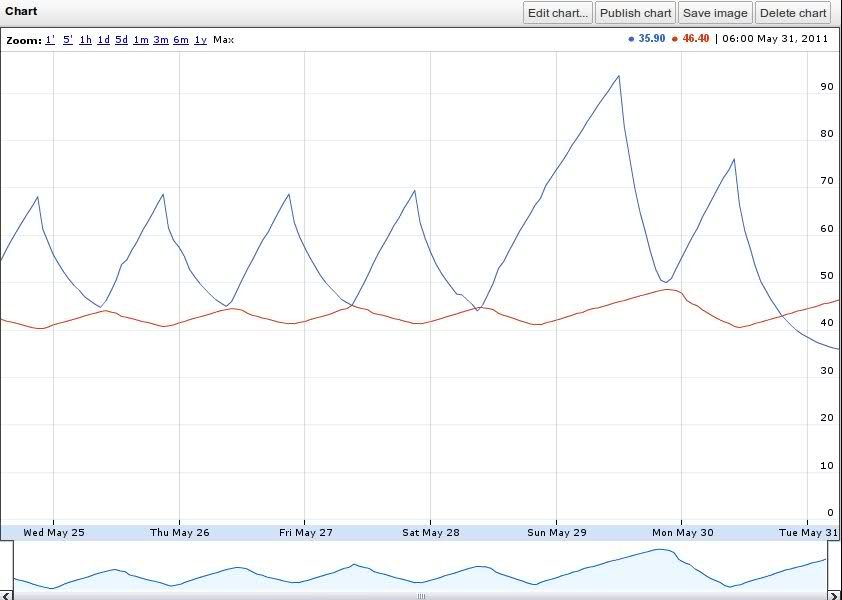
OK, I'm about to retire this charting page as this crisis is past, so one last posting. Go TEPCO engineers. We have to celebrate their small victories. Check out the results of their circulating pump change-out after the big spike.by radioguy via I56.tinypic 5/31/2011 2:57:53 AM- Reactor 5 Core (red) and SFP (blue)by radioguy 5/31/2011 2:58:44 AM
- @radioguy It seems when they can be let to work they can do things. I hate that they seem hamstrung by corporate so much.by Nancy 5/31/2011 2:59:42 AM
- This can't possibly work..can it? Seawater purifiers to be set at Fukushima plant
The operator of the damaged Fukushima Daiichi nuclear power plant says it will install equipment to purify highly radioactive seawater near the reactors' water intakes.
Tokyo Electric Power Company says it will start work on Tuesday to install seawater purifiers, which use the mineral zeolite to absorb radioactive cesium.
The utility previously built undersea silt barriers around the water intakes for the No.2 and 3 reactors after highly contaminated water was found to be leaking into the sea.
But radioactive substances exceeding the government-set safety limits are still being detected both inside and outside the barriers.
To stop contamination entering the sea, TEPCO decided to install new equipment to decontaminate seawater. www3.nhk.or.jpby LM 5/31/2011 3:01:38 AM  @Lm...doesn't sound like it will work, but correct me if I am wrong...at this point it is definitely worth a shot!! Probably a palliative though to try to immunize the public against any bad news. Oh, and if nervous in NJ is on here....don't vaccinate your kids!!!by wrshpr 5/31/2011 3:07:02 AM
 by radioguy via I52.tinypic 5/31/2011 3:08:33 AM
- @Peter Melzer Thanks for the helpful explanation.by Will 5/31/2011 3:09:53 AM
- @wrshpr True..any effort is probably a good idea...can't hurt at this point. And too late...my kids are in their teens and have been vaccinated...no problems here!!by LM 5/31/2011 3:10:03 AM
- @LM They said they were going to do zeolite bags in March or April??? NOW they are going to do them? Sheesh.by Nancy 5/31/2011 3:10:06 AM
- @Nancy I thought the zeolite was for the trenches. I didn't realize they intended to use it at the intakes as well. I just have trouble believing it will work in an open sea (albeit somewhat protected) environment. I guess something is better than nothing. I do feel like their playing with bandaids though...by LM 5/31/2011 3:23:59 AM
- @LM Funny... I feel like they're playing with fire.by radioguy 5/31/2011 3:26:50 AM
- @radioguy That too!by LM 5/31/2011 3:27:37 AM
- @LM My understanding was they were going to put it in mesh bags and suspend the bags at the intakes to filter the outgoing water as it passes through. Sort of like aquarium filter media. I thought I saw pictures of them doing this long ago. So now I wonder did they not really start it? Are they mentioning it again for some "look we are doing something" PR?by Nancy 5/31/2011 3:31:13 AM
- Here's a wild idea to deal with the water. Is there any way to evaporate the water while leaving the contamination behind? Maybe distillation to collect the contamination but just don't recondense it?by Nancy 5/31/2011 3:32:16 AM
- @Nancy I didn't realize that...given the storm they've just had and the probably massive release that has already happened or will happen any second...I wouldn't be surprised if they brought it up again just to head off the negative news abthey to hit. You're probably right.by LM 5/31/2011 3:35:19 AM
- @Nancy 'about' to hit.by LM 5/31/2011 3:36:08 AM
- @Nancy If they could somehow contain the open trenches and supply a heat source..it might be an option. The problem would be radioactive steam...not that they don't have a lot already!by LM 5/31/2011 3:37:57 AM
- @LM I don't know how much rain they got but i'm sure it added to the water levels plus ran off lots of surface contamination.
If they can find a way to sort the water and the contamination and then evaporate the water. I'm ready to send the 100,000 cases of Brita water filters. :-)by Nancy 5/31/2011 3:39:00 AM - Sorry long article, but very descriptive.
Fukushima schoolchildren long to play outdoors again
2011/05/31
FUKUSHIMA--In an art class held in the humid halls of Watari Elementary School here, Toko Matsumoto looks at her gray drawing and frowns.
"If we were outside, we would be able to draw trees and mountains using a variety of colors," the 11-year-old says. "All I can do inside is sketch the corridor and lockers. This only makes my picture look gloomy."
But the children at the school are not allowed to venture outdoors. Nor are they or many other children in Fukushima Prefecture allowed to use swimming pools or wear clothes suited for the warming temperatures.
These rules are aimed at protecting the children from exposure to radiation emanating from the crippled Fukushima No. 1 nuclear power plant. But the schools may be forced to take even more extreme measures.
Concerned parents in the prefecture recently protested the education ministry's acceptable radiation level for schoolchildren of 20 millisieverts a year, a standard critics said was more geared toward workers at nuclear power plants.
The ministry lowered the standard to 1 millisievert a year on May 27.
"Of course, we respect the acceptable standard decided by the government," says Kenichiro Ikeda, a health education official at the prefectural board of education. "But at the same time, we have to come up with measures to give the parents of the children a sense of security."
Among the children themselves, signs of stress were already evident before the ministry lowered its radiation standard.
The municipal Koken Elementary School, in the center of Koriyama city, has prohibited its 770 students from going outdoors for physical education classes or recess since the nuclear crisis started on March 11.
In one homemaking class, sixth-graders were making miso soup. A fan placed at the entrance sent a warm breeze into the already sultry room.
A respite from the rising temperatures is also not in the cards at Watari Elementary School.
At 7:45 a.m. on May 24, pupils arrived at the school, 2 kilometers from JR Fukushima Station and 60 km from the Fukushima No. 1 nuclear power plant, all wearing long-sleeved shirts, face masks and hats.
A teacher at the gate scolded a boy whose sleeves were rolled up: "Put on a jacket."
The school has instructed its 680 pupils to cover as much skin as possible.
Principal Tomonori Takahashi says he feels sorry for the youngsters.
"We are having children wear similar clothes that may not be suited for the season," he says.
To block out the sun, the city of Koriyama decided to give blinds made of reeds to all of its 86 municipal elementary and junior high schools. Two additional fans per classroom will also be offered.
Koriyama city decided to remove the top layer of soil at schools although the radiation levels were lower than the limit designated by the ministry, which is providing dosimeters to 1,800 facilities, including all schools in the prefecture.
Fukushima city has closed outdoor pools at its elementary and junior high schools.
New rules are also being applied indoors to limit radiation exposure at schools.
At the end of a homeroom period for a class of sixth-graders at Koken Elementary School, the on-duty student announced, "Clean and tidy your desks."
The students who sat nearest to the corridor moved to the center of the room, while those in the center moved closer to the window. Those with window seats shifted to the corridor.
According to the teacher, the rule is intended to give the students equal access to the cool breeze from the fan.
But teacher Yuichi Onizawa cites another reason. "Radioactivity is higher near the window, so the seating changes are intended to treat each child equally."
Keiko Omori, co-representative of the Great East Japan Earthquake Project of the Fukushima Society of Certified Clinical Psychologists, says the situation at schools in Fukushima Prefecture could end up harming the mental health of the students.
"I think the children are feeling anxieties about not knowing what the future holds for them. If this situation is prolonged, their stress will increase," Omori says.
In the art class in the corridor of Watari Elementary School, some of Toko's classmates sketched a mountain range--seen from the windows.
"I like the scenery outside better," one student said.
Ryu Kuwahata, another sixth-grader, says he is looking forward to a school trip in June to the Aizu district of the prefecture, farther away from the nuclear plant, where he can do what children normally do.
"Here, we cannot play outside," he says. "I want to remove my mask and run around with all my might."
(This article was written by Atsuko Kawaguchi and Toru Furusho.)
www.asahi.comby estacion 5/31/2011 3:40:01 AM

Japan Earthquake | Page 1449
- Who's Blogging
-
 hudebnik
 alblee
 UKVal
UKVal Jonathan Keebler
 Oliver (ScribbleLive)
 kaykodh
 Markfm
- Angie
 Mid Valley
 Matt (ScribbleLive)
 George Gibb
 elainekirk
 PKelley
 lillymunster
 dean
dean bo
bo Edano
Edano Deb
Deb- Pedro Jesus
 IanGoddard