Japan Earthquake | Page 1539
 10:02 JST 08 Jun 2011 37.2N 140.9E 10 km M2.9 Fukushima-ken Hamadoriby estacion 6/8/2011 3:44:34 AM
 @lillymunster I will try to find them,i think they are on twitter....by Majj 6/8/2011 3:49:50 AM
- @AustralianCannonball Here they are : www.safecast.orgby Majj 6/8/2011 3:51:30 AM
 @all Off topic, but interesting. When I search the IAEA website for "Japan Management of Plutonium", I get a 404 error.by smoss 6/8/2011 3:54:08 AM
- @all ANNUAL FIGURES FOR HOLDINGS OF CIVIL UNIRRADIATED PLUTONIUM 2005 (Japan) www.iaea.orgby smoss 6/8/2011 3:58:21 AM
 BETA RADIATION IN THE US
I am conducting a statistical analysis of post-Fukushima beta radiation in the US.
The EPA Radnet gross beta (in pCi/m^3) from air filters was used.
The analysis was broken up into months, and the corresponding month in 2010 was used as background.
Overall results showed a statistically significant increase in beta, for March 15-May 23.
Each month, March, April, and May were also significant (p < .001).
The overall results show beta radiation in the US to be 3.78x background.
March 15-31 was 8.18x background.
April 1-30 was 2.48x background.
May 1-23 was 1.52x background.
I am breaking it down by city, and hope to have this ready in a day or two.by Bobby1 6/8/2011 4:04:46 AM @Bobby1 Well done, Bobby. Excellent work. =)by Pedro Jesus 6/8/2011 4:10:14 AM
- @Pedro Jesus ty, those March figures are pretty disturbing.by Bobby1 6/8/2011 4:11:00 AM
 @Bobby1 Thanks so much! I would be interested in seeing numbers for San Diego compared to background. Our levels of beta and gamma seem high but I don't have a reference to compare them. Your work is much appreciated!by LM 6/8/2011 4:13:42 AM
- Following the Idea of Contaminate Ballast Water from Japan. There are no prevision on the law to prevent distribution of radioactivity contaminate ballast water. INTERNATIONAL CONVENTION FOR THE CONTROL AND MANAGEMENT OF
SHIPS' BALLAST WATER AND SEDIMENTS, 2004
THE PARTIES TO THIS CONVENTION,
RECALLING Article 196(1) of the 1982 United Nations Convention on the Law of the Sea
(UNCLOS), which provides that “States shall take all measures necessary to prevent, reduce and
control pollution of the marine environment resulting from the use of technologies under their
jurisdiction or control, or the intentional or accidental introduction of species, alien or new, to a
particular part of the marine environment, which may cause significant and harmful changes
thereto,” Here I got the full text Regulation D-2 of the Convention describes the discharge (or treatment) standards for ballast water www.nei-marine.comby Majj 6/8/2011 4:17:48 AM - 'Melt-through' at Fukushima? / Govt report to IAEA suggests situation worse than meltdown. www.yomiuri.co.jpby LM 6/8/2011 4:18:47 AM
- Watering #1 SPF right now at TEPCO Live Webcam.
www.tepco.co.jpby estacion 6/8/2011 4:19:49 AM - @LM San Diego
March 11.42x background
April 2.59x background
May 1.75x backgroundby Bobby1 6/8/2011 4:20:06 AM - *SFPby estacion 6/8/2011 4:21:09 AM
- @Bobby1 You're awesome! Thanks...It's funny how they weren't posting data until the end of the second week..I guess with those numbers I'm not surprised!by LM 6/8/2011 4:22:04 AM
- Govt to test vegetable radioactivity / Data on cesium absorption from soil aimed to help Fukushima farmers. www.yomiuri.co.jpby LM 6/8/2011 4:26:34 AM
- @all Must say bye for now...by smoss 6/8/2011 4:26:59 AM
 On the subject of radiation, ran across this article from August 2010, Shrinking atmospheric layer linked to low levels of solar radiation. A study published today by the American Geophysical Union links a recent, temporary shrinking of a high atmospheric layer with a sharp drop in the Sun’s ultraviolet radiation levels. www.agu.orgby deb 6/8/2011 4:29:51 AM
- Night smoss!by LM 6/8/2011 4:30:21 AM
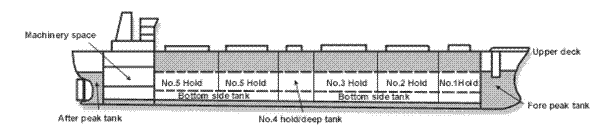
www.pkharbour.org The above sketch indicates a longitudinal cross section of a modern bulk carrier. The sections marked in grey are normally filled with water ballast when the holds are empty. As the cargo is delivered to the ship, the ship pumps out the water ballast into the receiving waters of the port. Larger or smaller bulk carriers simply have more or less hold spaces to carry extra cargo and of course more water ballast. This water ballast cam contains lost of RADIATION . Like a Minerals ships go full from Brazil to Japan ,unload the cargo. Get tons of Contaminate waters for ballast there ,travel back and relive the contaminate water just near the Brazilian coast just before get a new cargo of minerals....
by Majj via Pkharbour.org 6/8/2011 4:30:30 AM- @LM ty, I hope you had the windows taped shut in March!by Bobby1 6/8/2011 4:32:01 AM
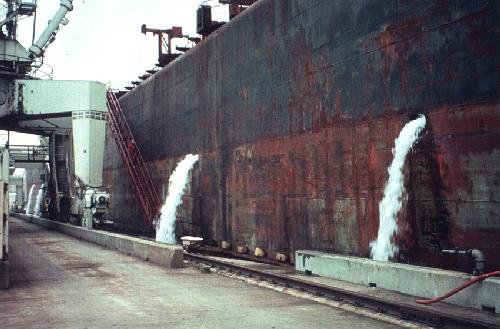
www.pkharbour.org Bulk carrier discharging water ballast in port. Imagine the amount of water japan is exporting to all the word. Express deliver :-(((
by Majj via Pkharbour.org 6/8/2011 4:32:41 AM- @Bobby1 Unfortunately...no. I've got my fingers crossed.by LM 6/8/2011 4:38:38 AM
- @deb Very interesting article! Thanks.by LM 6/8/2011 4:39:11 AM
- @Majj That's pretty scary. Do you know if they're testing any ballast water from Japanese ships before discharging it?by LM 6/8/2011 4:41:14 AM
- @LM I'm reading the American coast guard paers. they only talk in biologic danger . nothing in this subject has ever be prepare.... I have this idea last night I have be trying to discover .. The first bad news is that in the end EPA is responsible for controlling it....by Majj 6/8/2011 4:45:09 AM
- very day, large quantities of ballast water from all over the world are discharged into United States waters. Carried in this water are plants, animals, bacteria, and pathogens. These organisms range in size from microscopic to large plants and free-swimming fish. These organisms have the potential to become aquatic nuisance species (ANS). ANS may displace native species, degrade native habitats, spread disease, and disrupt human social and economic activities that depend on water resources.
In recent years there has been increased international focus on Ballast Water Management (BWM) due to the ecological, economic, and potential health threats caused by the spread of ANS from ballast water. The United States Coast Guard is responding to these concerns through a comprehensive national BWM program. This program applies to all vessels equipped with ballast water tanks that operate in U.S. waters and are bound for ports or places in the U.S. Highlights of the program are: (1) requires mandatory ballast water management practices for all vessels that operate in U.S. waters; (2) establishes additional practices for vessels entering U.S. waters after operating beyond the EEZ; and (3) requires the reporting and recordkeeping of ballasting operations by all vessels. More information on the BWM program regulations may be found in 33 CFR Part 151 Subparts C and D. www.uscg.milby Majj 6/8/2011 4:46:12 AM - @Majj That is a problem...since they've pretty much dropped the ball. I must admit that I'm glad I don't live in the Los Angeles area near the big Long Beach port....San Diego has a lot of the military ships but they are a lot more cautious...they know the risks!by LM 6/8/2011 4:49:50 AM
- @LM I got it. I'm not alone . India also think the same Is radioactive seawater from off Japan reaching India? It’s a far-fetched fear, but it has gained ground in at least one Indian port, Mormugao, as cargo ships return and offload ballast water—seawater admitted into tanks at the bottom of a ship to stabilise it for the high seas.
After the near-meltdown at the Fukushima nuclear plant, caused by the March 11 temblor and tsunami, some 57 million litres of seawater has been used to cool the crippled reactors and drained back into the Pacific as radioactive waste. The Goa State Pollution Control Board (GSPCB), it seems, was so worried that it ordered the Mormugao Port Trust (MPT) to ensure that no ship—not just those that had touched Japan—empties ballast tanks at the port. “The south Goa collector received some reliable information that two ships that had touched Japanese ports recently were likely to visit MPT,” says GSPCB chairman S.N. de Sousa. One of these ships—the MV Azul Integra—was on arrival held in quarantine for ten days and examined by experts from the Bhabha Atomic Research Centre, who said radiation levels were within permissible limits. “The ship’s agents claimed it had already de-ballasted in the South China Sea and in Colombo,” says de Sousa. There’s no word yet on the second ship, but the order stands as a precautionary measure. www.outlookindia.comby Majj 6/8/2011 4:53:20 AM - @Majj It's good to know that some countries are thinking about it...hopefully they'll all catch on. The ramifications of this disaster are so far-reaching!by LM 6/8/2011 4:56:13 AM
- Night all!by LM 6/8/2011 4:56:44 AM
- @LM god dreamsby Majj 6/8/2011 5:00:44 AM
- Radiation check in Kashiwa Japan June 8th JR train station I went to Kashiwa's JR train station just before noon today June 8th, right outside the South exit. www.youtube.comby Majj 6/8/2011 5:10:42 AM
 @majj those video's are great weaponsby elainekirk 6/8/2011 5:54:47 AM
 @elainekirk What are you doing up already???by Angie 6/8/2011 5:55:30 AM
- @angie dunno madness i cant sleep (well you re going to be very tired today! lol early to bed tonight for you! - Angie)by elainekirk edited by Angie 6/8/2011 5:58:34 AM
- Return of plutonium and MOX
So far one shipment of separated reactor-grade plutonium recovered from used fuel reprocessing has been returned to Japan, in 1993. This was reactor-grade material, with about 30% Pu-240 in it and therefore useable only as a reactor fuel. It is not suitable for nuclear weapons.
Further plutonium is being returned as mixed oxide (MOX) fuel, in which the plutonium is mixed with depleted uranium and fabricated into fresh fuel elements ready for use in a power station reactor (see information page on Mixed Oxide (MOX) Fuel). Shipments of MOX fuel assemblies were sent in mid-1999, early 2001, early 2009 and mid-2010.
Part of the 1999 shipment, intended for Kansai's Takehama plant, was returned to the UK in 2002 due to doubts about quality control. In 1999 and 2001, the shipments contained 60 MOX fuel assemblies for use in Tepco's Fukishima I-3 and Kashiwazaki-Kariwa 3 BWR units, respectively. The 2009 shipment contained 24 assemblies for Shikoku's Ikata 3, 28 for Chubu's Hamaoka 4, and 16 for Kyushu's Genkai 3. The 2010 shipment from France contained 12 assemblies for Kansai's Takahama 4 and 20 assemblies for the second load at Genkai 3.
www.world-nuclear.orgby ch 6/8/2011 6:00:11 AM - @ch I read that yesterday and it just doesnt ring true with what I know from other sourcesby elainekirk 6/8/2011 6:05:12 AM
- @elainekirk What do you mean?by ch 6/8/2011 6:06:18 AM
- @ch I am just trying to find something to show you what I mean ::)by elainekirk 6/8/2011 6:10:51 AM
- Fisheries Agency opposes Fukushima Daini nuke plant water release plan
TOKYO, June 8 - (Kyodo) english.kyodonews.jp Kyodo headline subscriptionby jt 6/8/2011 6:24:05 AM - Nuclear accident inspection must give public a fair view of Fukushima crisis
A report on the nuclear crisis at the Fukushima No. 1 Nuclear Power Plant that the government has compiled ahead of this month's International Atomic Energy Agency ministerial conference has unveiled 28 lessons from the crisis. Many of these lessons had already been pointed out by experts and the media, but the government had not officially acknowledged them. (Mainichi Japan) June 8, 2011 mdn.mainichi.jpby jt 6/8/2011 6:28:11 AM
from @jt's link english.kyodonews.jp
Tokyo Electric Power Co.'s plan to release water containing traces of radioactive materials from the tsunami-hit Fukushima Daini nuclear power plant to the sea has been stopped due to stiff opposition from the Fisheries Agency, sources close to the mater said Wednesday.
Although the utility known as TEPCO told the agency that it will release the water after removing radioactive substances to an undetectable level, the agency is not approving the plan, leaving the fate of the 3,000 tons of the water accumulated in the nuclear power station, located 15 kilometers south from the crippled Fukushima Daiichi power plant, undecided.
If the water remains in tanks for a prolonged time, the storage facility may be corroded by salt in the water.by elainekirk 6/8/2011 6:29:20 AM- Fisheries Agency opposes plan to dump radioactive water into seaby jt 6/8/2011 6:29:42 AM
- www.japantoday.com Japan Today full article Although TEPCO told the agency that it will release the water after removing radioactive substances to an undetectable level, the agency is not approving the plan, leaving the fate of the 3,000 tons of the water accumulated in the nuclear power station, located 15 kilometers south from the crippled Fukushima Daiichi power plant, undecided.
If the water remains in tanks for a prolonged time, the storage facility may be corroded by salt in the water.
After being flooded by tsunami following a magnitude 9.0 earthquake that struck northeastern Japan on March 11, the Fukushima Daini power station saw about 7,000 tons of water accumulate in its facilities.by jt 6/8/2011 6:30:47 AM


Japan Earthquake | Page 1539
- Who's Blogging
-
 hudebnik
 alblee
 UKVal
UKVal Jonathan Keebler
 Oliver (ScribbleLive)
 kaykodh
 Markfm
- Angie
 Mid Valley
 Matt (ScribbleLive)
 George Gibb
- elainekirk
 PKelley
 lillymunster
 dean
dean bo
bo Edano
Edano Deb
Deb- Pedro Jesus
 IanGoddard