Japan Earthquake | Page 1532
 Something else I found regarding MOX fuels. They have to have a certain percentage load in the reactor in order to burn more plutonium than they generate. So reactors like #3 created MORE plutonium rather than consuming it.by lillymunster 6/7/2011 7:23:29 PM
 Sorry for driveby posting lately, been pretty consumed with the Wallow fire going on here in Arizona.by wtm 6/7/2011 7:24:34 PM
 This says fukushima has 210kg actually in reactor 3 does that sound right www.physics.ohio-state.eduby elainekirk 6/7/2011 7:24:44 PM
- @wtm hope you are all coping with it :( I should imagine people are getting wearyby elainekirk 6/7/2011 7:25:38 PM
 7 June vs. 6 June plant parameters. #1 shows another burst on DW SC B reading, rising from 35.5 to 247 Sv/hr, with a small rise on the A reading; other parameters stable or decreasing slightly. #2 RPV bellows temp shows a drop from 75 to 43C, other parameters stable or slow decrease. #3 RPV temps up 4 - 6C, at 146/182C, mixed changes in DW temps at 177/157C, other parameters stable or slight decrease. #5 and #6 have some ups, some downs, all temps under 50C.by Markfm 6/7/2011 7:25:53 PM
- @Elaine, expect more evacuations today !!by wtm 6/7/2011 7:26:07 PM
- @wtm that doesn't sound fun at all. :-(by lillymunster 6/7/2011 7:28:23 PM
- NHK stories carried in today’s JAIF EQ report: (Fukushima NPP Site) ●Inspections begin at Fukushima nuclear plant ●Work continues to support No.4 reactor pool ●More hydrogen produced than TEPCO's estimate ●No.1 reactor vessel damaged 5 hours after quake ●Highly radioactive debris found at Fukushima plant (Other news) ●Kaieda:Nuclear plants to resume operating in July ●Monitoring of beach radiation begins in Ibaraki ●Govt panel on nuclear accident holds 1st meeting ●Japan's FM seeks nuclear standards review ●Japan to separate nuclear bodies ●IAEA chief to propose tougher nuclear safety ●Scientists call for radiation exposure reduction ●Govt. document shows offsite center dysfunctional ●Naraha town residents make short home visit ●Emergency measures urged for Fukushima studentsby Markfm 6/7/2011 7:31:11 PM
- @wtm that is not good :( where do they evac to?by elainekirk 6/7/2011 7:33:17 PM
 "Technical issues that arise in the analysis of risk at plants using MO
X focus on the vulnerability of
fuel to neutronically induced core disruption and the different invent
ory of radionuclides available for
release from the fuel during accidents. The differences in neutronics
and coupling between neutronics
and
thermal hydraulics result in different responses of MOX and convention
al fuel to reactivity transients.
The differences in responses are consequences of changes in Doppler an
d moderator reactivity feedback,
and decrease in delayed neutron fraction, which decreases the response
time of MOX to reactivity
transients. These dynamic characteristics of MOX pose both safety and
control issues that will require
the staff to conduct careful review of the neutronics analysis of reac
tor cores with MOX. Most experts
believe now that the number of MOX fuel assemblies and the percentage
of plutonium in MOX should be
limited to reduce the vulnerability of the core to these neutronic eff
ects." www.nrc.govby Edano 6/7/2011 7:37:09 PM- @Edano In order to actually burn up the plutonium as promoted they have to have a huge percentage of the core be MOX..but that puts them over those safely operating ranges.by lillymunster 6/7/2011 7:45:43 PM
- @lillymunster : japan uses 6% pu in mox, i just read it.by Edano 6/7/2011 7:46:50 PM
- "Mixed oxide fuel (MOX fuel) is a combination of plutonium oxide and uranium oxide. It is similar to CSNF containing only uranium oxide. The fuel pellets and fuel rod cladding are exactly the same in both cases. The pellets are fabricated in a similar manner in that milled powders are blended together, compacted, and sintered, except extra precautions are taken to isolate the workers against exposure to plutonium-containing powders. The cladding will be identical to the current state-of-the-art cladding now utilized by fuel vendors to take advantage of improved process controls and materials. A summary report by Seibold et al. (2000 [DIRS 172859]) compares the performance of the improved claddings for boiling water reactors and pressurized water reactors. Since MOX fuels will utilize improved cladding, they will likely have better performance." pbadupws.nrc.govby Edano 6/7/2011 7:49:24 PM
 backby Dean 6/7/2011 7:51:26 PM
- @Dean while you were gone we were looking at what sort of degradation would happen to unused MOX sitting in a SFP for 10 years?
by lillymunster 6/7/2011 7:58:22 PM - @lilly.. not sure if they would store new unussed MOX fuel elements in the SFP but, unless the chemistry was maintained in the SFP to reactor grade water, there could be build up of oxide layers around the pellets.by Dean 6/7/2011 8:00:50 PM
- "4. Conclusion
We have reported the observations made on the oxidation
of spent fuel stored successively for 10 years in
dry air and 15 years in a moist environment. Even
though oxidation has occurred, the spent fuel still shows
a generally good condition.
Based on the microscopic observations and (semiquantitative)
calculations of the amount of reacted UO2
in spent MOX fuel stored for 25 years in dry air and the
spent UO2 fuel in the current study, it is found that
moisture enhances the oxidation rate, also at ambient
temperatures. The oxidation affects first the grain
boundaries, and several stages could be identified. First,
the grain boundary bonding is weakened, followed by an
enhanced sensitivity to chemical attack, grain boundary
decohesion and finally the onset of bulk oxidation of the
UO2 grains." www.sckcen.beby Edano 6/7/2011 8:00:59 PM - "Citizen Action in Japan Prevented Larger Plutonium Disaster at Fukushima Reactor 3
By nuclearhistory
WASHINGTON–(ENEWSPF)–March 31 – A concerted Japanese citizen action that delayed the loading of mixed plutonium-uranium fuel – known as MOX – into the core of the Unit 3 reactor at Fukushima and prevented the use of MOX at several other reactors, likely prevented a far worse outcome than is currently occurring at the troubled reactor today.
Japanese citizen groups successfully resisted the use of MOX fuel at Fukushima-Daiichi for a decade. MOX fuel was not loaded into the reactor until August 21, 2010 and the reactor began operation on September 18, 2010. Consequently, all the MOX fuel remains in the core and none of it had yet been transferred to the unprotected fuel pool."
nuclearhistory.wordpress.comby Edano 6/7/2011 8:03:40 PM - where I worked we performed "oxide" measurements to ensure the oxide layer was within specs for all new and re-used fuelsby Dean 6/7/2011 8:03:45 PM
- archive.greenpeace.org other supporting report to your Edanoby Dean 6/7/2011 8:04:37 PM
- “If the citizen groups had not been successful, there would have been a 33% load of MOX at Fukushima Daiichi 3 instead of the current 5% and there would have been MOX in the spent fuel pool,” said Kamps. “The activists have saved countless lives by preventing what might have been a worse disaster than is already taking place.”by Edano 6/7/2011 8:05:04 PM
- @Dean TEPCO documented storing the MOX in the SFP due to volatility issues.by lillymunster 6/7/2011 8:05:40 PM
- interesting lilly, in USA new fuel elements are considered in the security plans at facilities, and are not considered self protecting until they have reached a certain burn up level... then they are hot radioactively such that terrorists cannot take them with out dying. If the ones that are not self protecting are put in the POOL's, then they need extra security measures in place
by Dean 6/7/2011 8:09:18 PM - @Dean There seemed to be some people complaining about lack of security in and around Japan. It seems that Japan left it to the utilities to deal with security of incoming shipments and transport of fuel rods including MOX.by lillymunster 6/7/2011 8:12:55 PM
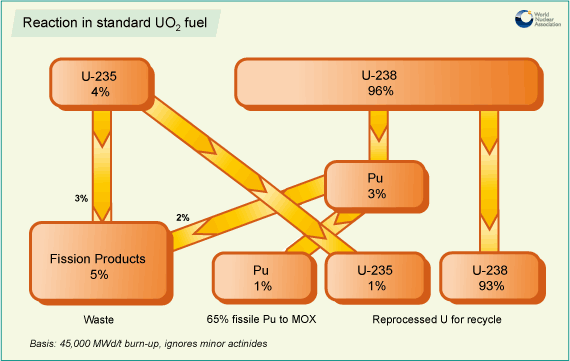
 by Edano via World-nuclear.org 6/7/2011 8:13:05 PM
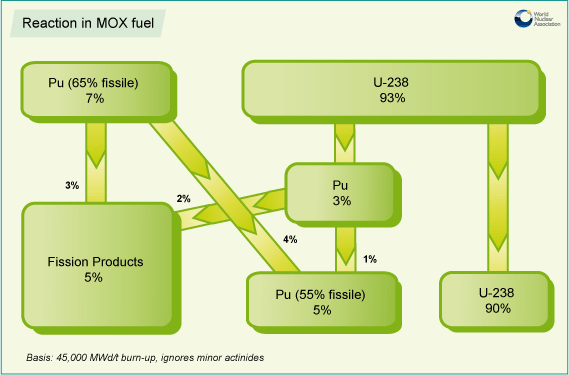
- by Edano via World-nuclear.org 6/7/2011 8:13:05 PM
- lilly.. that sure makes it vulnerable to transport and handle with out compromising the security of the fuelby Dean 6/7/2011 8:15:07 PM
- @nancy what date was the mox delivery we have photo's of?by elainekirk 6/7/2011 8:15:37 PM
- "Fukushima 1-3 Begins Operating with MOX Fuel
On September 18, 2010 Tokyo Electric Power Company (TEPCO) started up its Fukushima I-3 Nuclear Power Plant (BWR, 784MW) using MOX fuel. It loaded MOX fuel into the reactor on August 21 and plans to begin generating electricity on the 23rd.
Over 10 years had passed since this fuel was fabricated. It was fabricated between 1997 and 1998 and arrived at the nuclear power station in 1999, but it was never loaded. Falsification of fuel quality control data for MOX fuel for Kansai Electric Power Company's Takahama-3&4 nuclear power plants was discovered and troubles and cover-ups were discovered at TEPCO nuclear power plants. In response, the prefectural government revoked its agreement with TEPCO. On January 20 2010, TEPCO applied again for permission to use MOX fuel and on August 6 the governor gave his consent." www.abovetopsecret.comby Edano 6/7/2011 8:16:47 PM  @Edano Nice find w/ nuclearhistory.wordpress.com
So, "...all the MOX fuel remains in the (#3)core and none of it had yet been transferred to the unprotected fuel pool."by Reed 6/7/2011 8:17:16 PM- @Reed : yes, if it's true ...by Edano 6/7/2011 8:17:56 PM
- www.nci.org use of MOX detrimental to severe accidentsby Dean 6/7/2011 8:18:36 PM
- That account matches what I have seen elsewhere.by lillymunster 6/7/2011 8:19:04 PM
- what was the plutonium % in the fuku mox anybody know?by elainekirk 6/7/2011 8:20:26 PM
- @elainekirk 6-8%by Reed 6/7/2011 8:20:49 PM
- @elainekirk 6%by Edano 6/7/2011 8:20:51 PM
- "If there is an accident at Fukushima I-3
Exposure doses for residents resulting from a diffusion of radioactivity caused by a severe accident at Fukushima I-3 were calculated by applying the same method used in the disaster assessment in 'WASH-1400', an accident analysis report produced by the U.S. Atomic Energy Commission.
The plan to burn MOX fuel in light water reactors is called the pluthermal program in Japan. In the core of a pluthermal reactor, there are ten times more actinides such as plutonium, americium, and curium than the core of a uranium reactor. Actinides cause serious internal exposure in human bodies and thus pose a very serious threat to human health.
In short, exposure doses resulting from an accident at a pluthermal reactor would be twice those produced by an accident at a uranium reactor. A given exposure dose would be received by residents over twice the distance. The overall affected area would be four times larger. When fatalities by cancer from an accident at a pluthermal reactor is calculated with an assumption that Tokyo was downwind, the number of cancer fatalities would increase from 0.4 million in the case of an accident at a uranium reactor to 10.6 million. In view of such risks, MOX utilization is simply too dangerous. "
By Chihiro Kamisawa
/pg1">www.abovetopsecret.comby Edano edited by Edano 6/7/2011 8:22:20 PM - time for alittle break..will returnby Dean 6/7/2011 8:23:34 PM
- "Japan's pluthermal program (using MOX fuel) began in 2009, ten years later than planned. Plutonium shipped and loaded into reactors is reflected in the figures in these tables. The 1,458 tons of plutonium held as "Unirradiated new fuel at reactor sites etc." includes 210 kg at Fukushima I-3 (TEPCO), 205 kg at Kashiwazaki-Kariwa-3 (TEPCO), 213 kg at Hamaoka-4 (Chubu) and 831 kg at Ikata-3 (Shikoku). (The figures don't add up due to rounding.) The plutonium held at Tokyo Electric Power Company's (TEPCO) reactors was shipped there in MOX fuel over ten years ago. The plutonium held at Chubu Electric's and Shikoku Electric's reactors arrived in MOX fuel from France in May 2009. MOX fuel for Kyushu Electric's Genkai-3 plant (677 kg) also arrived in May 2009, but it was loaded in the same year, so it is included in "Plutonium loaded in nuclear reactors" under "Separated Plutonium in Use". The remaining 669 kg of the total 1,345 kg plutonium loaded in nuclear reactors was loaded in Monju last year. (Monju started up in May this year.)
Hideyuki Ban (CNIC Co-Director)" www.abovetopsecret.com
so where has it been stored all the time ?by Edano 6/7/2011 8:26:36 PM  leakspinner is citing radioactive water at Danini www.youtube.com Maybe the IAEA team visited Daini first to inspect an undisclosed crisis there. ??
Brings to my mind the radiation graph for the Okayama-Tottori prefectures here (scroll down) : www.sendung.de Since March 28th the average readings have doubled from around 30 nGy/h to around 60 nGy/h.
Note that the rise on the Okayama-Tottori graph is progressive, steady and uniform (not just for avg but min and max readings too). So the whole range of detection has roughly doubled. Those prefectures are well south of Fukushima and prefectures between them show no such change, suggesting that any cause of the apparent rise is not Fukushima or some other global rad effect.by Ian 6/7/2011 8:28:05 PM- @Edano That falls in line with what I am reading in the PDF Dean just posted. How sick is it that you look at that and wish it would have been just a plain old uranium meltdown.. I wonder how this impacts the regional contamination. They won't post anything but Iodine and Cesium numbers.by lillymunster 6/7/2011 8:28:15 PM
- @lillymunster : if you think it's bad, you never think it can get worse.by Edano 6/7/2011 8:30:55 PM
- the MOX problem is not even mentioned by tepco or the japanese media. i wonder if the people are aware of it.by Edano 6/7/2011 8:32:38 PM
- @lillymunster No doubt. ONLY I-131 and Cs-137&-134 number posting has been my biggest frustration from the start.
We all know that there's a chain of others...most with either very large half-lives or very dangerous short ones.by Reed 6/7/2011 8:33:43 PM - Just read this 'old' kyodo news report www.next-up.orgby elainekirk 6/7/2011 8:33:50 PM
Japan Earthquake | Page 1532
- Who's Blogging
-
 hudebnik
 alblee
 UKVal
UKVal Jonathan Keebler
 Oliver (ScribbleLive)
 kaykodh
 Markfm
 Angie
Angie Mid Valley
 Matt (ScribbleLive)
 George Gibb
- elainekirk
 PKelley
- lillymunster
 dean
dean bo
bo- Edano
 Deb
Deb- Pedro Jesus
 IanGoddard