Japan Earthquake | Page 1837
 @Dean, thanks for your insights! Also curious is that the darkening on the assembly tops gradually increases over assemblies in one rack, this suggests that the darkening process was a function of proximity, not time. If the darkening was uniform across all assemblies in one rack, it might be some kind of build up (like an oxide film you suggest for the blades) measuring the duration of storage. But the gradual darkening suggests that the darkening was a function of proximity, not time. This seems to favor a fire interpretation.by Ian 7/5/2011 4:04:06 PM
 @dean , yup, having quake-proof recombiners installed may have saved tepco.by Peter Melzer 7/5/2011 4:04:39 PM
 true @Ianby dean 7/5/2011 4:04:53 PM
- @Peter, yes, I've seen Sekimura's pdf, but I'm not following what the Standby Gas Treatment System indicates. His report has the best presentation of Tepcoby Ian 7/5/2011 4:08:03 PM
- (con't)
's Unti 4 gas-injection theoryby Ian 7/5/2011 4:08:23 PM - @Ian, well the system provides the path they believe the hydrogen took. As to the control rods, they may contain hafnium: en.wikipedia.org . Hafnium oxide would be white.by Peter Melzer 7/5/2011 4:13:33 PM
 Another worker heat stroke case (Japanese) sankei.jp.msn.comby lillymunster 7/5/2011 4:16:13 PM
- @Peter, the Standby Gas Treatment System broke shortly after some gas ejected from the stack. We were examining the ejection from the stack here a day or two ago.
Why should we believe gas also passed the wrong way from Unit 3 to 4?by Ian 7/5/2011 4:21:05 PM - The ejection occurred at the time Unit 3 exploded, and then the vent from it to the stack severed.
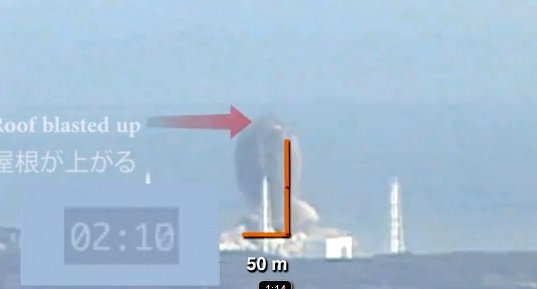
by Ian 7/5/2011 4:22:17 PM 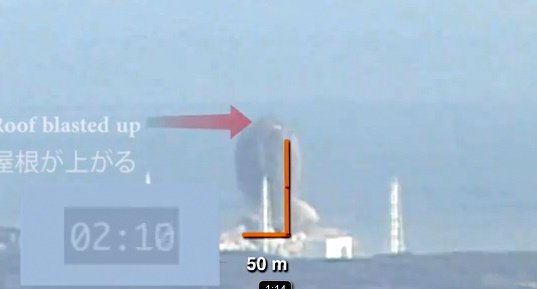
@Peter, Elaine made this screen cap of what is consistent with fast ejection from the Unit 3/4 stack at the time of the U3 blast images.scribblelive.com
by Ian 7/5/2011 4:32:36 PM For our tool belt: Another news outlet that welcomes citizen news reports: DigitalJournal.com is an international news network where thousands of citizen reporters ("Digital Journalists") contribute from 140 countries around the world.[1] digitaljournal.comby Mid Valley 7/5/2011 4:33:02 PM
- @Mid Valley do you know much about how this and CNN's ireport work? Should we sign up with individual accounts or would a group account work?by lillymunster 7/5/2011 4:44:10 PM
- Also re Tepco's Unit4 gas-injection theory , Edano posted reported stack venting times
#3: 3/12 20:41 ; 3/13 8:41 - 9:20 ; 3/14 5:20
#2: 3/13 11:00 ; 3/14 20:35 ; 3/15 0:02
#1: 3/12 6:40 , 10:17 , 14:30 , 13:42 (? inofficial, on videos)
In his data plots www.houseoffoust.com
So we know the vents were working to eject gasses outside, and some vent events were captured on TeppyCam www.youtube.com Here's the full video clip from which Elaine made the screen shot, the faint wisp from the U3/4 stack lasts for fractions of a second.
All of this makes me skeptical that Unit 3 vented much if anything into Unit 4, causing it to explode a day later. Me thinks the burden on proof is on Tepco to show that the vents behaved in a extraordinary way as they theorize, and until they can show that, the default assumption is that the vents worked ordinarily as we can see they were doing.by Ian 7/5/2011 4:44:44 PM - @lilly and@Peter, I was thinking that the posting of signs or markers along road ways where TEPCO or other private measurement groups is an excellent idea and FUKUSHIMA may prove a good start for international markings to alert people to what radiation is there or contamination, levels with some universal danger warning and the date/time.. etc..by dean 7/5/2011 4:45:42 PM
- Opps, forgot full video clip of U3/4-stack venting : www.youtube.comby Ian 7/5/2011 4:46:14 PM
- @lillymunster. I will create an account and explore.by Mid Valley 7/5/2011 4:46:33 PM
- @Ian , the point with the location of this system is that if GE built Unit 1 turn-key, the system was in all likelihood located under the roof, which explains why the roof caved in and there is not much visible damage to the floors below. If it was located under the service floor in the other units, it might explain why they show more damage there. As to Unit 4, the only fashion I can see tepco's hypothesis work is that the gas had seeped into Unit 4 in the days before the explosion of Unit 3 and was ignited by a different event.by Peter Melzer 7/5/2011 4:51:27 PM
- @dean @Peter, this could be something to coordinate with some of the groups on the ground in Japan, especially ones working directly with the people in the region. We could figure out what groups are working with people and see if they would be interested in doing something with such signs. They would be easy enough for someone to get locally produced either as metal or an outdoor plastic sign. This made me think about it, I don't think anyone is labeling hot spots after they fin them.by lillymunster 7/5/2011 4:59:31 PM
- @Peter, and Sekimura's presentation (page 51) should some vent outlets on the floor below U4's service floor.by Ian 7/5/2011 5:00:12 PM
 Independent radiation readings of 1000 Japanese locations released translate.google.comby Bobby1 7/5/2011 5:05:16 PM
agreed @ lillyby dean 7/5/2011 5:10:45 PM
@ all I like this area so much because we bring ideas and theories to the table for consideration.. .like the unit 4 explosion etc, like the unit 3 explosion and the detailed look into how they happened where the blast patterns were, how the HVAC responded to the percussion from the blasts, how all the systems reaced to the EQ's etc. one thing is.. for many of the things there is concrete proof (pardon the pun on concrete), for for so many others our best efforts become theories only...by dean 7/5/2011 5:15:10 PM
time to go to lunch.. be backby dean 7/5/2011 5:26:10 PM
According to the link posted below, Professor Kunihiko Takeda recommends evacuation when more than 0.6 uSv/hr radiation is detected. There are 46 locations in that list of 1,000 which exceed this criterion. Also of note, cesium has been detected in Karatsu, which is very far from the NPP, near Nagasaki.by Bobby1 7/5/2011 5:26:16 PM
@Bobby1 Do you remember the chernobyl threshold for evacuation?by lillymunster 7/5/2011 5:28:41 PM
@Dean, good observations! Btw, do you know the dimensions the upper-tie plat (or 'handle') of a fuel assembly? Even just a rough estimate. As a total novice I don
tby Ian 7/5/2011 5:28:52 PM
@lillymunster Eh, offhand no, but it was based on becquerels of cesium, not radiation levels.by Bobby1 7/5/2011 5:32:01 PM
 M5.5 quake shakes northern Wakayama Prefecture
TOKYO, July 5, Kyodo
A fairly strong earthquake with a magnitude of 5.5 shook northern Wakayama Prefecture on Tuesday evening, the Meteorological Agency said, but caused little damage, no reported injuries, and no tsunami warning was issued.
There were no immediate reports of damage, Chief Cabinet Secretary Yukio Edano told a news conference after the 7:18 p.m. quake, which measured upper 5 on the Japanese seismic intensity scale of 7 and was followed by several aftershocks including one with a magnitude of 4.4 that occurred 16 minutes later.
All local train services operated by West Japan Railway Co. in the western prefecture south of Osaka were briefly suspended, but the quake did not affect expressways, bullet train services, or nuclear power plants, according to local officials.
english.kyodonews.jpby Edano 7/5/2011 5:32:51 PM
 Magnitude 5.5 quake hits western Japan
Japan's Meteorological Agency says a 5.5-magnitude quake hit western Japan on Tuesday night.
The agency says the quake occurred at around 7:18 PM, Japan Time, in northern Wakayama Prefecture. The quake's focus is estimated at 7 kilometers below ground.
The quake registered an intensity of 5-plus on the Japanese scale of 0 to 7 in Hirogawa and Hidakagawa towns, both in the prefecture. 5-minus was registered in Arida City and Yuasa Town, also in the prefecture.
Jolts with intensities ranging from one to 3 were recorded in wide areas of western Japan.
Tuesday, July 05, 2011 20:04 +0900 (JST)
www3.nhk.or.jpby Edano 7/5/2011 5:34:58 PM
@lillymunster "The Soviet National Committee on Radiation Protection (NCRP) proposed a 350-mSv lifetime dose intervention level for the relocation of population groups (Il87). This value was lower by a factor of 2 to 3 than that recommended by the International Commission on Radiological Protection (ICRP) for the same countermeasure. Nevertheless, this value proposed by the NCRP was strongly criticised as being a very high level. The situation was further complicated by the political and social tension in the Soviet Union at that time. As a result, the NCRP proposal was not adopted by the Supreme Soviet. Later, a special Commission was established which developed new recommendations for intervention levels. These recommendations were based on the levels of ground contamination by the radionuclides 137Cs, 90Sr and 239Pu. As has been mentioned above, large areas were contaminated mainly by 137Cs and a ground contamination level by this radionuclide of 1 480 kBq/m2 was used as the intervention criterion for permanent resettlement of population, and of 555 to 1 480 kBq/m2 for temporary relocation." www.oecd-nea.orgby Bobby1 7/5/2011 5:35:32 PM
@Bobby1 micro not milli, right ?by Edano 7/5/2011 5:36:25 PM
Emergency generators faulty at 2 nuclear plants
Japan's Nuclear and Industrial Safety Agency says the defective components discovered in emergency generators at 2 nuclear power plants have been replaced.
Agency inspections found faulty parts in the back-up generators for the No. 1 reactor at Hokuriku Electric Power Company's Shika plant, and the No. 1 reactor at Kansai Electric Power Company's Mihama plant.
The inspections followed the discovery of defective parts in an emergency generator for a fast-breeder reactor in Tsuruga City, on the Japan Sea coast.
Last December, a crack in a component of the cylinder of the generator for the "Monju" reactor caused a malfunction.
The crack was blamed on weakness of the component due to its lead content having been wrongly mixed with other metals in the manufacturing stage.
Tuesday, July 05, 2011 17:53 +0900 (JST)
www3.nhk.or.jpby Edano 7/5/2011 5:37:34 PM
4 local governments seek to scrap nuclear plants
An NHK survey of local governments with nuclear power plants has found that 4 of 28 respondents are ready to break with nuclear energy.
Last week, NHK asked local governments with nuclear plants, except those in Fukushima Prefecture, how their thinking about the plants has changed since the Fukushima Daiichi crisis began.
Of the 28 prefectures and municipalities that responded, 15 said they could not make an immediate decision on whether to pursue closure of their plants.
Five municipalities said they would not seek to have their plants scrapped, because nuclear power remains a vital source of energy.
Shizuoka Prefecture, however, said it wants to immediately launch a campaign to have its plants decommissioned.
Three other local governments said they hope to launch such campaigns in the near future.
Shizuoka Governor Heita Kawakatsu said the nuclear crisis in Fukushima has underscored the need for a fundamental review of Japan's energy policy. He said the country must make efforts to shift to new sources of energy.
Mayor Tatsuya Murakami of Tokai Village, where a criticality accident occurred in 1999, said it's become impossible to predict the extent of impact a nuclear disaster would have.
He said Japan should take the global initiative in moving toward the abandonment of nuclear energy.
Tuesday, July 05, 2011 19:08 +0900 (JST)
www3.nhk.or.jpby Edano 7/5/2011 5:38:54 PM
@Edano The original Soviet proposal was for a 350 millisievert lifetime dose. It's not clear whether the proposal that was adopted is higher or lower than this.by Bobby1 7/5/2011 5:40:28 PM
@Ian The GE BWR manual that I think I have a copy of on my website has all the fuel assembly data in it. Look in the documents links or let me know if you don't find it. I should have a back up copy,.by lillymunster 7/5/2011 5:41:32 PM
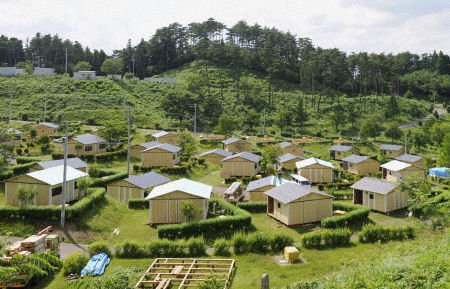
english.kyodonews.jp
Temporary housing in campground
Photo shows temporary housing units for people affected by the March 11 quake and tsunami under construction in a campground in Rikuzentakata, Iwate Prefecture, on July 5, 2011. A total of 108 units are expected to be built there by the end of the month. (Kyodo)
english.kyodonews.jpby Edano via English.kyodonews.jp 7/5/2011 5:42:10 PM
 @Edano they are great so much better for families than mats on a gym floorby Elaine Kirk 7/5/2011 5:43:15 PM
@Elaine Kirk There were some evacuees living in a hotel that had gone out of business. It made local news when they were all moving out to other locations since the building was being knocked down to build a new one. It didn't sound like the building was in bad shape, just being replaced by something newer/bigger. One of the few creative solutions to get people off of gym floors.by lillymunster 7/5/2011 5:52:53 PM
@lillymunster it was a big hotel in tokyo.by Edano 7/5/2011 6:04:52 PM
@lillymunster yes they were moved out last week I believe search.japantimes.co.jpby Elaine Kirk 7/5/2011 6:06:37 PM
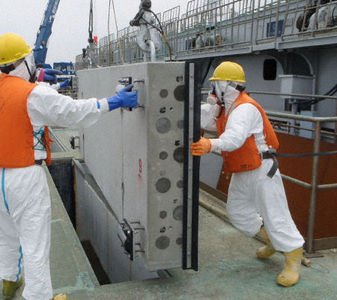
english.kyodonews.jp
No. 2 unit at Fukushima Daiichi nuclear plant
Workers in protective suits install a partition plate to prevent radioactive water from flowing into the sea around the water intake of the No. 2 reactor at the crippled Fukushima Daiichi nuclear power plant in Fukushima Prefecture on June 12, 2011. (Photo courtesy of Tokyo Electric Power Co.)(Kyodo) english.kyodonews.jpby Edano via English.kyodonews.jp 7/5/2011 6:15:16 PM
@Edano cant say I am impressed with the 'seals'by Elaine Kirk 7/5/2011 6:17:34 PM
@Elaine Kirk : no ? ;)by Edano 7/5/2011 6:19:14 PM
 ---- Safecast ----
This site is not meant as a replacement for government or nuclear agencies. Our hope is that data sets from various places can provide additional context to the official statements in these rapidly changing events. We welcome your thoughts on how to improve the site, and appreciate your work to provide a richer understanding of these events.
If you are a scientist or member of a government agency, and would like to contribute data in an official capacity, please contact us here.
While we are gathering our own data, we want to recognize the efforts of others who are actively seeking, parsing and making data available for others to use.
More: www.safecast.orgby joniver 7/5/2011 6:27:22 PM

 by RadioGuy via Guy-sports 7/5/2011 6:29:35 PM
Japan Earthquake | Page 1837



- Who's Blogging
-
 hudebnik
 alblee
 UKVal
UKVal Jonathan Keebler
 Oliver (ScribbleLive)
 kaykodh
 Markfm
 Angie
Angie Mid Valley
 Matt (ScribbleLive)
 George Gibb
 elainekirk
 PKelley
- lillymunster
- dean
 bo
bo- Edano
 Deb
Deb Pedro Jesus
 IanGoddard