Japan Earthquake | Page 1968
 www.ssd.noaa.gov
Ma-On satellite image loop since midnight UTC.by RadioGuy 7/19/2011 2:12:56 PM- Wow...look how the jet stream is ripping the spin right out of it (and some moisture away from it) as it blows by on the north. And how hard another cyclonic is trying to form above it.by RadioGuy 7/19/2011 2:14:30 PM
 Daily news roundup done www.simplyinfo.orgby lillymunster 7/19/2011 2:26:39 PM
www.geekologie.com
It helps me understand this more, though.by RadioGuy via Geekologie 7/19/2011 2:27:32 PM- Tip of the hat, Lilly. I've been frantically busy. Great work.by RadioGuy 7/19/2011 2:29:43 PM
- off againby RadioGuy 7/19/2011 2:29:47 PM
 Looking at the MTSAT and then the teppy cam, made me sick to my stomach :( Even through the wind and rain you can see the smoke pouring out of 3 & 4. This is such a nightmare.by deb 7/19/2011 2:30:39 PM
- @deb TEPCO = "no radiation leaking out" REALITY= 1 billion bq/hourby lillymunster 7/19/2011 2:37:43 PM
- @RadioGuy Thanks. Trying to blast through some needed content and info this morning before I dive head first into work for the day. I am working on a short article about the cold shutdown BS, the lack of food testing and a tie in to Bo's new article www.dianuke.org
I want to finish up the protect yourself article tonight and hoping to get a plutonium facts one out in a few days so we can push it and hopefully get more information to people so they can try to easily educate those they run into. One of the parents groups members had a teacher tell her plutonium wasn't dangerous unless in huge amounts.by lillymunster 7/19/2011 2:40:09 PM - @lillymunster Yeah, saw and already posted on FB!by deb 7/19/2011 2:48:47 PM
 i hope the taifun destroys the dolphin slaughterers' homes.by Edano 7/19/2011 3:04:13 PM
 @Edano agreedby Panserbjorne9 7/19/2011 3:05:34 PM
 @lillymunster, as to "cold shutdown", all they achieved now is keeping the measured water temps below the boiling point. As long as radioactivity is released into the air at the rate you mentioned, the situation is not contained. In addition, we cannot take for granted that the recirculation cooling systems are truly closed loops. As long as the primary containments cannot be sealed and coolant flows freely into the basements, the water is going to seep into the ground. As long as the airborne and waterborne emissions are not contained, it will be ill-advised to declare the crisis under control and encourage people to return to their homes in the exclusion zone.by Peter Melzer 7/19/2011 3:05:44 PM
- @Panserbjorne9 i just wanted to censor myself.by Edano 7/19/2011 3:05:59 PM
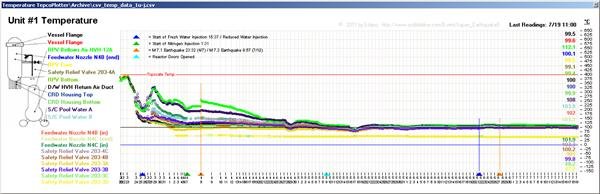
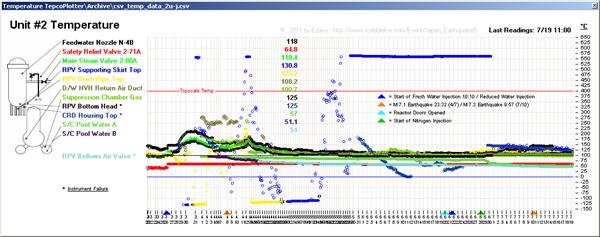
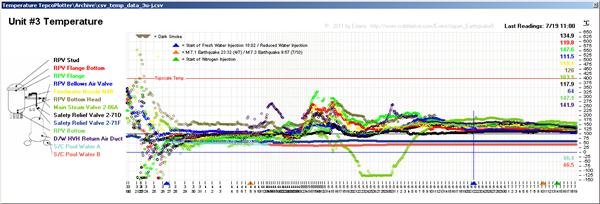
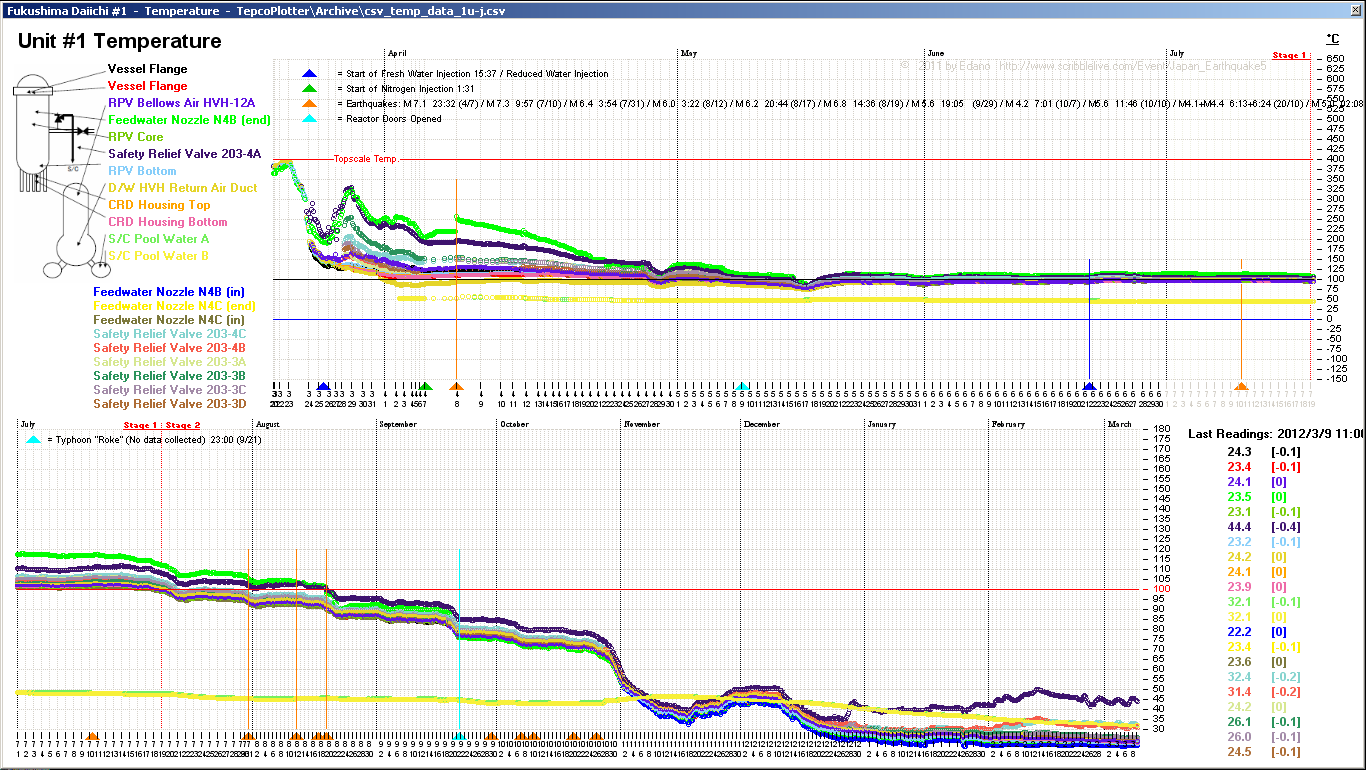
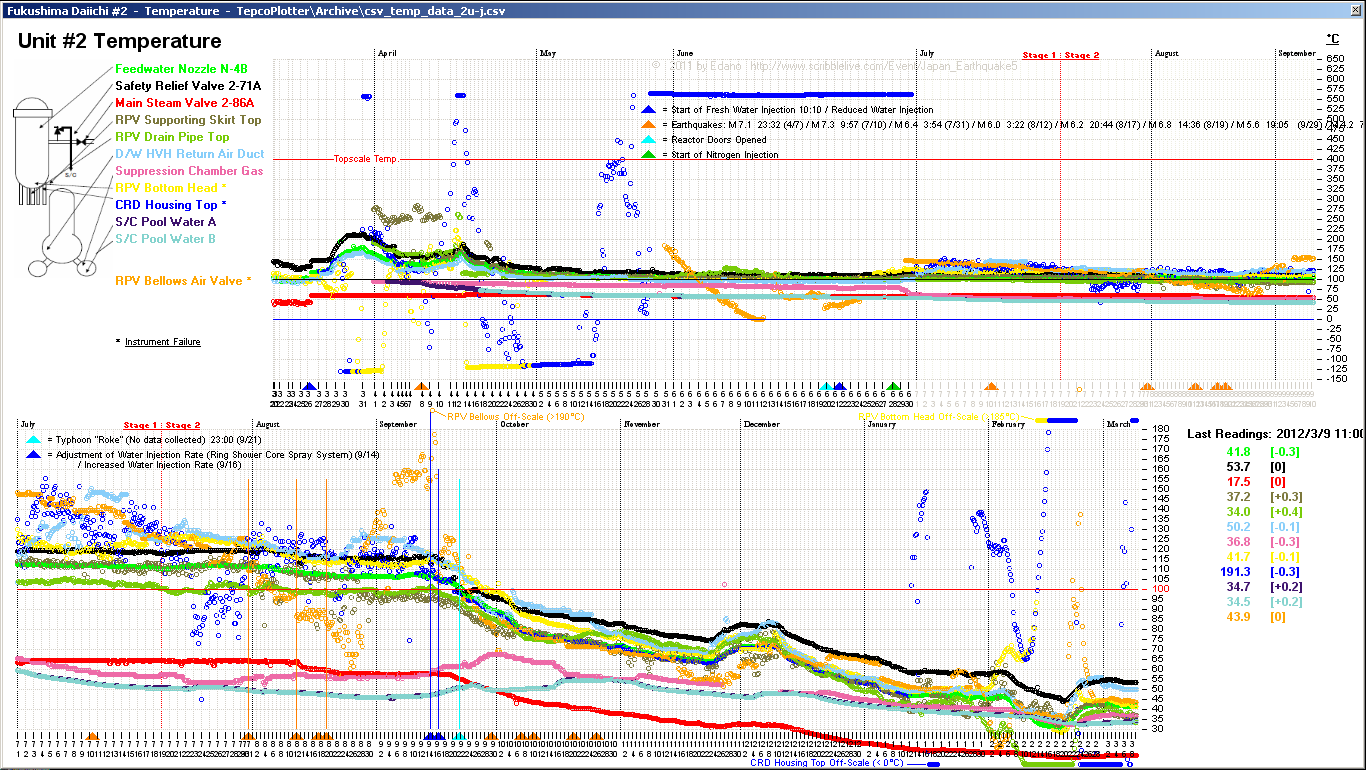
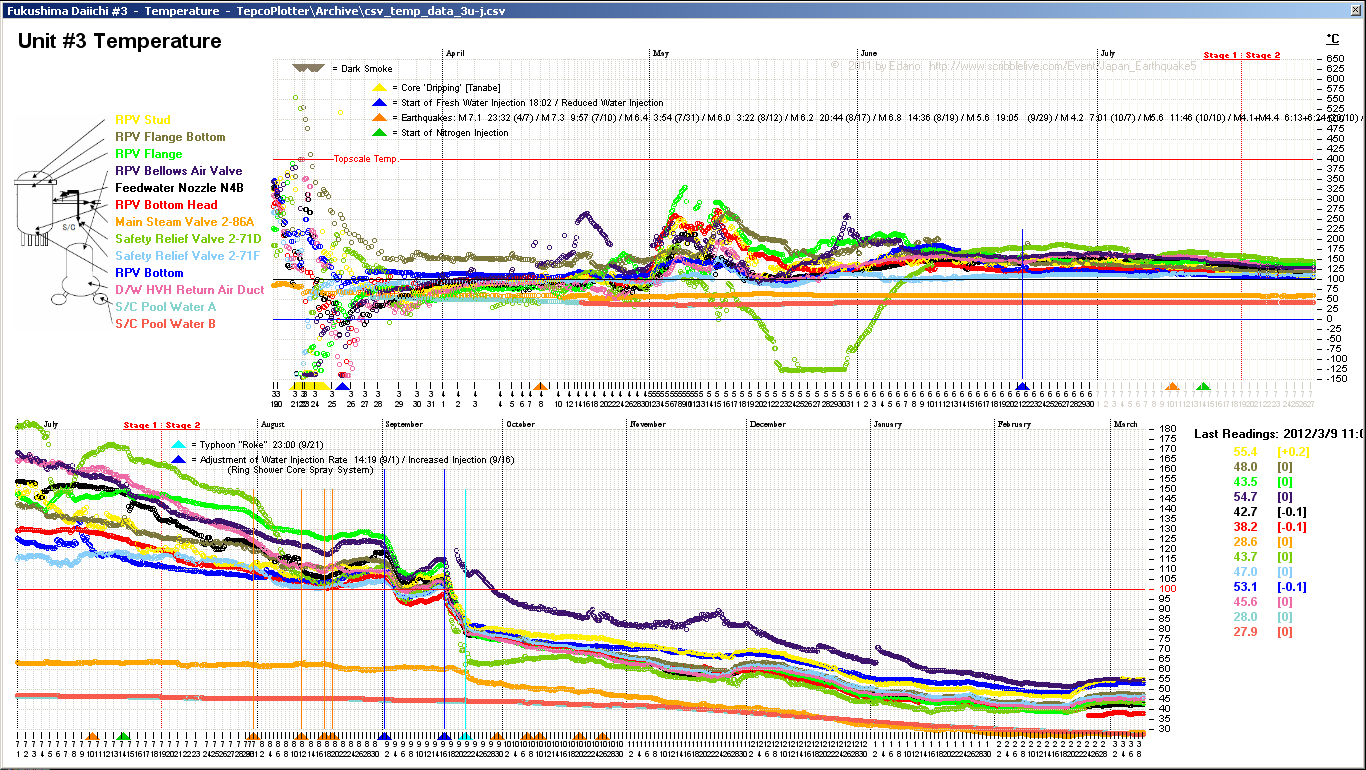
- @Peter Melzer : the reactor temps are far from below boiling temp.by Edano 7/19/2011 3:07:07 PM
- @Edano , I thought that was their definition of cold shutdown. Well, then they even have not achieved that. Also, imagine where the corium lurks, the temps are still hundreds of degrees centigrade for sure.by Peter Melzer 7/19/2011 3:09:05 PM
- @Edano that's taking Mod Power to a weird level :)by Panserbjorne9 7/19/2011 3:09:22 PM
- by Edano via Houseoffoust 7/19/2011 3:10:30 PM
- by Edano via Houseoffoust 7/19/2011 3:10:30 PM
- by Edano via Houseoffoust 7/19/2011 3:10:30 PM
- the temps converge to a point above 100°. i wonder how they want to achieve lower temperatures.by Edano 7/19/2011 3:11:52 PM
- at this point, i think they can only hope and wait for lower temperatures.by Edano 7/19/2011 3:14:21 PM
- @lillymunster , I believe monitoring car air filters regularly may help establish an accurate sense of airborne particulate contamination.by Peter Melzer 7/19/2011 3:17:19 PM
- @Edano , I wonder on which of these records they base their judgement. I wonder whether they were able to reduce the boil off at all.by Peter Melzer 7/19/2011 3:19:30 PM
 Morning all! Anyone looking at the Tepco cam? Even through the rain you can see them spewing. 3 looks a lot worse than it has been...large plumes of steam/smoke shooting upward.by LM 7/19/2011 3:26:26 PM
- Japan Beats the Heat (And Power Cut) With 'Air-Conditioned Clothes'
www.medindia.netby Panserbjorne9 7/19/2011 3:28:23 PM - @Peter Melzer : maybe for the spent fuel pools, but surely not for the reactors.by Edano 7/19/2011 3:29:08 PM
- @Peter Melzer thanks, I am working on something about the cold shutdown nonsense. Good points to add.by lillymunster 7/19/2011 3:32:27 PM
- @lillymunster : well, they did not say they have a cold shutdown yet. they only use the word "stabilized". cold shutdown is the next step in their roadmap. don't mix it up.by Edano 7/19/2011 3:33:58 PM
- tho, a cold shutdown with a molten core is not possible in my opinion.by Edano 7/19/2011 3:34:58 PM
- "The taskforce said the first stage of the plan outlined in mid-April for the stable cooling of the reactors has been completed on schedule by mid-July. It added radiation levels in the plant's surrounding areas have been steadily reduced. ..."
"In the second stage of the plan for the cold shutdown of the reactors, TEPCO plans to improve its systems to decontaminate wastewater and to cool reactors and fuel rod pools at the plant."
www3.nhk.or.jpby Edano 7/19/2011 3:38:46 PM - U.S. regulators need to take steps to ensure safety within 5 yrs
mdn.mainichi.jpby Panserbjorne9 7/19/2011 3:38:50 PM - Miyagi man who sold contaminated straw blames gov't for scandal
A man in Osaki, Miyagi Prefecture, who sold straw contaminated with high levels of radioactive cesium told the Mainichi on July 18 that he had never imagined that his straw was contaminated because the city is about 150 kilometers away from the crippled Fukushima No. 1 Nuclear Power Plant. mdn.mainichi.jpby Panserbjorne9 7/19/2011 3:40:22 PM - @Edano , I found this in the NISA report to IAEA and wonder whether they have been able to reduce the amount since then:
Total water boil-off as steam until end of May [metric tons]:
Unit 1: 5,100
Unit 2: 7,900
Unit 3: 8,300by Peter Melzer 7/19/2011 3:40:29 PM - @Edano , I see, I wasn't reading the fine print. Stable cooling can be at any temp. and we are still far way from cold shutdown.by Peter Melzer 7/19/2011 3:43:10 PM
- @Peter Melzer : yes :) but it is cleverly paraphrased. one could mean a cold shutdown is reached already.by Edano 7/19/2011 3:44:33 PM
- @edano, but I thought that was the first goal on the roadmap, ;)by Peter Melzer 7/19/2011 3:44:58 PM
- the cold shutdown, I meant!by Peter Melzer 7/19/2011 3:45:33 PM
- has anyone found documentation of what irockhopper tweeted earlier- "TEPCO/gov announced today that the current amount of radioactive chemicals spewing from the #Fukushima is 1 billion Bq/hour."?by Panserbjorne9 7/19/2011 3:48:11 PM
- @Panserbjorne9 not yet. Let me go ask.by lillymunster 7/19/2011 3:48:34 PM
- @Panserbjorne9 : this could be correct, mathematically.by Edano 7/19/2011 3:50:10 PM
- @Peter Melzer : they just mean a sort of circulation cooling that they achieved now. not just pouring water in.by Edano 7/19/2011 3:53:01 PM
- @Peter Melzer
Govt to define "cold shutdown"
The second-stage target to bring the nuclear disaster under control will involve achieving a cold shutdown, under which the disabled reactors are to be cooled down to about 100 degrees Celsius or lower.
The Japanese government is due to make this clear on Tuesday when it releases a revised plan to contain the accident at the Fukushima Daiichi nuclear power plant.
The government has so far failed to specify what a cold shutdown entails. It now plans to define the term as bringing reactor-bottom temperatures to about 100 degrees or lower, and substantially reducing the public's radiation exposure by controlling the release of radioactivity.
Achieving a cold shutdown has been cited as one of the conditions for lifting the 20-kilometer no-entry zone around the Fukushima Daiichi plant.
It remains unclear, however, when the lifting would come, as the government still hasn't decided on benchmark levels of radiation that it deems safe enough for people to return to the restricted zone.
Tuesday, July 19, 2011 09:42 +0900 (JST)
www3.nhk.or.jpby Edano 7/19/2011 3:55:34 PM - @Edano , interesting. Yesterday the tenor of the government's pronouncements sounded more upbeat like you will be able to go home within weeks.by Peter Melzer 7/19/2011 3:58:09 PM
- Japan moves on to stage to seek cold shutdown of crippled reactors
TOKYO, July 19, Kyodo
Japan said Tuesday it has succeeded in stably cooling the crippled nuclear reactors at the Fukushima Daiichi power plant and reducing the radiation dose around the site, an announcement that would lead restoration efforts to move on to the next stage of seeking a ''cold shutdown'' of the reactors by January.
In an updated road map to contain the four-month-old nuclear crisis, unveiled the same day, the government said it plans to work out by around autumn safety guidelines to maintain the ravaged plant's stability for a long period, while plant operator Tokyo Electric Power Co. will seek to start removing spent nuclear fuel within three years following the stabilization of the reactors.
''We're starting to see a tremendous critical condition heading toward a certain level of settlement,'' Prime Minister Naoto Kan told a parliamentary committee as he welcomed the completion ''almost as scheduled'' of the so-called ''step one'' phase of the utility's restoration road map.
''Some progress has been made earlier than originally scheduled'' in the step one phase,'' Kan also told a meeting of the government's task force on the world's worst nuclear crisis in 25 years.
The government left unchanged the originally set timeline to achieve the ''step two'' phase, which includes the goal of realizing a cold shutdown of the Nos. 1 to 3 reactors, in the latest scenario.
Industry minister Banri Kaieda said the government could lift a directive that requires residents in a zone 20 to 30 kilometers from the plant to be prepared to evacuate or stay indoors in an emergency, before completing the next phase.
The road map also showed that the government will consider lifting a ban on people entering areas within a 20-kilometer radius of the plant towards the end of the step two phase, which is to be implemented in the three to six months following the completion of the first phase.
As for the definition of a state of cold shutdown, the government said that the bottom part of a reactor's pressure vessel should be basically kept at 100 C or below, and that radiation exposure caused by the additional release of radioactive substances should be ''greatly restrained.''
At present, the maximum amount of such substances leaking from the damaged Nos. 1 to 3 reactors is 1 billion becquerels per hour, around one two-millionth of the level at the time of the accident, the utility known as TEPCO said.
Based on the data, the maximum radiation dose amounts to 1.7 millisieverts per year around the plant, and TEPCO is expected to bring the level to below the legal limit of 1 millisievert per year, an official at the government's Nuclear and Industrial Safety Agency said.
TEPCO also said it will try to improve the operational ratio of water decontamination devices from around 70 percent of capacity this month as well as consider creating another system as the current water treatment system can be used for only about a year.
The utility plans to design an underground wall, expected to extend 30 meters deep, to prevent contaminated water from seeping from the reactor and turbine buildings and getting mixed with groundwater, it said.
Restoration efforts have continued since the March 11 magnitude 9.0 earthquake and tsunami hit the six-reactor complex and led the cooling functions of the reactors and spent nuclear fuel pools at the Nos. 1 to 4 units to fail.
One of the key challenges during the past months has been how to deal with the massive amount of highly radioactive water that has accumulated in the reactor turbine buildings and nearby areas as an outcome of an emergency measure to continue injecting water into the reactors to cool the fuel inside.
Nitrogen, an inert gas, is also being injected into the reactors to prevent hydrogen explosions, which could lead to the release of massive amounts of radioactive substances. But basically all the spent fuel tanks of the Nos. 1 to 4 units are already being kept cool.
==Kyodo
english.kyodonews.jpby Edano 7/19/2011 4:01:09 PM
Japan Earthquake | Page 1968
- Who's Blogging
-
 hudebnik
 alblee
 UKVal
UKVal Oliver (ScribbleLive)
 Jonathan Keebler
 kaykodh
 PKelley
 Markfm
 Angie
Angie Deb
Deb Mid Valley
 Pedro Jesus
 Matt (ScribbleLive)
 George Gibb
 elainekirk
- lillymunster
 dean
dean bo
bo- Edano
 IanGoddard