Japan Earthquake | Page 1986
 @lillymunster , it is important that they agree on a standard protocol for their readings. Otherwise, you will not be able to compare them.by Peter Melzer 7/21/2011 2:17:59 PM
 agriculture ministry under fire over rice straw mdn.mainichi.jpby lillymunster 7/21/2011 2:26:37 PM
- Kan, Japan should reconsider exporting nuclear power www.nasdaq.comby lillymunster 7/21/2011 2:27:10 PM
- As a thought, even though the Western European governments never conceded that the contamination levels from Chernobyl posed an immediate hazard to their nations' public health, citizen action may have saved lives. Since there is no comparison (like how many more people would have died of cancer, had citizens not acted), we shall never truly know how many. But the German experience should encourage the citizens of Japan to protect themselves as much as possible. Obviously, in Europe, as much as in Japan, governments are unable to provide adequate help.by Peter Melzer 7/21/2011 2:28:08 PM
- @Peter Melzer I really does seem like a copy of the same events. Maybe people who experienced Chernobyl in Germany can provide some support and guidance to those in Japan because they went through the same thing before.by lillymunster 7/21/2011 2:33:29 PM
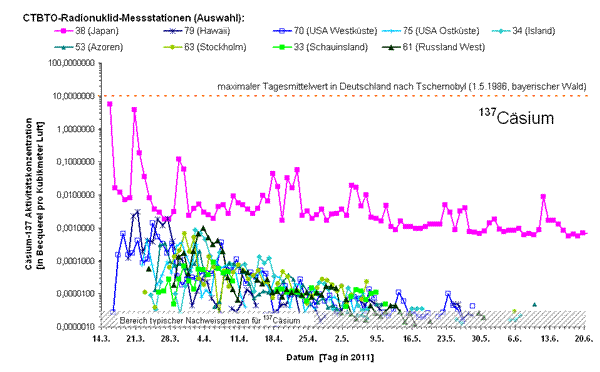
Also, looking at the CTBTO measurements above, we find that Cs-137 in Japan seems to level out at 10,000 times the amount measured in the rest of the world. The disconcerting point is, the levels in Japan may not decline any further. www.bfs.de
by Peter Melzer via Bfs.de 7/21/2011 2:39:55 PM @Peter Melzer Re: Chernobyl, that is not true. I was here and I remember. There was major concern and a lot of special measures were taken even by the Governments of countries that were not affected, such as Portugal.by Pedro Jesus 7/21/2011 2:52:45 PM
 Cancer patients' urine suspected in Wissahickon iodine-131 levels : Three weeks after an earthquake and tsunami severely damaged Japan's Fukushima nuclear power plant, Lisa Daniels opened an e-mail with test results of river water samples from Southeastern Pennsylvania.
It was just after lunch April 1. Nationwide, officials were testing rain, rivers, milk, and other substances to learn if radioactivity from the stricken plant was present. www.philly.comby Majj 7/21/2011 3:02:13 PM- 59 more homes evacuated in hot spots in Minamisoma ow.ly
Same story in English at Kyodo english.kyodonews.jpby lillymunster 7/21/2011 3:15:12 PM - @Pedro Jesus , in Germany it took quite a while for government to come up with a unified strategy. In Switzerland, it was as though nothing publicly disconcerting ever happened. While the Germans sequestered milk on one side of the Rhine, the Swiss pretended that radioactivity had not crossed the river. I cannot recall a single incident in which Swiss produce was overtly banned from markets in Switzerland. though we know now that contamination levels were quite elevated at higher altitude in the mountains.by Peter Melzer 7/21/2011 3:39:01 PM
 Suffolk Closeup: Rejecting nuclear power
The Fukushima Daiichi nuclear disaster has caused several nations to say no to nuclear power, mainly through elections, referenda and protests. But the position of the U.S. government, including the federal officials who represent Long Island, is different. Despite Fukushima, as U.S. Senator Chuck Schumer says, “I’m still willing to look at nuclear.”
Since Fukushima, the stance of the U.S. government has been in “sharp contrast” to the direction taken by these other nations, notes Kevin Kamps of the organization Beyond Nuclear (beyondnuclear.org). Officials in Washington are “living in a bubble,” he says. This has much to do with the continued intense lobbying by the nuclear industry and the massive campaign contributions it provides.
President Barack Obama has not only continued his support of nuclear power, a reversal of the critical position he took during his election campaign, but since Fukushima has renewed his call for $36 billion in taxpayer-based loan guarantees to construct new nuclear plants.
Polls show that, since Fukushima, a growing number of people in the U.S. — more than a majority — are against nuclear power. How can this be translated politically?
Meanwhile, on Long Island, Priscilla Star of Montauk, through the Coalition Against Nukes (CAN), is organizing coordinated protests throughout the nation, including in Manhattan on October 1.
“We have to show Washington where the people stand on deadly nuclear power and what we have learned from the Fukushima catastrophe.
Time’s up, Washington!” said Ms. Star last week. She can be reached at priscillaastar@hotmail.com or at 631-680-5163.
More: shelterislandreporter.timesreview.comby joniver 7/21/2011 3:44:15 PM @Majj From that Philly article:
They've also realized that worrisome levels of iodine-131 had been detected long before the Fukushima accident in several Philadelphia drinking water samples taken as part of an obscure monitoring program run by the U.S. Environmental Protection Agency.
Within that limited data set of 59 locations across the country, Philadelphia's levels were the highest in the previous decade, the Water Department discovered.by RadioGuy 7/21/2011 3:44:43 PM- Detected and ignored, apparently, because who would want to know?by RadioGuy 7/21/2011 3:45:47 PM
- @RadioGuy Mom of 3 was tracking this. She was trying to get answers.by lillymunster 7/21/2011 3:46:03 PM
- @Peter Melzer It's strange that that was the case in central Europe because in Northern and Western Europe things were quite different. I have a friend from Sweden who lived through that and she remembers that a lot of food was taken off the market and the Government told people to only drink bottled water, for example. They were also told to remain in doors as much as possible and wear protective gear whenever going outside. Same happened in regions of Finland. In Portugal and Spain a lot of food was quarantined and analysed and people were told to only drink bottled water. We didn't get any fallout in Portugal, luckily.by Pedro Jesus 7/21/2011 3:58:10 PM
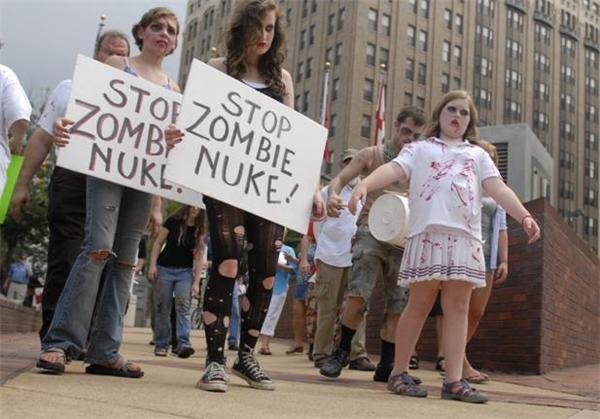
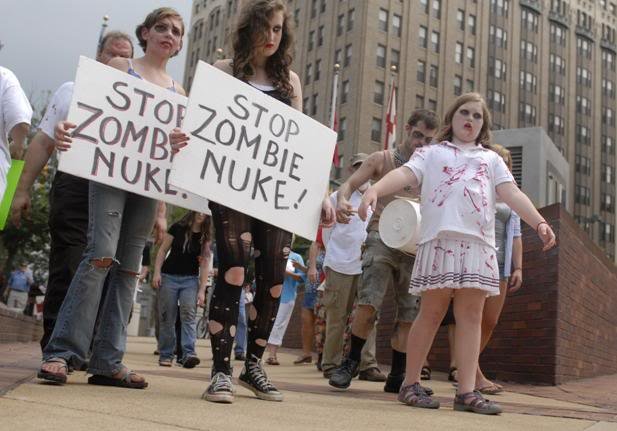
With deep under-eye shadows and painted-on blood stains, zombies brought a nuclear protest to the TVA headquarters on Market Street on Wednesday.
Holding signs that read "No new nukes" and "Bellefonte = Danger + Debt," about 50 protesters ranging from young teens to grandparents crowded the sidewalk at the Tennessee Valley Authority building downtown to ask CEO Tom Kilgore and the TVA board to say no to more nuclear reactors in the Tennessee Valley.
"We don't want our children to have to have this kind of test," said Sandy Kurtz, holding up a radiation Geiger counter like those in photographs of Japanese health officials scanning children on the heels of the Fukushima Dai-ichi nuclear meltdowns in March.
Kathleen Ferris, a grandmother who drove from Murfreesboro, Tenn., to be part of the protest, said it will take more than that to change her mind.
"I have two grandchildren, and the whole world has grandchildren," she said.
"Nuclear reactors emit radiation. Radiation causes cancer. It causes childhood leukemia. It can cause genetic defects," she said. "I don't want the grandchildren of the world to be genetically modified. I just want a healthy, clean world for them to live in. And that's why I'm carrying a sign that says 'Go green!'"
According to a number of recent polls, Chattanooga's protest may be just the tip of the cooling tower of America's frosty attitude toward nuclear power after an earthquake and tsunami led to multiple meltdowns in Japan.
An ABC and Washington Post poll in mid-April found an 11-percentage point increase in the number of Americans opposing the building of new nuclear plants.
That poll found that 64 percent of respondents now oppose new nuclear plant construction, while 33 percent support it.
In a similar poll in 2008, 53 percent of Americans opposed new nuclear plant construction.
More: timesfreepress.comby joniver via I1235.photobucket 7/21/2011 3:59:13 PM- WTH, capsules of powered humans smuggled to South Korea sankei.jp.msn.comby lillymunster 7/21/2011 4:01:00 PM
- @Pedro Jesus , you are quite right. Perhaps, I was generalizing too much. In Northern Scandinavia, I remember, the contamination was so great that it could not be ignored. The rain deer meat still shows elevated levels and the native Sami developed distinct health problems. But I cannot remember much happening in France and Italy. The official response may have dependent a lot on how wind and weather blew the plume.by Peter Melzer 7/21/2011 4:04:46 PM
 @lillymunster Please tell me this isn't true! Soylent powder?by Diane_NJ 7/21/2011 4:14:55 PM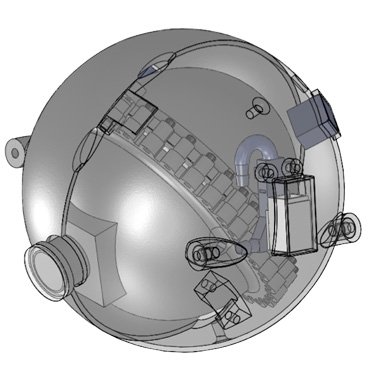
The Associated Press released results from a yearlong investigation, revealing evidence of “unrelenting wear” in many of the oldest-running facilities in the United States.
That study found that three-quarters of the country’s nuclear reactor sites have leaked radioactive tritium from buried piping that transports water to cool reactor vessels, often contaminating groundwater. According to a recent report by the U.S. Government Accountability Office, the industry has limited methods to monitor underground pipes for leaks.
“We have 104 reactors in this country,” says Harry Asada, the Ford Professor of Engineering in the Department of Mechanical Engineering and director of MIT’s d’Arbeloff Laboratory for Information Systems and Technology. “Fifty-two of them are 30 years or older, and we need immediate solutions to assure the safe operations of these reactors.”
Asada says one of the major challenges for safety inspectors is identifying corrosion in a reactor’s underground pipes. Currently, plant inspectors use indirect methods to monitor buried piping: generating a voltage gradient to identify areas where pipe coatings may have corroded, and using ultrasonic waves to screen lengths of pipe for cracks. The only direct monitoring requires digging out the pipes and visually inspecting them — a costly and time-intensive operation.
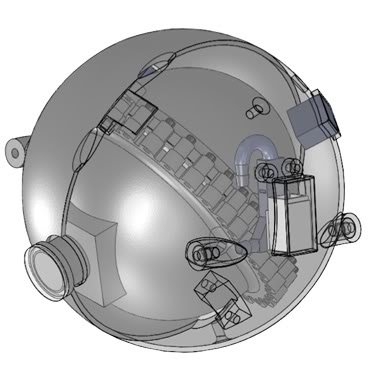
Now Asada and his colleagues at the d’Arbeloff Laboratory are working on a direct monitoring alternative: small, egg-sized robots designed to dive into nuclear reactors and swim through underground pipes, checking for signs of corrosion. The underwater patrollers, equipped with cameras, are able to withstand a reactor’s extreme, radioactive environment, transmitting images in real-time from within.
More: web.mit.eduby joniver via I1235.photobucket 7/21/2011 4:16:18 PM- @Diane_NJ I double checked the two sources hoping it was a translation oddity. It isn't. It is just creeping me out!by lillymunster 7/21/2011 4:19:16 PM
- @lillymunster OMG.by Diane_NJ 7/21/2011 4:20:39 PM
- @lillymunster
"the capsule of the powder entering which was made from the human flesh of the infant of the baby and the raw rear 1~2 mosquito month which stillbirth are done from China flows into Korea, is sold secretly in the Seoul medicine market".
Am I reading this right? Powdered infant? Say it ain't so.by joniver 7/21/2011 4:25:09 PM - @joniver still born but yes.by lillymunster 7/21/2011 4:28:09 PM
- What are you talking about? Soylent powder, powered (or was it powdered?) humans? Those really bad translations from Japanese are driving some of you girls nuts.by Pedro Jesus 7/21/2011 4:28:39 PM
- @Pedro Jesus IF you read the entire thing it was genetically tested to be human tissue. It isn't a translation oddity.by lillymunster 7/21/2011 4:30:44 PM
- English citing of the incident www.breitbart.comby lillymunster 7/21/2011 4:32:52 PM
- @lillymunster I couldn't open the page. I stayed there for 5 minutes and nothing. Couldn't even press the translate button (on Chrome) because it didn't show any. Do you have another source that I could double check. Isn't the article possibly referring to stem cells or something like that?by Pedro Jesus 7/21/2011 4:33:32 PM
- The breitbart link cites a S. K magazine.
Try this one for the MSN link - the print version, it might work better.http://sankei.jp.msn.com/world/print/110721/chn11072123320011-c.htm
The English one states both embryos and stillborn infants.by lillymunster 7/21/2011 4:35:25 PM - OK, did you notice the word allegedly? And the source is South Korean anyway.by Pedro Jesus 7/21/2011 4:36:01 PM
- (sorry I'm a bit slow typing today)by Pedro Jesus 7/21/2011 4:36:20 PM
- They might be referring to the stem cell black market.by Pedro Jesus 7/21/2011 4:38:09 PM
- Or not.by lillymunster 7/21/2011 4:38:54 PM
- contaminated water in unit 1 basement increased by 44cm after typhoon www3.nhk.or.jpby lillymunster 7/21/2011 4:50:07 PM

english.kyodonews.jp
Gov't designates new 'hot spots' near Fukushima plant
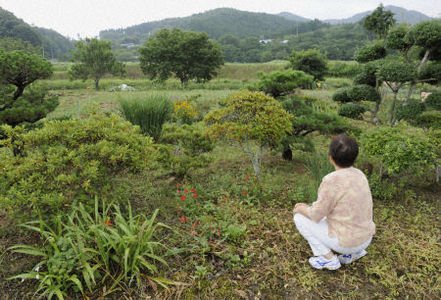
A woman is pictured in the garden of her home in Takanokura in the city of Minamisoma, Fukushima Prefecture, on July 21, 2011. The government the same day newly designated 59 households in Takanokura and three other areas in Minamisoma, near the crippled Fukushima Daiichi nuclear power plant, as located in ''hot spots'' recommended for evacuation. The woman told Kyodo News she was at a loss as to whether she should evacuate because she has been living there for decades. (Kyodo) english.kyodonews.jpby Edano via English.kyodonews.jp 7/21/2011 4:58:07 PM- Gov't to buy up all beef containing cesium exceeding allowable levels
TOKYO, July 21, Kyodo
The government will buy up all beef found to contain radioactive cesium at levels exceeding the allowable limit, and incinerate it, a senior farm ministry official said Thursday.
Nobutaka Tsutsui, senior vice minister of agriculture, forestry and fisheries, said the ministry is considering expanding the inspections currently imposed on all cattle shipped from Fukushima Prefecture to those from other prefectures.
''We're considering how much we can broaden the inspections on all the cattle and farms from outside Fukushima Prefecture,'' he said.
english.kyodonews.jpby Edano 7/21/2011 5:00:54 PM  @Edano considering ..... lets all go dance round the buttercups with the elves...oh we can't the buttercups mutatedby elainekirk 7/21/2011 5:04:51 PM
- 1400 cattle fed contaminated hay shipped
NHK has learned that at least 1,400 beef cattle were shipped from 76 farms in 11 prefectures after being fed rice straw contaminated with radioactive cesium at levels higher than the government safety limit.
The straw had been distributed by agents in Miyagi and farmers in Fukushima and Iwate prefectures, near the crippled Fukushima Daiichi nuclear power plant.
Investigations are now underway to identify distribution channels of the straw and cattle.
The number of farms found to have fed the straw to their cattle may rise further.
Thursday, July 21, 2011 21:20 +0900 (JST)
www3.nhk.or.jpby Edano 7/21/2011 5:05:55 PM - didn't we have 1500 before ?by Edano 7/21/2011 5:06:34 PM
- Govt to ask utilities to conduct nuke safety tests
Japan's nuclear safety agency says it will demand that power companies conduct additional tests to ensure the safety of nuclear power plants.
The move will follow Thursday's approval by the Nuclear Safety Commission of the agency's revised 2-stage test plan.
Using computer simulations, the utilities will assess the ability of reactors to withstand earthquakes, tsunami and the loss of external power, as well as a simultaneous quake and tsunami.
Power companies will also check the effectiveness of previous safety measures.
The government requires the measures before allowing utilities to restart reactors that have been offline for regular checks.
But the deadline for the additional safety tests and the length of time it will take for the agency to assess the results has yet to be determined.
Thursday, July 21, 2011 21:09 +0900 (JST)
www3.nhk.or.jpby Edano 7/21/2011 5:08:01 PM - @Edano Perhaps GoJ should have considered offering to buy up all of the contaminated cattle before 11... 32... 114... 500... 1,200... 1,400... 1,500... 1,400 of them shipped. Perhaps they should have been testing the other prefectures for MONTHS! Perhaps they might rethink their preposterous voluntary compliance destroy-your-annual-crop-for-nothing strategy.
If we were betting types, we could take bets on how long it takes before GoJ realizes there are other animals grown in Japan, and other crops besides rice straw!
My bet would be on Fall harvest time, when they absolutely cannot hide it any more.by RadioGuy 7/21/2011 5:29:06 PM - "hide" should have been "avoid" This is active avoidance on a scale that only serious denial or a quest for plausible deniability can bring about, and you'd have to question "plausible" so far.by RadioGuy 7/21/2011 5:32:29 PM
- @RadioGuy : sorry, this was "beyond our expectations" :)by Edano 7/21/2011 5:32:43 PM
- My bets are on Asahi Shimbun breaking the news on the next food outbreak by having some other meat tested at a private lab.by lillymunster 7/21/2011 5:33:35 PM
- @Edano Exactly. When your "expectations" are tailored to what you want to hear rather than tethered in the general vicinity of reality, that's easy.by RadioGuy 7/21/2011 5:34:22 PM


Japan Earthquake | Page 1986
- Who's Blogging
-
 hudebnik
 alblee
 UKVal
UKVal Jonathan Keebler
 Oliver (ScribbleLive)
 kaykodh
 Markfm
 Angie
Angie Mid Valley
 Matt (ScribbleLive)
 George Gibb
- elainekirk
 PKelley
- lillymunster
 dean
dean bo
bo- Edano
 Deb
Deb- Pedro Jesus
 IanGoddard