Japan Earthquake | Page 2015
 @Pedro Jesus Thanks. I searched that number briefly and then just pulled it from approximate memory.by RadioGuy 7/25/2011 4:16:41 PM
 @RadioGuy yw, you were very close =)by Pedro Jesus 7/25/2011 4:20:51 PM
- www.irishweatheronline.com - Japan Earthquake Provides Scientists With Data Treasure Trove
Not actually NEWS news. We know strong quakes liquefy fill and less solid strata. We see that with every good-sized quake in areas of San Francisco that are built on fill. This studied quantified data from the Tohoku Quake on how this same effect affects undamaged strata.by RadioGuy 7/25/2011 4:22:01 PM - From the other board.by RadioGuy 7/25/2011 4:22:09 PM
- Analysing data from multiple measurement stations, scientists at the Georgia Institute of Technology found that the quake weakened subsurface materials by as much as 70 percent.by RadioGuy 7/25/2011 4:22:50 PM
 @RadioGuy so weakened like collapse?by lillymunster 7/25/2011 4:25:33 PM
 In today's Le Monde: Greenpeace highlights the flaws of the EPR in case of power failure
The environmental organization Greenpeace has pointed to flaws, Monday, July 25, in the security of future third-generation nuclear reactor, the EPR, in case of outage lasting power. A particular situation that had occurred at the Fukushima plant, following the earthquake and tsunami of March 11.
"Security measures are based on the assumption that electricity is supplied by the grid is the primary emergency power can be restored within twenty-four hours," said Greenpeace, which recalls that "in Fukushima the total power failure lasted eleven days. "The environmental group based on a report commissioned Helmut Hirsch, Austrian nuclear expert with the German and Austrian governments and a member of the expert group of the Nuclear Energy Agency of OECD.by Olivier 7/25/2011 4:26:33 PM- We've known for a while that shale as "bedrock" has layer shear-and-slip issues when used as bedrock. I bet shale is near the top of that 70% range.by RadioGuy 7/25/2011 4:26:34 PM
- @lillymunster Weakened materials means compromised stability, not collapse. Collapse might be a potential consequence but not in every case.by Pedro Jesus 7/25/2011 4:27:04 PM
- They deal mostly with the effects on soils. My Dad would have loved this/hated this. He was a clay mineralogist and soil guy, mostly dealt with x-ray diffraction techniques. He would have been the first person I called for facts about this were he still alive.by RadioGuy 7/25/2011 4:29:23 PM
 Aeon Says Suspected Tainted Beef Sold in Total of 174 Stores
www.sfgate.comby Panserbjorne9 7/25/2011 4:30:38 PM- @lillymunster When soils and near-soils like sedimentary rock get shaken well enough they liquefy in amounts based on their cohesive strength. I'd guess that a hard lateral shake on shale would shear layers in it making them slip more easily. This could actually be a mitigating factor at times, if the strata above the quake shear and slide and allow a "tablecloth out from under the dishes" trick.by RadioGuy 7/25/2011 4:33:49 PM
- But then from then on the shale's structural integrity would be questionable.by RadioGuy 7/25/2011 4:34:36 PM
- That's just stuff I remember from talking with my Dad way back when they first started working on extracting the oil from oil shale. He was going on about techniques to shatter or slip the shale to release the oil, which at that age bored me to tears so I paid marginal attention.by RadioGuy 7/25/2011 4:38:06 PM
- From that article:
Beyond the immediate effect of the strongest shock, the researchers were interested in how the soils recover their strength after the shaking stops. That recovery time can vary from fractions of a second to several years, Wu said.
“It is still not clear whether there could be longer recovery times at certain sites,” Wu noted. “This is a function of soil type and other factors.” If the soils are very porous, water can lengthen the recovery. “For porous media, the ground shaking could cause water to go into the pores, which will also reduce the shear modulus of the soil. If water is involved, the recovery time will be much longer.”
Soil response to aftershocks, which ranged up to magnitude 7.9 after the main Tohoku earthquake, was also studied.by RadioGuy 7/25/2011 4:46:17 PM  Press Release (Jul 25,2011)
Restructure of Government/Tokyo Electric Power Company Joint Office
Government/Tokyo Electric Power Company Joint Office will be restructured
as follows.
1. Purpose of the Restructure
♦ Steady implementation of each countermeasures of Step 2
♦ Recognition of medium- to long-term tasks and review of the
countermeasures
2. Date of Implementation
Monday, July 25. 2011
3. Abstract of the Restructure
(1) Previous Structure
i Medium- to Long-term Countermeasures Team
ii Radioactive Fuel Removal and Transfer Team
iii Remote Control Facilitation Team
iv Long-term Cooling Systemization Team
v Radioactive Accumulated Water Removal and Process Team
vi Environmental Impact Assessment Team
(2) New Structure
i Medium- to Long-term Countermeasures Team
(Team i to iii of (1) will be combined.)
ii Long-term Cooling Systemization Team
iii Radioactive Accumulated Water Removal and Process Team
iv Environmental Impact Assessment Team
v Radiation and Health Management Team
(Newly established.)
www.tepco.co.jpby elainekirk 7/25/2011 5:16:32 PM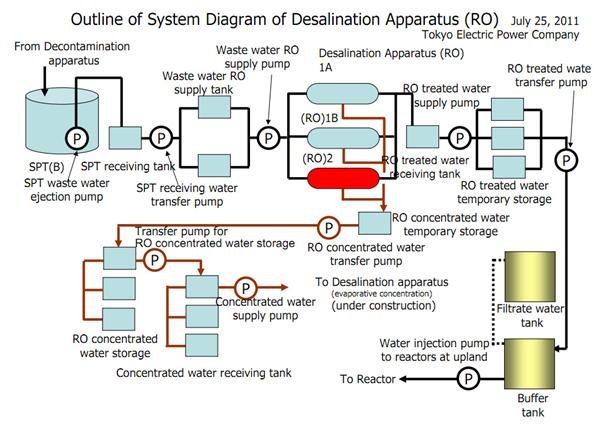
www.tepco.co.jp further details
by elainekirk 7/25/2011 5:17:17 PM- Thought this was interesting. Ions? Salt water? Corrosion? Fatigue? Welds? Fuku has it all...:( Corrosion is the primary means by which metals deteriorate. Most metals corrode on contact with water (and moisture in the air), acids, bases, salts, oils, aggressive metal polishes, and other solid and liquid chemicals. Metals will also corrode when exposed to gaseous materials like acid vapors, formaldehyde gas, ammonia gas, and sulfur containing gases. Corrosion specifically refers to any process involving the deterioration or degradation of metal components. The best known case is that of the rusting of steel. Corrosion processes are usually electrochemical in nature, having the essential features of a battery.
When metal atoms are exposed to an environment containing water molecules they can give up electrons, becoming themselves positively charged ions, provided an electrical circuit can be completed. This effect can be concentrated locally to form a pit or, sometimes a crack, or it can extend across a wide area to produce general wastage. Localized corrosion that leads to pitting may provide sites for fatigue initiation and, additionally, corrosive agents like seawater may lead to greatly enhanced growth of the fatigue crack. Pitting corrosion also occurs much faster in areas where microstructural changes have occurred due to welding operations.
corrosion-doctors.orgby M.I.A. 7/25/2011 5:20:40 PM 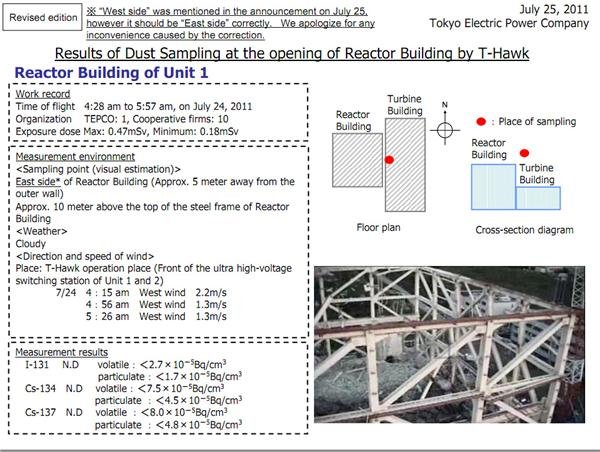
doc www.tepco.co.jp
by elainekirk 7/25/2011 5:21:26 PM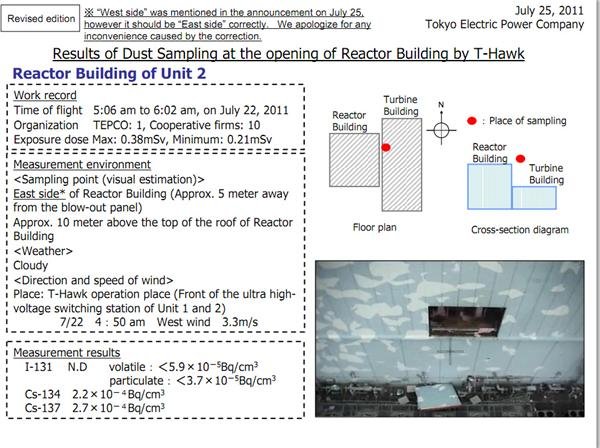
doc www.tepco.co.jp
by elainekirk 7/25/2011 5:22:09 PM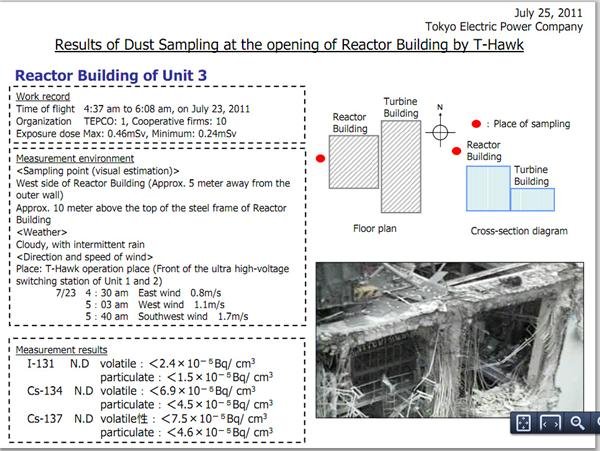
doc www.tepco.co.jp
by elainekirk 7/25/2011 5:22:47 PM- @M.I.A. great find MIA :( they dont talk much about corrosion do they ? but it must be happened or maybe it is going to be classed as 'unforseeable natural disaster'by elainekirk 7/25/2011 5:24:20 PM
- Closing out the shale bit: If Daiichi was built on a shale "bedrock", which we have been its long term status would now have to be in question. The entire substrata is now inundated with additional water, due to both plant leakage and the fact that the level of the entire water table was lowered, so would seem to make quakes with a large lateral coefficient particularly dangerous for that area until the shale stabilizes and re-melds. Shale starts being shale only a few steps up from the layered sedimentation of clay soils that created it, and ranges from fairly hard to crumble-with-your-hands density. But even the hardest shale, with enough lateral force or a quick strike, can shear and slip like graphite, only luckily without quite the lubricating effects.
OK...found it. It's even less stratified than shale, which would help with shear, but hurt with liquefaction; apparently it's classified as
Mudstone:
A sedimentary rock composed of clay-size particles but lacking the stratified structure that is characteristic of a shale.
Mudstone is an extremely fine-grained sedimentary rock consisting of a mixture of clay and silt-sized particles. Terms such as claystone and siltstone are often used in place of mudstone, although these refer to rocks whose grain size falls within much narrower ranges and under close examination these are often technically mudstones. Shale is often used to describe mudstones which are hard and fissile (break along bedding planes). Marl is often used to describe carbonate-rich soft mudstones.by RadioGuy 7/25/2011 5:30:45 PM - -which we have been
(told is the case) but i found the ref and didn't finish the thought.by RadioGuy 7/25/2011 5:31:29 PM - @elainekirk so would that mean there will be some labor department people involved on a daily basis in the new Radiation & Health Management Team? One can hope. :-)by lillymunster 7/25/2011 5:34:50 PM
- @elainekirk Corrosion and embrittlement are the major reasons the idea of re-upping all these 40 year old plants just gives me the willies.by RadioGuy 7/25/2011 5:35:13 PM
- @RadioGuy That was my first thought. Heaping new corrosion factors on top of brittle 40 year old metals that have been under constant moisture situations. They may not have much to decommission by the time they get there.by lillymunster 7/25/2011 5:38:11 PM
- I'm calling shenanigans on the thawk testing. They seemed to purposely pick locations where they would not catch a load of steam. Those numbers still seem low to me considering workers still can't get inside #3 and the plant is known to still be releasing large amounts of radiation in recent weeks.by lillymunster 7/25/2011 5:40:53 PM
 IAEA chief says cooling operation going as planned
The head of the International Atomic Energy Agency says operations to bring the Fukushima Daiichi nuclear power plant under control are going as planned.
IAEA Director General Yukiya Amano visited the plant on Monday, one day after he arrived in Japan. This is his first visit to Fukushima Daiichi since the March 11th disaster triggered the nuclear accident there.
Amano later told reporters that he wore protective clothing and toured the plant on a bus, while being briefed about damage to reactor buildings and other facilities by the head of the nuclear station.
Amano said he inspected the cooling operation to check on the progress of the stabilization plan.
He said he also visited the plant's headquarters to talk with workers there about the content and the environment of the stabilizing operations.
Amano said steps are being carried out systematically and that he believes the prospects are bright.
Amano added that IAEA knowledge and know-how could be helpful for future operations at the plant, such as removing radioactive materials and taking out spent nuclear fuel rods.
He said he wants to discuss possible cooperation with the Japanese government.
Monday, July 25, 2011 19:00 +0900 (JST)
www3.nhk.or.jpby Edano 7/25/2011 6:27:45 PM- Have the plutonium health risks article done. wp.me Let me know if you find things that need changing, adding, other info etc.by lillymunster 7/25/2011 6:35:00 PM
- "He said he wants to discuss possible cooperation with the Japanese government." is this the point where we just burst into tears and jump inti the nearest volcano 'possible' and 'cooperation' should never be in the same sentence when discussing Fukushimaby elainekirk 7/25/2011 6:47:02 PM
- Radiation survey meets skepticism / Fukushima Pref. residents asked to recall diet, activities from 4 months ago
www.yomiuri.co.jpby Panserbjorne9 7/25/2011 7:11:28 PM - @Panserbjorne9 I try to tell myself that they are acting in the interests of the people who pay their salaries, who provide the workforce, who keep the country running but I believe that they act in the interests of those who run the country ie the power companiesby elainekirk 7/25/2011 7:18:51 PM
- www.liveleak.com
This came up in a peripheral search. Tokyo Central Park liquefaction after the Tohoku quake caught on video.by RadioGuy 7/25/2011 7:22:36 PM - wow. Just saw this on twitter. This is the kind of crap people are dealing with trying to get help for their kids or some sort of help so they can evacuate enenews.comby lillymunster 7/25/2011 7:25:51 PM
- @elainekirk watch the video I just posted. That is exactly what is going on. :-(by lillymunster 7/25/2011 7:26:41 PM
- @lillymunster : biological half live of plutonium is 200 years, so it stays in the body for several centuries (better milleniums), not decades. en.wikipedia.orgby Edano 7/25/2011 7:37:03 PM
- in fact, once incorporated, you will never get rid of it.by Edano 7/25/2011 7:37:40 PM
- @Edano okay, what I read claimed it cleared out of the body in a couple of decades. So that is incorrect? Once in there it doesn't clear out?by lillymunster 7/25/2011 7:46:52 PM
- @lillymunster If it gets incorporated into a permanent structure like bone, you don't get rid of it.by RadioGuy 7/25/2011 7:52:21 PM
- @lillymunster : in 200 years half of it clears out, so theoretically 2000 years for complete clearance.by Edano 7/25/2011 7:52:35 PM
- That video is maddening. OK... so we have a new addition to the civil protest. Now GoJ gets mailed not only dirt samples bu urine samples. ;)by RadioGuy 7/25/2011 7:53:47 PM
- @RadioGuy If I wasn't so horrified I would have been laughing at the guy yelling to "take this urine". I think some of the parents were dumping dirt on desks and front steps at the Diet. :-)by lillymunster 7/25/2011 8:01:45 PM
- @lillymunster sickening vid I have spread it in hope it wakes some of the international 'community' upby elainekirk 7/25/2011 8:02:49 PM
- @Edano So if plutonium is in the liver or the lungs is will be stuck there too?by lillymunster 7/25/2011 8:07:35 PM
Japan Earthquake | Page 2015
- Who's Blogging
-
 hudebnik
 alblee
 UKVal
UKVal Jonathan Keebler
 Oliver (ScribbleLive)
 kaykodh
 Markfm
 Angie
Angie Mid Valley
 Matt (ScribbleLive)
 George Gibb
- elainekirk
 PKelley
- lillymunster
 dean
dean bo
bo- Edano
 Deb
Deb- Pedro Jesus
 IanGoddard