Japan Earthquake | Page 2495
 @Peter : isolation condenser ?by Edano 10/12/2011 5:08:38 PM
 Ah that is what I was thinking of.by lillymunster 10/12/2011 5:09:38 PM
 acute radiation syndrome: www.examiner.com
What is often referred to as radiation poisoning or radiation sickness is actually called “Acute Radiation Syndrome” or “ARS” for short. Acute Radiation Syndrome indicates that someone has been exposed to a high level of radiation in a short period of time. This is opposed to chronic radiation exposure which would mean that someone has become sick as exposure to low levels of radiation over a longer period of time
With ionizing radiation, the frequency waves are higher and can break down chemical bonds. Ionizing radiation is composed of extremely short wavelengths that can break electrons (or charged molecules) from an atom, creating two ions (charged particles). This creates one positively charged molecule and a free electron. There are three forms of ionizing radiation and these are alpha, beta and gamma. When the human body is exposed to ionizing radiation, changes occur at the cellular level.
Ionizing radiation causes cells to break down and the free electrons that are released during the process have been identified as carcinogenic. The impact exposure to ionizing radiation will have on the human body depends upon the length and intensity the person was subjected to the radiation. On March 14, 2011, 17 U.S. Navy crew members responded to the crisis in Japan and were exposed to radiation in the atmosphere. The crew members thoroughly washed themselves with soap and hot water to reduce contamination. At this point, no illnesses have been reported. If they were to become sick they would have suffered vomiting, diarrhea and possibly skin rashes immediately following contact.
There are two types of radiation sickness (chronic and acute); and these are referred to as stochastic and non-stochastic. Stochastic effects are associated with chronic radiation exposure and non-stochastic effects are the result of high level radiation exposure in a short amount of time. There is no doubt that the impact of radiation is directly related to the length and level of radiation exposure.
It’s important to realize that radiotherapy, such as chemotherapy, is composed of ionizing radiation. Those undergoing chemotherapy experience the same symptoms experienced by those with Acute Radiation Syndrome, however, those experiencing chemotherapy are under a doctor’s care; are monitored for adverse reactions and exposure to the treatment is on a scheduled basis. Symptoms of Acute Radiation Syndrome are as follow:
x = mr acute lukemia symptoms
x 1. Changes in Blood Chemistry
x 2. Nausea
x 3. Fatigue
x 4. Vomiting
? 5. Hair Loss
? 6. Diarrhea
?7. Destruction of the Intestinal Lining
?8. Internal Bleeding
?9. Central Nervous System Damage
x10. Loss of Consciousness
x11. Death
Each symptom is associated with the level of exposure; the list is measured from the smallest to greatest amount of rems (the increments by which ionizing radiation is measured). The symptoms of Acute Radiation Syndrome were accurately determined by monitoring the victims of Hiroshima and Nagasaki. There is no question that ionizing radiation causes cancer and disrupts the molecular components of cellular activity.
What would happen if we put together a simple case to prove the deaths are likely attributable to acute radiation poisoning, that TEPCO and the doctor are likely negligent, lying or worse, and get a big petition of people who are willing to stand by the conclusion vs Tepco and Japanese government, and demand to release the names of the victims so that their families can be contacted? If publicized in the japanese press or blogosphere, the families could come forward and be encourage to file a lawsuit, but Japanese do not have the litigation culture in the US.by artnuke 10/12/2011 5:09:51 PM Yes, isolation condenser (IC), sorry. He did it because RPV temp dropped faster than 55 degrees centigrade which was prescribed in the manual as the permitted rate of change. The station superintendent was not informed about this decision.by Peter 10/12/2011 5:11:00 PM
- i just read there were two of two isolation condensers switched off.by Edano 10/12/2011 5:14:30 PM
- @lilly, edano, One thing I realized researching this issue is how long it ordinarily takes to take a reactor to cold shutdown without causing damage to the components. At North Anna the process took several days.by Peter 10/12/2011 5:14:53 PM
- @Peter scram and pray :)by Edano 10/12/2011 5:15:46 PM
- @Edano , the distinction with tepco is always actuation of a process and actual execution. They tried to switch the two they had on, but had to concede that they got feedback on only one working.by Peter 10/12/2011 5:17:42 PM
- @Peter @lillymunster Fukushima Dai-Ichi Unit 1: The First 30 Minutes David Lochbaumby Edano 10/12/2011 5:18:05 PM
- @Peter Now take that days long process and throw a couple major compounding disasters on top. Not good.by lillymunster 10/12/2011 5:21:04 PM
- Did we ever determine why unit 1 failed so fast? Was it the IC valve issue?
There was smoke out of the stack for unit 1. It was the oldest unit, so whatever pipes were going to break were most vulnerable in unit 1. IC was turned off at first, the other units have steam turbine driven units that still faileded after batteries conked out. The crack in the ground may be indication it had some seismic issues that other units did not have. Nobody had a clue as to even how to vent the thing when the power went out, they had to look at paper plans with a flashlight to figure stuff out. If they plans were computerized, they would even be able to do this. No contingency plans for such an event, they had to wing it. They should have had a hotline to GE / Hitachi to people like Apollo 13 had a hotline to the people who designed the command and lunar modules to figure out ways to fix things offsite. Even a crowd sourced board like this might have been a help then, and probably could help now but obviously they don't monitor this board. No doubt no such hotline exists even today.by artnuke 10/12/2011 5:21:09 PM - @lillymunster @Peter Analysis and evaluation of the operation record and accident record of Fukushima Daiichi Nuclear Power Station at the time of Tohoku-Chihou-Taiheiyou-Oki-Earthquake (summary) by tepcoby Edano 10/12/2011 5:21:19 PM
- lochbaum concludes that the temperature rise (no, the water level drop) in #1 is not fully explainable with the data given.by Edano 10/12/2011 5:27:00 PM
- @Edano I have always seen unit 1 as an outlier not just due to the IC issue and older design. It is spewing far more radiation than the others and seems to be more of a problem at the plant. These later effects after complete meltdown do not make senseby lillymunster 10/12/2011 5:32:34 PM
- Eventually found this cryptic info in their update to IAEA p II-80: "The main steam isolation valve (MSIV) closed, causing an increase in pressure in the reactor pressure vessel (RPV); and at 14:52 on March 11, the IC automatically started up. Thereafter, in accordance with the operating manual for the IC, to ensure that the RPV temperature does not fall at a rate greater than 55 degrees/h, the IC was manually shut down at 15:03 on March 11. In addition, during the period from 15:10 to 15:30 on March 11, only A train of the IC was manually operated three times, and reactor pressure fluctuated up and down." See, "automatically started up" does not necessarily mean that they acutally did. Only the A train actually worked.by Peter 10/12/2011 5:40:24 PM
- And so the disaster continued to unfold: "TEPCO performed the operation of opening the valve for the IC A system after the tsunami hit, and this operation was continued to maintain the function of the IC. However, according to the results of the investigation on the valve circuits TEPCO conducted in April, it is not definite to what angle the valve was opened, and so, at this stage, it cannot be determined to what degree the IC fulfilled its function."by Peter 10/12/2011 5:42:57 PM
- Hi@all, there was a 2.6 earthquake in Virginia today. 9 km (6 miles) S (169°) from Louisa, VA
10 km (6 miles) SW (221°) from Mineral, VAby Liz 10/12/2011 5:44:02 PM - If it were not for the aggravated circumstances, the record would read like the playbook of a Punch and Judy show, ;)by Peter 10/12/2011 5:45:11 PM
- @Peter LOLby lillymunster 10/12/2011 5:45:43 PM
- @Liz , thanks. Did not feel anything. When was it?by Peter 10/12/2011 5:45:45 PM
- by Liz 10/12/2011 5:46:19 PM
- @lillymunster , the one on Are You Being Served, remember that one? :)by Peter 10/12/2011 5:47:19 PM
- Japan's food radiation limits set too high: Belarusian scientist
TOKYO, Oct. 13, Kyodo english.kyodonews.jpby Edano 10/12/2011 5:50:05 PM
20 year olds on anti-nuke Hunger Strike Japan
After the tragic nuclear accident in Fukushima, many people in Japan decided to further educate themselves about energy. There is now a nation wide critical thinking based debate going on about energy policy to which people are openly expressing themselves. This could be a sign of societal shift because in Japan, going against convention is not common. If an action or view point disturbs the harmonious status-quo, it is often avoided. I heard about a few young people who were on a ten day hunger- strike, camped out in front of the Ministry of Economy Trade and Finance building in Tokyo. To further understand why they are starving for change, I asked them for an interview. The long-term question is will these pockets of cries for change actually lead to reform in Japan.
Source: japonkokoro radioactive.eu.comby Edano 10/12/2011 5:52:49 PM @Edano that radiation one is good to tweet I will go tweetyby elainekirk 10/12/2011 5:57:03 PM
- radioactive.eu.com very nice partner site !!! with links to ex-skf, fuku diary, enenews, enformable, .....by Edano 10/12/2011 5:58:17 PM
- Breaking News: Hydrogen gas found in reactor 2 too
10/12/2011 20:09
Tepco announced they measured hydrogen gas in the pipe to the containment vessel of reactor 2 as well.
“According to Tepco” ,it was 6.5 %.
However,4% of hydrogen and 5% of oxygen cause hydrogen explosion.
It’s enough to cause another hydrogen explosion.
They are planning to use a filter to eliminate radioactive particles in the pipe. They are going to try to reduce hydrogen after installing the filter. fukushima-diary.comby Edano 10/12/2011 6:00:23 PM - Hearings on the death of former KGB officer Alexander Litvinenko should be open for the public and media, the Russian embassy in London said in a statement on Tuesday.
"Taking into account the importance of the inquest for the overall state of Russia-U.K. relations and the obvious need to establish the truth about Alexander Litvinenko's death, we believe that only public hearing of the case can give a guarantee of impartial consideration of this case," the embassy said.
Litvinenko, a former KGB officer and outspoken critic of then-president Vladimir Putin, died in November 2006 in a London hospital, presumably after being poisoned with the radioactive substance polonium-210. A court in London is to begin hearings to establish Litvinenko's cause of death on Thursday.
"The Russian side has learnt with disappointment that the pre-inquest review hearing regarding the death of Russian citizen Alexander Litvinenko, scheduled for 13 October 2011 at St Pancras Coroner's Court, will be closed for the public and media, thus making it impossible for Russian media and the Russian Embassy's representatives to attend," the statement reads. en.rian.ruby Liz 10/12/2011 6:02:15 PM - @Edano this is the piping plan to get nitrogen in looks very close for those workers docs.google.comby elainekirk 10/12/2011 6:04:20 PM
- Japanese Government has “always known” about concentrated radiation hot spots discovered In Tokyo, Yokohama
TOKYO (Dow Jones)–Japanese researchers have discovered high levels of radioactive material in concentrated areas in Tokyo and Yokohama, more than 241 kilometers away from the Fukushima Daiichi nuclear plant, as increasingly thorough tests provide a more disturbing picture of just how far contamination has spread and accumulated after the March disaster.
In Tokyo, a sidewalk in Setagaya Ward in the western part of the city recorded radiation levels of 2.707 microsieverts per hour, about 50 times higher than another location in Setagaya where the ward regularly monitors radiation levels.
In Yokohama, the local government said last month that it detected 40,200 becquerels of radioactive cesium per kilogram of sediments collected from one part of a roadside ditch.
By comparison, the Japanese government has banned cultivation of rice in fields found to have more than 5,000 becquerels of cesium per kilogram of soil.
Yokohama is currently investigating another spot on an apartment rooftop where tests conducted by a local private research institute detected more than 60,000 becquerels of radioactive cesium per a kilogram of sediments.
Both Setagaya Ward and Yokohama discovered those concentrated spots after local residents carrying their radiation measuring devices noticed such spots and reported it to local officials.
In the roadside ditch where 40,200 becquerels were detected, another spot in the same ditch recorded only 3,030 becquerels. enformable.comby Edano 10/12/2011 6:04:22 PM - @Peter LMAO :-)by lillymunster 10/12/2011 6:05:10 PM
- @Edano Its a game right? Find the hot spot? Is it like a lottery?by lillymunster 10/12/2011 6:06:53 PM
- good news:
Dominican Republic starts up wind power project
SANTO DOMINGO | Tue Oct 11, 2011 6:42pm EDT
SANTO DOMINGO (Reuters) - Dominican Republic inaugurated its first large-scale wind power project on Tuesday in a move to develop renewable energy sources in the Caribbean country's crisis-ridden power sector.
President Leonel Fernandez attended the opening of the twin wind parks of Los Cocos and Quilvio Cabrera in Pedernales province in the southern part of Dominican Republic's frontier with Haiti.
The facility, which involved an investment of around $100 million by private local power companies Punta Cana-Macao (CEPM) and EGE-Haina, has 19 wind towers and will contribute 33 megawatts (MW) to the national electricity network. It will save around 200,000 barrels of oil a year, officials said.
The country's electricity sector, which relies on costly oil imports, has been in crisis for decades and consumers suffer frequent power blackouts. Private estimates say some 40 percent of Dominicans fail to pay for electricity, with many using illegal hookups to power their homes.
Under a $1.66 billion International Monetary Fund (IMF) stand-by program, the government has been slashing hefty subsidies to the electricity sector and raising fees, but it has still budgeted around $350 million in subsidies this year.
A number of wind power projects already exist in the Caribbean -- in Jamaica, Cuba, Aruba and Guadelupe -- but the Dominican Republic facility was believed to be the largest of its kind so far, EGE-Haina officials said.
EGE-Haina said a second phase of the wind farm project would add an additional 52 MW in 2012.
(Reporting by Manuel Jimenez; Editing by Pascal Fletcher and David Gregorio) www.reuters.comby Edano 10/12/2011 6:09:24 PM  @lillymunster Lottery? I think it's more those faire games where you hit the can with a ball and you get a Hello Kitty doll. Much easier than the lottery.by Pedro Jesus 10/12/2011 6:13:46 PM
- @Pedro Jesus Maybe a scavenger hunt is more apt comparison. Though faire games works too. :-)by lillymunster 10/12/2011 6:14:40 PM
- @lillymunster We have to throw in a joke now and then to vent some steam... [pun intended]. =)by Pedro Jesus 10/12/2011 6:16:26 PM
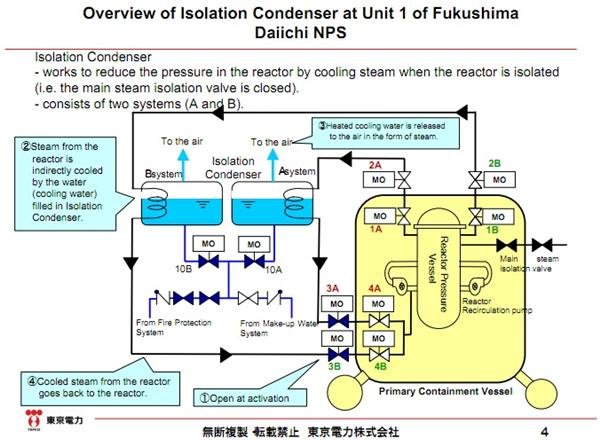
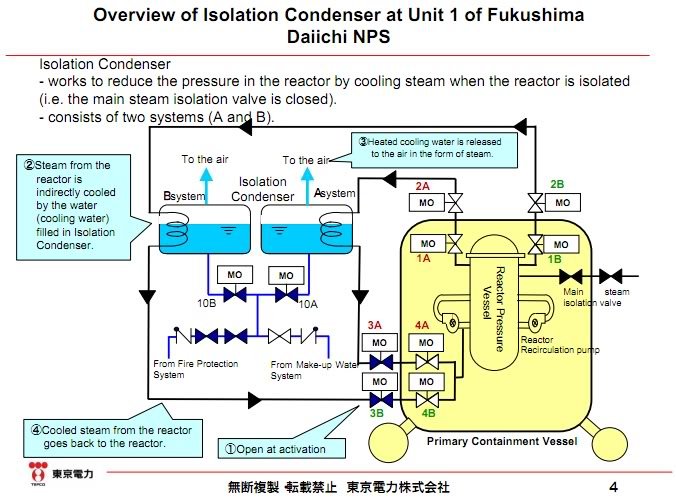
@lilly, edano, the schema in the tepco doc www.tepco.co.jp edano posted shows the IC and its valves nicely. Note that apparently only the A train was operable. If I am not mistaken, the NRC stipulates that only one operable train suffices during an emergency shutdown. However, as the events at Fukushima show two operable IC trains could have saved the reactor core of unit 1 from meltdown. The circumstance that only one train worked after the quake suggests that the quake already damaged the emergency cooling systems of the reactor, and the tsunami only aggravated the emergency. i1214.photobucket.com
by Peter via I1214.photobucket 10/12/2011 6:30:35 PM- @Liz, thanks for the usgs info.by Peter 10/12/2011 6:32:39 PM
- @Peter could have saved from meltdown ? the others melted anyway.by Edano 10/12/2011 6:33:32 PM
- @elainekirk , did rockhopper and her friend translate both 1987 issues of Strahlentelex?by Peter 10/12/2011 6:35:17 PM
- Portugal is as of 2010 the second biggest producer of wind power in the world, rating at over 9TWh. On the top of the list comes another European country, Denmark. en.wikipedia.orgby Pedro Jesus 10/12/2011 6:36:52 PM
- @Edano , well with those other systems (the turbine-driven pumps) that unit 1 was not equipped with failed.by Peter 10/12/2011 6:40:00 PM
- @Pedro Jesus Is Portugal particularly windy?by lillymunster 10/12/2011 6:43:00 PM
- Spokane public TV documentary on Hanford: video.ksps.org Excellent viewing, I have DVD off of tv broadcast. Shows people taking the finished blob of silly putty plutonium with gloved hands and putting it in a plastic bag, and the guy who delievered it to California in a suitcase.by artnuke 10/12/2011 6:45:12 PM
- @lillymunster It can be. Here in the south the total wind power installed capacity is 75MWh. As of December 2010 the total capacity in the whole mainland was nearly 4 GWh (4,000 MWh) but there are still ongoing projects that haven't made the statistics. We've been investing a lot in renewable energy. Fortunately, our governments are not very fond of nuclear energy after all the problems we've had, throughout the years, with contamination (of rivers) originating in Spanish nuclear power plants near our border. There are also geothermal and tidal wave energy projects on the go as we speak.by Pedro Jesus 10/12/2011 6:49:41 PM
Japan Earthquake | Page 2495
- Who's Blogging
-
 hudebnik
 alblee
 UKVal
UKVal Oliver (ScribbleLive)
 Jonathan Keebler
 Matt (ScribbleLive)
 kaykodh
 PKelley
 Markfm
 dean
dean Angie
Angie- Edano
 Deb
Deb Mid Valley
- Pedro Jesus
 George Gibb
- elainekirk
- lillymunster
 bo
bo IanGoddard