Japan Earthquake | Page 2497
 Anyone else want time to review the radiophobia article or should I post it as is?by lillymunster 10/12/2011 9:01:08 PM
 Officials at Creech Air Force Base in Nevada knew for two weeks about a virus infecting the drone "cockpits" there. But they kept the information about the infection to themselves - leaving the unit that's supposed to serve as the Air Force's cybersecurity specialists in the dark. The network defenders at the 24th Air Force learned of the virus by reading about it in Danger Room.
gizmodo.comby elainekirk 10/12/2011 9:13:52 PM www.bls.gov Bureau Labor Statistics on death rate by profession.by artnuke 10/12/2011 9:47:50 PM
- www.nrc.gov
NRC ISSUES LICENSE TO AREVA ENRICHMENT SERVICES FOR
GAS CENTRIFUGE URANIUM ENRICHMENT PLANT IN IDAHOby elainekirk 10/12/2011 9:48:04 PM - @lillymunster post it pretty pleaseby elainekirk 10/12/2011 9:48:33 PM
- Here is what I calculate for fatality rate for Fukushima Plants 1 and 2, including people who drowned in turbine building and crane operator at 2. It's 500, 20 times worse than 25 for worst US profession, agriculture forestry fishing and hunting. Of course this after earthquake, tsunami, meltdown and explosions. Note the US total for all "utility" which is everything from the powerplants to your neighborhood utility pole including those crazy people who latch onto high voltage wires in helicopters is 24.
www.bls.gov
Number / Rate per 100,000 full time workers
5 500 Fukushima 1 and II (1000 workers) tsunami / earthquake / meltdown / explosion
596 26.8 Agriculture, forestry fishing and hunting
172 19.8 Mining
631 13.1 Transportation and Warehousing
751 9.5 construction
24 2.5 Utility
42 1.5 Informationby artnuke 10/12/2011 9:56:28 PM - EX-SFK found a couple of radio-phobia peddlers, one used to work for TEPCO
ex-skf.blogspot.com
ex-skf.blogspot.comby lillymunster 10/12/2011 10:09:09 PM  @lilly and all
The NRC and other organizations have responded to the fukushima accidents with mixed efforts as well as the utility companies. Questions of BWR-1 reactors in the United States came immediately to mind and what vulnerabilities they have as a result of severe accidents or other natural phenomena. Recently the floods experienced have shut down plants, some with additional problems from power supply to malfunction. The low probability seismic event near the capital has the North Anna plant shutdown while efforts are identified to restore that reactor to service. I want to voice my recommendations as follows:
1. I strongly believe it is now time to commence an evaluation on re-organizing the NRC with the intent of separating the oversight, licensing and enforcement to separate agencies.
2. I strongly urge you and other Senators to ask that the 20 year extensions be put on a moratorium and reduce any extensions granted for GE BWR-1 reactors to 5 years as well as revise current extensions on these plants to 5 years.
3. I recommend convening a congressional hearing to address the inconsistencies in seismic analyses, probabilistic assessments, and severe accident analyses that extends the run time on the programs to points well beyond currently done. Especially analyses which examines the corium from a fuel melt at extended periods with continued seismic activity which I believe worsened the Fukushima reactors where the fuel melts occured.
Regardsby dean 10/12/2011 10:15:55 PM- time to train.. will return..by dean 10/12/2011 10:16:42 PM
- @ lilly .. that letter was sent to a senator from my state...by dean 10/12/2011 10:17:13 PM
 @lillymunster "social toxicity"
"Another thing is the toxicity of plutonium. The toxicity of plutonium is very much exaggerated. Experts dealing with health damage by plutonium call this situation "social toxicity." In reality, there's nothing frightening about plutonium.
Pluto-kun (Little Plutonium Boy)
Mascot Character of Power Reactor and Nuclear Fuel Development Corporation (now Japan Atomic Energy Agency)
Let's imagine some bad guys have just thrown me into a reservoir. I'm not only hard to dissolve in water, but also hard to be absorbed from the stomach or intestines, and eventually I will be out of the body. So I can't actually kill people.
But it so often happens that bad guys take a small thing and turn it into a big lie to threaten people."
:oby Edano 10/12/2011 10:30:06 PM- by Edano 10/12/2011 10:37:58 PM
- @Edano that isn't true though is it?by elainekirk 10/12/2011 10:39:01 PM
 @Edano , have you heard of BAYERN PLUTONIUM?by Peter 10/12/2011 10:41:46 PM
- @elainekirk watch the moderators. they don't pose a single question or introduce a new aspect. this is pure public relation. this wouldn't be possible in german tv without firing the responsible redakteur (editor).by Edano 10/12/2011 10:41:53 PM
- @Peter no. bayern münchen i know.by Edano 10/12/2011 10:42:13 PM
- by Edano 10/12/2011 10:48:46 PM
- @Edano Media standards? I vaguely remember what those are...by lillymunster 10/12/2011 10:48:57 PM
- @lillymunster you mean democratic media standards. :)by Edano 10/12/2011 10:50:35 PM
- @Edano , here is the link: www.br-online.deby Peter 10/12/2011 10:51:09 PM
- Nice letter by Dean. I need to write my congresscritter still. Finally sent of my NRC open govt. complaint and NRC public input letter on the Beyond Nuclear Mark 1 Petition today.by lillymunster 10/12/2011 10:55:06 PM
- @Edano We don't have media standards anymore...well except nudity. That will get you a multimillion dollar fine. :-)by lillymunster 10/12/2011 10:56:09 PM
- @lillymunster we still have here a relative strict separation of report, comment and commercial in media, except in the yellow press. imo it is a very important agreement. we don't have stations like foxnews (yet).by Edano 10/12/2011 11:03:16 PM
- @dean excellent letter !
@lillymunster excellent article about "radiophobia" (though it could be sharper, such as pointing out that it is not a medical term and ab-used in a bad way, it is a word invented by those who are interested in confusing people by upside-downing things) - oops i'm no good in explaining ....by Edano 10/12/2011 11:10:12 PM - Revised now that I found fuku#1 has 10,000 workers onsite, that's 5 for 20,000, 2.5 for 10,000 or 25 for 100,000, same as farmers and fishermen.
www.bls.gov
Here is what I calculate for fatality rate for Fukushima Plants 1 and
2, including people who drowned in turbine building and crane operator
at 2. It's 25, same as 25 for worst US profession,
agriculture forestry fishing and hunting. Of course this a after
earthquake, tsunami, meltdown and explosions.
Number / Rate per 100,000 full time workers
5 25 Fukushima 1 and II (10,303 workers I) tsunami / earthquake / meltdown / explosion
596 26.8 Agriculture, forestry fishing and hunting
172 19.8 Mining
631 13.1 Transportation and Warehousing
751 9.5 construction
24 2.5 Utility
42 1.5 Information
www.nytimes.com
"Japanese Workers Braved Radiation" April 10, 2011
Of roughly 83,000 workers at Japan’s 18 commercial nuclear power
plants, 88 percent were contract workers in the year that ended in
March 2010, the nuclear agency said. At the Fukushima Daiichi plant,
89 percent of the 10,303 workers during that period were contractors.by artnuke 10/12/2011 11:11:28 PM - @Edano so none of the medical or psychological establishments have accepted this terminology as a legit phobia or syndrome?by lillymunster 10/12/2011 11:12:31 PM
- @lillymunster no. it does not exist in the medical world.by Edano 10/12/2011 11:13:12 PM
- phobia is a groundless fear. fear of the radiation when a nuke explodes in your vicinity, is surely not a phobia.by Edano 10/12/2011 11:15:20 PM
- @Edano correct. I tried to outline the difference between a rational fear and an irrational fear. I can give it a bit more tweaking before I post it. Wrote it on one cup of coffee this morning. :-Dby lillymunster 10/12/2011 11:18:29 PM
 www.ncbi.nlm.nih.gov
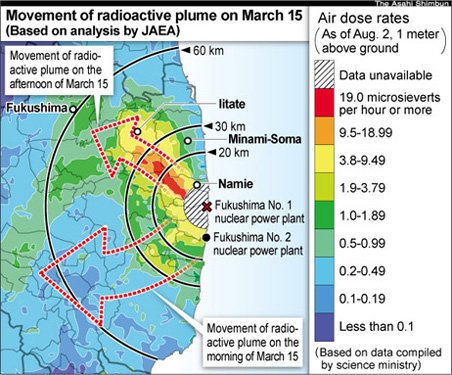
"Radionuclides were detected from the Fukushima nuclear accident at Fukuoka, Japan, 1000 km west of the Fukushima Daiichi nuclear power complex. Iodine-131 was first detected 3 d after the accident, indicating that it was probably transported dispersively because of local meteorological conditions, and not global air circulation. The maximum concentrations, 5.07 mBq m(-3) for (131)I, 4.04 mBq m(-3) for (134)Cs, and 4.12 mBq m(-3) for (137)Cs, were recorded in particles collected on April 6, 2011. However, these concentration levels decreased below the detection limit by April 26, 2011. Gaseous (131)I accounted for 30%-67% of the total (131)I content. The increase in dose by inhalation was negligible at Fukuoka."by Ian 10/12/2011 11:18:41 PM- www.ncbi.nlm.nih.gov "To understand how the high dose rate zones were created during the Fukushima Daiichi Nuclear Power Plant (FNPP1) accident on March 2011, the atmospheric dispersion of radionuclides during the period from 15 to 17 March was reproduced by using a computer-based nuclear emergency response system, WSPEEDI-II. With use of limited environmental monitoring data, prediction accuracy of meteorological and radiological fields by the system was improved to obtain best estimates of release rates, radiation dose maps, and plume movements. A large part of current high dose rate zones in Fukushima was explained by simulated surface deposition of radionuclides due to major releases of radionuclides on 15 March. In the simulation, the highest dose rate zones to the northwest of FNPP1 were created by a significant deposition of radionuclides discharged from FNPP1 during the afternoon. The results indicate that two environmental factors, i.e., rainfall and topography, strongly affected the spatial patterns of surface deposition of radionuclides. The wet deposition due to rainfall particularly played an important role in the formation of wide and heterogeneous distributions of high dose rate zones. The simulation also demonstrated that the radioactive plume flowed along the valleys to its leeward, which can expand the areas of a large amount of surface deposition in complex topography."by Ian 10/12/2011 11:19:12 PM
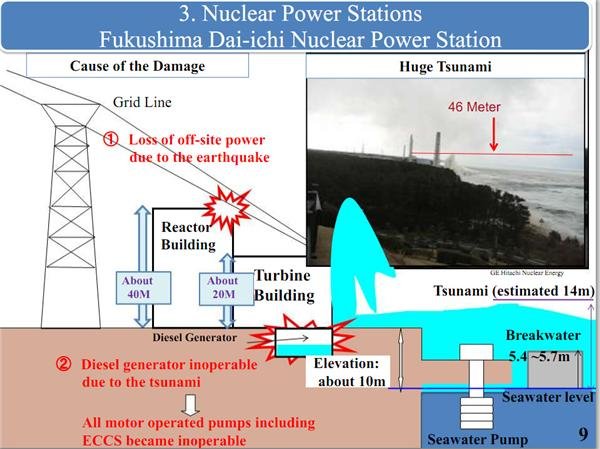
Look at this bang up to date doc from meti and no cold shutdown www.meti.go.jp and what is the flash on the unit for? picture is from page 9
by elainekirk 10/12/2011 11:26:08 PM- @lillymunster yes, phobia is irrational fear and a mental disorder.
the wikipedia article en.wikipedia.org explains the diagnostics for phobias quite exactly and distinguishes it sharply from:
"Terms for prejudice or discrimination
A number of terms with the suffix -phobia are used non-clinically but have gained public acceptance, though they are often considered buzzwords. Such terms are primarily understood as negative attitudes towards certain categories of people or other things, used in an analogy with the medical usage of the term. Usually these kinds of "phobias" are described as fear, dislike, disapproval, prejudice, hatred, discrimination, or hostility towards the object of the "phobia". Often this attitude is based on prejudices and is a particular case of most xenophobia. These non-clinical phobias are typically used as labels cast on someone by another person or some other group.
Below are some examples:
* Chemophobia – prejudice against artificial substances in favour of "natural" substances.
* Ephebiphobia – fear or dislike of youth or adolescents.
* Homophobia – fear or dislike of homosexuals or homosexuality.
* Xenophobia – fear or dislike of strangers or the unknown, sometimes used to describe nationalistic political beliefs and movements. It is also used in fictional work to describe the fear or dislike of space aliens.
* Islamophobia - this term is not connected to actual fear. It is used to refer to hating or discrimination against Muslims."
"radiophobia" is definitely a non-medical term to prejudice and discriminate people. this brings it very well to the point. it's discriminating.by Edano 10/12/2011 11:29:06 PM - @Edano perfect! Will add that into the article.by lillymunster 10/12/2011 11:30:21 PM
- @lillymunster yes, it's a very good and clear definition.by Edano 10/12/2011 11:32:00 PM
- looks like they are looking at resettlement this came up in the previous 24hrs search nlftp.mlit.go.jp
WTF! I hope I am getting the wrong idea of the meaning of this nlftp.mlit.go.jpby elainekirk 10/12/2011 11:33:38 PM - @Edano is it worth keeping that dated meti doc saying 1-4 are not in cold shutdown?by elainekirk 10/12/2011 11:34:37 PM
- @elainekirk will read it now. :)by Edano 10/12/2011 11:37:09 PM
- Lots of docs in this doc www.meti.go.jp
Japan’s Challenges
Concerning the Domestic and International Implications of TEPCO's Fukushima Dai-ichi Nuclear Power Station
October 12, 2011
Ministry of Economy, Trade and Industry
Cover Page (PDF:109KB)
Table of Contents
A. Japan Faces an Unprecedented Challenge
(Enormous Earthquake, Tsunamis and Nuclear Accident)(PDF:817KB)
Damage
Rescue Efforts and Foreign Assistance
Nuclear Power Stations
B. Key Challenges (PDF:1,321KB)
Cool Down of the Reactors
Contain the Spread of Radioactive Substances (sea, soil and atmosphere)
Rigorous and Intensive Monitoring
Ensure the Safety of Food, Products and Ports and Airports, and Decontamination
C. Impact on Japanese Economy (PDF:753KB)
Reconstruction and Recovery
Estimated Economic Damage of the Earthquake and Plan for Reconstruction
Electricity and Energy Policy
Steps in Policy Measures for Reconstruction
D. Information Sharing and Cooperation and with the International Community (PDF:317KB)
Cooperation with International Organizations
Speedy Dissemination of Accurate Information
Press Release by International Organizations
Full text (PDF:2.8MB)by elainekirk 10/12/2011 11:39:12 PM - There is a river map with an option to select to find data nlftp.mlit.go.jpby elainekirk 10/12/2011 11:41:54 PM
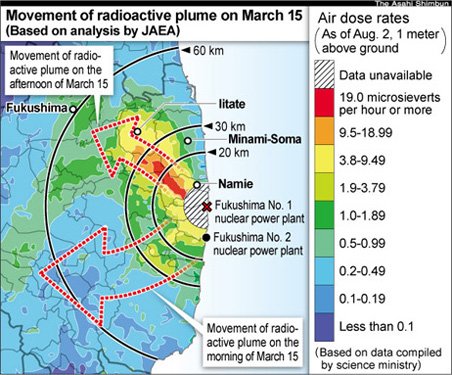
dwqovw6qi0vie.cloudfront.net The study abstract I posted below www.ncbi.nlm.nih.gov is of the findings that were reported in the media some time ago ajw.asahi.com (and above) that the red-hot high-dose zone across Fukushima was caused by a single rain late on March 15, which underscores what a small fraction of the total emissions cause the severe land contamination.
by Ian via Dwqovw6qi0vie.cloudfront.net 10/12/2011 11:42:10 PM- @elainekirk it's worth keeping for the nice tsunami illustration. they did never say that the units are already in cold shutdown, this is planned for december or january, when the tents succeed in containing the fallout.by Edano 10/12/2011 11:46:18 PM
- IIRC #3 exploded on the 15th, not the 14th as wikipedia has it listed. The time list was 11:15 JST if so the wind shifted soon after the explosion. If the wind had not shifted there would be a much bigger problem down towards Tokyoby lillymunster 10/12/2011 11:50:38 PM
- @lillymunster #3 exploded on the 14th, 11:45.by Edano 10/12/2011 11:51:52 PM
 Radioactive 'Hot Spots' Are Found in Tokyo
Tiny Areas Don't Pose Danger, but Show Contamination's Spread, Officials Say. Japanese researchers discovered high levels of radioactive material in concentrated areas in Tokyo and Yokohama, more than 150 miles away from the Fukushima Daiichi nuclear plant, as increasingly thorough tests provide a clearer picture of how far contamination has spread and accumulated after the March disaster.
In Tokyo, a sidewalk in Setagaya ward, in the western part of the city, recorded airborne radiation levels, about 50 times higher than another location in Setagaya where the ward regularly monitors radiation levels.
"What's puzzling is that the levels detected on other parts of the same sidewalk were very low," said Ken Hatanaka, head of the ward's section in charge of radiation monitoring. online.wsj.comby Majj 10/12/2011 11:52:17 PM
Japan Earthquake | Page 2497
- Who's Blogging
-
 hudebnik
 alblee
 UKVal
UKVal Oliver (ScribbleLive)
 Jonathan Keebler
 Matt (ScribbleLive)
 kaykodh
 PKelley
 Markfm
- dean
 Angie
Angie- Edano
 Deb
Deb Mid Valley
- Pedro Jesus
 George Gibb
- elainekirk
- lillymunster
 bo
bo IanGoddard