Japan Earthquake | Page 2571
 out to the forest play the minis. :)by Edano 10/29/2011 12:27:43 PM
- "the big forest where the animals live" :)by Edano 10/29/2011 12:28:17 PM
 he wild forestby dean 10/29/2011 12:30:15 PM
- theby dean 10/29/2011 12:30:19 PM
 Morning! (afternoon-evening)by lillymunster 10/29/2011 12:58:20 PM
- Reading morning news here. They have a 70% unemployment rate among those who had to evacuate, with those who can't work excluded. Why is the government not hiring some of these people as PAID cleanup crews rather than volunteers?
The new hot spot in Setagaya, how can NHK say it isn't FUKU when they don't know the source. It is starting to sound like the standard excuse.by lillymunster 10/29/2011 1:05:42 PM  Good morning, dean, take asperin, one of the oldest pharmaceuticals for which scientists and doctors still discover good uses. Another good news in this respect is that lipitor is going to be a generic drug anytime soon. That will lower the costs enormously. I prefer a good Pinot, though, :).by Peter 10/29/2011 1:07:22 PM
- @Edano if your still around, I found the rough area of the control rooms, 2nd floor in that bridge building. This is about level with the bottom area of the RPV and the floor level where the containment bulb starts. There are a number of heat exchangers on that level of the reactor building.by lillymunster 10/29/2011 1:07:34 PM
- @Peter I don't know if Lipitor has gone generic yet, Zocor (simvastatin) has but I don't know if the two are interchangeable drugs.by lillymunster 10/29/2011 1:09:26 PM
- As to the nuke stress test, the value is way low. 980 gal = 1 g. That translates into 0.13 g. If this was the design basis earthquake, it would be lower than that for North Anna.by Peter 10/29/2011 1:11:07 PM
- @dean, are control rooms always that close to the reactor? Does not that render them inoperable in an radiological emergency?by Peter 10/29/2011 1:13:26 PM
- Could the high rads in the control room be caused by building cracks rather than corium proximity? If some of the recent shaking failed an already damaged area and created a new open crack in the buildings it could be allowing radioactive steam etc to vent up into the control room.
There was mention of doors that seal to contain the control room air system. The door on one of the control rooms was bent - this led to the two workers who stayed on during the worst to get exposed when they tried to eat.by lillymunster 10/29/2011 1:13:34 PM - @lillymunster , that those vital rooms are not hermetically isolated is also something I wonder about. At Fukushima, the operators were not able to access these rooms at times to read the instruments because of the high rad levels.by Peter 10/29/2011 1:17:49 PM
- @lillymunster , ah we must be careful. There is a distinction between the command and control center on the hill to which the operators withdrew and the control rooms.by Peter 10/29/2011 1:19:30 PM
- @Peter they are supposedly sealed and appear to have their own air system, there is a venting system of some sort next to the doors that can be seen in the Cryptome images from last night. It doesn't seem to be very effective in practice though since the blasts foiled at least one door an as you said, when the meltdowns started the rad levels spiked in those rooms. They do have a distant central control room but I can't remember the exact location.by lillymunster 10/29/2011 1:19:57 PM
- @Peter I am speaking of the reactor control rooms next to the reactor itself. There is the central control room and also the EQ proof building. I am not sure if the EQ proof building has any control access or not?
Most of the pre-quake photos show the combined 1-2 and 3-4 control rooms where there is a visual division between each reactor side of the room by it being a mirror of the other.by lillymunster 10/29/2011 1:20:55 PM - The rad problem arose early on. Here from p II-88 of the NISA update pertaining to March 12: "In the Main Control Room, because dose was increasing, the shift supervisor made the people on duty move to the side of Unit 2 of which dose was lower."by Peter 10/29/2011 1:32:02 PM
- @Peter hmm so exactly what does that mean? The "2" side of the main control room? The unit 2 control room? Something else? There may be some hints hidden among the pre-disaster routine documents from TEPCO about the exact control room set up. What I wonder is how they relay the reactor data to the remote main control room? Is it repeated from the reactor control room on as some sort of data signal? Is there a direct connection split off from the sensor?by lillymunster 10/29/2011 1:37:29 PM
- It bit more from the event log for Unit 1 of this day, which sheds a light on the role of the different rooms, same report pp 86:
"Late at night on March 11 an increase of dose was confirmed in the site; moreover, an increase of drywell (D/W) pressure was also confirmed.
At 21:51 on March 11, admission to the reactor building was prohibited because dose in the building increased.
At around 22:00 it was reported to the NPS Emergency Response Headquarters that alarm pocket dosimeter (APD) had indicated 0.8 mSv on the scene in the reactor building in a very short time. At 23:00 on March 11, radiation dose increased in the turbine building by the impact of the increased dose in the reactor building (1.2 mSv/h in front of the north double door of the turbine building 1st floor, 0.5 mSv/h in front of the south double door of the turbine building 1st floor).
At around 23:50 on March 11, in the Main Control Room the restoration squad of the NPS Emergency Response Headquarters connected a small generator placed for temporary restoration of illumination of the Room to a D/W pressure gauge to confirm the indicated value to be 600 kPa abs.
Therefore, in the Main Control Room materials such as piping and instrumentation diagram, an AM procedure book and drawings of valves, and an acryl board were brought to start to confirm concrete venting procedures such as an operation method and procedure of valves.
At 02:24 on March 12, the evaluation results on the work time with respect to the site operation of venting were reported to the NPS Emergency Response Headquarters indicating that there was only 17 minutes of work time (20 minutes for self-air-set. Iodine preparation needs to be taken.) not to exceed the dose limit (100 mSv/h) in emergency response if in the atmosphere of 300 mSv/h.
At 02:30 on March 12, it was confirmed that the D/W pressure had reached 840 kPa abs (maximum working pressure: 427 kPa gage#).
# 528.3 kPa abs (=427kPa gage + 101.3 kPa)
At around 03:45 on March 12, exposure dose assessment in the vicinity at the time of venting was performed at the Response Headquarters of the TEPCO main office, which was shared with the NPS. Also, although the double door was opened at the NPS to measure dose in the reactor building, the dose measurement could not be performed because the door was shortly closed at the sight of white “haze something like steam”.
In the Main Control Room, with the goal of vent operation, confirmation was repeated about an order of valve operation, valve arrangement in the torus chamber, and how high the valve was positioned, etc. Also, fire-resistant clothes, self-air-sets, APDs, survey meters and flashlights were collected as many as possible as necessary equipment for work."by Peter 10/29/2011 1:40:28 PM - @lillymunster , that communication was disrupted. The operators had to access the control rooms with flashlights to read the gauges and actuate valves.by Peter 10/29/2011 1:46:19 PM
- @Peter SO NPS must be the quake proof building they have been using as command center on site. Main Control room is another building and the quake proof NPS does not have any data connections to the reactors. What has probably added to the complexity of all this is building the reactors one after the other rather than a bank of multiple units all at once.by lillymunster 10/29/2011 1:51:29 PM
- @all - I must run. I have a pack of teenage girls coming over to our house for a sleep over - must go clean.by lillymunster 10/29/2011 1:52:01 PM
- On communications from the NISA report, pII-78:
"Due to the loss of all AC power supplies, the status of communication tools in the power stations was extremely limited. PHS, normally used for communication among the staff in the NPSs, became dysfunctional, and communication tools between the main control room of each plant and the emergency response headquarters of the power stations where the plant manager, etc. gathered were limited to hotline and landline.
In addition, in the emergency response headquarters of the NPS, the Safety Parameter Display System (SPDS) had been deployed but due to the loss of power supply, instrumentation device monitoring parameter etc. did not function, thus transmission to SPDS was impossible. Accordingly, SPDS was usable with emergency power supply, however, as there was no displayed data, eventually it was unusable. Because of this, it became difficult for the emergency response headquarters of the NPS to figure out the status of plants and to plan measures on the basis of it."by Peter 10/29/2011 1:54:59 PM - I was posting this account taken from the September addition of NISA report to IAEA www.iaea.org , pp II-78, because it aptly demonstrates that the organization of station controls at Fukushima Dai-ichi NPS were fundamentally flawed. Any nuclear power station should be outfitted with an EMERGENCY CONTROL ROOM in which vital reactor parameters can be read at all times and from which the emergency core cooling system can be actuated.by Peter 10/29/2011 2:08:08 PM
- @Peter taking a break for a bit, reading those notes. I may try to make some sort of graphic to show all of these and the systems as explained in these reports. It seems like there are some major flaws in these redundant systems.by lillymunster 10/29/2011 2:55:32 PM
- @lillymunster , this seems like they were not counting on a true emergency ever happening. I do not believe this to be much different in the US.by Peter 10/29/2011 2:58:21 PM
- @Peter the US 4 hour battery supply, yea the US is just as unprepared. Another thing I noticed is that the Japanese emergency response system and their offsite command center relied heavily on having functioning telecom and power with no back up system. The generators were not quake resistant and were damaged. Telecom doesn't work without power and wired telecom can easily go down or be overloaded in an emergency. They had no radio or satellite system. I don't think any US nuclear facility has an offsite emergency center like Japan did. These issues discussed yesterday and today about control rooms, power, other fallback command centers etc. show the huge flaws in these plans. This isn't unique to a country either.by lillymunster 10/29/2011 3:14:21 PM
- out for a while, need to run to townby lillymunster 10/29/2011 3:18:52 PM

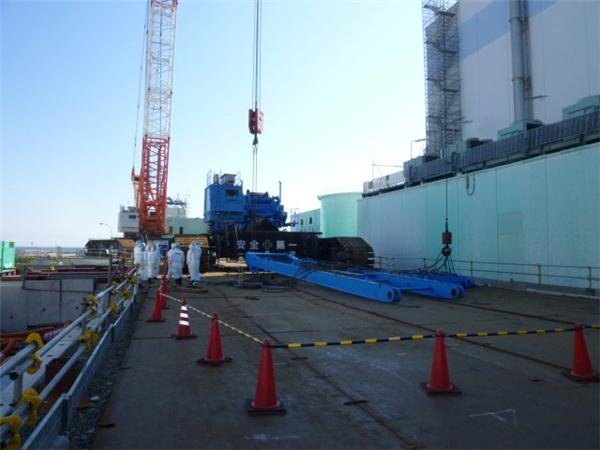
www.tepco.co.jp
details of how their 200ft crane collapsed www.tepco.co.jpby elainekirk via Tepco.co.jp 10/29/2011 3:49:11 PM- @lillymunster , according to NRC rules the operator must provide for a offsite emergency center to coordinate public matters together with local, state and federal agencies. This is laid out in the Emergency Plan www.nrc.gov the operator must submit for a license. I don't know whether they ever practice this plan. We have a loudspeaker emergency warning system on Campus here that is so loud we can hear it at our home. Imagine this will blurt out on day, "There has been a radiological emergency at North Anna NPS. Close your windows and stay indoors! This is not a test!" Everbody with kids would get in the car and try escape. Ever since Katrina we lost faith in the system.by Peter 10/29/2011 4:07:29 PM
- it is quite impossible to establish a complete fail proof telecom, but you can build redundant systems. which might not help in multi emergencies like in fuku.by Edano 10/29/2011 4:30:05 PM
- though a long wave radio with independent batteries should be standard.by Edano 10/29/2011 4:32:43 PM
- Excessive cesium detected in greenhouse-grown mushrooms in Fukushima
FUKUSHIMA, Oct. 29, Kyodo english.kyodonews.jpby Edano 10/29/2011 4:35:12 PM - it is strange that tepco does not mention the control room problems.by Edano 10/29/2011 4:38:42 PM
- our finance minister miscalculated germany's debts: they are € 55.5 billions less. hmmm.... news.ninemsn.com.au on monday i will go recalculate mine.by Edano 10/29/2011 4:40:56 PM
- Hi had a thought while stuck in traffic. The torus is underground under where the control rooms are. The reactor is offset in th e bldg. So something in the wetwell is possibly the issue with the control room rads in 3 and wasn't there a 5 quake the other day?by lillymunster 10/29/2011 4:44:32 PM
- @lillymunster no bigger quake on 27 or 28 oct. www.jma.go.jp but 26 was a 5.0 near fuku. the first high rad reading is from 10/28 11:00 , very abrupt. www.tepco.co.jp last column.by Edano 10/29/2011 4:49:07 PM
- @elainekirk , if you ever come across pictures that identify the condensate storage tanks, keep them for us.by Peter 10/29/2011 4:50:35 PM
- and no change in torus or drywell pressure.by Edano 10/29/2011 4:52:19 PM
- this is more comprehensive than the csv file: www.tepco.co.jpby Edano 10/29/2011 4:58:59 PM
- Hi@all :), i just watched this clip of a nuke missile in flight. Its spooky. Pakistan test fires nuclear-capable cruise missile
www.dailymotion.comby Liz 10/29/2011 5:08:00 PM - @Peter will have a look peterby elainekirk 10/29/2011 5:08:57 PM
- @Peter your condensate tanks will try get better placement drawings but these got each unit www.tepco.co.jp
and
www.tepco.co.jpby elainekirk 10/29/2011 5:11:43 PM 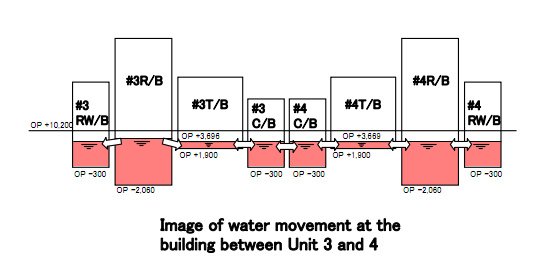
were these buildings being discussed re control room? www.tepco.co.jp
further text in the doc identify C/B as the control buildingby elainekirk 10/29/2011 5:26:03 PM- @elainekirk , if we were able to locate these tanks on pictures, we could evaluate what state they are in. They provide the water for emergency core cooling by default.by Peter 10/29/2011 5:31:34 PM
Japan Earthquake | Page 2571
- Who's Blogging
-
 hudebnik
 alblee
 UKVal
UKVal Oliver (ScribbleLive)
 Jonathan Keebler
 kaykodh
 PKelley
 Markfm
 Angie
Angie Deb
Deb Mid Valley
- Pedro Jesus
 Matt (ScribbleLive)
 George Gibb
- elainekirk
- lillymunster
- dean
 bo
bo- Edano
 IanGoddard