Japan Earthquake | Page 2894
 video 4 seemed to have the white wash out on it. I need to double check where that video starts out if it is at the penetration level or continuing lower or higher.
I should be able guess for a max distance for the camera scope. They said how long the scope was in a document. So minus containment thickness we should know max reach.by lillymunster 1/21/2012 11:29:12 PM 512 Sieverts / hr means 51,200 RADs or a 50/50 lethal dose in half a minuteby dean 1/21/2012 11:32:05 PM
- @lilly.. IF the radiation levels are that high at the penetration, even if the camera went inside a foot, as you can see that white out tells us something... potentially that the high rad level is directly related an extremely high radiation source some number of feet away and that would have to be the fuel corium materialby dean 1/21/2012 11:34:15 PM
- according to TEPCO via the media the scope:
The camera is 10 meters long with an 8 millimeter device on the end.by lillymunster 1/21/2012 11:34:39 PM - we'd have to subtract the thickness of the penetration wall and even then to get to those levels,,,, something extremely high in radiation level is causing such high readingsby dean 1/21/2012 11:35:50 PM
- I am not sure of the exact height of the penetration itself vs. the floor level. Dean are these penetrations at a standard height vs. the floor or would the be all over based on need to locateby lillymunster 1/21/2012 11:35:56 PM
- @lilly, not sure on the standard height but maybe we could search for the number on google and see what pops upby dean 1/21/2012 11:36:39 PM
- I have containment thickness in a photo somewhere. I want to say 2 meters? Not 100% sure that is right.by lillymunster 1/21/2012 11:36:49 PM
- another thing @lilly.. if the radiation level was that high inside, there would be a radiation beam shining through that penetration and the people there could have received alot of dose fastby dean 1/21/2012 11:37:23 PM
- x-53 is the penetrationby lillymunster 1/21/2012 11:37:41 PM
- 2at least @ lilly especially where that is the thickest part due to having the air lock access doorby dean 1/21/2012 11:38:11 PM
- @dean they worked in teams and Happy mentioned something about using a fan to force air back into the penetration. He didn't say if they used any sort of lead shield or anything while they workedby lillymunster 1/21/2012 11:38:32 PM
- looking on the elevation drawing for the thickness.. duh. :-)by lillymunster 1/21/2012 11:41:03 PM
- www.tepco.co.jp @LILLY CHECK THIS OUT, THERE ARE SOME PHOTOSby dean 1/21/2012 11:41:12 PM
- @lilly can you translate that page? ... the photos are interestingby dean 1/21/2012 11:41:51 PM
- I think those photos were taken at the mockup work they did at unit 5by dean 1/21/2012 11:46:08 PM
- No guarantee that it is the same at Fukushima, but in a US BWR-3/4, penetration X-53 was used for initial power testing. It is located below the centerline of the spherical portion of the drywell, but above the top of the vent pipes from the drywell to the torus. That is consistent with boring being performed on the first floor of the reactor building.by dean 1/21/2012 11:46:50 PM
- Based on the elevation drawing the containment at that level is only 1.5 meters thick 1400 millimetersby lillymunster 1/21/2012 11:47:45 PM
- www3.nhk.or.jp On 17 January workers entered into the north-west part of unit 2's reactor building first floor and drilled in the spare penetration the hole through which the endoscope will be inserted. The work is made by ten teams of four people, which makes a workforce of 40. They were trained in drills performed at unit 5 in order to spend as little time as possible. The maximum exposure was 3 mSv. On 18 January they will do preparation work such as installing the endoscope and on 19 January they will start taking pictures with it.by dean 1/21/2012 11:49:56 PM
- great find Dean. The images are of 5 but they show the penetration and camera rangeby lillymunster 1/21/2012 11:50:05 PM
- ty lilly,,,, not sure what to make out of the maximum exposure of 3msv probably for the workers as opposed to the rad levels right inside through the wall... still, if the camera white out occured that's the rad level... I've done it before with cameras and they are the sure sign that rad levels are getting too highby dean 1/21/2012 11:51:38 PM
- www.tepco.co.jp @ lilly, in this link which was at unit 5, the piping etc is actually conduits going into conduit boxes.. you can see the taped identifired just at the penetration of the boxesby dean 1/21/2012 11:53:14 PM
- @dean the 3 mSv was based on the day they drilled the hole. Happy seemed to say TEPCO was just ballparking the exposure from that day and using the previous excursion. Sounds like more TEPCO bSby lillymunster 1/21/2012 11:53:26 PM
- So with a camera like that do they white out when they get to their maximum radiation tolerance?by lillymunster 1/21/2012 11:54:19 PM
 @dean @lillymunster I'm sure I read a tweet that said actual exposure for some workers was higher than 3msv - up to 50???by UKVal 1/21/2012 11:54:54 PM
- @UKVal that makes more sense.by lillymunster 1/21/2012 11:55:24 PM
- www.tepco.co.jp @ lilly, video of trial run at 5by dean 1/21/2012 11:55:43 PM
- I think I have enough info to piece together exact areas now. The penetration is listed with an OP number on that document dean posted. So I can indicate camera range on the elevation drawing and may be able to use photos from 5 to help ID items inside 2.by lillymunster 1/21/2012 11:56:24 PM
- there are men walking down around where those conduits run to the boxes which means they were inside the PCV area when they shot the videoby dean 1/21/2012 11:56:27 PM
- @dean at 5? Yes. 5 was in shut down when the quake hit and it sounds like 5 has become their test bed for all sorts of things since it isn't damaged or leaking.by lillymunster 1/21/2012 11:57:15 PM
- @lilly, maybe the camera going to white out would be a good basis for the rad levels insideby dean 1/21/2012 11:59:11 PM
- The photo here of unit 5 matches up with the upright pipes seen in the unit 2 scope videos www.tepco.co.jpby lillymunster 1/22/2012 12:00:24 AM
- yesby dean 1/22/2012 12:01:35 AM
- @dean sounds like it. Working on putting together all these finds about location of the camera range vs. the reactor elevation drawing. This should tell us how close they could have gotten to any corium.
So how high does the rad level need to be to wash out the camera? Close to its maximum?by lillymunster 1/22/2012 12:01:44 AM - need to be convinced that what we really saw was whiteout of the cam as opposed to something else thoby dean 1/22/2012 12:02:14 AM
- Oh big duh on my part. The PDF identifies the pipes as the CRD and maps them out on the drawing of the building.by lillymunster 1/22/2012 12:03:03 AM
- Happy tweets 'The camera we used today can resist for 1000Sv, but even the camera got so much noise (the white spots), the radiation level is really high. At usual reactor test, we put water-resistant camera into the reactor but it gets too much noise when the camera goes close to the highly radioactive place called top guide.' fukushima-diary.com What does he mean by 'top guide'?by UKVal 1/22/2012 12:04:06 AM
- @dean there are 3 types of white that seems to show up. Reflection of the light, steam/water and white wash out. There are some that seem to be different like the camera does wash out but not seeing lots of that kind of thing before it is hard for me to determine exactly. The 4th videos are the ones that show it.by lillymunster 1/22/2012 12:04:27 AM
- our theory will have that assumption, the best we can see is white out on the cameraby dean 1/22/2012 12:05:17 AM
- & more.. 'f you put the camera at too radioactive place for too long, the camera gets broken. Today the endoscope became like that. To get more detailed image, we would need a more protective camera. It would cost 100 million yen to buy the camera what can get close to the fuel debris with color image.'by UKVal 1/22/2012 12:05:45 AM
- I don't know if it was due to where they put the camera or the time duration of using it but the images degraded as the time went on in the videos.by lillymunster 1/22/2012 12:12:26 AM
- @lilly.. I need to step away for a bit... how bout you put it out for discussion and comments, I will returnby dean 1/22/2012 12:12:38 AM
- @dean putting together the data and will make a peer review page and post here so people can look at all the data together and discuss.by lillymunster 1/22/2012 12:15:17 AM
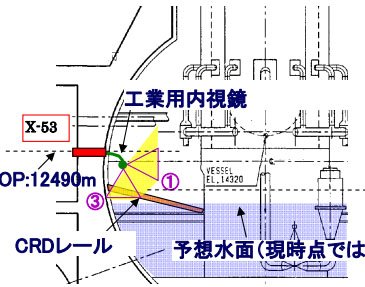
camera and light range in reactor
by lillymunster 1/22/2012 12:15:51 AM- I will get some measurements from the end of camera range to containment floor etc.by lillymunster 1/22/2012 12:16:27 AM
Japan Earthquake | Page 2894
- Who's Blogging
-
 hudebnik
 alblee
 UKVal
UKVal Oliver (ScribbleLive)
 Jonathan Keebler
 kaykodh
 PKelley
 Markfm
 Angie
Angie Deb
Deb Mid Valley
 Pedro Jesus
 Matt (ScribbleLive)
 George Gibb
 elainekirk
- lillymunster
- dean
 bo
bo Edano
Edano IanGoddard