Japan Earthquake | Page 633
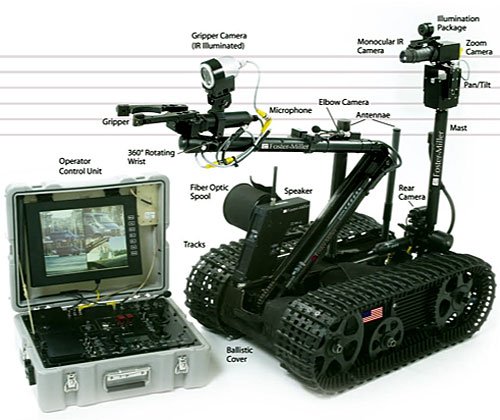
 @NHK Listener Interesting: Two (2) robot platforms are currently in large-scale use by the U.S. Military, the Foster Miller Talon, and the iRobot PackBot EOD. Naval Sea Systems Command, Naval Explosive Ordnance Disposal Technology Division fielded both of these systems under the Man Transportable Robotic System program to support the Explosive Ordnance Disposal mission. <...> Any technical data that iRobot would develop or technical documents they would produce would be specific only to their product. As the resulting Packbot 510 with HAZMAT Detection Kit is now a commercially available item, the Government would not be interested in purchasing the rights to the data. acquisition.army.milby Rob in SF 4/11/2011 4:37:18 AM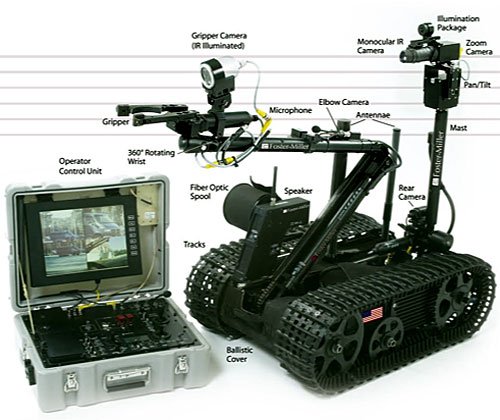
The Talon should hook up with the two hawks... robotcentral.com
by Rob in SF via Robotcentral 4/11/2011 4:38:35 AM @Rob in SF I wonder what is in the animal cage? www.usarak.army.milby NHK Listener 4/11/2011 4:40:15 AM
 Risk of massive radiation leaks 'considerably smaller' -kyodo english.kyodonews.jpby Scilla 4/11/2011 4:40:21 AM
- In addition to the four government transitions, ECBC and
iRobot Corporation established a cooperative research and
development agreement in February 2008. The agreement
provides great benefit to the Department of Defense by allowing
the CUGV team to implement additional improvements
to the vehicle. It also involves providing iRobot with
the technical data necessary to enable commercialization
of the CUGV, potentially benefiting the warfighters and first
responders by providing a commercial alternative for robotic
reconnaissance in times of urgent need. www.ecbc.army.milby NHK Listener 4/11/2011 4:50:18 AM - @NHK Listener if you see tenzing on will you ask her to look at pic 39 /41 above the ladies head at the dark green/grayish thing it look like what they were looking at today (on the flicer link that just posted 20 back)by fitter 4/11/2011 4:51:05 AM
I want one!
by Rob in SF 4/11/2011 4:52:34 AM- by Rob in SF 4/11/2011 4:53:29 AM
- @fitter I will mention it if I see tenzingby NHK Listener 4/11/2011 4:55:25 AM
 The GreenPeace DATA
www.greenpeace.orgby Veen Oui 4/11/2011 4:56:49 AM Fukushima Gov. Sato rejects meeting with TEPCO president
TOKYO, April 11 - (Kyodo) Tokyo Electric Power Co. President Masataka Shimizu visited the Fukushima prefectural government office Monday afternoon to apologize for the nuclear disaster at its Fukushima Daiichi power plant, but Gov. Yuhei Sato has declined to meet him, according to officials from the utility and the prefectural government. english.kyodonews.jp This guy reminds me of Billy Noneguesser from Louisiana, good for him.by Sinthia Domina 4/11/2011 5:05:27 AM There is a UStream which measures radiation count in West LA live. It just wrapped up its 10 pm recalibration averaging the counts of the past ten minutes and came out at 429. (It proports 421 to be the average amount of normal background radiation.) So not too bad, tonight.by wrshpr 4/11/2011 5:12:24 AM
- 2011-04-11
Monitoring of Radioactive Concentrations in Nearby Sea of Fukushima Daiichi NPS www.jaif.or.jpby NHK Listener 4/11/2011 5:12:46 AM
Didn't see this coming.....Japan plans to extend evacuation zone around damaged nuclear plant because of high radiation levels - Reuters nyti.msby wrshpr 4/11/2011 5:33:54 AM- @NHK Listener Uhhhh, bit of a discrepancy between Gov. measurements and TEPCO measurements on the sea borne radiation... www.jaif.or.jpby Rob in SF 4/11/2011 5:39:50 AM
- @Rob in SF Concentration (Water: Bq/cc ) Tepco is measuring (Bq/cm3)by NHK Listener 4/11/2011 5:45:49 AM
- G20 to discuss Japan's nuclear disaster issues www3.nhk.or.jpby NHK Listener 4/11/2011 5:49:32 AM
- Evac area to soon be declared 'off-limits'
Kyodo News
The 20-km evacuation zone around the crisis-hit Fukushima No. 1 nuclear power plant will soon be turned into a legally binding off-limits zone, senior officials said Sunday.
News photo
Buried treasures: A woman looks for her belongings in the ruins of her home in Ofunato, Iwate Prefecture, on Sunday
The step is aimed at increasing government control over the area. Desperate residents have been braving radiation fears for quick return trips to pick up essential belongings. Officials suggested Sunday that they will now be able to force anyone out of the evacuation zone who refuses to leave. search.japantimes.co.jpby NHK Listener 4/11/2011 5:51:52 AM - Crews to pump water in trench to storage area
Transfer critical to securing No. 2 reactor
Kyodo News
Repair crews at the Fukushima No. 1 power plant Sunday prepared to pump highly radioactive water from a trench under the No. 2 reactor to a storage spot secured in its turbine building, the nuclear safety agency said.
Toxic water being produced from emergency cooling operations has flooded the basements of the turbine buildings of reactors 1, 2 and 3, as well as trenches connected to them.
Transferring the 60,000 tons of water to other containment facilities is crucial to restoring their critical cooling systems because its lethal radioactivity is keeping workers at bay. search.japantimes.co.jpby NHK Listener 4/11/2011 5:53:30 AM - Progress slow in restoring Fukushima plant amid pools of toxic water
The nuclear safety agency has asked the firm to check issues such as whether the condenser is sound enough to store such highly polluted liquid. english.kyodonews.jpby Rob in SF 4/11/2011 6:00:29 AM 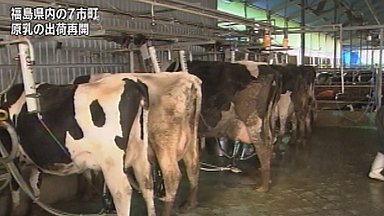
www3.nhk.or.jp Some dairy farms in Fukushima Prefecture have resumed shipping milk after radiation levels in the milk cleared the government's safety standards.
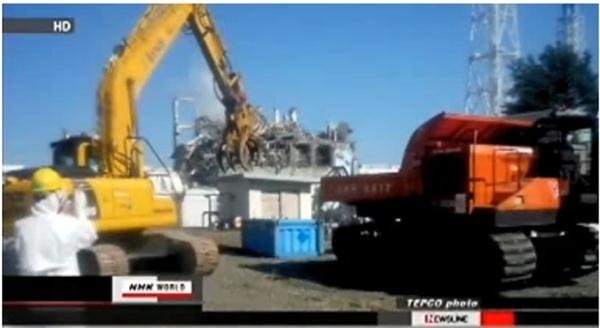
The shipments are the first since the Japanese government lifted a ban last Friday on milk from 7 cities and towns in the prefecture. www3.nhk.or.jpby Rob in SF via Www3.nhk.or.jp 4/11/2011 6:03:48 AM Are my tired eyes seeing a tiny bit of black smoke? pointscope01.jpby ColorMeRed 4/11/2011 6:35:30 AM
 @ColorMeRed - especially at 4 o'clockby Lethbridgean 4/11/2011 6:39:45 AM
 by NHK Listener via I140.photobucket 4/11/2011 6:42:24 AM
- @NHK Listener how many boards do we haveby fitter 4/11/2011 6:44:06 AM
- @fitter - 2by Lethbridgean 4/11/2011 6:44:30 AM
- @fitter 2 that I know ofby NHK Listener 4/11/2011 6:44:38 AM
- Why?by Lethbridgean 4/11/2011 6:44:46 AM
- @Lethbridgean iwas just on a third, but it had two pages thought they had delete this board GLAD to find youby fitter 4/11/2011 6:45:40 AM
- @Lethbridgean now im going back to sleepby fitter 4/11/2011 6:46:16 AM
- we need the first pin to be a heading = so you can tell you r onthe right board nite allby fitter 4/11/2011 6:47:39 AM
- Flash back in time live.reuters.comby NHK Listener 4/11/2011 6:49:07 AM

2.bp.blogspot.com The 2:46 Quakebook project started with a tweet and is on the verge of something great, a way that we can help all those hit by the the March 11th, 2011 earthquake and its aftermath.
Led by OurManInAbiko, a call went out across Twitter for contributors to create a book to raise funds for Red Cross Japan. The idea was to share the stories and experiences of people actually on the ground during the earthquake, whilst raising funds for the Red Cross. www.quakebook.orgby Rob in SF via 2.bp.blogspot 4/11/2011 6:51:26 AM- @fitter -lol good night buddy.by Lethbridgean 4/11/2011 6:54:59 AM
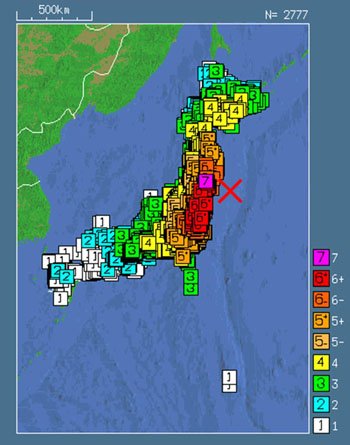
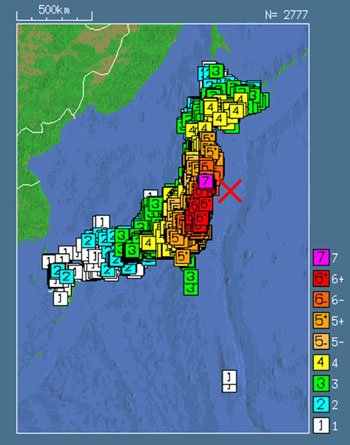
www.japantimes.co.jp Japan's seismic nerve center
Those tasked with warning the nation of quakes and tsunami can never drop their guard The Earthquake Phenomena Observation System, located inside the Japan Meteorological Agency in Tokyo's central Otemachi district, is usually operated by five teams of seven who work in rotating shifts that span every minute of the year. But at 2:46 p.m. on March 11 this year, all that changed. In an atmosphere that even one of Japan's famously reserved bureaucrats — an agency staffer — admitted was "extremely intense," everyone who physically could report for duty did, and some didn't go home for the next 72 hours.
Shock and awe: Data from meters all over Japan, as seen at right, helped computers create this constantly updated map of shaking during the March 11 megaquake (above). JAPAN METEOROLOGICAL AGENCY
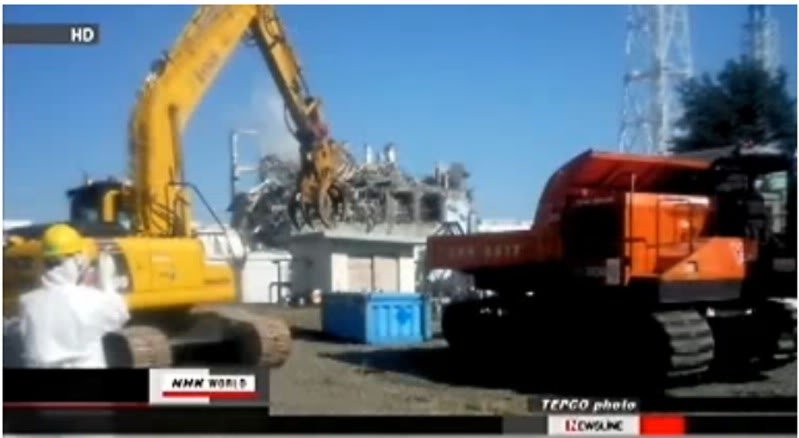
During the first three days after the Great Eastern Japan Earthquake struck, the EPOS operators in Tokyo detected and monitored what was literally a nonstop barrage of aftershocks. In that 72-hour period, they recorded more than 250 quakes of magnitude 5 or higher — that's an average of one every 17 minutes. At least 45 of those exceeded magnitude 6, and three topped magnitude 7. search.japantimes.co.jpby Rob in SF via Japantimes.co.jp 4/11/2011 6:55:27 AM- @NHK Listener Lotta' steam behind that crane arm...by Rob in SF 4/11/2011 6:55:54 AM
- People 'rounds these parts always recount how animals know an earthquake is coming, birds and insects go silent, dogs and horses spook... Seems the animals are detecting the P-waves... earthquake.usgs.govby Rob in SF 4/11/2011 7:02:03 AM
- @Rob in SF I found 2 other boards so there is 4 not 2 lolby NHK Listener 4/11/2011 7:09:35 AM
- End to crisis is years, fortune away
Decommissioning reactors to take decades, untold millions search.japantimes.co.jpby Rob in SF 4/11/2011 7:09:53 AM - nhk liveby NHK Listener 4/11/2011 7:10:25 AM
- @NHK Listener - ghost boards? How many pages? could you post them?by Lethbridgean 4/11/2011 7:11:50 AM
- The March 11 tsunami dealt a crippling blow to abalone fishing along the Tohoku region's Sanriku coast, sweeping tons of debris into the sea and destroying fishing vessels.
It is expected to be years before abalone fishing in the area can resume, leading some retailers in China--a major consumer of abalone--to rush to secure supplies. www.yomiuri.co.jpby Rob in SF 4/11/2011 7:16:21 AM - Edano 4pm 4/11/2011 - Japan Gpn (Edano) announced the expansion of non-uegent evacuation zone to 5 nearby district outside 20km zoneby Veen Oui 4/11/2011 7:18:51 AM
- Yoshihama Bay in the Sanrikucho-Yoshihama district of Ofunato, Iwate Prefecture, was hit by a 15-meter-high tsunami that utterly destroyed a fishermen's cooperative building. Of 296 ships working before the disaster, only 11 survived. <...> As wholesale prices soar, the menu price of a small abalone had jumped from 550 Hong Kong dollars (about 6,000 yen) to H.K.990 dollars as of April 1. www.yomiuri.co.jpby Rob in SF 4/11/2011 7:19:10 AM
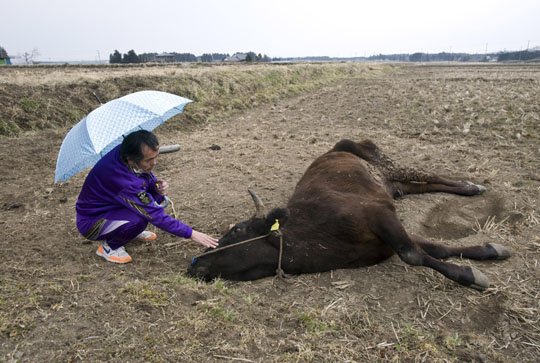
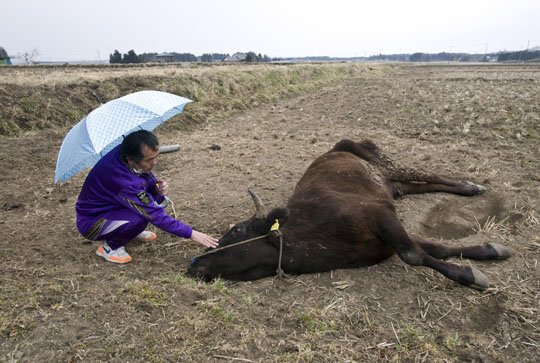
www.japantimes.co.jp MINAMISOMA, Fukushima Prefecture — There's a repellent stench coming from the cowshed. It's a mixture of manure, hay and something more difficult to pinpoint — something dank, musty, unworldly.
At the back, penned behind large wooden troughs, two cows stumble back and forth, searching for food and water. Two others are lying on their sides, eyes vacant, their bodies bloated. They, too, had waited to be fed, but in vain.
There is no water — the taps are dry — and there's nothing to feed them with, though even if there was, there's no one to put it out for them. The farmer has fled, along with all the other residents of this small community, who were told to leave following the disaster that began on March 11 a short distance down the road.
They obviously left in a hurry — doors of homes are left ajar, partially finished cups of tea lie abandoned on a table. The only beings here — dead, or barely living — are parched and famished farm animals and pets that roam the streets aimlessly in a chilling scene reminiscent of an Alfred Hitchcock film. search.japantimes.co.jpby Rob in SF via Japantimes.co.jp 4/11/2011 7:24:31 AM

Japan Earthquake | Page 633
- Who's Blogging
-
 hudebnik
 alblee
 UKVal
UKVal Jonathan Keebler
 Oliver (ScribbleLive)
 kaykodh
 Markfm
 Angie
Angie Mid Valley
 Matt (ScribbleLive)
 George Gibb
 elainekirk
 PKelley
 lillymunster
 dean
dean bo
bo Edano
Edano Deb
Deb- Pedro Jesus
 IanGoddard