Japan Earthquake | Page 629
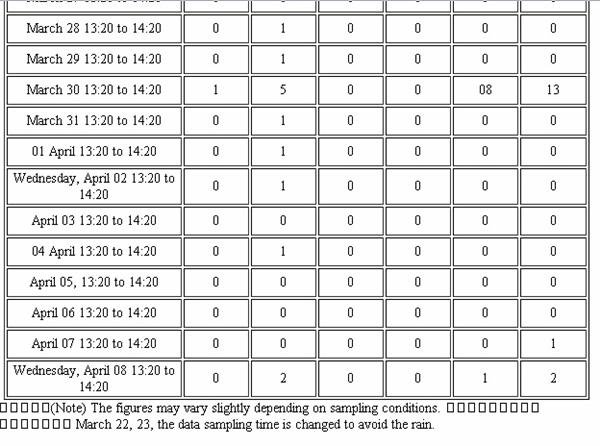
 Don't know if you need that but here is up to date radiation measurements from a city in south of Ibaraki: www.aist.go.jp (in Japanese)by LE edited by elainekirk 4/10/2011 11:10:51 PM
 No news from Fukushima while reactor one is running hot and in high pressure... this is disgusting.by Salvador 4/10/2011 11:11:00 PM
 @LE thank you all information is usefulby elainekirk 4/10/2011 11:11:27 PM
- @salvador very strange that we get no further news on the nitrogen progress#by elainekirk 4/10/2011 11:12:11 PM
 @Salvador We are waiting for the latest thermals.by NHK Listener 4/10/2011 11:13:56 PM
 @LE Could you synopsize? It's in Japanese, and I (blush) don't know how to google.by marie rich 4/10/2011 11:16:25 PM
 @All, does anybody know if N2 was also injected into unit #3 ?by WolfDK 4/10/2011 11:17:19 PM
- I read the following in Wikipedia:by WolfDK 4/10/2011 11:19:30 PM
bottom
by elainekirk 4/10/2011 11:20:19 PM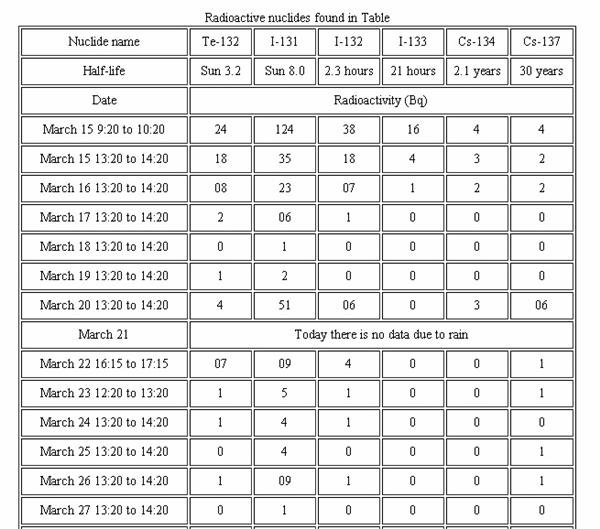
top
by elainekirk 4/10/2011 11:20:45 PM- I read the following in Wikipedia: Plutonium is a transuranic radioactive chemical element with the chemical symbol Pu and atomic number 94. It is an actinide metal of silvery-white appearance that tarnishes when exposed to air, forming a dull coating when oxidized. The element normally exhibits six allotropes and four oxidation states. It reacts with carbon, halogens, nitrogen and silicon. When exposed to moist air, it forms oxides and hydrides that expand the sample up to 70% in volume, which in turn flake off as a powder that can spontaneously ignite. It is also a radioactive poison that accumulates in bone marrow. These and other properties make the handling of plutonium extremely dangerous.
Source: en.wikipedia.orgby WolfDK 4/10/2011 11:21:33 PM - @marie this is the nuclides chart from @LE linkby elainekirk 4/10/2011 11:21:38 PM
- @marie rich I can read only a little Japanese, but they measure in two locations: the 3rd floor patio and the parking lot. The normal background radiation is 0,06 µSv/hr. I have no idea about the isotope measurements further down.by LE 4/10/2011 11:22:00 PM
- www.tepco.co.jp -From April 2nd, we began to transfer the radioactive water we collected
from the Central Environmental Facility to the Unit 4 turbine building.
On April 4th, water level of the pit in the trench of Unit 3 increased
by 15cm from previous day. Pathway of water flow is unknown. We can not
deny the possibility that water in the turbine building of Unit 4 flows
into the trench of Unit 3. So, we stopped transferring water to the
Unit 4 turbine building to make assurance. Present water level of the
pit in the trench of Unit 3 is not changed from the time we stopped
transferring, and is being stable.by marie rich 4/10/2011 11:26:48 PM - @LE how far are you from the plantby elainekirk 4/10/2011 11:26:58 PM
- @LE Thanks. somebody will xlateby marie rich 4/10/2011 11:27:16 PM
- @Marie which other charts (nuclide posted here) would you like?by elainekirk 4/10/2011 11:28:38 PM
 Major facilities at the Fukushima No. 1 nuclear power plant, including reactor and turbine buildings, were flooded to a depth of four meters to five meters during the March 11 tsunami, according to Tokyo Electric Power Co.
The tsunami inundated facilities including the Nos. 1 to 4 reactors and turbine buildings and rose as high as about 15 meters above sea level, according to TEPCO. www.yomiuri.co.jpby Rob in SF 4/10/2011 11:28:43 PM- @elainekirk At the moment over 9000 km because I am in Germany but I will return 30th of April. The city called Tsukuba is about 180 km from the power plant.by LE 4/10/2011 11:28:56 PM
- TEPCO is now working to set up a water transfer hose to clear more contaminated water that has flooded the basements of the turbine buildings of the No. 2 reactor and other facilities. www.yomiuri.co.jpby Rob in SF 4/10/2011 11:29:43 PM
- @elainekirk don't wanna take advantage of you. whatever your inclined to do, I'd take gratefully.by marie rich 4/10/2011 11:30:52 PM
- @@Marie what do you think 180km and the 30th 137 level?by elainekirk 4/10/2011 11:31:38 PM
- @Marie translate.google.com is your friend -- it can take individual text or a Web page: translate.google.comby Markfm 4/10/2011 11:32:47 PM
- would give us a good wider view? I like itby marie rich 4/10/2011 11:32:54 PM
- The government and plant operator Tokyo Electric Power Co. have repeatedly said there will be no major health impact "for the time being" and that there will be no "immediate" effects. <...> Monitoring data has shown the total fallout of cesium-137 in Hitachinaka, Ibaraki Prefecture, for 18 days through Tuesday morning was 26,399 becquerels per square meter. In Shinjuku Ward, Tokyo, the figure was 6,615 becquerels per square meter.
Rain on March 21-22--the first since the nuclear crisis began--brought down a large amount of cesium-137, spreading the contamination to Tokyo and 13 prefectures in and around the Kanto region. <...>
The level of radioactive fallout in Hitachinaka and some other areas in the wake of the Fukushima crisis is believed to be higher than that reported in the 1979 Three Mile Island accident in the United States, and about the same as that reported in Europe after the Chernobyl incident.
Fallout levels in the Kanto region have been decreasing this month. Daily readings have been about the same as the early 1960s when so many nuclear tests were conducted. Some experts have said these levels pose no threat to people's health. However, highly radioactive water leaked from the Fukushima plant into the ocean could cause severe damage to marine life. www.yomiuri.co.jpby Rob in SF 4/10/2011 11:33:39 PM 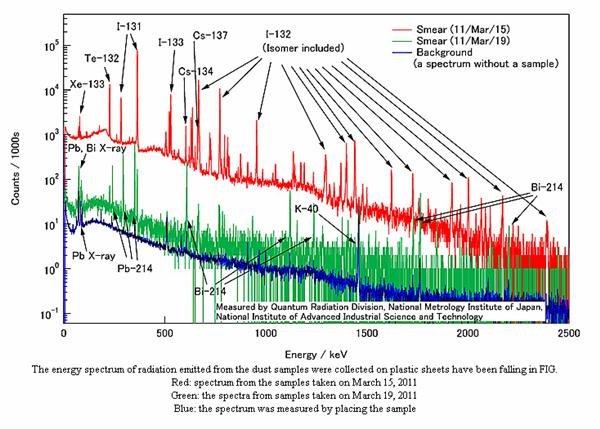
Radiation emitted by radioactive materials deposited on dust drifting through the atmosphere (ray γ) the energy spectrum of the germanium detector was measured using an instrument called. March 15, red, green energy spectrum of radiation emitted by material collected on March 19. What is called a blue background and the spectrum measured in samples taken place. Background spectrum is present in the environment, K-40 (radioactive potassium, the body is about 0.01 grams, about 3,000 becquerels exist) are visible radiation. The measurements of the March 15, iodine, cesium, xenon, was detected as a radioactive nuclide and tellurium materials. These nuclei, in the general environment that does not exist, it is estimated that emitted by the Fukushima Daiichi Nuclear Power Station accident. Posted a new measurement date of March 19. On this day, because a decrease in radioactive and radioactive iodine, a naturally occurring K-40 (radioactive potassium), Pb-214 (radiogenic lead), Bi-214 (Bi radioactive) was observed noticeable radiation from .
by elainekirk 4/10/2011 11:40:14 PM- @LE do you have family there LE? is it your hometown :)by elainekirk 4/10/2011 11:42:41 PM
- @elainekirk No, I work there but I have friends in Tsukuba of course.by LE 4/10/2011 11:43:47 PM
- @elainekirk thankyouby marie rich 4/10/2011 11:44:26 PM
- @LE thankyouby marie rich 4/10/2011 11:44:42 PM
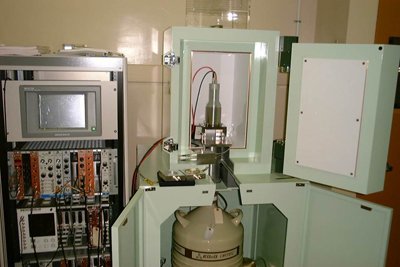
This activity is one of the plains site AIST m × 1.5 m plastic sheet spread of radioactive dust wiped off the sample adhered to one hour, is measured by the germanium detector. Germanium semiconductor detector (pictured below), X is a detector for measuring γ-ray energy lines and. Radiation detection portion is made from a substance called germanium semiconductor. The radiation enters the semiconductor, resulting in a pulsed current. The higher the radiation energy will be large pulse of current. Energy spectrum can be obtained to measure the magnitude of the electric current pulse.
by elainekirk 4/10/2011 11:46:44 PM- @LE is there anything you want to know about the data?by elainekirk 4/10/2011 11:47:19 PM
 @LE Thank you very much for the AIST link.by Reed 4/10/2011 11:47:50 PM
- @marie rich Have you tried tracking reports of Te-132 ?by Reed 4/10/2011 11:49:12 PM
- @elainekirk Thank you, I'm fine. I understand the data.@Reed Your welcome. I think it is a good source because it is independent and valid for me.by LE 4/10/2011 11:49:37 PM
- @elainekirk IsotopesMain article: Isotopes of bismuth
The only naturally occurring isotope of bismuth, bismuth-209, was traditionally regarded as the heaviest stable isotope, but it had long been suspected to be unstable on theoretical grounds. This was finally demonstrated in 2003 when researchers at the Institut d'Astrophysique Spatiale in Orsay, France, measured the alpha emission half-life of 209Bi to be 1.9 × 10¹⁹ years,[8] over a billion times longer than the current estimated age of the universe. Owing to its extraordinarily long half-life, for all presently known medical and industrial applications bismuth can be treated as if it is stable and non-radioactive. The radioactivity is of academic interest, however, because bismuth is one of few elements whose radioactivity was suspected, and indeed theoretically predicted, before being detected in the laboratory. Bismuth has the longest known alpha decay half life, although tellurium-128 has a double beta decay half-life of over 2.2×1024 years.
Several isotopes of bismuth with short half-lives occur within the radioactive disintegration chains of actinium, radium, and thorium, and more have been synthesized experimentally.
[edit] Occurrenceby marie rich 4/10/2011 11:51:35 PM - @LE Be well and safe.by Reed 4/10/2011 11:52:23 PM
- rerowland.com radioactive potassiumby marie rich 4/10/2011 11:53:17 PM
- @Marie thankyouby elainekirk 4/10/2011 11:54:17 PM
- IsotopesMain article: Isotopes of lead
Lead can be found or produced in many isotopes, with three of them being stable. The four natural isotopes of lead are 204Pb, 206Pb, 207Pb, and 208Pb with the slightly radioactive 204Pb regarded as completely primordial lead, and the stable isotopes 206, 207, 208 being formed probably from the radioactive decay of two isotopes of uranium (U-235 and U-238) and one isotope of thorium (Th 232).
The one common radiogenic isotope of lead, 202Pb, has a half life of about 53,000 years.[2]
And there's (previously discussed) techniumby marie rich 4/10/2011 11:58:23 PM - oops, source: en.wikipedia.orgby marie rich 4/10/2011 11:59:25 PM
- The government has decided to shorten the period required for the presumption of death of persons missing in disasters from the current one year to three months, it has been learned.
The change will allow the timely payments of life insurance benefits, survivors' benefits from workers' compensation and pension payments to families of missing people presumed killed in the March 11 disaster. www.yomiuri.co.jpby Rob in SF 4/11/2011 12:02:23 AM - From 3:59 pm to 4:28 pm on April 10th, an unmanned helicopter was sent
over Unit 1 to 4 to grasp the situation of reactor building.
www.tepco.co.jpby NHK Listener 4/11/2011 12:03:10 AM - Massive search by Japan, US 1 month after disaster On Sunday alone, 86 bodies were recovered. The Self-Defense Forces plan to keep searching for the missing. www3.nhk.or.jpby Rob in SF 4/11/2011 12:05:39 AM
- @NHK Listener I want IMAGES!by Rob in SF 4/11/2011 12:05:49 AM
Japan Earthquake | Page 629
- Who's Blogging
-
 hudebnik
 alblee
 UKVal
UKVal Oliver (ScribbleLive)
 Jonathan Keebler
 kaykodh
 PKelley
 Markfm
 Angie
Angie Deb
Deb Mid Valley
- Pedro Jesus
 Matt (ScribbleLive)
 George Gibb
- elainekirk
 lillymunster
 dean
dean bo
bo Edano
Edano IanGoddard