Japan Earthquake | Page 650
 Drywell was supposed to handle 500+ kPa, but we know they are getting leak problems now, at under 200 kPa absoluteby Markfm 4/12/2011 3:41:17 AM
 @all Is it just me but do the Tepco cam images seem bogus?by LM 4/12/2011 3:42:10 AM
- Good question, no idea on the answer. #1 drywell is self-venting at under 200 kPa, since they can't seem to get the pressure higher, haber reported that out its leaking radioactive stream plus nitrogen.by Markfm 4/12/2011 3:43:46 AM
 @borrrden thank you. am interested to know what exactly they are referring to (iodine, etc).by Meretisa 4/12/2011 3:44:00 AM
 @Meretisa My guess would be overall release (all elements), since earlier they were talking about total releases as the basis for raising it to a 7.by borrrden 4/12/2011 3:45:26 AM
 NRC says the designaccident basis is 125% of operating pressure, or max 1375 psig. and there's also a low; 28psig (think units 2 and 3)by marie rich 4/12/2011 3:53:50 AM
- Could you, please, keep scientific about your remarks?by Pedro Jesus 4/12/2011 3:54:04 AM
- @borrrden ok. thank you. could you compare this with the levels released at Chernobyl and give your thoughts? en.wikipedia.orgby Meretisa 4/12/2011 3:57:27 AM
 Tokyo (CNN) -- Japanese authorities Tuesday "provisionally" declared the country's nuclear accident a level-7 event on the international scale for nuclear disasters -- the highest level -- putting it on par with the 1986 Chernobyl disaster.
Japan's Nuclear and Industrial Safety Agency announced the new level Tuesday morning. It had previously been at 5.
Regulators have determined the amount of radioactive iodine released by the damaged reactors at the Fukushima Daiichi nuclear plant was at least 15 times the volume needed to reach the top of the International Nuclear Event Scale, the agency said. That figure is still about 10 percent of the amount released at Chernobyl, they said.
The amount of radioactive Cesium-137, which has a half-life of 30 years, is about one-seventh the amount released at Chernobyl, according to the agency.
Hidehiko Nishiyama, the safety agency's chief spokesman, explained the final level won't be set until the disaster is over and a more detailed investigation has been conducted. www.cnn.comby Sinthia Domina 4/12/2011 3:58:52 AM- @Sinthia Domina you notice they left out all those pesky numbers with zeros behind them??by Meretisa 4/12/2011 4:00:38 AM
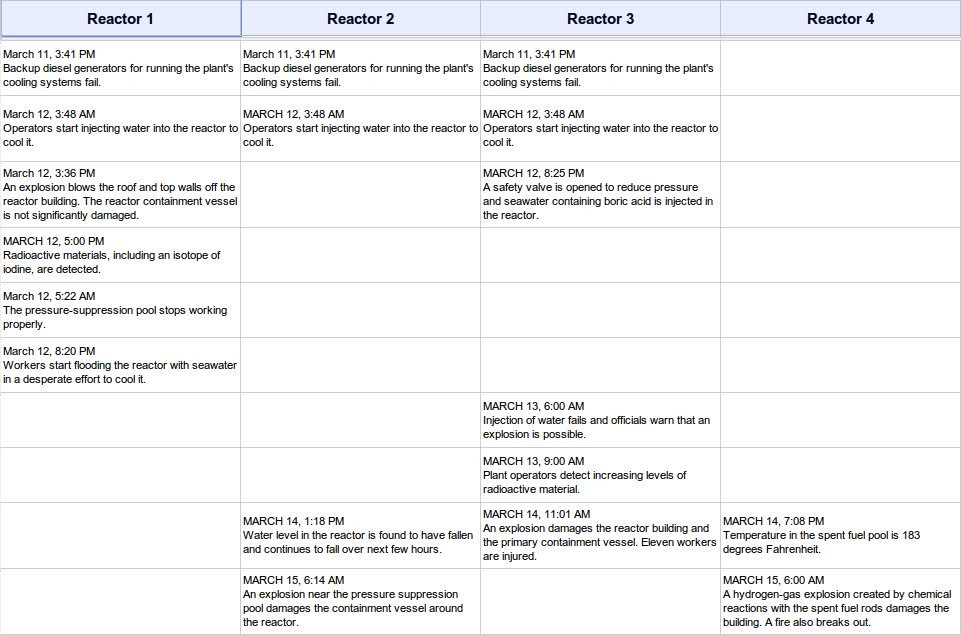
 Since we're suddenly seeing things surface that we noticed a long time ago, here's a quick grid to remind us of the chaos or those first four days. These are gridded from the NYT status updates, more becasue they're concise than becaus etheyby radioguy 4/12/2011 4:08:39 AM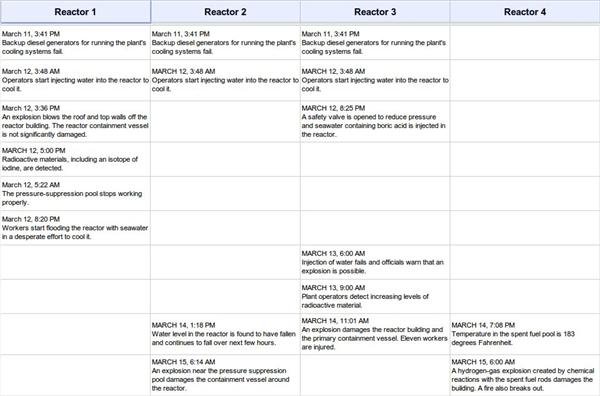
they're comprehensive:
i51.tinypic.comby radioguy via I51.tinypic 4/12/2011 4:08:56 AM
4:18 AM GMT - 7:00 12 April 2011 is the 50th anniversary of my attempt at being human. My wish is that everyone involved in this community take a moment to include a few words of support and encouragement for the people of Japan. subsequentchapters.files.wordpress.com
by Tenzing via Subsequentchapters.files.wordpress 4/12/2011 4:10:19 AM- URGENT: Radiation leakage may eventually exceed that of Chernobyl: TEPCO
TOKYO, April 12, Kyodo
The operator of the crippled Fukushima nuclear plant said Tuesday that it is concerned that radiation leakage at the plant could eventually exceed that of the 1986 Chernobyl catastrophe.
''The radiation leak has not stopped completely and our concern is that the amount of leakage could eventually reach that of Chernobyl or exceed it,'' an official from the Tokyo Electric Power Co. said.
Meanwhile, the Nuclear and Industrial Safety Agency said that most of the radioactive material released in the air from the crippled Fukushima Daiichi nuclear plant came from the No. 2 reactor damaged by an explosion on March 15.
At 6:10 a.m. on March 15, part of the reactor's containment vessel was damaged following an apparent hydrogen explosion. Massive amounts of radioactive substances are believed to have been released from the suppression pool of the reactor, the agency said.
Japan on Tuesday raised the severity level of the accident at the plant to the maximum 7 on an international scale, up from the current 5 and matching that of the Chernobyl disaster in the former Soviet republic of Ukraine.
The agency said, however, that the amount of radioactive materials released from the nuke plant is estimated to be about 10 percent of the amount released in the Chernobyl accident.
==Kyodo english.kyodonews.jpby Sinthia Domina 4/12/2011 4:10:30 AM - Remember how they totally forgot about R4 till it was pushing the boiling point?by radioguy 4/12/2011 4:10:32 AM
- @Meretisa This is my simple dummy attempt at a calculation for iodine-131 releases based on the data that I provide in the document itself....... tinyurl.comby borrrden 4/12/2011 4:12:05 AM
- ''The radiation leak has not stopped completely and our concern is that the amount of leakage could eventually reach that of Chernobyl or exceed it,'' an official from the Tokyo Electric Power Co. said.
Wow. Pretty stark for TEPCO.
"(You know, I think there's a very good chance Grandma may not make it.)"by radioguy 4/12/2011 4:12:17 AM  @radioguy Wow, that's pretty much plain-speak, huh?by pj 4/12/2011 4:14:22 AM
- @borrrden it said I don't have permission to use it???by Meretisa 4/12/2011 4:15:43 AM
- @Meretisa Oops, try it now. Don't take this as any kind of fact though, someone could very well come along and say "borrrden!! That's not how it works at all!!"by borrrden 4/12/2011 4:16:49 AM
- @borrrden ok... I'm not a math person. WHAT does that mean?? LOL Is it bigger than what they say about fukushima's 360,000- 630,000 TBq? It's Greek to me (actually, Greek I may be able to guess at better)by Meretisa 4/12/2011 4:21:37 AM
- @Meretisa I included TBq where relevant, my conclusion was 7,256,900.63 TBq (7.257 EBq). 7 million is bigger than 630,000 ^^;by borrrden 4/12/2011 4:22:59 AM
- Of course, that 7 million is not there anymore. It was gone within 3 months because of iodine's short half-life....by borrrden 4/12/2011 4:24:09 AM
- @borrrden lol. yes it is. I just wish there was info on the levels of OTHER isotopes. I-131 is the "little guy".by Meretisa 4/12/2011 4:29:19 AM
- @borrrden Gotta love that short half-life, now if only the other isotopes had those as well.by pj 4/12/2011 4:30:00 AM
- @pj Things would be slightly simpler, but with shorter half-lives come higher releases of radiation (tendency, not all the time...) so there is also that problem.by borrrden 4/12/2011 4:31:30 AM
- Japan quake's economic impact worse than first feared (Reuters) - Japan's economics minister warned on Tuesday that the economic damage from last month's earthquake and tsunami is likely to be worse than initially thought as power shortages will crimp factory output and restrict supply chains.
The more sober assessment came as Japan raised the severity of its nuclear crisis at the Fukushima Daiichi nuclear plant to a level 7 from 5, putting it on par with the Chernobyl nuclear disaster in 1986.
The Bank of Japan governor said the economy was in a "severe state", while central bankers were uncertain when efforts to rebuild the tsunami-ravaged northeast would boost growth, according to minutes from a meeting held three days after a record earthquake struck Japan on March 11. in.reuters.comby Sinthia Domina 4/12/2011 4:45:37 AM  latest from the IAEA www.facebook.com!/notes/international-atomic-energy-agency-iaea/iaea-update-on-fukushima-nuclear-accident-12-april-2011-445-utc/209209679108826by NHK Listener 4/12/2011 4:48:29 AM
- Excert from the IAEA The re-evaluation of the Fukushima INES rating resulted from an estimate of the amount of radioactivity released to the environment from the nuclear plant. NISA estimates that the amount of radioactive material released to the atmosphere is approximately 10 percent of the 1986 Chernobyl accident, which is the only other nuclear accident to have been rated a Level 7 event.
Previous INES ratings at the Fukushima Daiichi nuclear power plant were assessed on a per-case basis at each nuclear power plant unit. Japanese authorities have now classified the nuclear accident as a singular event on INES.by NHK Listener 4/12/2011 4:50:21 AM  Japanese video showing radiation readings..caption says "The state of Suginami. There is little to Tokyo from the accident is not raining. March 21 ~ February 22 1.5mm only. Ash has accumulated on the roof after the accident.: www.youtube.comby ColorMeRed 4/12/2011 5:05:05 AM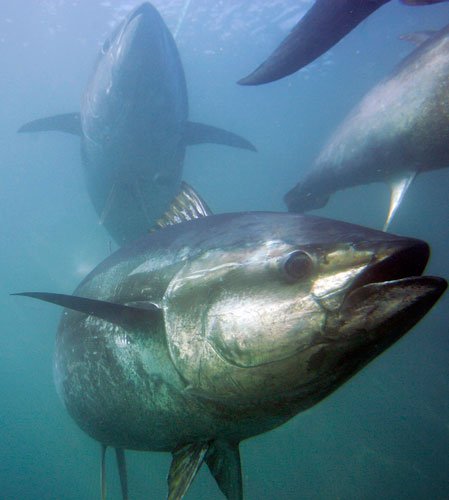
media.bonnint.net
"The Washington Department of Health continues to test the air, the drinking water and even milk for any signs of radiation from the disaster in Japan. So far, the tests have shown only small amounts of radiation. Amounts that are far below what the experts say could be dangerous.
But should someone be testing the fish in the ocean?
Local fishermen catch about 100,000 pounds of albacore tuna off the Washington and Oregon's coasts each summer. Those fish spend years off the Japanese coast before migrating to the Pacific Northwest.
Albacore that end-up off the Washington coast are hatched between the Philippines and Japan. They spend a few years around Japan before moving into the Central Pacific. After a few more years, they begin their annual treks to the West Coast."
From a KIRO Radio report.by radioguy via Media.bonnint.net 4/12/2011 5:08:29 AM- TEPCO to resume removing contaminated water
The operator of the crippled Fukushima Daiichi nuclear plant expects to resume the removal of highly radioactive water as early as Tuesday, after a one-day delay due to a strong aftershock.
www3.nhk.or.jpby Sinthia Domina 4/12/2011 5:09:16 AM - Japan apologizes after raising nuclear crisis level to highest
TOKYO, April 12, Kyodo
Top government spokesman Yukio Edano apologized on Tuesday to residents near the crippled Fukushima Daiichi nuclear power plant and the global community after Japan raised the severity rating of its nuclear crisis to the highest level of 7.
Despite the changed assessment that puts it on a par with the 1986 Chernobyl catastrophe, the chief Cabinet secretary told reporters, ''Unlike in the case of Chernobyl, we have not seen cases of direct damage to health because of the accident.'' english.kyodonews.jpby Sinthia Domina 4/12/2011 5:11:48 AM  Just curious, but we haven't trusted TEPCO's numbers from the start of the Fukushima disaster. Why then should we trust NISA's numbers (which they obviously got from TEPCO) in regards to the amount of radioactive substances released from Fukushima? Is it really equal to 10% of what was released from Chernobyl, or more than that? I guess we'll find out more as time goes on.by James Ward 4/12/2011 5:19:16 AM
- new quake 6.3 english.kyodonews.jp at 14:07jstby lisat131 4/12/2011 5:20:48 AM
- fukushima workers ordered to evacuate againby lisat131 4/12/2011 5:21:41 AM
- Yeah, it was seismic scale 5+ and even 6- again. It is impossible to work under those conditions.....this is insane.by borrrden 4/12/2011 5:23:40 AM
- @James Ward Only time will tell on that really. More time than I think any of us want to wait.by borrrden 4/12/2011 5:25:19 AM
- @Sinthia Domina Edano knows for a fact that illnesses due to radioactivity will in most cases take years to surface. Those guys are still playing fast and loose with reality.by James Ward 4/12/2011 5:26:19 AM
- seems that some of these latest aftershocks have been much shallower (is that a word, sorry?).by lisat131 4/12/2011 5:29:03 AM
- @lisat131 Actually I'm convinced that one of the recent earthquakes was a new event causing its own aftershocks....because of how far inland the epicenter was, but I'm not a geologist.by borrrden 4/12/2011 5:30:16 AM
- * BREAKING NEWS: No abnormality observed in power sources at Fukushima Daiichi: TEPCO (14:28)
* BREAKING NEWS: Workers at Fukushima Daiichi nuclear plant ordered to evacuate (14:19)
* NEWS ADVISORY: Slight tidal wave changes may be observed, no damage feared: agency (14:14)
* BREAKING NEWS: Strong quake jolts Fukushima Prefecture (14:11) english.kyodonews.jpby Sinthia Domina 4/12/2011 5:30:50 AM  @lisat131 USGS 6.0 in 10.6km depthby ifz 4/12/2011 5:30:53 AM
- @borrrden do you mean the 7.1 (?) about a week ago??? could be!by lisat131 4/12/2011 5:30:54 AM
- Radiation measured in the waters and air ( Fukushima Plant )
April 11, 2011 (Monday)
Radiation measured in the waters and air near the No.1 Fukushima Nuclear Power Plant (Source: Tokyo Electric Power Co. TEPCO)
【No.1 Plant : Radioactive substances detected in the waters 】
▼From samples collected 30 meters north of the outlets of No.5-No.6 reactors at 13:30 April 10.
Iodine 131: 11 Bq/cc (280 times the acceptable value)
Cesium 134: 8.7 Bq/cc (150 times the acceptable value)
Cesium 137: 8.8 Bq/cc ( 98 times the acceptable value)
▼From samples collected 330 meters south of the outlets of No.1-No.4 reactors at 13:15 April 10.
Iodine 131: 4.5 Bq/cc (110 times the acceptable value)
Cesium 134: 3.6 Bq/cc ( 60 times the acceptable value)
Cesium 137: 3.7 Bq/cc ( 41 times the acceptable value) www9.nhk.or.jpby Sinthia Domina 4/12/2011 5:34:21 AM


Japan Earthquake | Page 650
- Who's Blogging
-
 hudebnik
 alblee
 UKVal
UKVal Jonathan Keebler
 Oliver (ScribbleLive)
 kaykodh
 Markfm
 Angie
Angie Mid Valley
 Matt (ScribbleLive)
 George Gibb
 elainekirk
 PKelley
 lillymunster
 dean
dean bo
bo Edano
Edano Deb
Deb- Pedro Jesus
 IanGoddard