Japan Earthquake | Page 744

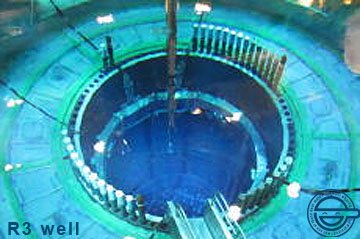
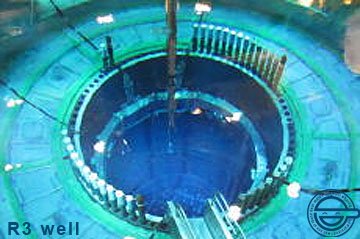
@radioguy I finally got a look at a reactor core yesterday. They do have a big grid of assemblies. www.houseoffoust.com
by Nancy via Houseoffoust 4/18/2011 1:54:58 AM @Nancy So what's the ring of rods around the well? Control? Convenient temporary storage?by radioguy 4/18/2011 1:57:10 AM
 Those are cam bolts - like they use in furniture.by FradyKat 4/18/2011 1:58:21 AM
 bolts for the containment cap.by Edano 4/18/2011 1:59:47 AM
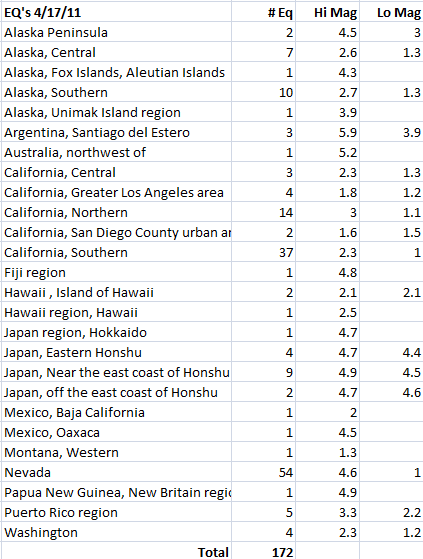
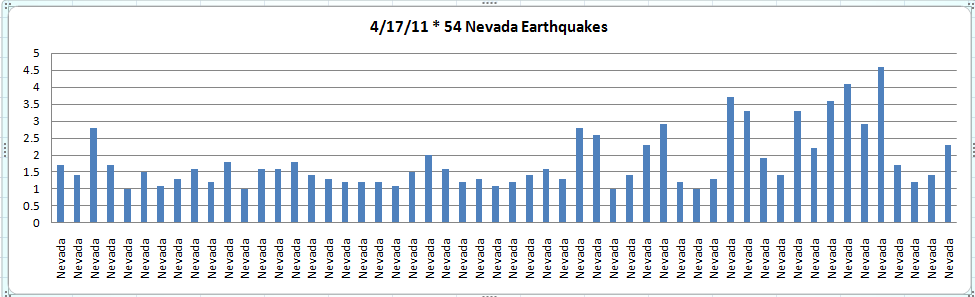
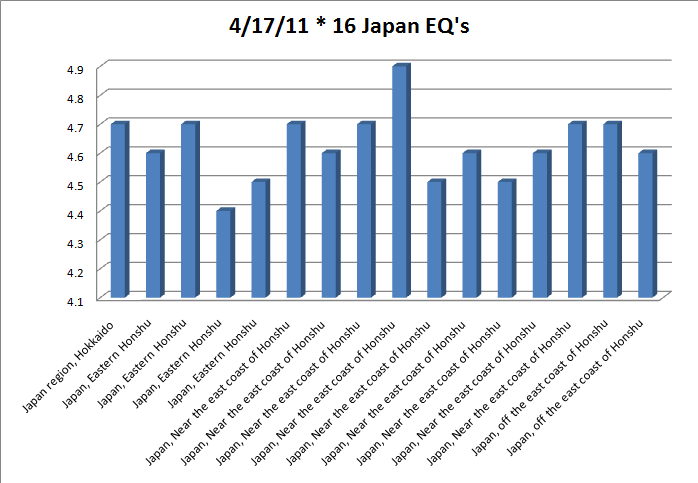
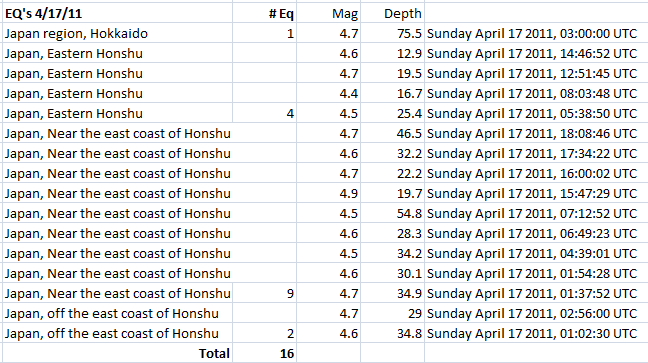
- @Edano That EQ patter continues. Look at it. &0 minutes where all but threre quakes are in Nevada, and none beyond North America.by radioguy 4/18/2011 2:01:09 AM
 @radioguy, I am a bit amazed that none of the SoCal or Nev state public information types seem to be fielding inquiries from the public regarding these quake trends (?)by ALBLEE 4/18/2011 2:04:33 AM
 The Nuclear Safety Commission of Japan has failed to send designated experts to Fukushima Prefecture even though required to do so by law english.kyodonews.jpby Bobby1 4/18/2011 2:08:04 AM
- @alblee Until something BIG happens, they will just monitor it and remain puzzled by the ... extremely active tremblings.by FradyKat 4/18/2011 2:09:32 AM
- @radioguy cribbage! :-)by Nancy 4/18/2011 2:10:07 AM
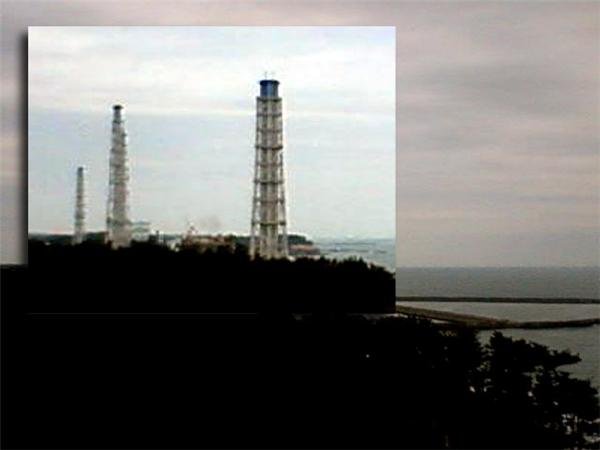
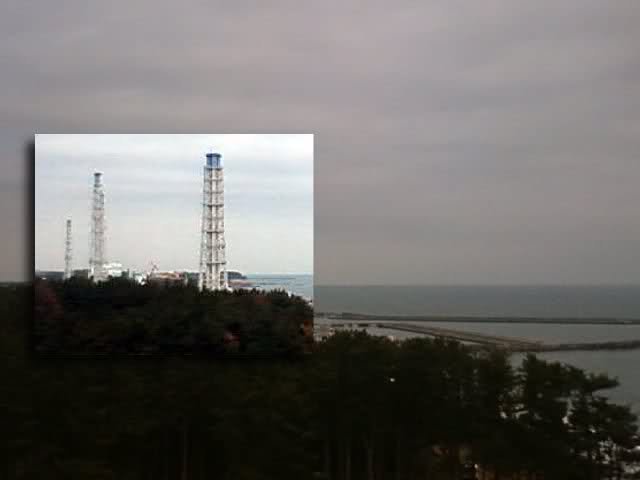
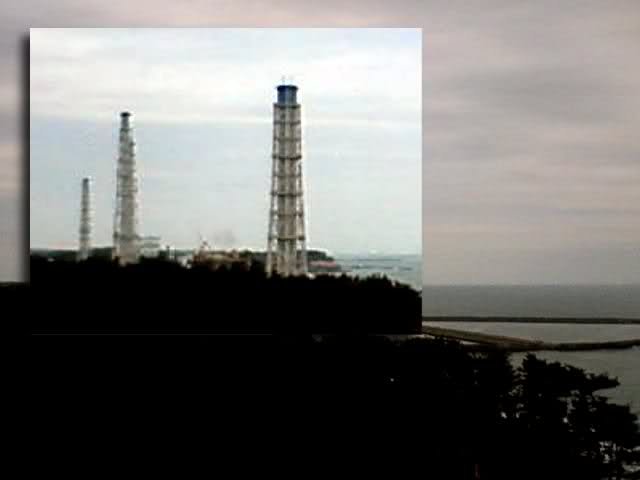
 @all Black smoke continues. www.tepco.co.jpby LM 4/18/2011 2:10:10 AM
- @LM looks low in the trees. Guessing it is more likely the common fuel pool. Not a good thing. Hope they get power back before it goes boom too.by Nancy 4/18/2011 2:12:35 AM
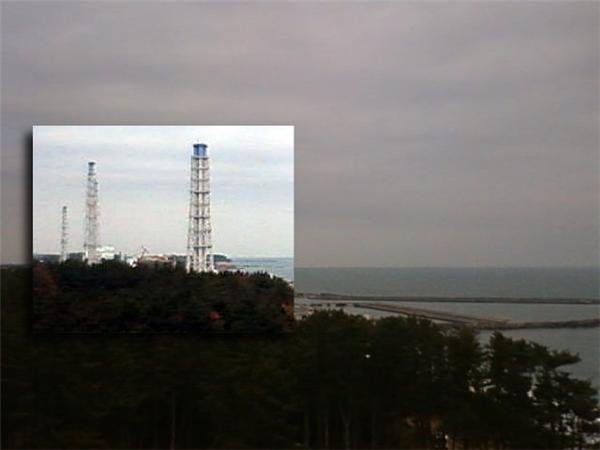
i55.tinypic.com
@LM No, check it out... is this the Putzmeister?by radioguy via I55.tinypic 4/18/2011 2:13:28 AM- @radioguy I suppose it's possible but it's been visible all day without clean definition...wisps coming off and straight up earlier.by LM 4/18/2011 2:18:18 AM
- Wow... Nevada is the only game in town.by radioguy 4/18/2011 2:23:30 AM
- @radioguy They have two red pumping booms on site now. The one that has been at 4 and a new one at 3 that showed up on the drone shots from the 14th. They are identical booms. If they brought in a 3rd piece of equipment like the big putzmeister truck they did that after the 14thby Nancy 4/18/2011 2:25:02 AM
- Dr. Saji update: It was reported today that the Project Team of the Headquarter for Coordination for Accident Counter Measures, organized by the Prime Minister, decided to construct temporary protective structures covered with reinforced plastic sheets, often used for construction of all-weather baseball stadium such as Tokyo Dome, on top of the 1F1, 3 and 4. It is planned to construct them at a place within a reach of a huge self clawling crane and put them in place like a huge cap. Another method being studied is to first construct steel frame structures around the damaged buildings and then cover with the reinforced plastic sheets. An idea is being investigated for providing an ventilation hole to establish filtered venting. TEPCO plans to start construction as early as June. www.ambersharick.com
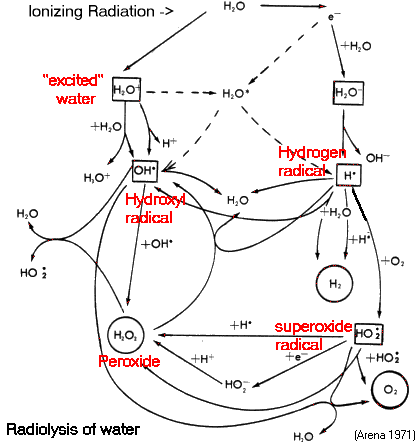
For me, it is indispensable to have a ventilation to prevent another hydrogen explosion. However, due to the prejudice among the safety specialists, internationally, that the hydrogen can only be produced through the Zr-water reaction, I am scared to see another gigantic hydrogen explosion without providing appropriate measures for prevention of hydrogen accumulation through water radiolysis. By this time, those established advisors guiding the accident management, should learn from how the hydrogen explosion occurred in 1F4, with all of the fuels stored in the spent fuel pit.by Bobby1 4/18/2011 2:25:43 AM  Does Nuclear Medicine Save Lives? Yes. More than 20 million Americans benefit each year from nuclear medicine procedures used to diagnose and treat a wide variety of diseases. The use of radiation in these procedures— with low risks—offers a safe and cost-effective means to provide doctors with information that would otherwise require exploratory surgery, necessitate more costly and invasive procedures or simply be unavailable. The risks of not performing a needed medical exam are usually much greater than the risks of the radiation exposures associated with the exam.
Nuclear medicine can be used to
* determine whether or not organs are functioning normally,
* show whether the blood supply to the heart is adequate,
* detect cancers at an early stage,
* determine the extent of cancer and assess the response of cancer to treatment,
* discover whether the heart can pump blood adequately,
* identify abnormal brain lesions without exploratory surgery,
* detect whether the brain is receiving an adequate blood supply and if brain cells are functioning or not,
* check whether or not kidneys are functioning normally and whether the stomach is emptying properly,
* ascertain lung function and bone density and
* locate a bone fracture before it can be seen on an X-ray.by dean 4/18/2011 2:33:54 AM
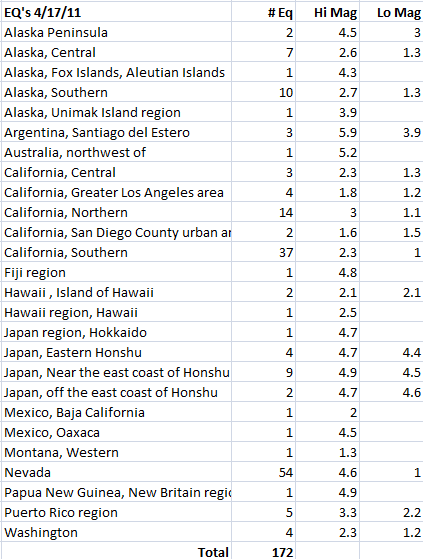 by Debra Beckham via I1097.photobucket 4/18/2011 2:39:36 AM
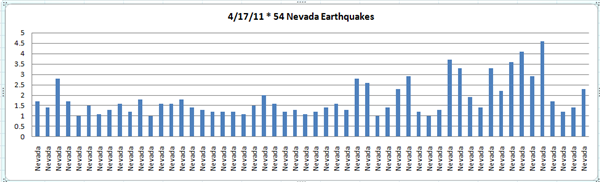 by Debra Beckham via I1097.photobucket 4/18/2011 2:40:26 AM
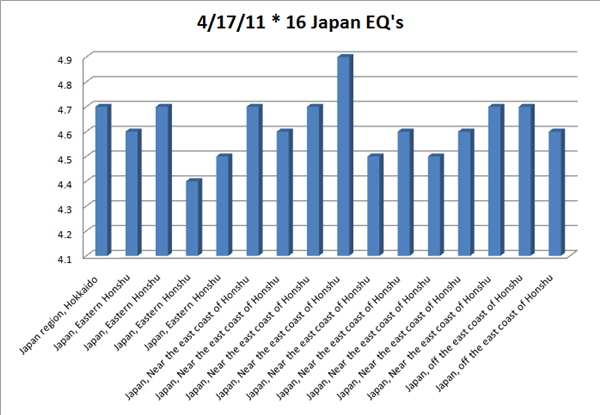 by Debra Beckham via I1097.photobucket 4/18/2011 2:40:45 AM
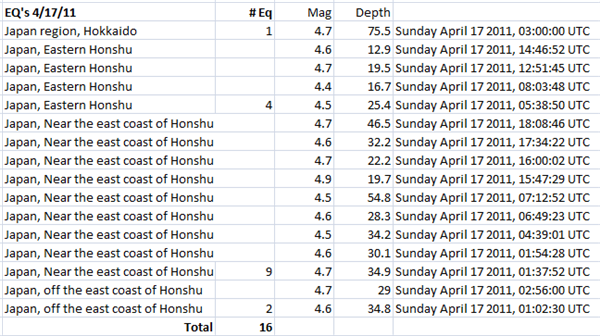 by Debra Beckham via I1097.photobucket 4/18/2011 2:41:36 AM
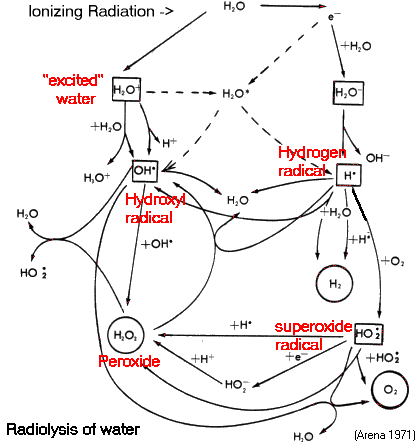 by Jim Carver via Mun.ca 4/18/2011 2:45:00 AM
- @Debra Beckham All the double digit frequency numbers on the West Coast in to Nevada.by radioguy 4/18/2011 2:50:06 AM
- Radioactive Lanthanum, Usually Lead-Shielded in Labs, detected in Japan's Air in March and early April www.idealist.wsby Bobby1 4/18/2011 2:53:44 AM
- by faquindici 4/18/2011 2:55:32 AM
- Workers can't go near buildings www3.nhk.or.jpby Nancy 4/18/2011 2:57:15 AM
- "Although the chemistry between oxygen and zirconium has led to its use as an oxygen sensor and an oxygen conductor, it is the surface zirconium-oxygen bond that filled my days and nights for many years. Zirconia is an interesting catalyst, and it is the Zr–O bond that makes it interesting." pubs.acs.orgby Jim Carver 4/18/2011 2:57:59 AM
 @Nancy Radiation levels measured between the double doors of those reactor buildings was 270 millisieverts in the Number One reactor, 12 in Number 2, and 10 in Number 3.
The radiation level detected at the Number One reactor exceeds the national exposure limit of 250 millisieverts for nuclear contract workers.by NHK Listener 4/18/2011 2:59:11 AM- @radioguy I will get some daily Nevada graphs up later, there is a pattern going on with them, the graph visual makes it more apparent. Give me about 30 minutes for those :)by Debra Beckham 4/18/2011 3:00:00 AM
- @Debra Beckham The swarm is mindboggling, particularly if you've been following it for days. It's been constant and relentless.by radioguy 4/18/2011 3:02:21 AM
- Definite smoke on tepco cam againby NervousinNJ 4/18/2011 3:04:17 AM
 by radioguy via I52.tinypic 4/18/2011 3:09:44 AM
WARNING DEAD ANIMALS IN THIS VIDEO
by Sinthia Domina 4/18/2011 3:17:53 AM- U.S. is increasing nuclear power through uprating
Turning up the power is a little-publicized way of getting more electricity from existing nuclear plants. But scrutiny is likely to increase in the wake of Japan's nuclear crisis. April 17, 2011, 7:23 p.m.
The U.S. nuclear industry is turning up the power on old reactors, spurring quiet debate over the safety of pushing aging equipment beyond its original specifications.
The little-publicized practice, known as uprating, has expanded the country's nuclear capacity without the financial risks, public anxiety and political obstacles that have halted the construction of new plants for the last 15 years.
The power boosts come from more potent fuel rods in the reactor core and, sometimes, more highly enriched uranium. As a result, the nuclear reactions generate more heat, which boils more water into steam to drive the turbines that make electricity.
Tiny uprates have long been common. But nuclear watchdogs and the U.S. Nuclear Regulatory Commission's own safety advisory panel have expressed concern over larger boosts — some by up to 20% — that the NRC began approving in 1998. Twenty of the nation's 104 reactors have undergone these "extended power uprates." www.latimes.comby Sinthia Domina 4/18/2011 3:28:54 AM - @Sin Not a good idea to take aging complex machines above their design ratings.by Jim Carver 4/18/2011 3:31:23 AM
 Nice moon scene over a farm in NC tonight guess the moon came up an hour or 2 ago.... Found some one to add to our team... He's a pharmacotherapy consultant involved with hematology and oncology. He was involved with some other online papers associated with anthrax .... Also I shot the post tornado images from Sanford NC today... OMG how wild it was... It gives me a little insight into the gravity of what the poeople of Japan must be going through... the scale is almost unfathomable... as they say in the south "bless their hearts"by carabnr 4/18/2011 3:31:45 AM
- I meant that in a nice way....by carabnr 4/18/2011 3:41:00 AM
 @Sinthia Domina "Uprating" by as much as 20% for as many as 20 of the 104 US reactors? Really BAD idea! Guess we'll find out if the nuclear industry is allowed to have their way.by James Ward 4/18/2011 3:45:15 AM
- @James Ward They have, here's a list of power-ups spreadsheets.latimes.comby Sinthia Domina 4/18/2011 3:49:10 AM

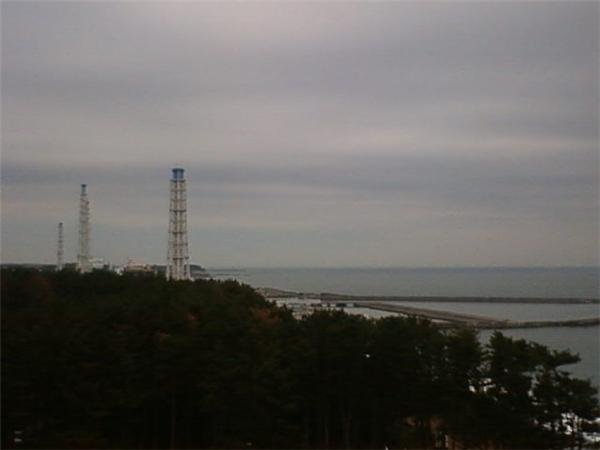 by VeenOui via Pointscope01.jp 4/18/2011 4:19:04 AM
- Workers cannot approach reactor buildings
At the Fukushima Daiichi nuclear plant, high levels of radiation have kept workers from approaching the buildings housing the first 3 reactors, which lost their cooling functions in the March 11th earthquake and tsunami.
On Friday, the highest radiation level measured outside the double-entry doors of the Number 1 to 3 reactor buildings was 2 to 4 millisieverts per hour.
Radiation levels measured between the double doors of those reactor buildings was 270 millisieverts in the Number One reactor, 12 in Number 2, and 10 in Number 3.
The radiation level detected at the Number One reactor exceeds the national exposure limit of 250 millisieverts for nuclear contract workers.
Tokyo Electric Power Company, TEPCO, has started using a remote-controlled robot inside the reactor buildings.
But issues remain as radioactive water has been found in turbine buildings and the utility tunnel outside the reactors.
At the Number 2 reactor, the level of highly contaminated water in the tunnel is still rising. To prevent overflow, TEPCO is stepping up the inspection of the nuclear waste processing facility, to which it aims to transfer contaminated water.
Underground water at the plant is also contaminated.
On Wednesday, the level of radioactive substances sharply increased at facilities where underground water from the Number 1 and 2 reactors is collected.
On Friday, workers kept on monitoring the situation.
They say the level of radioactive substances has stabilized or decreased in every reactor from 1 to 6.
So they say it's unlikely that highly radioactive water is still seeping into underground water.
Monday, April 18, 2011 08:44 +0900 (JST) SORRY IF THIS IS OLD NEWS, WAS NEW TO ME
www.scribblelive.comby Sinthia Domina 4/18/2011 4:26:52 AM  TEPCO Workers' Beta Burns Likely Caused by Strontium-89:
The former secretariat of the Nuclear Safety Commission of Japan had this to say:
"The estimated concentration of Sr-89 and 90 are supplemented in the above table, by scaling from the Cs-137 concentration, since no values have been reported from TEPCO. Considering the beta-ray burn incident of the three electricians irradiated in the skin of their feet, it is obvious that these radioactive species should be included in the contaminated water. It is likely the radiation injury was though [sic] Sr-89, considering its high concentrations." www.idealist.ws Fantastic post @Bobby1. Thank you.
by Reed 4/18/2011 4:35:16 AM- I don't suppose the perceived recent swarms of tectonic activity in various places around the Pacific rim are not all that recent? Is it possible to discern the swarm patterns, if any, of a similar two-week period, say, from late-Frebruary to early March? Thanks.
From @radioguy:
> The swarm is mindboggling, particularly if you've been following
> it for days. It's been constant and relentless.
.by ALBLEE edited by alblee 4/18/2011 4:41:03 AM - You know how it used to be all Nevada... look at the West Coast!
quakes.globalincidentmap.comby radioguy 4/18/2011 4:43:14 AM - NHK TICKER now says 57 millisieverts inside #3by Sinthia Domina 4/18/2011 4:45:40 AM

Japan Earthquake | Page 744
- Who's Blogging
-
 hudebnik
 alblee
 UKVal
UKVal Jonathan Keebler
 Oliver (ScribbleLive)
 kaykodh
 Markfm
 Angie
Angie Mid Valley
 Matt (ScribbleLive)
 George Gibb
 elainekirk
 PKelley
 lillymunster
 dean
dean bo
bo Edano
Edano Deb
Deb- Pedro Jesus
 IanGoddard