Japan Earthquake | Page 739
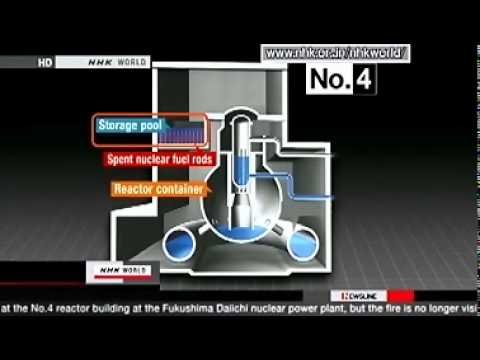
 @James Ward The picture I just posted is the red boom arm they lowered into the pool. Looks pretty damaged to meby NHK Listener 4/17/2011 1:52:56 PM
 @James Ward There is some damage on the crane, bent things, the view of the pool from next to the crane makes the water really dark, no sunlight. Hard to tell if rubble is in it or not. Overhead shots so far have not given up a good idea of 4's sfpby Nancy 4/17/2011 1:53:04 PM
- @James Ward everything is highly edited so it is hard to see the whole picture of an areaby Nancy 4/17/2011 1:53:39 PM
 @NHK Listener The exact picture to which I'm referring was posted by edano with the following caption..."english.kyodonews.jp spf #4 lots of water in it". It is an overhead shot showing a container at the bottom of a cable of some sort possibly being lowered into a pool they claim is the #4 SPF. There is NO red boom arm in that photo, and there is ZERO damage anywhere in that picture.by James Ward 4/17/2011 1:58:02 PM
 Those cams numbers that jo notes below, for 2&3 suppression chambers, are hugeby Markfm 4/17/2011 1:58:05 PM
- Fukuskima 2003. Nipponese BUSINESS recruit homeless people to clean up nuclear plants www.elmundo.esby Olivier 4/17/2011 1:59:06 PM
- @James Ward This vid shows where that picture came from www.tepco.co.jpby NHK Listener 4/17/2011 2:01:14 PM
- @James Ward www.youtube.comby NHK Listener 4/17/2011 2:02:35 PM
- 17 apr plant parameters (see suppression chamber values): www.meti.go.jpby Markfm 4/17/2011 2:07:07 PM
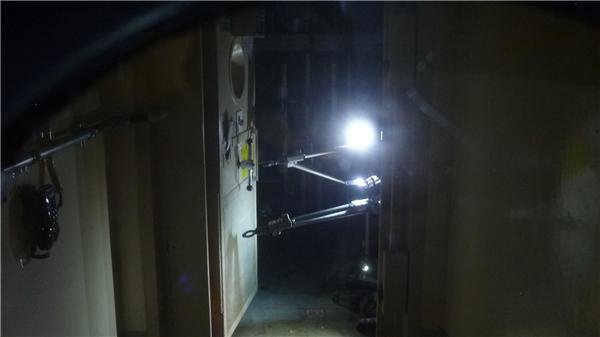 by NHK Listener via Tepco.co.jp 4/17/2011 2:11:47 PM
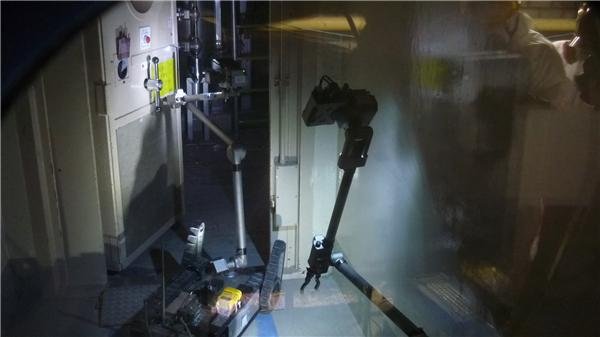 by NHK Listener via Tepco.co.jp 4/17/2011 2:12:09 PM
- @NHK Listener There is an obvious splice at about one minute in that film of SFP #4. Why? Additionally, as I stated before, and will continue to state, there is no discernible damage in the pic posted by edano below, and no damage or debris in the film after 60 seconds. Additionally, why is there no debris in the alleged SFP? So, my question is as follows: When did they take the second part of the film (and subsequent still photo) of what they tell us is the #4 SFP? Remember, we're dealing with TEPCO, and you have to question everything they offer to the public.by James Ward 4/17/2011 2:15:38 PM
- by NHK Listener 4/17/2011 2:16:53 PM
- Press Release (Apr 17,2011)Roadmap towards Restoration from the Accident at Fukushima Daiichi Nuclear Power Station www.tepco.co.jpby NHK Listener 4/17/2011 2:17:36 PM
- @Nancy - I agree 100% with your comment below: "everything is highly edited so it is hard to see the whole picture of an area". Exactly why the work you're doing is so valuable.by James Ward 4/17/2011 2:17:54 PM
 @James they took film of 5 + 6 didnt they? I remember thinking it odd because they should be able to vissually inspect and they have roofsby elainekirk 4/17/2011 2:20:29 PM
- @James Ward Thanks. I just wish they would be more forthcoming with video and images. It would go far to improve their credibility. @Elaine, I have not seen anything of 5 or 6 other than some early roof shots.by Nancy 4/17/2011 2:23:48 PM
- @Nancy it just came back to me when someone questioned where they had got the other shots that were purpotedly #4 it is tepco after allby elainekirk 4/17/2011 2:29:21 PM
- @elainekirk if anyone sees new image data on 5 or 6 let me know.by Nancy 4/17/2011 2:33:28 PM
- @Nancy this may be a clue they use #5 to trial the robots so a safe assumption would be that the camera was trialed there too?? mdn.mainichi.jpby elainekirk 4/17/2011 2:42:40 PM
- @elainekirk that trial footage could really help at least get a rough idea of some more intact insides.by Nancy 4/17/2011 2:45:38 PM
- @nancy I think after hunting this long we have got to locate something soonby elainekirk 4/17/2011 2:47:52 PM
 I think we maybe should consider that these phenomena are players in the situation. Probably not the only factor, but a prime mover.
The vent-to-vent desynchronization effects on LOCA steam condensation loads in BWR pressure suppression pool
Purchase
$ 31.50
UNIT 1
References and further reading may be available for this article. To view references and further reading you must purchase this article.
Yutaka Kukitaaand Ken Namatameb
aJapan Atomic Energy Research Institute, Tokai-Mura, Ibaraki-Ken, 319-11 Japan
bInstitute of Nuclear Safety, Japan, 1-4-28 Mita, Minatoku, Tokyo, 108 Japan
Received 5 November 1984. Available online 19 February 2003.
Abstract
During a loss-of-coolant accident of a boiling water reactor (BWR), direct-contact steam condensation in the pressure suppression pool will induce undesirable dynamic pressure loads onto pool boundary structures. The magnitudes of the pool boundary loads will be influenced by finite desynchronization among the condensation processes, which take place at the outlets of multiple (about one hundred) vent pipes. This paper investigates the effects of the condensation desynchronization on the pool boundary loads, with regard to test data obtained from large-scale tests which represented seven full-sized vent pipes in a BWR Mark II pressure suppression containment system. The desynchronization effects are studied by analyzing the test data in the time and frequency domains. Attempts are made to extrapolate the experimental results to the actual plant geometry. Mechanisms responsible for the desynchronization are also discussed
www.sciencedirect.com
Pressure suppression pool mixing in passive advanced BWR plants
Purchase
$ 31.50
References and further reading may be available for this article. To view references and further reading you must purchase this article.
Robert E. Gamble, , a, Thuy T. Nguyena, Bharat S. Shiralkara, Per F. Peterson, b, Ralph Greifc and H. Tabata, d
a GE Nuclear Energy, 175 Curtner Avenue M/C 365, San Jose, CA 95125, USA
b Department of Nuclear Engineering, University of California, Berkeley, CA 94720-1730, USA
c Department of Mechanical Engineering, University of California, Berkeley, CA 94720-1730, USA
d Japan Atomic Power Company, 1-6-1 Otemachi, Chiyoda-ku, Tokyo 100-0004, Japan
Received 5 July 2000; accepted 5 July 2000 Available online 11 April 2001.
Abstract
In the SBWR passive boiling water reactor, the long-term post-accident containment pressure is determined by the combination of noncondensible gas pressure and steam pressure in the wetwell gas space. The suppression pool (SP) surface temperature, which determines the vapor partial pressure, is very important to overall containment performance. Therefore, the thermal stratification of the SP due to blowdown is of primary importance. This work looks at the various phases and phenomena present during the blowdown event and identifies those that are important to thermal stratification, and the scaling necessary to model them in reduced size tests. This is important in determining which of the large body of blowdown to SP data is adequate for application to the stratification problem. The mixing by jets from the main vents is identified as the key phenomena influencing the thermal response of the suppression pool and analytical models are developed to predict the jet influence on thermal stratification. The analytical models are implemented into a system simulation code, TRACG, and used to model thermal stratification behavior in a scaled test facility. The results show good general agreement with the test data.
Article Outline
www.sciencedirect.com
www.osti.gov
www.osti.gov
Unit 2 suppression pool
www.osti.gov
EXPERIMENTAL AND THEORETICAL STUDY OF STEAM
CONDENSATION INDUCED WATER HAMMER PHENOMENA
Imre Ferenc Barna, Gábor Baranyai and György Ézsöl
KFKI Atomic Energy Research Institut(AEKI) of the Hungarian
Academy of Sciences, Thermo-hydraulic Department,
Address P.O. Box 49, H-1525 Budapest, Hungary,EU
Tel:00-36-392-2222/1472 , Fax:00-36-1-395-9293,
Email: barnai@sunserv.kfki.hu
Abstract We investigate steam condensation induced water hammer (waha)
phenomena and present experimental and theoretical results. Some of the
experiments were performed in the PMK-2 facility, which is a full-pressure
thermohydraulic model of the nuclear power plant of VVER-440/312 type and
located in the Atomic Energy Research Institute Budapest, Hungary. Other
experiments were done in the ROSA facility in Japan.
On the theoretical side waha is studied and analyzed with the WAHA3 model
based on two-phase flow six first-order partial differential equations that present
one dimensional, surface averaged mass, momentum and energy balances. A
second order accurate high-resolution shock-capturing numerical scheme was
applied with different kind of limiters in the numerical calculations. The applied
two-fluid model shows some similarities to Relap5 which is widely used in the
nuclear industry to simulate nuclear power plant accidents. Experimentally
measured and theoretically calculated waha pressure peaks are in qualitative
agreement.
I. INTRODUCTION
Safety of nuclear reactors is a fundamental issue.
Nuclear and thermo-hydraulic processes in the active zone
of modern reactors are well known and well-controlled,
explosions are out of question. However, violent unwanted
thermo-hydraulic transients in the primer loop may cause
serious derangement or pipe breakage. Such an unplanned
transient is the steam condensation induced water
hammer(waha). In thermal loops of atomic reactors or in
other pipelines where water steam and cold water can mix,
quick and dangerous transients can occur causing
explosions which mean high financial expenses or even
cost human lives.
In the following we will introduce the ROSA1 and
the PMK-2 facility 2 which is an integral experimental
device and capable to produce waha effects.
On the other side we present the WAHA3 3 model
we use, which is a complex physical model suitable to
simulate various quick transients in single and two-phase
flows.
In the last two decades the nuclear industry
developed a few complex two-phase flow-codes like
Relap5 4 , Trac 5 or Cathare 6 which are feasible to solve
safety analysis of nuclear reactors and model complicated
two-phase flow transients.
The model, WAHA37 is very similar to Relap5. This
means that the conservation equations and all the applied
correlations are essentially the same. The main difference
between the above mentioned models and our WAHA3
code is basically the applied numerical scheme; other
commercial codes have a ratio of spatial and time resolution
Dx / Dt which describes usual flow velocities. This code,
however is capable of capturing shock waves and describes
pressure waves which may propagate quicker than the local
speed of sound. To our knowledge there is no special
model and computer code for numerical simulation of water
hammer in the field of nuclear thermal-hydraulics.
WAHA3 model can successfully reproduce the
experimental data of different one- or two-phase flow
Proceedings of ICAPP ‘09
Tokyo
back to unit 1
www.nks.org
Combined Effects Experiments with
the Condensation Pool Test Facility
Markku Puustinen
Lappeenranta University of Technology, Finland
Abstract
This report summarizes the results of the condensation pool experiments in
spring 2006, where steam and steam/air mixture was blown into the pool through
a DN200 blowdown pipe. Altogether three experiments, each consisting of several
blows, were carried out with a scaled down test facility designed and constructed
at Lappeenranta University of Technology. The main purpose of the experiments
was to study the effects of non-condensable gas present in the discharge
flow. Particularly pressure pulses inside the blowdown pipe and at the
pool bottom caused by chugging were of interest.
The test pool was an open stainless steel tank with a wall thickness of 4 mm
and a bottom thickness of 5 mm containing 15 m3 of water. The nearby PACTEL
test facility was used as a steam source. During the experiments the initial pressure
of the steam source was 0.5 MPa and the pool water bulk temperature
ranged from 40 C to 70 C. The test facility was equipped with high frequency instrumentation
for capturing different aspects of the investigated phenomena. The
data acquisition program recorded data with the frequency of 10 kHz. A digital
high-speed video camera was used for visual observation of the pool interior.
Air, in quantities even less than 1 %, reduced the condensation rate considerably.
The high pressure pulses registered inside the blowdown pipe due to water
hammer propagation during chugging almost disappeared when the combined
discharge period of steam and air started. With non-condensable gas fractions
above 3 % the damping of pressure oscillations inside the blowdown pipe was
practically complete. Air quantities in the vicinity of 2 % started to have an effect
also on the oscillations measured by the pressure sensor at the pool bottom.
Both the amplitude and frequency of the pressure pulses decreased considerably.
The experiments demonstrated that even small quantities of non-condensable
gas can have a strong diminishing effect on pressure oscillations and structural
loads.
Key words
condensation pool, steam/air blowdown, non-condensable gas, pressure oscillations
NKS-148
ISBN 978-87-7893-211-2
Electronic report,by marie rich 4/17/2011 2:48:24 PM- Does somebody want to point out to Tepco that it's leisure holdings will be in negative equity for the foreseeable? Do they not realise the damage they have caused to the tourism industry???
TOKYO -(MarketWatch)- Tokyo Electric Power Co. (9501.TO), is planning to sell real estate assets worth about Y100 billion to raise funds for the compensation it is expected to pay following the devastating March 11 earthquake, tsunami, and subsequent nuclear crisis, the Yomiuri Shimbun said Saturday.
Tepco, the main utility for the Tokyo area, owns such property as housing units and resort facilities for its employees and is involved in real estate and hotel management. Sales in Tepco's division that handle real estate totaled Y133.5 billion for fiscal 2009, the newspaper said.
Quoting sources close to the company, it said that the utility has Y300 billion worth of property that could be sold, of which it aims to sell assets worth Y50 billion this fiscal year and Y50 billion next fiscal year.
Compensation payments are expected to reach as much as Y10 trillion. Late last month, Tepco received about Y2 trillion in loans from financial institutions.
www.marketwatch.com
Still there will be a market for their housing stock so does that mean the victims will be providing them with the funds to compensate them? - yeah sounds about rightby elainekirk 4/17/2011 2:51:28 PM - @elainekirk so tepco owns housing units and resorts. Maybe they should use some of those unoccupied units to house people who can't go home due to the reactor disasterby Nancy 4/17/2011 2:59:05 PM
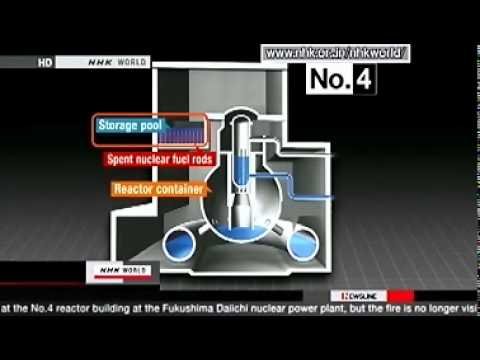
@nancy oh but Nancy that would be an admission of liability. Does your car insurance stipulate that if you have an accident you must never admit liability even if it is your fault you must sontact insurer?? well tepco are doing the same just hiding behind their insurers Plan of 4 from tepco if it any use, very basic I will keep hunting cdn4.wn.com
by elainekirk via Cdn4.wn 4/17/2011 3:05:41 PM- @elainekirk possibly helpful. It shows an offset well. Adds to other info. I guess they are getting that from somewhere.by Nancy 4/17/2011 3:15:40 PM
- It did say tepco I am still scouring and will try to confirm it @Nancyby elainekirk 4/17/2011 3:25:05 PM
- @Olivier: Articles like this makes me lose faith in mankind
Fukuskima 2003. Nipponese BUSINESS recruit homeless people to clean up nuclear plants www.elmundo.es
by Olivier at 3:59 PMby estacion 4/17/2011 3:31:57 PM - IDENTIFICATION AND ASSESSMENT OF BWR IN-VESSEL
SEVERE ACCIDENT MITIGATION STRATEGIES www.iaea.orgby marie rich 4/17/2011 3:34:21 PM  Breaker, breaker, @Nancy...
Over at the other board, @Jim_Carver has just signified positive inclination to offer web space for archiving our idea of non-Tepco generated but Daiichi reactors-centric news stories. Thanks.
.by alblee 4/17/2011 3:42:14 PM- Suppression Pool operating parameters acc'd to NRC: normal temp. range: 95-105F/35-40.5C Reactor cold shut-down: 120F/48.8C chugging: 135F/57.2C in operation max temp.: 340F/171.1C water level range: 12'2"-12'6"/3.708M-381M The suppression pool is the single most imp. cooling element in a LOCA. Water level in S/P is very imp. to adequate cooling and has a very narrow range of operational efficency (only 4 inches)by marie rich 4/17/2011 3:43:34 PM
- @Janis Moulton : this is known. tepco hirers homeless people for work in their plants. it is not new.by Edano 4/17/2011 3:44:39 PM
- @Janis Moulton : www.google.deby Edano 4/17/2011 3:45:55 PM
- @mod: in this case, delete me too (2x) thx.by Edano 4/17/2011 3:49:53 PM
- @alblee Maybe I just need coffee this morning. What info are they talking about putting on a web site?by Nancy 4/17/2011 3:50:39 PM
- Check out neilhartmannlife.wordpress.com for documentary on Japanese nuclear temp workers' health risks. It is not just TEPCO, or Japan, by the way. The whole industry relies on "nuclear slaves" as a Russian Chernobyl liquidator explained.by Dom 4/17/2011 3:51:04 PM
- @elainekirk I am around, sorta lurking while I work on video captures. What image?by Nancy 4/17/2011 3:51:36 PM
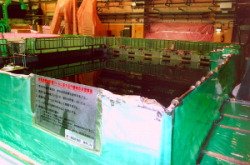
@Nancy stuff of nightmares in that pic mdn.mainichi.jp
by elainekirk via Mdn.mainichi.jp 4/17/2011 3:51:51 PM- @elainekirk Do you have the original news story link, there may be a larger view option in it.by Nancy 4/17/2011 3:52:44 PM
- @Nancy mdn.mainichi.jp The pool for spent fuel at the No. 4 reactor of TEPCO's Fukushima No. 1 nuclear power plant is pictured in this Feb. 1, 2005, file photo. (Mainichi)by elainekirk 4/17/2011 3:53:00 PM
- @Nancy, remember we mentioned to each other earlier in the day/night that it might be a good idea to have a sort of dossier of news stories focusing on the reactors but which are not Tepco-issued press releases? The better, that is, to independently follow updates/wazzups on the Daiichi reactors.
Well, @Jim_Carver seems to be inclined to offer web space for this purpose.
.by alblee 4/17/2011 3:53:35 PM - @alblee Ah, got it. :-) Sounds like a plan. A running static record of some of this would be a good idea, also adding all those older (pre quake) incidents from the news or press releases like damaged pipes at the reactors.
[Yes, @Nancy. - Alblee]by Nancy edited by alblee 4/17/2011 3:56:38 PM - The SFP image looks a bit icky I think because of the light and they have everything covered in tarps and duct tape to do work. I am learning that duct tape is a critical tool in nuke plants. :-)by Nancy 4/17/2011 3:57:45 PM
- If anyone finds a larger version of that image let me know. I tried a few URL hacks to see if I could find it with no luck. I think there is a larger version based on their naming structure.by Nancy 4/17/2011 3:58:48 PM

Japan Earthquake | Page 739
- Who's Blogging
-
 hudebnik
- alblee
 UKVal
UKVal Oliver (ScribbleLive)
 Jonathan Keebler
 kaykodh
 PKelley
 Markfm
 Angie
Angie Deb
Deb Mid Valley
- Pedro Jesus
 Matt (ScribbleLive)
 George Gibb
- elainekirk
 lillymunster
 dean
dean bo
bo Edano
Edano IanGoddard