Japan Earthquake | Page 767
 @Nancy: did you see the 3 pictures from the robots inside ?
OK, the door is not damage; but it's a huge shielded door.
Inside #1: can see small debris there
inside #2: the roof seems damaged, look like lot of steam there
inside #3: something looking like a bent beam on the floor, ...
I think the door is at the floor level, coming from the turbine building side. #3 does not seem too badly damaged at floor level, except at the north side. I just feel strange that there's no water there, given the amount of water spread on the SFP and the one leaking from the core...by Jo Lindien 4/19/2011 8:26:43 PM @fitter MarkFm was talking earlier today about the CODECs etc. related to the videos and the quality of the original vs. TEPCO's version and what gets released through back channels like cryptome and you tube. There is a very obvious pattern of TEPCO releasing the worst possible version as in they degrade the hell out of it before they post it to their website.by Nancy 4/19/2011 8:27:05 PM
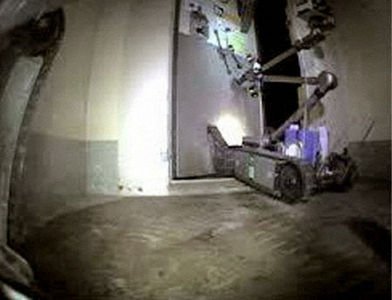
Re the ultra clear robot pic I'm certain that it's the runthrough at #5 a couple of days earlier - compare with the actual pic of the robot going in to reactor #2 english.kyodonews.jp
by hudebnik via English.kyodonews.jp 4/19/2011 8:27:12 PM @dean are you out thereby fitter 4/19/2011 8:27:23 PM
 There are specific formulas they use for assessments. Here is one they propose for AOT (allowable outage time ). In reference 4, Atefi and Gallagher suggested that a risk-based AOT be calculated using plant-specific probabilistic risk assessment (PRA) results and the equation: ΔCD - T < B where ΔCD is the increase in the plant core damage frequency (CDF) caused by the component being out of service, T is the AOT, and B is a dimensionless safety limit. The ΔCD term would be determined by using a plant's PRA results from a risk analysis code such as SAPHIRE.5 Since taking components out of service will increase the mean plant risk, and since this positive increase in core damage frequency is of concern,
the ΔCD term is defined by: ΔCD = CD after modification
- CD before modification . where CD after modification is the core damage frequency after the AOT component(s) are removed from service
and CD before modification is the nominal core damage frequency.
where CD after modification is the core damage frequency after the AOT component(s) are removed from service
and CDbefore modification is the nominal core damage frequency.
The definition of the term B from Equation (1) is stated by Atefi and Gallagher as "...the highest acceptable CDF integrated over the duration T, which is specified by the AOT." nuclear.inl.govby Sinthia Domina 4/19/2011 8:28:02 PM- @Jo Lindien Dry as a bone, and not a speck of damage. I did what I could with the degraded versions TEPCO released that Cryptome had larger sized ones of them. I raised the brightness to try to pull out some of the details in the dark. They still looks suspiciously clean, at least the ones they claim are from building 3 www.houseoffoust.comby Nancy 4/19/2011 8:29:21 PM
- @Nancy there are so many damaged buildings, those could be shots of the turbine builds and i would susepect that they have thick security doors....by fitter 4/19/2011 8:29:41 PM
- Looking at the METI reading today, you would think that by now they would have figures out how to lower a temp sensor into the SFP at #4 by now ?by wtm 4/19/2011 8:30:40 PM
- @fitter TEPCO described them as ground level doors.by Nancy 4/19/2011 8:31:56 PM
- @all been chained to my laptop since 7am. Need to go run and errand. Should be back in about 45min.by Nancy 4/19/2011 8:32:23 PM
- @Nancy when i was looking at the pic/video in seems that they will be things... blurred (small areas) that should not be in the steam path.... i've been looking at differnt things to try figure the systems... and have thought it was me that when i would get to a (spot) it is blurred but i not sure now.. some of it may be security reasons..(and would be ligt to do)by fitter 4/19/2011 8:32:58 PM
- @wtm if they can get a water sample they HAVE a temp, we just don't..... not rocket sienceby fitter 4/19/2011 8:34:30 PM
- @fitter there is a new video, have not had time to make stills out of it yet. Should have it done tonight. The quality is about 1000 times better than the drone vid TEPCO put out. Should be able to get much better images out of it so we can see more detail www.youtube.comby Nancy 4/19/2011 8:35:41 PM
- @fitter: robots pics artefact look like "standard" compression ones. I guess the amount of memory embedded in the robots is limited, so data are compressed as much as they can.
Remember that shielded electronics components used to go higly radioactive area are not powerfull as today ones; shielded processors I know about were designed in the 80's or early 90's...by Jo Lindien 4/19/2011 8:37:25 PM - @nancy nice quality, could you soom in on 1) tthe green equipment... 2) the pipe between the tank and the equip 3) the tankby fitter 4/19/2011 8:40:47 PM
- @Jo Lindien MarkFM thought they should have the same camera capability as the drone and he mentioned the drone had a pretty high quality camera on it. So either TEPCO is degrading these images as they have to other images & vid or the radiation was messing with the robots equipment.by Nancy 4/19/2011 8:41:37 PM
 @Jo Lindien: wow 133MHz www.broadreachengineering.com :)by ifz 4/19/2011 8:45:40 PM
- @Nancy: you cannot have the same quality on the robot: all electronic components here have to be insensitive to radiation which means they are shielded and use old technology: nowadays technologies are too sensible to be used there.
The technologies used are the same as the ones used for spacecrafts; hard drives cannot be used, magnetic tapes are still common, flash memory is a new technology in this area (it's a 25 years old technology for computers), ...by Jo Lindien 4/19/2011 8:46:00 PM 
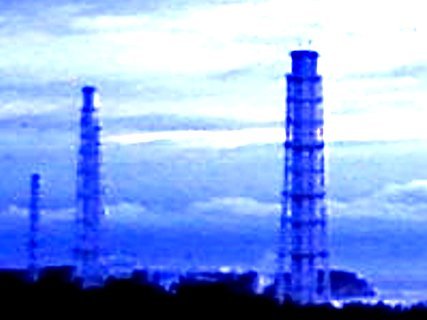
i51.tinypic.com Posted this over there. 50 minute old pic but I was curious.
5am TEPCAM: Contrast through the roof to get a good look at the steam.by radioguy via I51.tinypic 4/19/2011 8:49:26 PM- @ifz: PowerPC 440 is a very advanced technology there ! Only a 10 / 15 years old design !
133 MHz is a high speed... Only 83 MHz in space when operating from -55°C to 125°C...
I'd like to know the size of a transistor on the die... Not really like the same as our computers...by Jo Lindien 4/19/2011 8:51:46 PM - by e123 4/19/2011 8:56:10 PM
- No idea on hydrogen. They were at least measuring oxygen, no clue on h2.by Markfm 4/19/2011 9:03:12 PM
- Eeeek! Its time for us to start saving images/documents/video's etc that might vanish overnight. At least if there are multiple copies then they can be re-uploaded and re-distributed...by madrat 4/19/2011 9:07:08 PM
 More pics from tepco apologies if known already www.tepco.co.jpby elainekirk 4/19/2011 9:09:25 PM
 @Jo Lindien Maybe I misunderstood your comments, but the robots in the pics are "hardened" police/military grade robots that have been adapted for use in the reactor buildings. I know for a fact that the US military has been using equipment for decades that EMP/radiation cannot damage or disrupt.by James Ward 4/19/2011 9:12:00 PM
- @James Ward: what I mean is that radiation hardened electronics component are old and slow designs; this is a need for those components to operate under high level of radiations: nowadays technologies would just collapse at once or have random behavior in such cases...
Then we cannot expect getting beautiful hi-res film / pics from those equipments.by Jo Lindien 4/19/2011 9:18:09 PM - Technical paper on STRONTIUM-90 AND STRONTIUM-89: A REVIEW OF MEASUREMENT TECHNIQUES IN ENVIRONMENTAL MEDIA www.osti.govby Sinthia Domina 4/19/2011 9:26:39 PM
- In Finland the deposition of strontium-89 (90Sr) and strontium-90 (90Sr) has been monitored since the early 1960s. The measured ***ulative 90Sr deposition in 1963–2005 is on average 1200 Bq m−2, of which 150 Bq m−2 originates from the Chernobyl accident. Adding to this the deposition in 1945–1962 produces a value of 2040 Bq m−2 for the ***ulative deposition in Finland. The nuclear explosion-derived deposition up to 1985 obtained in this study, 1850 Bq m−2, is in good agreement with the zonal 90Sr deposition of 1740 Bq m−2 in the 60°N–70°N latitude band estimated by UNSCEAR. The regional deposition patterns of 89Sr and 90Sr following the Chernobyl accident resemble those of the refractory nuclides such as 239,240Pu and 95Zr. The total deposition of Chernobyl-derived 90Sr in Finland was about 5.3 × 10¹³ Bq. This activity corresponds to 0.027% of the reactor core inventory and 0.66% of the atmospheric emissions from the accident. The corresponding figures for 89Sr are 4.5 × 10¹⁴ Bq, 0.023% and 0.56%, respectively. www.sciencedirect.comby Sinthia Domina 4/19/2011 9:30:11 PM
- @madrat things that are in places of limited distribution like Tepco's website or YouTube are prone to disappearing. You can usually get a cached copy via google or archive.org but it might not be a bad idea to make copies of some the more critical or important items. I plan on keeping all the images I have been posting both on my website and on my network at home. But if someone wants to archive it or mirror it that is always just extra redundancy. But I don't know if anyone has been archiving videos off of youtube. Grabbing copies of those would be a really good idea since they are harder to find cached copies of after they are deleted. Anyone want to start building a video archive?by Nancy 4/19/2011 9:33:43 PM
- French company to decontaminate Daiichi water
French nuclear reactor maker Areva says it has agreed with the Tokyo Electric Power Company to build a facility to decontaminate radioactive water at the compound of the Fukushima Daiichi nuclear power plant. CEO Anne Lauvergeon told reporters in Tokyo on Tuesday that Areva -- one of the world's largest nuclear energy firms -- will build the facility to remove radioactive substances from the contaminated water.
The facility is to use chemical agents to remove radioactive iodine and cesium from contaminated water. The concentration of the radioactive substances is to be reduced to one-one thousandth to one-ten thousandth of the current level. A similar system is already in place in France. Lauvergeon said it is most important to decontaminate the water at the plant, and that her company will try to do this in every possible way. TEPCO told reporters on the same day that it has adopted Areva's proposal. The company says it will first transfer the contaminated water into a waste processing facility at the plant, and then decontaminate 1,200 tons of the water per day. It hopes to use decontaminated water to cool the reactors. TEPCO hopes to start operating the decontamination facility in June.
Tuesday, April 19, 2011 21:47 +0900 (JST)
www3.nhk.or.jpby Sinthia Domina 4/19/2011 9:33:44 PM  @elainekirk Could you update my pin, please?by Jim Carver 4/19/2011 9:35:57 PM
- SDF personnel sent to nuclear zone flees in panic A Japanese Ground Self-Defense Force member who'd been assigned to work near the damaged Fukushima Daiichi nuclear power plant has been dismissed for fleeing in panic.
The Defense Ministry says the 32-year-old sergeant was sent from Tokyo to Koriyama city, in Fukushima Prefecture, 2 days after the March 11th earthquake and tsunami to help decontaminate local emergency shelters. On the next day, he drove away without permission in one of his unit's trucks. He was later arrested by a Self-Defense Force police unit on suspicion of theft. The sergeant has reportedly told investigators that fear of the nuclear accident made him panic. He was dismissed on disciplinary grounds on Tuesday.
The commander of the Ground Self-Defense Force's First Division, Yoshiaki Nakagawa, expressed regret at what happened while so many SDF personnel are working hard in the disaster zone. He pledged to tighten discipline and prevent a recurrence.
Tuesday, April 19, 2011 18:54 +0900 (JST) www3.nhk.or.jpby Sinthia Domina 4/19/2011 9:38:30 PM - by e123 4/19/2011 9:43:23 PM
 MODERATOR: I click on the above unmoderated board, www.scribblelive.com, and the page that pops up says: 'Sorry, that live event was not found.' 'That live event doesn't seem to exist or has been deleted.' Would you please check into this? Thanks.
Hi Mary w try this link www.scribblelive.comby MaryW edited by elainekirk 4/19/2011 9:47:24 PM
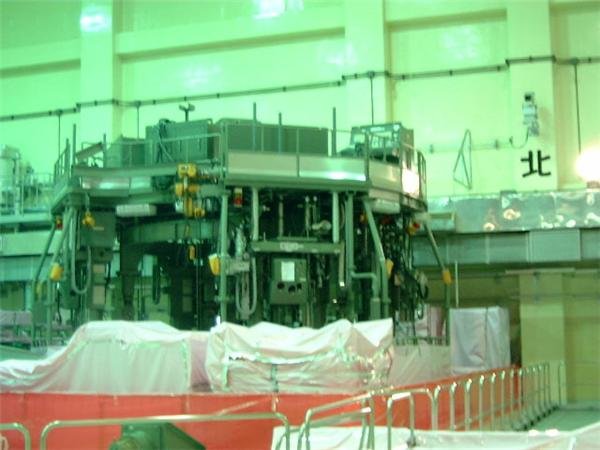
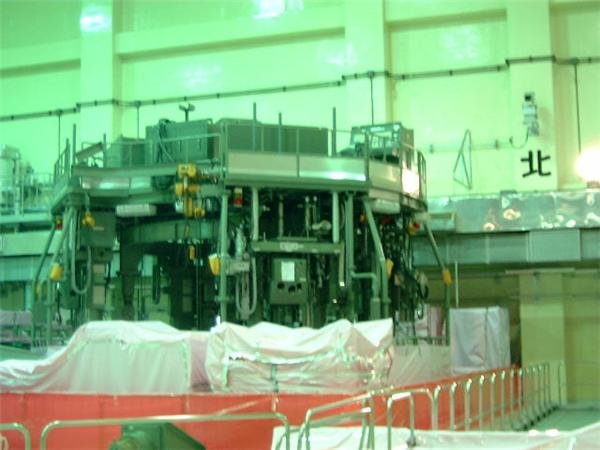
@Nancy "Machine for removing the cover of the upper part of the reactor." images.scribblelive.com
by NHK Listener 4/19/2011 9:48:05 PM- The robots used at the plant to go in are iRobot 510 packbot. No camera specs on it, seems able to use multiple cameras www.irobot.com The t hawk is what they are using for the fly arounds. You can see the shadow of it in the new video en.wikipedia.org Can't find camera specs for either one yetby Nancy 4/19/2011 9:49:51 PM
- @NHK Listener Any idea what is considered the upper part? The RPV cap or the steam condenser thing that sits under the cap?by Nancy 4/19/2011 9:50:56 PM
- Gov't to set up study group on tap water safety
Japan's health ministry is to set up a panel of experts to discuss ways to safeguard tap water from radioactive contamination. The move comes after radioactive iodine at levels higher than national limits was detected temporarily in tap water in parts of Fukushima and Ibaraki prefectures amid the disaster at the Fukushima Daiichi power plant. The ministry on Tuesday held a meeting of advisors including environment experts and water utility industry representatives to discuss countermeasures. Some participants asked that tap water safety be promoted publicly whenever radiation levels are low. Others said water in rivers and reservoirs should also be tested for radiation. The advisors agreed that a panel of radioactivity experts should be set up to discuss effective ways to prevent radioactive contamination of tap water through rainfall and other routes. The panel is also to discuss a long-term inspection system for tap water. The panel is to start discussions next week and come up with a report on specific measures by around June. Advisory council leader Sinichiro Ogaki, who heads the National Institute for Environmental Studies, says radioactive levels in tap water have stabilized. But he says he hopes to see the panel work out effective prevention measures and a proper inspection system so that everyone, from babies to adults, can safely drink tap water. Some municipalities of Fukushima and Ibaraki prefectures advised against tap water consumption by infants after radioactive iodine-131 at levels higher than 100 becquerels per liter was detected at water purification plants. Such advisories were also issued in Tokyo and neighboring prefectures after iodine levels at water purification facilities were found to exceed the safety limit for infants. But the advisories were all lifted by the end of March.
Tuesday, April 19, 2011 18:10 +0900 (JST) www3.nhk.or.jpby Sinthia Domina 4/19/2011 9:51:48 PM  Anyone have RadiGuys weblink to radio show ?by VeenOui 4/19/2011 9:56:21 PM
- @Nancy I think it is for the RPV cap. I think it is used to remove all the nuts that hold it downby NHK Listener 4/19/2011 10:03:28 PM
- Modern hardened cameras are decent technology, decent resolution. The video goes into a compact codec in an enclosure. Products like the thermo 8825dx.by Markfm 4/19/2011 10:11:59 PM
Transfer begins of highly contaminated water
The operator of the damaged Fukushima Daiichi nuclear power plant has begun transferring highly radioactive water from the No.2 reactor to a waste processing facility. Ahead of the operation, Tokyo Electric Power Company, known as TEPCO, sealed cracks in the walls of the facility and ensured that other measures were in place to prevent contaminated water from leaking. After the government's nuclear safety agency checked procedures and safety measures, TEPCO began the operation on Tuesday morning. About 25,000 tons of highly contaminated water has accumulated in the basement of the turbine building and a tunnel connected to the No.2 reactor. The water must be moved quickly, as it could escape into the ocean.
TEPCO says it plans to move about 480 tons of the water a day and it will take about 26 days to move about 10,000 tons to the waste facility near the No.4 reactor.
The utility firm estimates that about 67,500 tons of radioactive water has accumulated at the plant.
With more water being pumped into the reactors to restore the cooling system, the quantity is expected to rise and further hamper operations to bring the crisis under control.
Tuesday, April 19, 2011 12:48 +0900 (JST) www3.nhk.or.jp
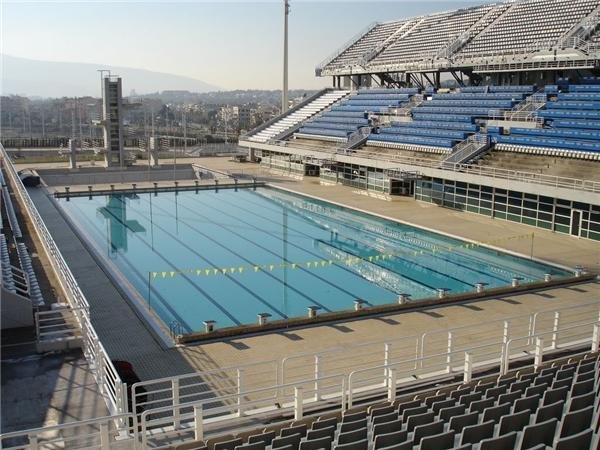
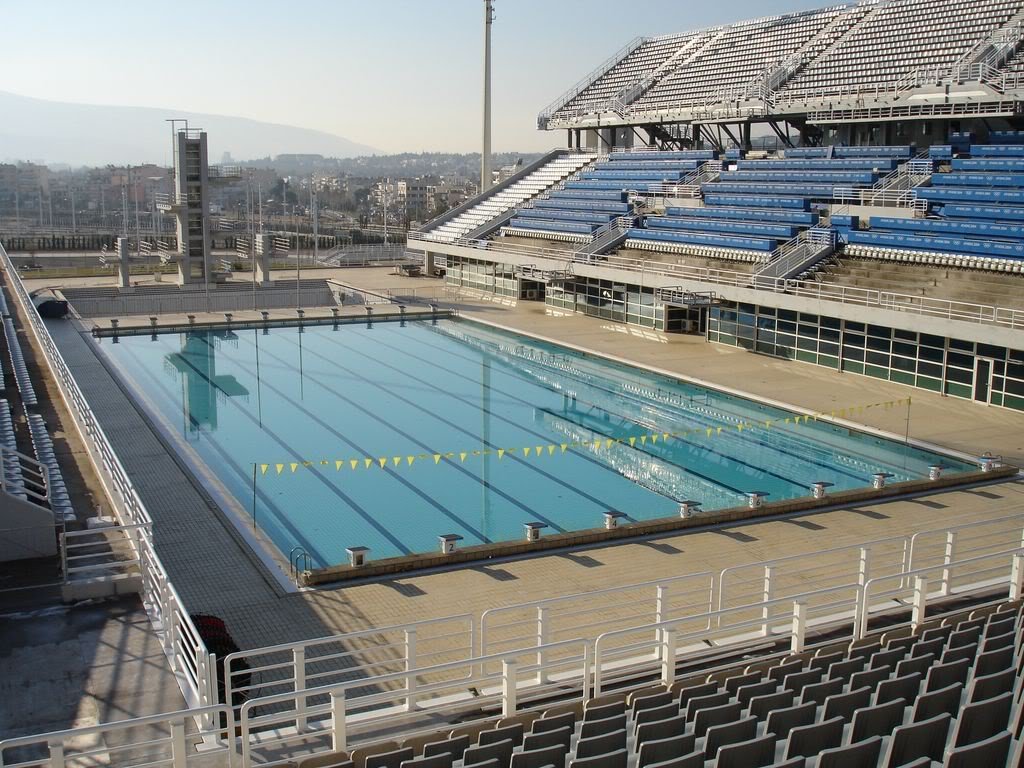
Conversions: 480 tons = 359,065 gallons 10,000 tons = 7,480,519 gallons 25,000 tons=18,701,298 gallons 67,500 tons = 504,93,506 gallons There are 660,253 gallons in one Olympic sized swimming pool. i173.photobucket.com Converter used: www.unitconversion.org
by you via I173.photobucketby Sinthia Domina via I173.photobucket 4/19/2011 10:12:09 PM- I really hope that tepco is using decent pipes and hoses now - remember some of their butcher jobs in past weeks.by Markfm 4/19/2011 10:16:07 PM
 hi NHK.. GOOD CALL on that machine.. we use a big spanner hydraulic wrench system.. but that's it for the COMMERCIAL size..by dean 4/19/2011 10:20:51 PM
- fitter are you still here?by dean 4/19/2011 10:25:55 PM

Japan Earthquake | Page 767
- Who's Blogging
-
 hudebnik
 alblee
 UKVal
UKVal Jonathan Keebler
 Oliver (ScribbleLive)
 kaykodh
 Markfm
 Angie
Angie Mid Valley
 Matt (ScribbleLive)
 George Gibb
- elainekirk
 PKelley
 lillymunster
 dean
dean bo
bo Edano
Edano Deb
Deb- Pedro Jesus
 IanGoddard