Japan Earthquake | Page 870
 @Nancy I will look and try to in a timely fashion. But it looks just like what was on the video...maxed out for days.by Jim Carver 4/27/2011 9:13:10 PM
 A dozen Fukushimas waiting to happen www.rollingstone.com
Long term health survey for residents (Kyodo) www.istockanalyst.comby Nancy 4/27/2011 9:18:15 PM @radioguy The suppression chamber is the "torus," right? I don't know where the sensor is in the SC, but I wonder how debris falling into the reactor well would get into that location?by General Armchair 4/27/2011 9:21:10 PM
 Has anyone else noticed the radiation readings in #3 S/C lately, they keep going up. currently 5.32 x10 Sv/h Something happening in the S/C !!!!by wtm 4/27/2011 9:22:13 PM
- @Nancy You're right, TEPCO should explain it. But at this point I would say TEPCO defines "dodgy," so I won't hold my breath.by General Armchair 4/27/2011 9:25:45 PM
 Nancy said, "Somehow it seems improbable that #4 was 90 degrees and boiled off 140 tons of water in two days." Perhaps there is a hard boil, but not where the sensor is placed? None the less, that would still be one heckuva' teapot...by Rob in SF 4/27/2011 9:25:59 PM
- @Nancy, remember that the normal sensor in #4 does not work, and they had to drop one off the concrete pumper that they are using into the SFP. Who knows if it is calibrated, or if it is even into the water, might just be hanging above it, or possibly they are just reading the temp of the water on the end of the pumper pipe?? But it so far is probably better than what they had before....nothing !by wtm 4/27/2011 9:30:47 PM
www.appsmini.com
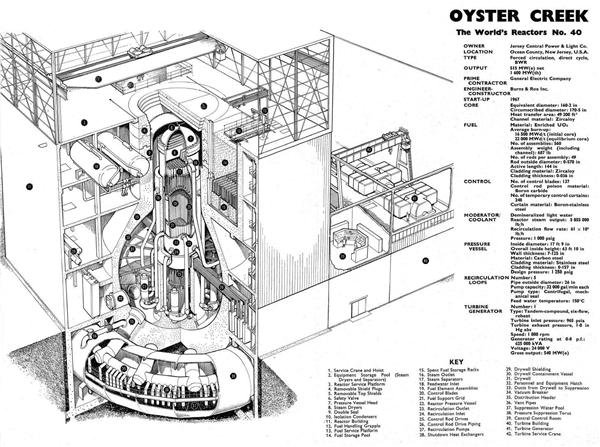
@General Armchair: "I don't know where the sensor is in the SC, but I wonder how debris falling into the reactor well would get into that location?" Perhaps via the drywell ducts (per diagram #33)? Were the removable top shields, (#5), even on Reactor 4 at the time of the quake?by Rob in SF via Appsmini 4/27/2011 9:32:58 PM- by Rob in SF 4/27/2011 9:35:58 PM
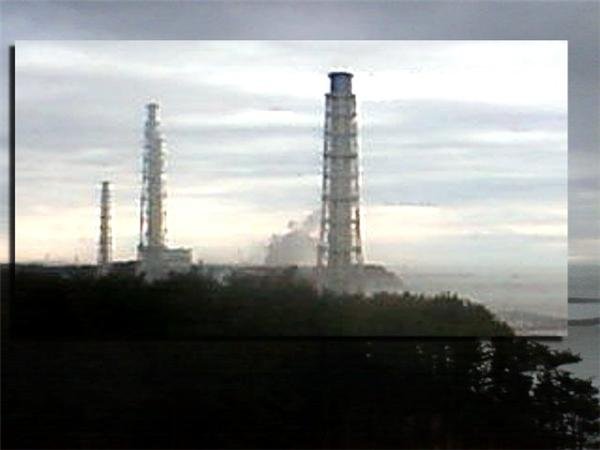
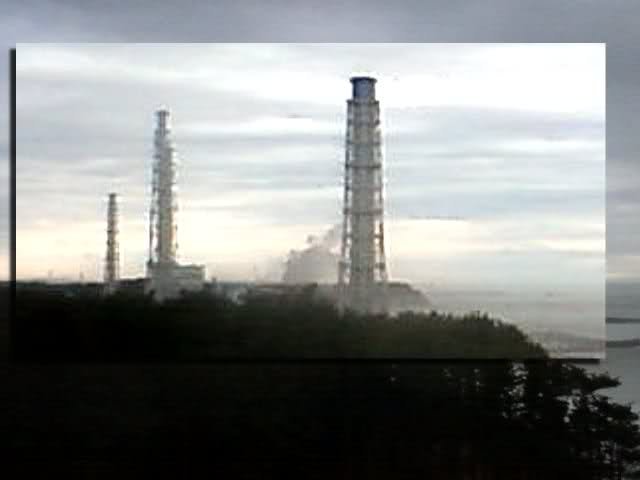
teppycam is hazy but looks like a nice steambath above reactor 4 again. I have the pasta, who brought the garlic bread??? www.tepco.co.jpby Nancy 4/27/2011 9:41:55 PM
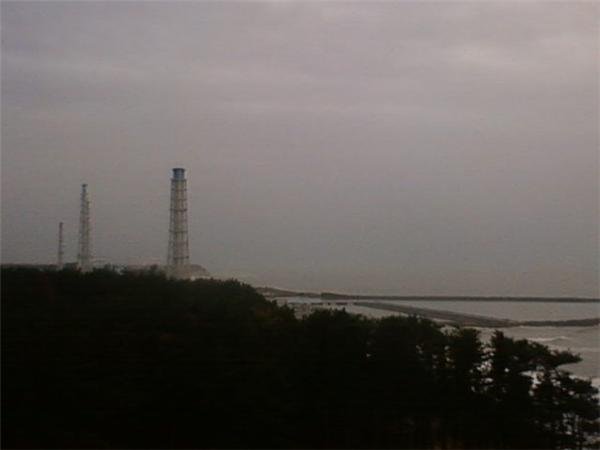
apparently typing is not my strong suit today. pointscope01.jp
by Nancy via Pointscope01.jp 4/27/2011 9:42:31 PM
 look at the haze of smoke speading from the plant across the horizon line , that to me says he
avy smokeby elainekirk 4/27/2011 9:43:40 PM
the reactor vessel itself becomes hot, radioactive, over time. What level of heat it would emit I have no clue, but the thermal images I have seen have not been all that hot.by Markfm 4/27/2011 9:46:03 PM
@elainekirk I wondered it it was that or haze, it does look pretty thick by the treeline.
go look the very latestby Nancy edited by elainekirk 4/27/2011 9:49:52 PM
@Nancy and elainekirk I would guess it's perhaps morning fog?
(back in a bit)by General Armchair 4/27/2011 9:52:37 PM
www.tepco.co.jp
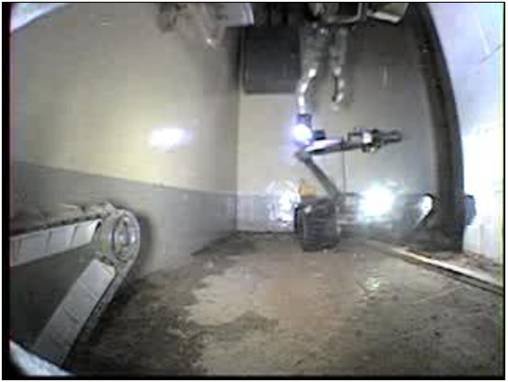
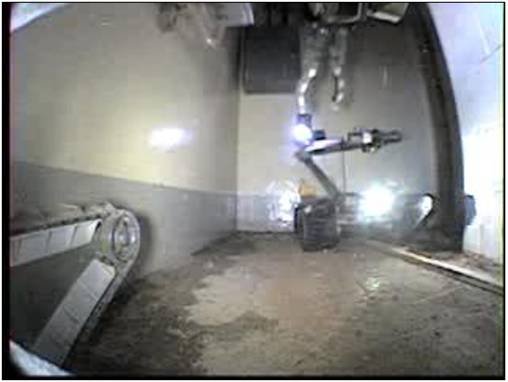
SHC pump room...
I'm still trying to figure out where this is... Is it perhaps #28, the Shutdown Heat Condenser (exchanger) pump room?
I will say that #32 on the diagram, the "hatch", looks like a potential trouble spot...by Rob in SF via Tepco.co.jp 4/27/2011 9:52:55 PM
resources.nei.org pdf. NEI Fact Sheet
Used Nuclear Fuel Storage at the Fukushima Daiichi Nuclear Power Plant The used fuel pools are designed so that the water in the pool cannot drain down as a result of damage to the piping or cooling systems. The pools do not have drains in the sides or the floor of the pool structure. The only way to rapidly drain down the pool is if there is structural damage to the walls or the floor.
What Could Happen During an Accident?
The systems that cool and maintain water levels in the pools are designed to withstand severe events. If these systems are unable to function, the heat generated by the used fuel would result in a slow increase in the temperature of the spent fuel pool water. The operating temperature of the pools is typically around 40 degrees C or 100 degrees F (the boiling point for water is 100 C or 212 F). This slow increase in temperature would result in an increased evaporation rate. Rapid evaporation of the water will not occur.by e123 4/27/2011 10:06:30 PM
@e123 "Rapid evaporation of the water will not occur." Unless... Nah, that could NEVER happen.by Rob in SF 4/27/2011 10:11:19 PM
Teppy cam looked hazy last late afternoon, almost like a smog, either that or it's lens is real dirty ?by wtm 4/27/2011 10:13:19 PM
Heh... Japanese press annoyed, eh?
Authorities try to get their story straight over Fukushima
For the first time since the reactors at the Fukushima No. 1 nuclear power plant started to spiral out of control, all of the major organizations responding to the disaster appeared together at a joint news conference on April 25.
An integrated headquarters to deal with the nuclear accident itself was set up in the early days of the crisis, on March 15, but separate news conferences were held by the government, the plant's operator Tokyo Electric Power Co. (TEPCO), the Nuclear and Industrial Safety Agency (NISA) and the Nuclear Safety Commission of Japan (NSC) until this week.
The public information effort has been criticized for often being repetitive and incoherent.
Goshi Hosono, Prime Minister Naoto Kan's special adviser dealing with the nuclear accident and the secretary-general of the integrated headquarters, said: "With the different news conferences we were holding, there was repetition of information as well as discrepancies. We want to increase the transparency of the information offered through a unified news conference. We will honestly pass on information about this severe crisis."
www.asahi.comby Rob in SF 4/27/2011 10:13:37 PM
 @Rob in SF @e123 : there is a cooling system and no pipes in foor or sides ? how that possible ? or do i misunderstand it ?by Edano 4/27/2011 10:13:38 PM
Piping going down from aboveby Markfm 4/27/2011 10:14:36 PM
 @Nancy URL reposting for reactor 4 rad readings: atmc.jpby es 4/27/2011 10:19:28 PM
This is interesting from MicroSimTech/PCTran re: #4 SFP:
We assumed that Unit 4 was in refueling with the full core discharged into the spent fuel pool. The fuels have burn-up to 64 MWD/MTU and 15 days after shutdown. There are 560 assemblies. So the decay heat level was 15.47 MBtu/hr, or 4.53 MW (0.20 % of rated 2311 MW power). The pool has room to accommodate fuels of previous cycles. Since their exact amount is unknown to us and its contribution to the total decay heat is minimal, it is ignored in this study. The fuel pool cooling system was in operation to maintain the pool at 97 ºF (36.1º C). The seawater for cooling was 50 ºF (10 ºC).
Right after the Scale 9 earthquake the AC power was lost. Without cooling to the pool the code immediately calculated the heat-up rate to be 6.4 ºF/hr (3.5 ºC/h). It would take about 17.8 hours to boiling (in the upper left “Time Estimate” panel of the simulator mimic).
We also assumed the earthquake has caused a crack to leak out 100 gpm (370 liters/min) water at the bottom of the pool. The projected time for fuel top exposure is 35.4 hours. Note the projected time is somewhat arbitrary, because we know neither the exact decay heat nor the crack size. Rather they are roughly consistent with the event chronicle to occur in 2 to 4 days.
In our first try to simulate this event, we made a gross estimate of the pool fuel inventory and its decay heat level. We also assumed a bottom leak that would expose the fuel in a couple of days. However, no attempt was made to match the timings exactly as the event chronicle. PCTRAN/SFP has turned out that the fuel cladding started to heat up and reached burning condition in about 2 days. www.microsimtech.comby Rob in SF 4/27/2011 10:26:20 PM
So..., did the emergency HPCI systems work?
More MicroSimTech insights:
Fukushima Daiichi Unit 1 is a GE BWR-3 rated 460/1380 MW (electric/thermal). Units 2 to 5 are BWR4 rated at 784/2381 MW. There are two external recirculation pumps. Jet pumps inside the reactor downcomer enhance the core flow for better efficiency. They all have Mark I (steel liner plus concrete drywell and torus-shaped suppression pool) containments. The emergency core cooling systems contain a steam-driven High Pressure Coolant Injection (HPCI) system. It starts on low reactor water level signal and draws water initially from the condensate storage tank. There is another Reactor Core Isolation Cooling system also powered by the reactor steam. It starts on main steam isolation and low reactor water level signal. A small constant flow provides coolant makeup until its battery control runs out of power. On the active side, the diesel generator-powered residual heat removal (RHR) pumps turn on low reactor water level. to inject water in the Low-Pressure Coolant Injection (LPCI) mode. It provides large flow to reflood the core after the reactor pressure is lowed by either a pipe break or forced depressruization.
The Fukushima event was unprecedented because it exceeded historical maximum in the region. The succeeding tsunami aggregated the damage that knocked out crucial cooling systems and disabled all diesel generators. Given the initiating conditions PCTRAN is able to reproduce the plant behavior and radiological consequence. Our specific observation/recommendations are:
1. All existing power plants' passive emergency cooling systems (BWR's RCIC and PWR's turbine-driven auxiliary feedwater system) should be inspected and reinforced to assure their reliability during adverse condition. Onsite emergency generators should be further protected.
2. PWR is more resilient than BWR because of its steam generator secondary water inventory and size of containment. This gives larger margin to core damage and containment failure. Further review is still necessary to improve the safety level.
3. Spent fuel pool safety has been grossly overlooked. A hardened and independent top spray system is necessary for all nuclear power plants.
www.microsimtech.comby Rob in SF 4/27/2011 10:38:49 PM
 We have to be ALL the Time aware that TEPCO can let out secretly ,wrong information for misled and direct our thoughts in the wrong direction. Every information we find has to be take with a lot of care. Is very easy to leak fake information ,charts,tables, photos. and get it spreed in the net.by Majjham Zazen 4/27/2011 10:41:20 PM
www.theage.com.au nuclear apologists play shoot the messenger.by e123 4/27/2011 10:55:16 PM
@Majjham Zazen You mean like reports that the SFP in #4 isn't leaking? ;-)by Nancy 4/27/2011 11:04:15 PM
@elainekirk You are one hard working woman Elaine. I should be caught up again in the morning. My brain is mush.by Nancy 4/27/2011 11:04:52 PM
www.tepco.co.jp be afraid, be very afraidby elainekirk 4/27/2011 11:08:50 PM
@elainekirk Oh that does NOT look good...by Nancy 4/27/2011 11:09:50 PM
 So, let me see. They built to protect against only the historic maximum, and then when people, reputable atmospheric scientists kept telling them that seas would rise, and that storms and natural disasters would get worse, they were so invested in protecting their turf that they had to minimize this at all costs. And then they believed their own bad estimates and blinding PR. "We don't believe it's happening so you're ALL wrong."by radioguy 4/27/2011 11:10:15 PM
@Bobby that smoky haze on the horizon a couple of hrs ago now has a visible sourceby elainekirk 4/27/2011 11:11:18 PM
@radioguy upgrading those tsunami walls sounds pretty cheap in hindsight...by Nancy 4/27/2011 11:12:07 PM
 @elainekirk That's building #4 right? Or #3 also?by Bobby1 4/27/2011 11:13:03 PM
I pulled the image into photoshop to lighten in to pull out some detail. It is a big cloud of smoke coming out of 4 and you can see a bit of a wave of thin smoke out over the sea.by Nancy 4/27/2011 11:13:03 PM
by e123 4/27/2011 11:16:40 PM
This is a home video of measurements taken at multiple locations in Fukushima city for radiation contamination. Fukushima city is roughly 63 kilometers from the Fukushima Daiichi Nuclear Plant placing it outside of the exclusion zone. In some locations the measurements reach as high as 97 µSv/h.by e123 4/27/2011 11:17:22 PM
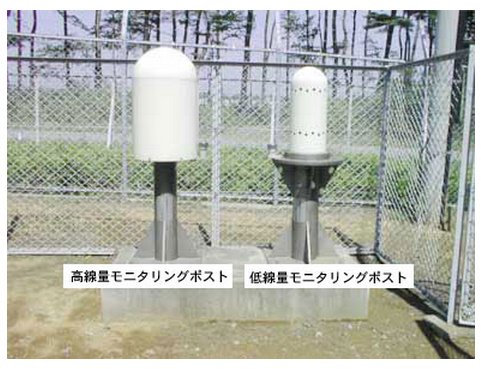
It is no good I just have to share this monitoring post with you.....we already thought they were ..... we now have confirmation
by elainekirk 4/27/2011 11:17:47 PM
i56.tinypic.com
I went for quick.by radioguy via I56.tinypic 4/27/2011 11:18:09 PM
@radioguy Thank you, apparently I can't run 2 java uploaders at the same time.by Nancy 4/27/2011 11:18:49 PM
R3 and lots from the stewpot.by radioguy 4/27/2011 11:18:51 PM
@Nancy You probably spliced them and sent them to DonaldTrump.com.by radioguy 4/27/2011 11:20:47 PM
Why can't they just admit they don't have a clue about controlling the situation?by Bobby1 4/27/2011 11:24:11 PM
Shower curtains, nuclear spa and a tsunami tent? I think they've pretty much admitted that.by radioguy 4/27/2011 11:26:25 PM
Japan Earthquake | Page 870


- Who's Blogging
-
 hudebnik
 alblee
 UKVal
UKVal Jonathan Keebler
 Oliver (ScribbleLive)
 kaykodh
 Markfm
 Angie
Angie Mid Valley
 Matt (ScribbleLive)
 George Gibb
- elainekirk
 PKelley
 lillymunster
 dean
dean bo
bo Edano
Edano Deb
Deb- Pedro Jesus
 IanGoddard