Japan Earthquake | Page 1368
 Hiroshima survivor on Fukushima www.asahi.comby Nancy 5/25/2011 1:49:19 AM
 *presentby estacion 5/25/2011 1:49:29 AM
 Hey all, just got in. Catching up.by radioguy 5/25/2011 1:57:21 AM
- OK...re the spreadsheet. I have the live one, which updates regularly, and I have the historic data up till today that I grabbed statically.by radioguy 5/25/2011 1:59:21 AM
- What may be best is to keep the static one and sort the live one newest first, but the other option is to take the live sheet, use a function to find the last row, which will be the newest readings, and pull then into the visualizer.by radioguy 5/25/2011 2:01:19 AM
- @radioguy really? cool. can you email me the address for the one that gets live data? I can take a stab at getting the gadget working in the morning.by Nancy 5/25/2011 2:01:40 AM
 @estacion ty I am learning all the time :)by elainekirk 5/25/2011 2:01:50 AM
- @radioguy Having newest first would be way easier as far as coding and making it play nice.by Nancy 5/25/2011 2:02:40 AM
 @radioguy, I figured a few steps out on how to procede in principle. Check these links out: 1) How to select last update or a range of updates:
www.google.com , 2) how to select last update: www.google.com , and, finally, 3) how to publish update in a gauge: Insert gadget and get code.by Peter Melzer 5/25/2011 2:05:19 AM- Live spreadsheet: pressure readings and temp readings as separate spreadsheets. It takes a bit to load the live data. ==> spreadsheets.google.com
Historic data through noon today, but with frozen headers on the columns. ==> spreadsheets.google.com
Btw, the csv inport function into googledocs is simplicity itself: =importData("URLtoCSV")by radioguy 5/25/2011 2:06:20 AM - @radioguy love it. :-) Sounds like you may have this thing handled? Is there a part you need me to do or can you do the code to the gadget visualization?by Nancy 5/25/2011 2:08:45 AM
- I haven't looked at it, but I'm loading some test functions into another sheet to see if I can get useful rows. What all is needed for the viz? Or where's the link to that info?by radioguy 5/25/2011 2:10:16 AM
 @Nancy, Edano...
Unfortunately, although probably not that big of a deal, the CSV reactor data tables are individual, kinda...
Plant water pressure data (CSV)
Unit 1 - www.tepco.co.jp
Unit 2 - www.tepco.co.jp
Unit 3 - www.tepco.co.jp
Plant temperature data (CSV)
Unit 1 - www.tepco.co.jp
Unit 2 - www.tepco.co.jp
Unit 3 - www.tepco.co.jp
Unit 5&6 - www.tepco.co.jpby Rob in SF 5/25/2011 2:10:16 AM- I loaded them into individual sheets.by radioguy 5/25/2011 2:10:39 AM
- @radioguy
From your Google Documents account you open the existing spreadsheet.
Select the gauge field in the doc, then go to - Insert > Gadget > Charts > Gauges
From there on I'm kinda lost...by Rob in SF 5/25/2011 2:11:33 AM - Select a row/field for the Gadget...by Rob in SF 5/25/2011 2:12:02 AM
- @radioguy I will email you the links for all the how to etc. Rather than jamming the forum full of them again. :-)by Nancy 5/25/2011 2:12:09 AM
- @radioguy If you have the Gauge Gadgets working, they provide HTML embed code you could forward to Nancy and she can drop it into the website...by Rob in SF 5/25/2011 2:13:49 AM
- OK, Testing the test functions.by radioguy 5/25/2011 2:13:54 AM
- @radioguy "use a function to find the last row" a standard DOCX formula, but I'm terrible at Excel...by Rob in SF 5/25/2011 2:16:54 AM
- @Rob in SF do we get any data in the feed for 4 or do they skip it since the RPV is empty?by Nancy 5/25/2011 2:16:58 AM
- @Nancy It's mysteriously missing... It would be nice to have #4 SFP temp data, eh?by Rob in SF 5/25/2011 2:18:14 AM
- @radioguy There are a lot of cool Chart gadgets we might employ, FWIW. And the Map Gadgets are very cool as well.by Rob in SF 5/25/2011 2:19:29 AM
- 'Everything was by the book' / TEPCO: Manual shutdown of reactor cooling system followed rules
The Yomiuri Shimbun
www.yomiuri.co.jp
An emergency cooling system for the No. 1 reactor at the Fukushima No. 1 nuclear power plant was shut down manually by plant workers on March 11, after the earthquake but before the tsunami hit the plant, it has been learned.
The revelation was made in a report submitted Monday by plant operator Tokyo Electric Power Co. to the Nuclear Safety and Industrial Safety Agency.
TEPCO said the immediate response procedures taken on March 11 were in line with the firm's operational manual.
The company has been criticized over a series of problems with cooling systems at the plant on March 11 and for days after, which some experts believe may have contributed to the meltdown of fuel rods in reactors at the plant.
According to the report submitted to the Economy, Trade and Industry Ministry's nuclear safety agency, when the magnitude-9.0 earthquake struck at 2:46 p.m., the Nos. 1-3 reactors lost all external power, but emergency power sources were still in working order.
The quake triggered an automatic shutdown of the No. 1 reactor, and control rods were inserted into the reactor core.
At 2:52 p.m., an isolation condenser--a system designed to cool the reactor--was automatically activated.
But at 3:03 p.m., just 11 minutes later, the cooling system was suspended manually by plant workers.
The TEPCO operational manual says the reactor's temperature should not be allowed to fall at a rate of 55 C per hour or more, and isolation condenser operations should be adjusted to prevent such an occurrence.
TEPCO said its workers halted the cooling system because it had caused excessive cooling, with the reactor temperature falling more than 100 C in the time the condenser had been operating.
The workers soon reactivated the condenser, before the tsunami hit the plant shortly after 3:30 p.m.
The tsunami wiped out the direct-current power supply to the plant, and the power loss was interpreted by control systems as indicating a pipe fracture.
This set off an automatic shutdown of the condenser, closing a series of valves between it and the reactor.
Plant workers suspected the valves had been closed, and a visual check confirmed it. The workers then manually opened the valves, enabling the restart of the condenser, according to the report.
Meanwhile, the Nos. 2 and 3 reactors were using a different type of cooling system, known as a reactor core isolation system.
The report said losses of external power caused the systems at both reactors to halt several times, and on each occasion TEPCO workers manually restarted the systems, in line with the operation manual.
The system at the No. 2 reactor continued to be operated in this fashion until 1:25 p.m. on March 14.
At the No. 3 reactor, the cooling system stopped working at 11:36 a.m. on March 12.
About an hour later, another emergency cooling system called a high-pressure core-flooding system was put into use at the No. 3 reactor, but this was stopped at 2:42 a.m. on March 13.
The operation was back under way at 9:25 a.m. that day, using freshwater containing boric acid.
The relative lack of continuity in efforts to cool the No. 3 reactor is believed to have caused meltdown to occur faster there than that at the No. 2 reactor.
(May. 25, 2011)by estacion 5/25/2011 2:22:58 AM  estacion.. I had written my report on the first hours of unit 1 then learned of them shutting off the system.. I had heard it was due to operator thinking it may hurt the reactorby dean 5/25/2011 2:27:27 AM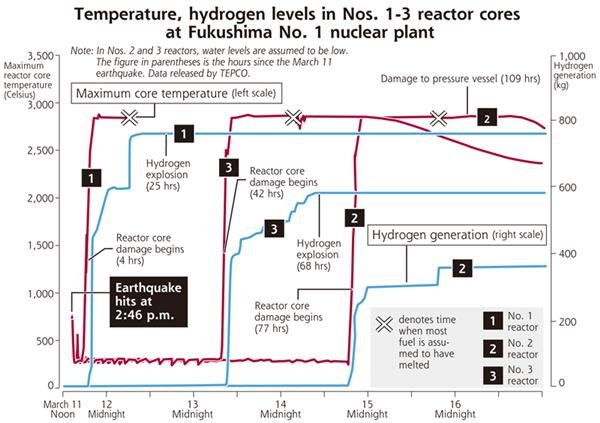
Meltdown speed varied by reactor
The Yomiuri Shimbun
www.yomiuri.co.jp
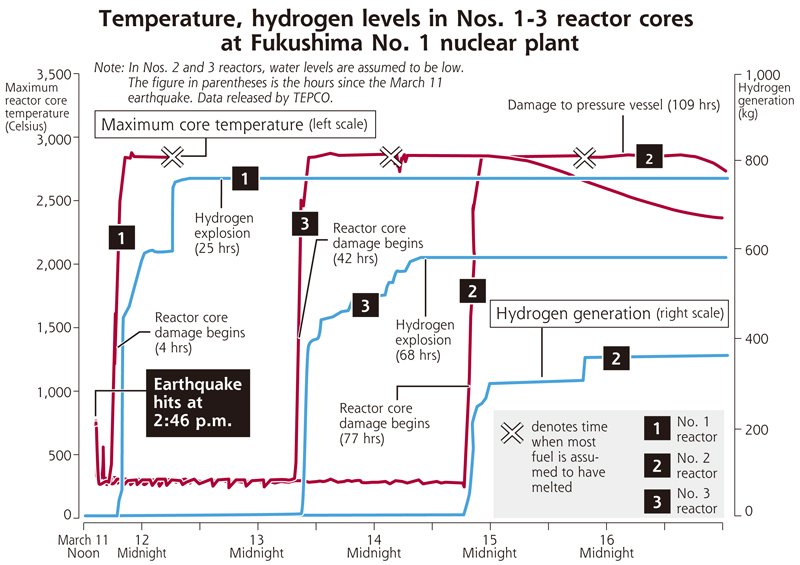
Nuclear fuel rods in the No. 2 reactor at the Fukushima No. 1 plant are believed to have mostly melted and dropped to the bottom of the pressure vessel 101 hours after the March 11 earthquake, and those in the No. 3 reactor likely reached the same state in 60 hours, according to Tokyo Electric Power Co.'s worst-case scenario.
The worst-case speculation was based on the assumption the water level in the pressure vessels was lower than originally thought--similar to what happened in the No. 1 reactor.
TEPCO's analysis of the state of the plant's reactors was submitted Monday to the Economy, Trade and Industry Ministry's Nuclear and Industrial Safety Agency. The report was the first admission by the utility that the reactors were in a critical condition soon after the plant automatically shut down when the earthquake hit.
It is highly likely the pressure chambers of the Nos. 2 and 3 reactors were damaged when the melted fuel dropped down, which caused the hydrogen explosions, TEPCO's report said.
Nuclear fuel rods in the No. 2 reactor at the Fukushima No. 1 plant are believed to have mostly melted and dropped to the bottom of the pressure vessel 101 hours after the March 11 earthquake, and those in the No. 3 reactor likely reached the same state in 60 hours, according to Tokyo Electric Power Co.'s worst-case scenario.
The worst-case speculation was based on the assumption the water level in the pressure vessels was lower than originally thought--similar to what happened in the No. 1 reactor.
TEPCO's analysis of the state of the plant's reactors was submitted Monday to the Economy, Trade and Industry Ministry's Nuclear and Industrial Safety Agency. The report was the first admission by the utility that the reactors were in a critical condition soon after the plant automatically shut down when the earthquake hit.
It is highly likely the pressure chambers of the Nos. 2 and 3 reactors were damaged when the melted fuel dropped down, which caused the hydrogen explosions, TEPCO's report said.
www.yomiuri.co.jpby estacion via Yomiuri.co.jp 5/25/2011 2:39:40 AM
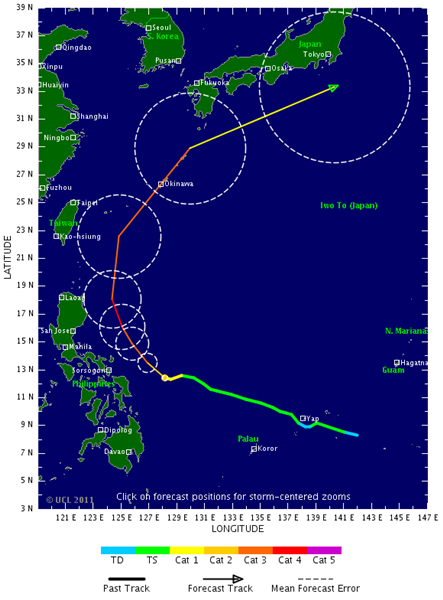
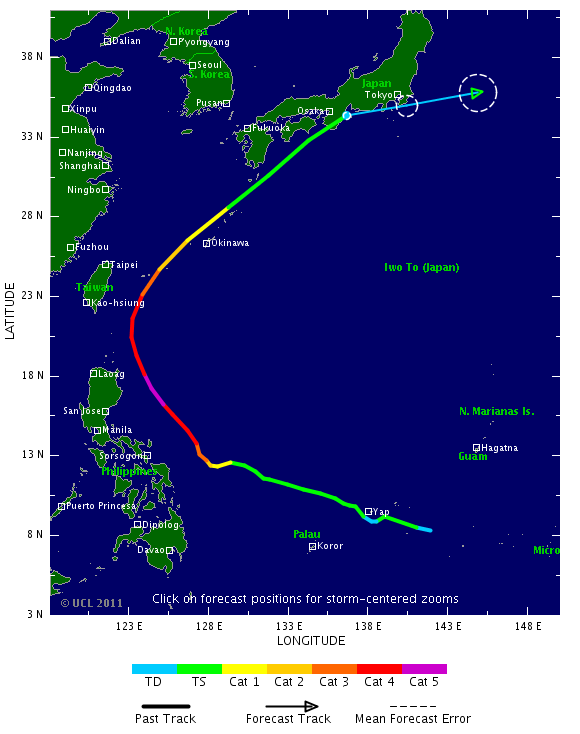
Typhoon SONGDA: Current Data www.tropicalstormrisk.com
by Majj via Tropicalstormrisk 5/25/2011 2:42:36 AM- Fuel in No. 1 melted in 15 hours
The No. 1 reactor building was the first to be struck by a hydrogen explosion.
Immediately after the earthquake, the reactor was halted when control rods were automatically inserted to slow down power output. When outside power was cut off, two emergency diesel generators started up. Valves that send steam to the turbine closed and an isolation condenser to convert steam back into water started six minutes after the earthquake.
When the tsunami struck, however, all electricity supplies at the plant were destroyed, rapidly aggravating the situation in the No. 1 reactor.
According to TEPCO's analysis, the water level in the pressure vessel declined in the two hours after power was lost, exposing fuel rods in the reactor's core. An hour later, the temperature in the reactor apparently shot up to as high as 2,800 C. The heat melted the casing for the fuel rods and nuclear fuel pellets inside began to melt and fall apart--a meltdown.
It is believed all the fuel rods had melted and dropped to the bottom of the pressure vessel within 15 hours of the earthquake.
The fuel rods' casing is made of zirconium, which forms zirconia when it combines with oxygen in water. Hydrogen left over from this chemical reaction--water is composed of hydrogen and oxygen--quickly filled the reactor. TEPCO's report said about 800 kilograms of hydrogen was produced by this reaction, which leaked from the pressure and containment vessels to fill the building that houses the reactor. This massive amount of hydrogen is believed to be what caused the explosion at 3:36 p.m. on March 12.
Freshwater was poured into the vessel to try to cool the reactor core shortly before 6 a.m. on March 12. According to the report, the fuel had completely melted by the time this began. Freshwater injections stopped at 2:30 p.m. and seawater injections started at about 8:20 p.m.
TEPCO had initially started injecting seawater into the reactor at 7:04 p.m. on a trial basis, but stopped after 20 minutes because the company had not properly informed the government of its plan. Monday's analysis did not mention the effect of this 55-minute gap.
www.yomiuri.co.jpby estacion 5/25/2011 2:46:10 AM - No. 2 cooled for 3 days after quake
A reactor core isolation cooling system, which injects water into a reactor core in emergencies, began running at the No. 2 reactor in the time after the earthquake and before the tsunami.
According to a TEPCO worker's log and other sources, staff switched the cooling system off and on trying to deal with fluctuations in the water level in the pressure vessel. The cooling system stopped working at about 1:25 p.m. on March 14, meaning it ran for about three days after the earthquake hit at 2:46 p.m. on March 11.
After the cooling system failed, seawater was sprayed on the reactor from fire trucks starting at 4:34 p.m. the same day, but the water level continued to decline. By 6 p.m. on March 14, the tips of the fuel rods were exposed, and just an hour later they were almost totally out of the water, according to the report.
Since water gauges for the reactors may have been damaged and are no longer accurate, TEPCO speculated on the situation inside the reactor cores based on worst-case scenarios, in which the water levels in the Nos. 2 and 3 reactors sank despite the injection of seawater.
Based on these assumptions, TEPCO concluded damage to fuel rods in the No. 2 reactor began about 8 p.m. on March 14, an hour after the fuel rods were fully exposed. The rods melted and fell to the bottom of the pressure vessel by 8 p.m. on March 15. Eight hours later, or at about 4 a.m. on March 16, the bottom of the pressure vessel was damaged, according to TEPCO's analysis.
Although "the worst" has likely happened, TEPCO said recent temperature measurements near the No. 2 reactor's pressure vessel showed the situation is relatively stable.
If the water gauge is accurate, it would mean the seawater injection worked to a certain extent, meaning meltdown did not occur until at least a week after the earthquake, according to the report.
www.yomiuri.co.jpby estacion 5/25/2011 2:46:53 AM  TEPCO says response procedures taken at Fukushima N-plant on March 11 were in line with operational manual. bit.lyby Veenie 5/25/2011 2:47:38 AM
- Multiple failures doomed No. 3
It was early on March 13, or 36 hours after the Great East Japan Earthquake happened on March 11, that conditions at the No. 3 reactor began to clearly worsen.
Though the No. 3 reactor lost its power source in the tsunami, TEPCO had managed to continue pouring water into the nuclear reactor, albeit with a gap of one hour, using two different types of emergency cooling systems--the high-pressure core flooding system and the reactor core isolation cooling system.
However, the high-pressure core flooding system, which was considered the last resort, automatically stopped at 2:42 a.m. on March 13 because of falling pressure inside the reactor. The conditions inside the reactor drastically deteriorated after all batteries ran out and the reactor became uncontrollable.
The reactor's pressure rapidly rose from 0.58 megapascals to more than 7 megapascals in only two hours.
Operators tried to reactivate the reactor core isolation cooling system, but they could not.
TEPCO then reported to the government at 5:10 a.m. that all functions to inject water into the reactor had been lost.
During that time, the water level at the No. 3 reactor kept going down. According to TEPCO's estimates, fuel rods became exposed above the water's surface at around 7 a.m.
When operators released steam from inside the pressure vessel to the containment vessel to relieve pressure in the reactor shortly after 9 a.m., fuel rods were exposed to the air completely, and they began to be damaged.
At 9:20 a.m., operators vented steam from the containment vessel to the outside. Soon after the operation, at 9:25 a.m., operators started to inject freshwater into the pressure vessel for the first time since the loss of cooling functions about seven hours earlier.
On the afternoon of March 13, they changed the water injected into the vessel from freshwater to seawater. But, in the early hours of March 14, they stopped injecting water for about two hours to replenish their seawater supply.
According to TEPCO's worst-case estimates, fuel rods remained exposed and most of them melted and dropped down to lower parts of the reactor during that time. TEPCO believed the reactor's condition continued to get worse even after the company started to inject water and the pressure vessel was damaged at 9 a.m.
About 59 percent of the metal covering the fuel rods apparently reacted chemically with water to produce a huge amount of hydrogen, which exploded around 11 a.m. on March 14.
On the other hand, according to TEPCO's estimates, if the water injection had been conducted successfully, the pressure vessel would not have been damaged, but about 70 percent of the metal covering the fuel rods would have reacted with water. This still could have generated enough hydrogen to cause an explosion.
www.yomiuri.co.jpby estacion 5/25/2011 2:48:03 AM  More radioactive water may leak from Fukushima plant. www.asahi.comby LM 5/25/2011 3:07:02 AM
- Elderly volunteers seek to stabilize nuclear plant. www.asahi.comby LM 5/25/2011 3:08:29 AM
- @LM I have to wonder if some sort of lined pits would be a better option for water rather than dumping it in the ocean.by Nancy 5/25/2011 3:10:18 AM
- @Nancy I tend to agree but I don't know if they'd have enough space anyway...The question is....how long will they need to water. I suspect a very long time!by LM 5/25/2011 3:13:03 AM
- Nuclear cleanup workers being recruited from society's lowest rungs. www.japantoday.comby LM 5/25/2011 3:16:32 AM
- @LM recirculators on the spent fuel pools that can cool the existing water would help. It seems like the bulk of the water is the reactors. If all 3 are melted down I have to wonder if the watering is really helping anything.by Nancy 5/25/2011 3:22:03 AM
- There was a plan to scout for a suitable building on site to turn into a pool. I don't know if that is still an option or if they couldn't find a building stable enough.by Nancy 5/25/2011 3:23:11 AM
- @Nancy I agree....I was thinking the same thing. It's going to be critical to recirculate to the fuel pools and I think that's what they're hoping to accomplish. Do we know if they're still pumping water into the reactors?by LM 5/25/2011 3:24:24 AM
- @Nancy They're still assuming the corium hasn't left the buildings aren't they?by LM 5/25/2011 3:26:14 AM
- @Radioguy and @Nancy: Do you still need the headings on the spreadsheet translated?by dh 5/25/2011 3:39:53 AM
- @dh I am not sure. Radio Guy would know for sure. Do you know what spreadsheet it was for?by Nancy 5/25/2011 3:44:17 AM
- @LM It depends on when you ask them. The worst case that has been admitted to is holes in the RPVs and the likelihood that the cores have leaked out into containment. But you will then get another story that they are still in the RPV. I tend to believe the worst of their admisions based on TEPCO's track recordby Nancy 5/25/2011 3:45:52 AM
 Hey Nancy I am here to mod if you want to go to bed lol sorry forgot to tell you! I am just cleaning and getting dinner started but I have the comp open.by Angie 5/25/2011 3:56:32 AM
- @Nancy I believe the worst case as well. They're going to have to get those SFPs cooled with recirculated water and stop pumping into the cores in order to keep from contaminating the ocean and that's assuming that the SFPs don't have cracks in them..Yikes.by LM 5/25/2011 3:56:38 AM
Japan Earthquake | Page 1368
- Who's Blogging
-
 hudebnik
 alblee
 UKVal
UKVal Jonathan Keebler
 Oliver (ScribbleLive)
 kaykodh
 Markfm
- Angie
 Mid Valley
 Matt (ScribbleLive)
 George Gibb
- elainekirk
 PKelley
 lillymunster
- dean
 bo
bo Edano
Edano Deb
Deb- Pedro Jesus
 IanGoddard