Japan Earthquake | Page 1609
 @dean Morning... What's your best guess for the location of Corium 1, 2, and 3.by RBeaner 6/13/2011 12:38:53 PM
 mdn.mainichi.jp
Disposal of nuclear waste should be made a top priority
"Initially, Japan had planned to dispose of spent fuel in the depths of the sea, but after attracting much international criticism, decided instead to bury it underground."
(This statement towards the end of the article!)by jt 6/13/2011 12:39:02 PM @RBeaner, at this point my estimation "personally" is that the corium is not together totally in each unit and is probably not all out of the RPV in every case, has left the RPV's through different penetrations and is not interfacing with the concrete. I haven't been convinced that it's left the buildings as I at least haven't seen or heard any data that would suggest that... maybe by aerosol sampling etc or water sampling around the units (as you know in US plants they have to have test wells around the area from which to sample)by dean 6/13/2011 12:43:52 PM
- oops.. and is "NOW" INTERFACING WITH CONCRETE..by dean 6/13/2011 12:46:54 PM
- @jt As I read the article on nuke waste disposal, I thought of all the other crap we throw away everywhere. We in the US have moved largely to those crappy, over life rated compact flourescent bulbs (containing mercury), but have no recycle stream for them. I have about 6 of them in a bag in the garage. And Batteries, the little ones. We as a people are way screwed up on waste streams!by RBeaner 6/13/2011 12:46:58 PM

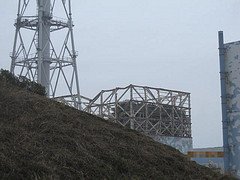
Have you seen the pics @jmona found www.flickr.com
by elainekirk via Flickr 6/13/2011 12:52:19 PM- @rBeaner I don't disagree. But they are in a bag in your garage. You haven't tossed them into the Pacific Ocean or the local creekbed. Regarding that statement, I wonder if there exist archived documents (from the 60s) stating that their plan was to dump the waste into the ocean. Quite possibly.by jt 6/13/2011 12:53:33 PM
- @elainekirk It was @Mona who found the pics (I think).by jt 6/13/2011 12:54:05 PM
- @jt oooops @mona sorry :)by elainekirk 6/13/2011 12:55:36 PM
- MILAN—Premier Silvio Berlusconi has conceded that Italy will "probably" have to give up plans to return to nuclear energy.
Tweet Be the first to Tweet this!.ShareThis .
Italians are in the final stretch of two days of voting on referendums that are seeking to block a revival of nuclear energy and plans to privatize the water supply. A final referendum would revoke legislation that provides Berlusconi with a partial legal shield from prosecution.
Berlusconi said on Monday that Italy "probably" will have to "bid farewell to the question of nuclear power plants" due to the vote.
The referendums need a 51 percent turnout to be valid -- something officials project will be reached.
Analysts forecast that the nuclear meltdown in Japan, following the March 11 quake and tsunami, would get voters to the polls.
www.boston.comby Diane_NJ 6/13/2011 12:58:13 PM - @jt US was first (known) to dump nuke waste at sea, and we dumped tons of it webcache.googleusercontent.com but back then we dumped everything in the ocean. Regarding the CFL's, I'm probably one of the few that have saved them, and only cause I'm pissed off that I got conned into buying them by the US Gov and other orgs.by RBeaner 6/13/2011 12:58:29 PM
 NIO plans electronic ballast water system
Panaji, June 12 (IBNS) In the wake of radiation leak into the Pacific Ocean from the earthquake hit plants in Japan, National Institute of Oceanography (NIO), Goa has decided to introduce electronic ballast water reporting system at India’s major ports to prevent the Ocean from being affected. Union Minister of State for the Science and Technology and Earth Sciences Ashwini Kumar said that the new introduction would facilitate ballast water risk assessment and decision support system for ballast water management. w.indiablooms.comby Majj 6/13/2011 12:59:35 PM- @dean Pressuming fairly complete meltdown in all three, What I see and I think hope: All RPV's some melthrough rod penetrations, some corium in torus and some on basemat. All receiving some cooling water. All corium acting like lava coming into contact with water, boiling bubbles breaking off and breaking up such that there is no big blobs left to "burn" through several meters of basemat. Hitting rebar and further dissipating heat and cracking parts of concrete. All this leads to further breaking up of corium blob to provide surface area for water to cool. This seems like a best hope condition possible at this time. My opinion only.by RBeaner 6/13/2011 1:04:38 PM
- @elaine.. very good photo set.. look at photo 30, and the walls of the entrance to the facility where the truck is, as if objects fell from above to bulge the walls out.. or . internal blast waves which bulged the walls and cause the panels to begin to seperateby dean 6/13/2011 1:05:11 PM
- that's a good breakdown of how I hope it is as well RBeanerby dean 6/13/2011 1:06:13 PM
 NHK stories carried in today’s JAIF Earthquake Report: (Fukushima NPP Site) ●Test-run to be delayed at Fukushima ●TEPCO to test water treatment system ●Excessive levels of strontium detected in seawater ●Water treatment device fixed ●Measures to prevent heatstroke to be added (Other news) ●Expert: Closer watch on marine life necessary ●Off-site centers unpreparedby Markfm 6/13/2011 1:08:05 PM
- 6 more nuke plant workers exposed to radiation above limit: TEPCO. Six more workers involved in efforts to contain the nuclear crisis at the Fukushima Daiichi power plant are feared to have been exposed to radiation above the limit, Tokyo Electric Power Co. said Monday.
The announcement follows a finding that two Tokyo Electric employees suffered radiation doses more than twice the maximum limit of 250 millisieverts, which has been set exclusively for workers dealing with the situation at the crippled complex.
The eight are among some 3,700 workers who were involved in emergency work at the plant in March, and Tokyo Electric, or TEPCO, reported to the government its provisional assessments of the external and internal radiation exposure of about 2,400 of them, the government's nuclear safety agency said. english.kyodonews.jpby Majj 6/13/2011 1:09:15 PM - @dean We might find out that all those (foolish) penetrations on the bottom of the RPV act as "separaters" of the corium and actually save the day. Some opinions on TMI said the day was saved by the actual high water flow out of the vessel moving the corium around, the same hi water flow that caused the problem in the first place.by RBeaner 6/13/2011 1:10:07 PM
- @rBeaner As you say, that was back then. And now dumping nuclear waste/material into the ocean is (supposedly) prohibited. But obviously it is going to happen off Japan, albeit indirectly, for some time to come. Yet their diet is so heavily oriented towards fish. Puzzled. [But I grew up in the southern hemisphere, where we swim in the ocean. ]by jt 6/13/2011 1:13:56 PM
 Photo, 4th floor of #4: mdn.mainichi.jpby Markfm 6/13/2011 1:17:13 PM
- @RBeaner, perhaps the perfect reactor vessel is one with thicker bottoms and no penetrationsby dean 6/13/2011 1:18:00 PM
- @jt I actually agree with their Intentional release (once) of the low level stuff. It was the best of a bunch of poor options at the time. better planning could have prevented that need, but the didn't plan. The high levels were all accidental (as far as we know) and really couldn't be forseen.by RBeaner 6/13/2011 1:18:12 PM
- @rBeaner But now high levels are foreseen for the next 6 months or longer.by jt 6/13/2011 1:21:02 PM
- @dean I think it was Fermi near Chicago? that they added last minute modifications to RPV bottom. Added ceramic plates (inverted cone) that would spread out any melted fuel problem. Unfortunately, a plate came loose, and when ever pumps went to high speed, it would float up and block random fuel channels. Caused a neltdown. Engineered safety feature causing one more engineered meltdown.by RBeaner 6/13/2011 1:22:04 PM
- @the nuclear industry has certainly had many "accidents of opportunity" to get it rightby dean 6/13/2011 1:26:30 PM
- @jt I am sure small amounts of hi level water are making it to the ocean and will continue, but I also believe they are doing everything they realisticly can to prevent it. I keep saying, these extremely high levels of radioactive water, in the llarge quantities, has Never been dealt with anywhere remotely like this. Savannah river and other nuclear weapons builing sites deal with this kind of stuff, but it takes 10 years to build the systems, and they don't work fast or well.by RBeaner 6/13/2011 1:27:12 PM
- @RBeaner, you think they can build a coal mine and operate it cheaper than a reactor?by dean 6/13/2011 1:27:29 PM
- @dean not cleanly. I'm having one of those days where our united future just looks really ******* bleak and hopeless.by RBeaner 6/13/2011 1:29:39 PM
- "But if the corium is cooled with water, it is highly unlikely that it could melt through eight metres (26 feet) of concrete" quote from an article on -3-28-11 in the TERRA DAILY.... think of 26 feet of concrete with the massive rebars.... now that's a long ways to burn throughby dean 6/13/2011 1:33:17 PM
- @dean This actually does make sense: "There are known knowns. These are things we know that we know. There are known unknowns. That is to say, there are things that we know we don't know. But there are also unknown unknowns. There are things we don't know we don't know." Donald Rumsfeldby RBeaner 6/13/2011 1:36:42 PM
- @rBeaner Sure, I agree. The quantities involved are unprecedented. However the reality is that a lot of it will end up in the ocean. They can't do it alone. Their denial hasn't helped matters because no-one trusts them anymore. Something's got to give. [Bye for now. Need to get some work done.]by jt 6/13/2011 1:41:03 PM
- These numbers don't make sense to me. "When the radiation level of the container's surface (the water filtering waste) is measured at 4 millisieverts per hour, the container will be replaced with a new one. " That means when what, 1 gallon is filtered?
www.asahi.comby RBeaner 6/13/2011 1:44:43 PM - RT in Fukushima: Radiation 1000 times over normal outside no-go zone www.youtube.comby Majj 6/13/2011 1:57:38 PM
- @rbeaner it always looks calm on the surface doesnt it lolby elainekirk 6/13/2011 2:02:20 PM
- @rbeaner not many would bother to look below the surface and work out what those figures were and thats what tepco rel;y onby elainekirk 6/13/2011 2:03:56 PM
- @RBeaner, I was reading something about that and the fact the some 400 containers would be estimated to be needed for a year. the way I see it they are going to have to build some sort of shielded storage area of some sort because what they will be doing is concentrating the radioactivity into one storage area. The way my math says.. if the rad techs just hold their monitor up over the container (which I doubt is shielded) and it reaches 4 milliSv (which is 400 mr/hr) they move it to storage. so, do the math.. if the workers take a couple of hours to move it and have to hook up rigging etc... seems like a lot of exposure over the cours of 400 containersby dean 6/13/2011 2:05:38 PM
- @elaine, I think these containers are like a filter of sorts that is fitted up to the clean up system and collects the radioisotopes which concentrate until a certain level is reached. This would then be a long term storage issue for sureby dean 6/13/2011 2:07:33 PM
- www.lastampa.it Referendum, quorum raggiunto
Primi dati: affluenza oltre 57% Berlusconi: "Addio al nucleare"by Olivier 6/13/2011 2:10:16 PM - After Germany and Italia who's next?by Olivier 6/13/2011 2:12:11 PM
- pennalternativefuels.com ....Kurion a startup company who must have some ion-specific media (not sure on details of what that is - filter, resin, etc) that will be exploited to treat the water. Kurions approach was to do full vitrification (encapsulate waste in glass) but only the ion-specific media will apparently be used initiallyby dean 6/13/2011 2:13:45 PM
- @Olivier I would love to say Holland but alas. There is only one NPS functional at the moment but our government wants to have another one. It is worse than stupid.by nls 6/13/2011 2:24:14 PM
- @ elaine... would be interesting to begin looking at the clean up of Japan, specificially with this first effort by this consortium of companies identified in the article.. then, look at this Kurion startup company and the venture capital fund companyby dean 6/13/2011 2:32:54 PM
- pass that on to Nancy please elaine.. for considerationby dean 6/13/2011 2:33:09 PM
 by Reed 6/13/2011 2:37:47 PM
 @all Morning! Anybody looking at the Tepco cam? I just woke up so I could be bleary eyed but does anybody else notice a dark plume that appears to be emanating from 3 behind the stack at 1? It appears to be making the stack look black for the top third...by LM 6/13/2011 2:42:08 PM
Japan Earthquake | Page 1609
- Who's Blogging
-
 hudebnik
 alblee
 UKVal
UKVal Jonathan Keebler
 Oliver (ScribbleLive)
 kaykodh
- Markfm
 Angie
Angie Mid Valley
 Matt (ScribbleLive)
 George Gibb
- elainekirk
 PKelley
 lillymunster
- dean
 bo
bo Edano
Edano Deb
Deb- Pedro Jesus
 IanGoddard