Japan Earthquake | Page 1922
 @Elaine Kirk great find.by lillymunster 7/14/2011 2:57:12 AM
 I must sleep I will leave you with this translated tweet
kamitori kamitori
by III4III
週刊文春 scoop! Match-grade pump fake briefing by TEPCO and the government fraud (people every day Tan) bit.ly scoop! Kyuden "fake email" reveals a former employee not far from Tokyo Electric Power Co. 'briefing fraud "! State sponsored "public hearings". TEPCO can race for self-approved plan
5 minutes ago
kamitori kamitori
by III4III
週刊文春スクープ!政府と東電によるペテン師級のマッチポンプやらせ説明会(日々坦々)http://bit.ly/n4qPyC スクープ!九電「やらせメール」どころじゃない東京電力元社員が明かす「ペテン説明会」!国が主催する「公開ヒアリング」。東電お手盛りの出来レースだったby Elaine Kirk 7/14/2011 2:57:38 AM Night Elaine! The tweets are priceless.by LM 7/14/2011 3:00:04 AM
- Nite elaine - this might be a big find....by lillymunster 7/14/2011 3:03:08 AM
 Good night elaine! And...great find! Thanks!by bo 7/14/2011 3:04:33 AM
- DH, if you stop by tonight can you look at the link Elaine just posted? I think it is outlining that TEPCO did the same dirty tricks Kyushu just got caught doing, stuffing public meetings and public input with employees that fake support for nuclear plants. I just need to make sure I am interpreting the google translated text properly.by lillymunster 7/14/2011 3:04:46 AM
- @Bo, if DH doesn't show up tonight/this morning can you see if someone on your end could take a look at the article and make sure I am interpreting it correctly?by lillymunster 7/14/2011 3:05:38 AM
- @lilly no problem.by bo 7/14/2011 3:07:35 AM
- @bo Thanks, this revelation if I have the translation correct could be big.by lillymunster 7/14/2011 3:08:36 AM
- Agreed. Have forwarded it to my friend.by bo 7/14/2011 3:10:07 AM
- Nite all!by lillymunster 7/14/2011 3:16:17 AM
 @lillymunster Good Night!by smoss 7/14/2011 3:17:39 AM
 ah, finally, the nuke lobby shows up:
Halting reactors would increase CO2 emissions
The Japanese government says annual carbon dioxide emissions would increase by 210 million tons if the country were to shift from nuclear power to fossil fuels.
The Environment Ministry estimates that if Japan halted all 54 domestic nuclear reactors in favor of thermal power generation using coal and natural gas, carbon dioxide emissions would increase by up to 16 percent compared to 1990 levels.
Under the Kyoto Protocol on global warming, Japan is obliged to cut average emissions by 6 percent from its 1990 output over a 5-year period through 2012.
Operating more thermal power plants might make it necessary to boost purchases of emission rights from overseas to offset the increase in CO2 output.
Japan could also have trouble achieving the government-set target of reducing greenhouse gas emissions by 25 percent by 2020.
The ministry plans to promote use of renewable energy, as it remains unclear when nuclear plants across Japan will be restarted.
Thursday, July 14, 2011 09:57 +0900 (JST)
www3.nhk.or.jp
maybe tepco wrote this article ;)by Edano 7/14/2011 3:18:47 AM- @lilly good night and tyby bo 7/14/2011 3:19:13 AM
- Nite Lilly! Time for me as well..Nite all!by LM 7/14/2011 3:20:19 AM
- Agency yet to finalize stress test plan
Japan's nuclear safety agency has yet to finalize plans for new safety checks on the nation's nuclear power plants, despite being asked to do so in a week.
The government announced on Wednesday last week that it would conduct so-called stress tests on all nuclear plants. It later said the tests would be carried out in 2 stages.
The Nuclear Safety Commission had asked the Nuclear and Industrial Safety Agency to finalize in about a week the methods and a timetable for the tests.
On Wednesday, a week after the safety commission's request, the agency's official in charge of nuclear disasters, Yoshinori Moriyama, said they are unable to say at present when they would be able to report on their plan.
Stress tests involve checking whether a plant's equipment and facilities could withstand computer-simulated earthquakes and tsunami.
Prime Minister Naoto Kan's abrupt instructions for the tests have created confusion among government officials and drawn skeptical views and criticism from local governments that have nuclear plants.
Thursday, July 14, 2011 09:57 +0900 (JST)
www3.nhk.or.jpby Edano 7/14/2011 3:20:39 AM - I have to run over to the Immigration office for a visa renewal. Who wouldn't want to stay in a place like this? Back in a bit.by bo 7/14/2011 3:23:23 AM
 @Bo Just wanted to say your article was very deep and read like a novel TYby Hokasai 7/14/2011 3:24:10 AM
- @Hokasai thank you very much. I'm moved to hear that.by bo 7/14/2011 3:24:43 AM
- I'de write more comments but I know you have to go. Really great job.by Hokasai 7/14/2011 3:25:35 AM
 @Bo, is your article linked somewhere?by Lurking 7/14/2011 3:27:26 AM
- @Lurking here is a link: www.japanfocus.orgby bo 7/14/2011 3:28:23 AM
- US nukes arer safe, who will doubt it ?
US task force calls for more nuclear safety steps
A task force of the US Nuclear Regulatory Commission has compiled a set of recommendations to make the country's nuclear power plants better prepared for natural disasters including earthquakes and tsunami.
The task force released a report on Wednesday. It had conducted emergency safety checks at US nuclear power plants after the accident in Fukushima, Japan.
The report says the task force found no immediate safety issues, but acknowledges the need for a more systematic regulatory framework, using predictions of risks in the event of severe accidents.
It urges requiring nuclear power plants across the US to reevaluate and upgrade their preparedness for natural disasters every 10 years.
The report says individual plant operators should boost their capacity to cope with station blackouts for at least 8 hours. It says they should also establish equipment, procedures and training to keep the core and spent fuel pool cool for at least 72 hours if their plants lose AC power.
The report also says the operators of the same type of reactors as those at the Fukushima Daiichi plant should confirm whether the reactors' venting valves are functioning properly to lower pressure inside containment vessels.
Based on the task force's recommendations, the Nuclear Regulatory Commission is expected to draw up a preliminary report.
Thursday, July 14, 2011 11:54 +0900 (JST)
www3.nhk.or.jpby Edano 7/14/2011 3:28:38 AM - Again, thanks @Hokasai. I'll be back in an hour or so.by bo 7/14/2011 3:28:38 AM
- @Bo, thanks! Going to read it now.by Lurking 7/14/2011 3:29:16 AM
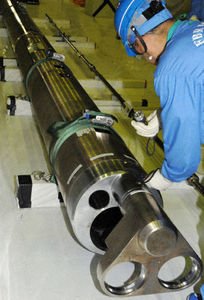
english.kyodonews.jp
Fallen device at Monju reactor disclosed to media
The Japan Atomic Energy Agency disclosed a recently retrieved fuel exchange device which had accidentally fallen into the vessel of the prototype fast-breeder reactor Monju to the media in Tsuruga, Fukui Prefecture, on July 13, 2011, after disassembling and inspecting the device. (Kyodo) english.kyodonews.jpby Edano via English.kyodonews.jp 7/14/2011 3:32:16 AM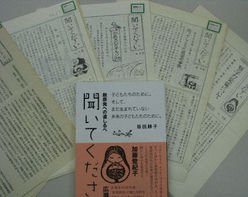
english.kyodonews.jp
FEATURE: Decades-old antinuclear newsletters reprinted
By Keiji Hirano
TOKYO, July 14, Kyodo
Masako Sakata was not fully supportive when her mother, Shizuko, started distributing self-made, mimeographed newsletters to campaign against nuclear power on the streets of a town in Nagano Prefecture more than 30 years ago.
''I thought her doubts over nuclear power plant safety might have been fair, but I had more belief in comments by scientists saying that safety issues had been sufficiently examined,'' Masako Sakata said.
But prompted by the nuclear emergency at the Fukushima Daiichi power plant, she recently reread the newsletters, called ''Please Listen,'' and realized that what her mother had feared until her death in 1998 at age 74 had actually come about.
english.kyodonews.jpby Edano via English.kyodonews.jp 7/14/2011 3:36:53 AM- @Bo, nice article. Things I had not considered before. My husband has many family members buried in a private cemetary. I can't imagine what it would be like to have it gone.by Lurking 7/14/2011 3:36:55 AM
- i haven often thought about the impacts of an explosion of a distinct nuke in my country. it is very hard to imagine a no-entry-zone, an entire region being devastated and depopulated all of a sudden, the fears of irradiation. why in hell do we risk that ?, is my final question. only for today's money ? are we that greedy ?by Edano 7/14/2011 3:58:40 AM
- @all (Off topic Warning) Core loading scheme and number of replaced
FA may therefore change from cycle to cycle, see figure 5 for examples. German units generally operate
in annual cycles with some stretch-out at the end. However, sometimes extra short cycles of 6 months
are introduced in order to optimize fuel efficiency: Some FA which have already achieved a high burnup
can be driven to even higher burnup, if a reshuffling of the FA is done after 6 months.
www.eurosafe-forum.orgby smoss 7/14/2011 4:02:41 AM - @smoss : doesn't this apply to daiichi as well ? www.oecd-nea.orgby Edano 7/14/2011 4:06:02 AM
- @Edano Cool stuff there with examination of irradiated fuel assemblies...I am seeing Reactor 2 at Fukushima II is a Mark 2(advanced) built by Hitachi...It would be amazing to see if any similar analysis was done at Fukushima I prior to 3-11-11.by smoss 7/14/2011 4:14:17 AM
- @all The point that I intended to make with the post referencing German units, was that short fuel cycles are indeed a possibility to consider. (as they may pertain to Fukushima I and the planned quick build up to 1/3 MOX core - referenced in @dean's pin above)by smoss 7/14/2011 4:21:18 AM
- @smoss : but i mean, the specifications (rod - assembly dimensions, loading scheme) shouldn't be the same in daiichi ? i saw you discussing the fuel loads and amount of assemblies per core.by Edano 7/14/2011 4:36:28 AM
- @Edano I saw what you mean with the 8x8 rod array and the # of rods per fuel assembly. What it doesn't say is how many FAs in the core...The Tepco document that I'm still in the process of translating specifically shows analysis of the doppler coefficients with a 9x9 rod array. I wish the document that I'm working with was as clear cut as the one you found.by smoss 7/14/2011 4:46:55 AM
- @Edano I took your lead with the PIE study and found this one specific to Fukushima I - 3 www.oecd-nea.orgby smoss 7/14/2011 4:49:21 AM
- @Edano Fukushima-Daiich-3 is BWR in Japan. Fuel Assembly is 8 by 8 type. From seven fuel assemblies, F3A1, F3A3, F3A5, F3A6, F3A7, F3A8, F3A9, 36 spent fuel samples were taken for the measurement of isotopic composition. The measurement was conducted in Japan Nuclear Fuel Development(NFD) under the auspices of Nuclear Power Engineering Corporation (NUPEC). www.oecd-nea.org Definately referencing a 8x8 fuel array. Thank You!!! Will now just have to figure out why Tepco would be considering a 9x9 array for this reactor as well, I don't know what this would mean for the core physics of the situation.by smoss 7/14/2011 4:52:38 AM
- @smoss : good to help you with the link ! :) very cool specs on their sites.by Edano 7/14/2011 5:17:02 AM
- TEPCO's employees and provisional value for others) for the 3,538 workers (since March) and the 3,254 workers (since April). (100-150mSv: 88 workers, 150-200mSv: 14 workers, 200-250mSv: 3 workers, 250mSv-: 6 workers) Definite exposure doses of 6 workers who received more than 250mSv are distributed from 309 to 678mSv. *The allowable emergency limit for radiation doses: 250 millisieverts www.jaif.or.jpby Ralph Unger 7/14/2011 5:31:22 AM
- @all Found this interesting on the TBS News i youtube channel: Not currently broadcastingHello, you either have JavaScript turned off or an old version of Adobe's Flash Player. Get the latest Flash player. "ムンバイで3か所同時爆発、21人死亡"
You must be logged in to view this video.
The following content has been identified by the YouTube community as being potentially offensive or inappropriate. Viewer discretion is advised. Please confirm that you wish to view this video.
This video or group may contain content that is inappropriate for some users, as determined by the video uploader. To view this video or group, please click here to sign in or sign up and verify that you are of the appropriate age.
This video or group may contain content that is inappropriate for some users, as flagged by YouTube's user community. Please confirm that you wish to view this video.
www.youtube.comby smoss 7/14/2011 5:35:59 AM - Back onboard all.by bo 7/14/2011 5:39:04 AM
- @all Seems as though content on this youtube channel has been deemed to be potentially inappropriate TBS News i :-(by smoss 7/14/2011 5:42:30 AM
- @all Must say "Good Night!"by smoss 7/14/2011 5:44:01 AM
- @smoss good nightby bo 7/14/2011 5:51:36 AM
- Any techies onboard? Can you look at this analysis that @asuperdry got on samples from soil nearby Tokyo. Does this look feasible? www.aluminumstudios.comby bo 7/14/2011 5:52:22 AM


Japan Earthquake | Page 1922
- Who's Blogging
-
 hudebnik
 alblee
 UKVal
UKVal Jonathan Keebler
 Oliver (ScribbleLive)
 kaykodh
 Markfm
 Angie
Angie Mid Valley
 Matt (ScribbleLive)
 George Gibb
 elainekirk
 PKelley
- lillymunster
 dean
dean- bo
- Edano
 Deb
Deb- Pedro Jesus
 IanGoddard