Japan Earthquake | Page 1977
 news roundup doneby lillymunster 7/20/2011 1:50:25 PM
 Japan not to lodge protest over U.S. subcritical nuclear tests
TOKYO, July 20, Kyodo
english.kyodonews.jpby Edano 7/20/2011 1:50:51 PM @Lilly So true! I know I've been paying more attention to origin. @Elaine I wouldn't be surprised. In the quest to keep profits up around the globe there has been a tremendous amount of pressure to accept all product from Japan. It's frightening. There seems more concern for money than health.by LM 7/20/2011 1:51:45 PM
english.kyodonews.jp
Fukushima city sows sunflower seeds to decontaminate 'hot spot'
FUKUSHIMA, Japan, July 20, Kyodo
english.kyodonews.jpby Edano via English.kyodonews.jp 7/20/2011 1:52:06 PM- Cleanup rate at Fukushima plant remains low
A system to decontaminate radioactive water at the crippled Fukushima Daiichi nuclear power plant continues to work below its target capacity.
The plant's operator, Tokyo Electric Power Company, has found that the system's decontamination rate was about 53 percent during the past week, compared with the target rate of 70 percent. It has been unable to reach the target rate for 3 consecutive weeks.
The utility says the system's low performance rate is due to water leaks as well as the fact that its capacity to remove radioactive materials is 30 percent lower than the catalog states.
TEPCO says the system's performance has not improved even after its piping was changed, and that the cause of the problem is still unknown.
At the troubled plant, water used to cool down reactors has become radioactive and has been accumulating in the basements of the reactor buildings.
TEPCO has operated the cyclical system since late last month, using the water to cool down the reactors after decontaminating it.
On Tuesday, the utility company and the government said that the reactors are being cooled down in a stable manner. However, the system to recycle cooling water is not working well.
At the Number 1 reactor building, the level of polluted water in the basement at 7 AM on Wednesday was 13 centimeters higher than the previous day. TEPCO says a tropical storm has raised the water levels.
Wednesday, July 20, 2011 21:14 +0900 (JST)
www3.nhk.or.jpby Edano 7/20/2011 1:54:32 PM - 80% was the target, not 70% !by Edano 7/20/2011 1:55:20 PM
 Over 1,000 cows fed nuclear-contaminated feed shipped in Japan : More than 1,000 beef cattle that ate feed contaminated with radioactive cesium have been shipped all over Japan from Fukushima and other prefectures, Kyodo news agency reported Wednesday, adding to anxiety after the world's worst nuclear crisis in 25 years.
The report comes a day after Tokyo ordered the suspension of all shipments of beef cattle from Fukushima prefecture after discovering that cattle fed rice straw contaminated with high levels of radioactive cesium had been shipped nationwide. www.reuters.comby Majj 7/20/2011 1:55:31 PM I somehow think tepco will be cursing that typhoon - all that contamination that could have washed into the ocean is still sitting thereby elainekirk 7/20/2011 1:58:28 PM
- Expert: Risks remain at Fukushima Daiichi plant
An expert says that radiation could be released from the Fukushima Daiichi nuclear plant in about 2 and half days if the injection of cooling water into reactors is halted for any reason.
Masanori Naito, director in charge of nuclear safety analysis at the Institute of Applied Energy, was speaking to NHK about the revised plan to bring the troubled plant under control. The Japanese government and Tokyo Electric Power Company, the plant's operator, announced the plan on Tuesday.
The government and TEPCO said in a joint assessment that the target of the first stage of the original plan ---- to steadily reduce the level of radiation being released from the plant ---- has been met over the past 3 months.
They said the amount of radioactive substances spewing from the No.1 to No.3 reactors has been cut to one 2-millionth of the peak recorded just after the nuclear accident in March.
The effort to stabilize the nuclear facility now shifts to the second stage, when workers will focus on further cutting the release of radioactive substances over the next 6 months. Emphasis will be on reactor cooling systems that recycle contaminated water. The goal is to achieve cold shutdown by reducing reactor water temperatures to below 100 degrees Celsius.
Naito says nuclear fuel levels at the plant have dropped below one-tenth of what they were immediately after the accident, but warns of remaining risks.
He says the government and TEPCO should explain these risks to nearby residents and whether the existing measures will be sufficient.
Wednesday, July 20, 2011 10:26 +0900 (JST)
www3.nhk.or.jpby Edano 7/20/2011 1:58:29 PM - what are "nuclear fuel levels" ?by Edano 7/20/2011 2:00:50 PM
- Appeal for Fukushima picked up our cold shutdown story from yesterday www.facebook.comby lillymunster 7/20/2011 2:01:23 PM
- @Edano Want to wager that they already know they'll have to stop the watering because of rising water levels in the basements because of the crappy water de-con system and the typhoon?by LM 7/20/2011 2:03:12 PM
- US: Sendai Airport poses low health risk
The US State Department says that Japan's Sendai Airport poses minimal health and safety risks to travelers.
In an updated Japan travel advisory issued on Tuesday, the State Department said that radiation levels around the airport indicate that long-term exposure from the Fukushima Daiichi nuclear power plant is low.
After the March 11th disaster, the department issued an evacuation advisory to US citizens living within 80 kilometers of the stricken plant.
Sendai Airport in Miyagi Prefecture, north of the plant, borders the 80-kilometer zone.
The airport will restart operations of regular domestic flights on Monday. It will also resume special flights linking Guam and Inchon, South Korea.
Wednesday, July 20, 2011 17:35 +0900 (JST)
www3.nhk.or.jpby Edano 7/20/2011 2:03:28 PM - i think this is meant as a warning.by Edano 7/20/2011 2:04:21 PM
- @all I love the Tepco PR...start a leak of info to lessen the shock of the event to come.by LM 7/20/2011 2:04:31 PM
- @Edano Indeed a warning. It just reeks of a Tepco PR stunt.by LM 7/20/2011 2:06:01 PM
- The version I read said the US is also still telling people to stay out of the 50mi zone. I wonder if it was a roundabout way to tell people the comments about opening the exclusion zone are BSby lillymunster 7/20/2011 2:12:10 PM
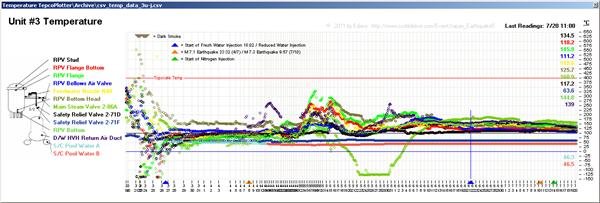
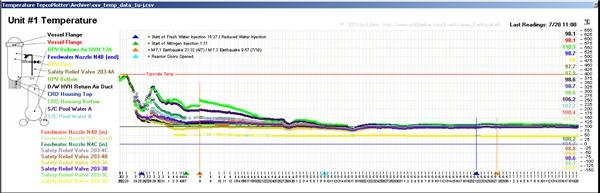
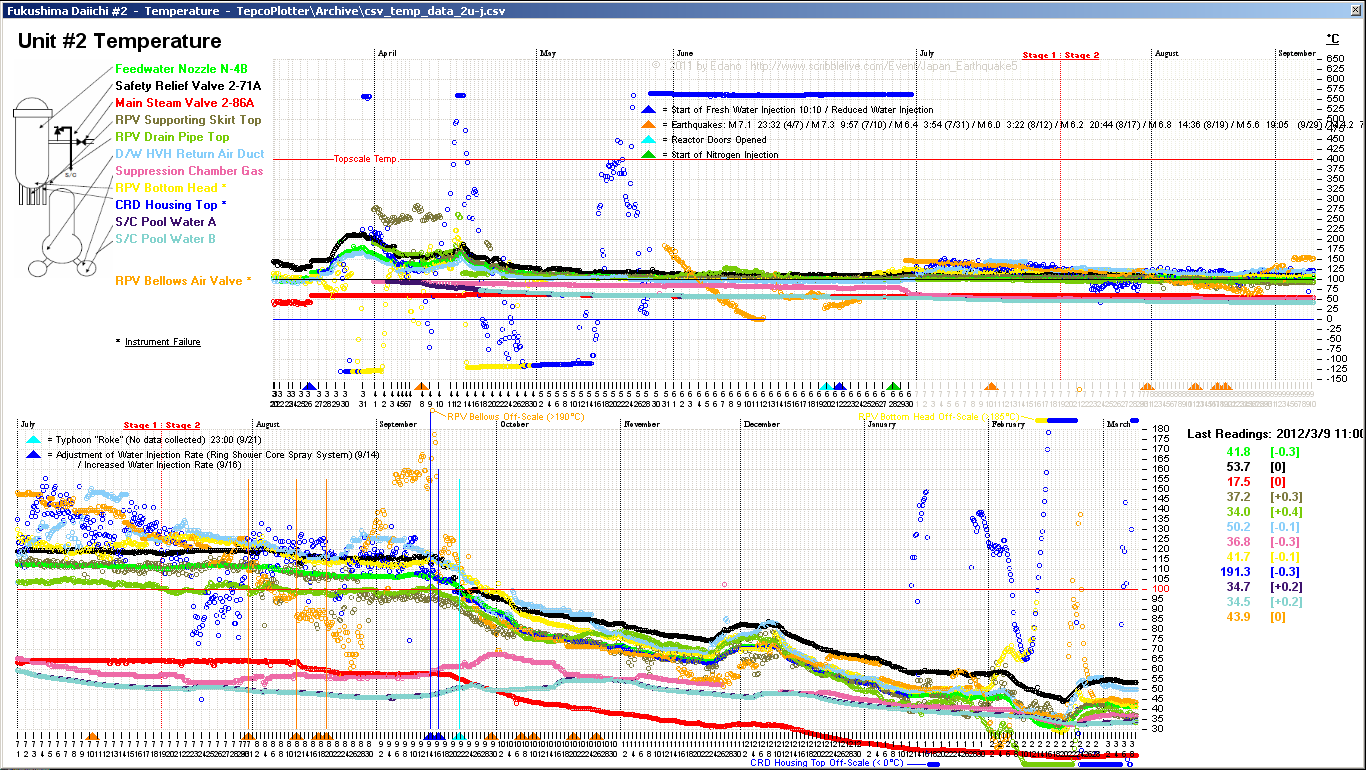
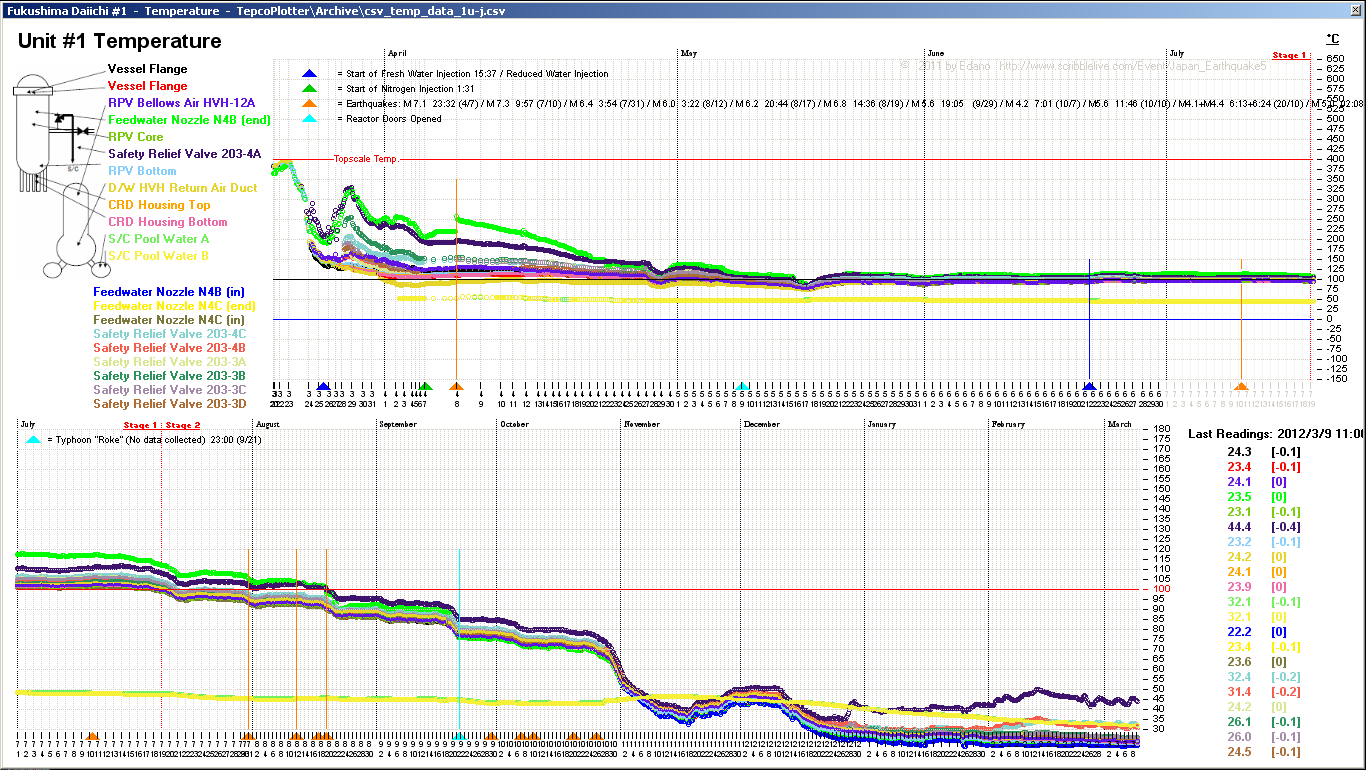
it is too early for a tendency, but the reactor graphs indeed show a slow temp decrease: www.houseoffoust.com
by Edano via Houseoffoust 7/20/2011 2:21:01 PM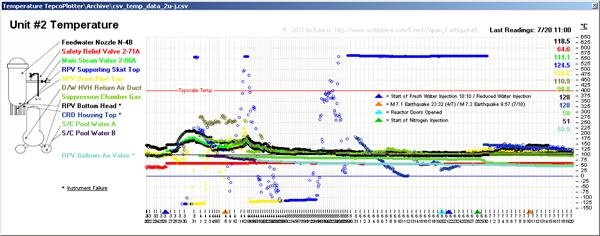 by Edano via Houseoffoust 7/20/2011 2:21:21 PM
 by Edano via Houseoffoust 7/20/2011 2:21:46 PM
- @Elaine. The cold shutdown story seems to be getting some tracktion. I sent it as a reply to Bakrad who posted an LA times story that bought into TEPCO's PR. He retweeted it to his 280 followers. If we keep doing that when we see people buying the PR we might be able to get it in lots more hands.by lillymunster 7/20/2011 2:25:34 PM
 @Edano I assume "nuclear fuel levels" are the decay heat remaining in the core. There should be ~ 0.25% of heat output compared with immediately after shutdown. That means whats left in the fuel requires less cooling than earlier and is less in danger of causing explosions or additional melting of RPV's. Unit 1 should be generating ~3.5 MW and unit 2&3 ~6 MW of heat generation at this point. It is easier to keep cool, but if cooling removed, temp will still skyrocket over time, just take more time.by RBeaner 7/20/2011 2:28:22 PM
- @RBeaner : your numbers are based on non molten fuel, i assume ?by Edano 7/20/2011 2:31:49 PM
 @lillymunster , the U.S. 50-mile radius caused quite a diplomatic stir. After reading about the evacuation zone considerations of the NRC, I believe that the commission determined these radii based on cost to public health. Because population density is on average lower around npps in the US, the NRC was able to strike more generous radii for their emergency planning than the Japanese and could not possibly concede that in Japan the smaller radii were acceptable because the licensees in the US would have immediately demanded that the smaller radii would be applicable to them as well.by Peter Melzer 7/20/2011 2:32:25 PM
- I am considering putting the protect yourself article on tonight. Can people let me know if they think it is ready to go or needs changes/new info etc.? wp.meby lillymunster 7/20/2011 2:33:50 PM
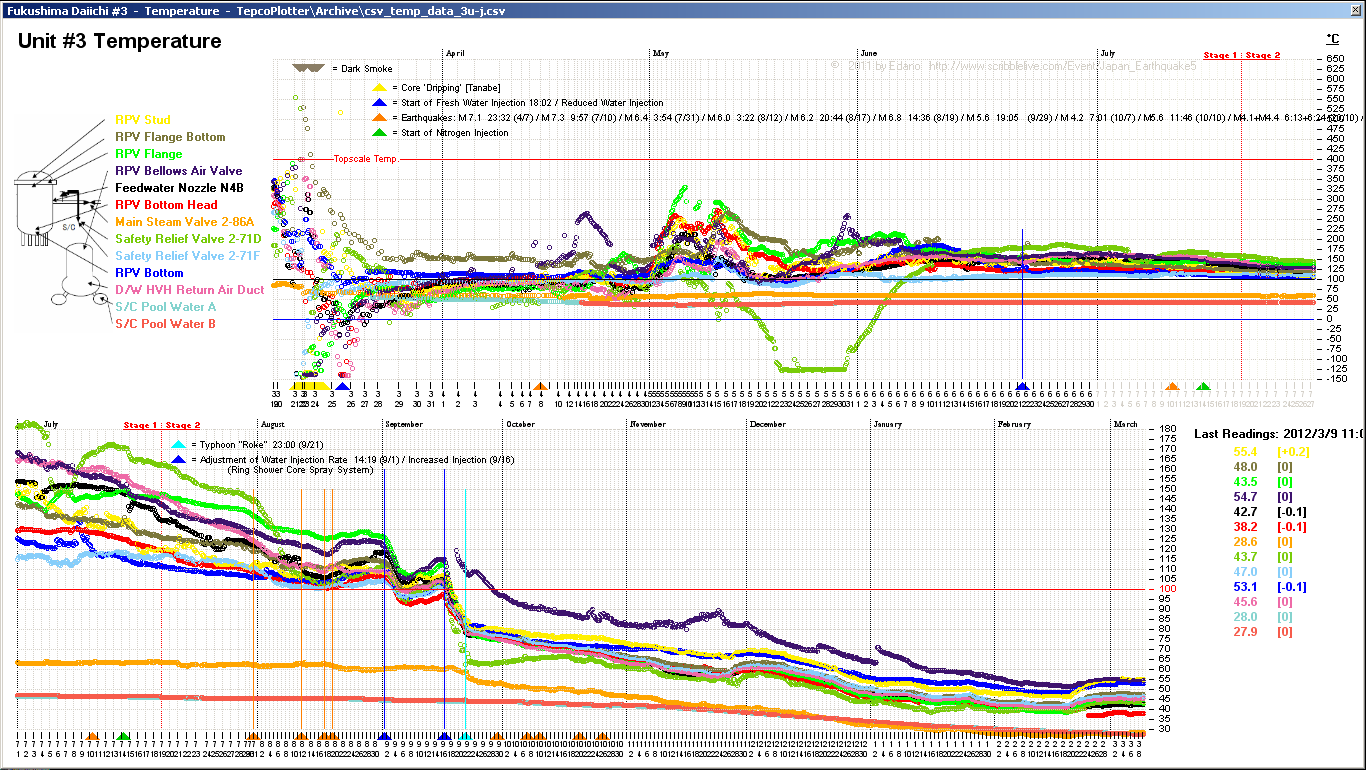
- @Edano Just an offer of improvement, FWIW, the graphs were useful early on, but consistent leower levels make new results or changes unidentifiable (to me) because of the high early levels. May I suggest newer graphs, cutting out the early highs, or seperating their range somehow, so that changes on recent days can be seen. Just a suggestion.by RBeaner 7/20/2011 2:34:00 PM
- @RBeaner i agree to that. will have to ask nancy for more space on her site.:)by Edano 7/20/2011 2:35:35 PM
- @Edano @RBeaner , perhaps it suffices to logarithmitize the ordinate. :)by Peter Melzer 7/20/2011 2:37:41 PM
- @Edano yeah, I guess your'e right. Decay heat based on an intact plant. From what Ive read though, even with molting fuel, as long as chain reaction has stopped (I see no evidence it has not stopped), the decay heat generation would actually be BELOW a normal plant, cause many of the fission products responsible for decay heat generation have leached out into the water and all over the basements. This would result in less than normal decay heat generation (total), although it could well be more concentratedby RBeaner 7/20/2011 2:38:00 PM
- @Peter Melzer : i tried to do that, but what do i do with negative numbers ???by Edano 7/20/2011 2:39:31 PM
- @Peter Melzer The US shuttle program has ended, I therfore feel it unneccessary to figure out what the heck "logarithmitize the ordinate" means, but if it means more recent minor changes are graphically represented, I am all for it..LOL
.by RBeaner 7/20/2011 2:41:07 PM - @Peter Melzer : i could add a constant to convert negative to positive at first ..... hell, a whole lot of calculationsby Edano 7/20/2011 2:43:26 PM
- @RBeaner , it means putting the numbers on the y-axis on a log scale. But edano is correct. I do not immediately know how to treat negative numbers in a simple way, ;)by Peter Melzer 7/20/2011 2:44:03 PM
- @Edano Aren't all negative tempertures bogus or inaccurate somehow anyway. Bad sensors or something?by RBeaner 7/20/2011 2:45:44 PM
- @RBeaner : yes, probably. there are also negative pressures. but i do not want to manipulate the (however false) numbers.by Edano 7/20/2011 2:46:56 PM
- i think the best is to make new plots with a different scale.by Edano 7/20/2011 2:48:35 PM
- Here is an excerpt I posted last night: “Due to the large volume of the consolidated core and lower plenum materials and low thermal diffusivity of the ceramic crust, the inner region of the consolidated mass could be prevented from cooling, as discussed concerning the degraded core of TMI-2.4) Furthermore, the large size of the consolidated mass could also prevent injected water flow. These could be causes of some difficulty in the medium- and long-term cooling of the degraded core of the 1F1 reactor.” I found that in a link posted last week: www.jstage.jst.go.jp
article/jnst/48/8/1135/_pdf
It is of interest in context of core melt cooling. I suppose the efficacy of the heat transfer is very low at the three units. If cooling broke down, the corium would reheat quickly. As the press conference shows tepco still fears new hydrogen production.by Peter Melzer 7/20/2011 2:48:53 PM - @Peter Melzer @Edano Yeah, I guess they can have neg pressures with respect to atmosphere, but I know they don't have any ice in those plants. The prob with the log thing is todays (recent) changes would then become even smaller in stature on the graph (i think). Something to maybe ponder over. It would be useful to SEE the differences in temps as they increase and decrease the (processed) and total water to the reactors. As noted earlier, they still have an ongoing total volume rad water problem, and I expect they will again try to decrease the water going to each reactor.by RBeaner 7/20/2011 2:51:35 PM
- @Edano , at least for the temps., not plotting negative values seems justified to me.by Peter Melzer 7/20/2011 2:52:09 PM
- @RBeaner : well, i converted relative (to atmosphere) pressures to absolute, but they are still negative :) i really tried to handle the readings as correctly as possible and made every effort .... but still ...by Edano 7/20/2011 2:54:19 PM
- @Edano Not a criticism of your work. Simply a proposal for somehow improving the visual representation. At this point, because of the temp range from mar, the graphs are not very useful. I appreciate your efforts, If I come up with a solution (not my area of expertise), I will share it. GL and I will BBL:)by RBeaner 7/20/2011 2:57:10 PM
 Fukushima is the long-term crisis that just doesn't get better. Step away for 8 days, temps still up there, the players have to redefine terms to claim success.
"Plugging reactors no longer stated goal for Tepco" search.japantimes.co.jp
"To substantially reduce the amount of radioactive materials released from the plant, Tepco needs to get to the bottom of the problem: plugging holes or cracks in the reactors' containment vessels that are allowing contaminated water to flood on-site facilities, including the reactor buildings and turbine buildings, experts said......The updated road map, however, includes no reference to this critical work in the second stage, even though it was mentioned in past plans. And without fixing this problem, it is difficult to say that the release of radioactive materials is under control."by Markfm 7/20/2011 3:01:06 PM Any reading that is «physically impossible» or «highly unlikely» should be disregarded and therefore not plotted, otherwise your graph won't display the real trend of temperatures or pressures. At least that's what we used to do in the lab back in my university days. You can then add the table with all the values showing the bogus ones in red with a legend indicating why they were not plotted. I believe this is the most reasonable way to handle that issue.by Pedro Jesus 7/20/2011 3:01:42 PM
- @RBeaner : i have been thinking of improvements since some weeks and i will do it. but i have to find a way that still supports automatic plotting. i cannot draw it by hand ;)by Edano 7/20/2011 3:01:54 PM
- @Edano , along this train of thought, you could express temps in Kelvin. What a mess! :)by Peter Melzer 7/20/2011 3:02:16 PM

Japan Earthquake | Page 1977
- Who's Blogging
-
 hudebnik
 alblee
 UKVal
UKVal Jonathan Keebler
 Oliver (ScribbleLive)
 kaykodh
- Markfm
 Angie
Angie Mid Valley
 Matt (ScribbleLive)
 George Gibb
- elainekirk
 PKelley
- lillymunster
 dean
dean bo
bo- Edano
 Deb
Deb Pedro Jesus
 IanGoddard