Japan Earthquake | Page 2160
 After Fukushima: nuclear dirty tricks
After nearly half a century of producing nuclear power, Japan has finally separated regulation from promotion
In a country where people have to use their own detectors to check on local radiation levels which the government failed to release, where information about threats to life and health after Fukushima dribbled out so haphazardly, and where a nuclear industry apparently unabashed by that disaster has been resorting to dirty tricks to influence public debate, mere bureaucratic rearrangement will hardly suffice. The latest blow to confidence came when it was reported last month that workers at the Kyushu Electric Power Company had been asked to pose as ordinary citizens with no connection to the industry and send emails calling for the resumption of operations at two nuclear reactors in southern Japan to a televised public hearing. Investigations showed this was standard behaviour long before Fukushima, with other power companies admitting that they had sent employees to make up as many as half of the participants in similar forums as far back as 2005. www.guardian.co.ukby Majj 8/16/2011 1:12:31 AM- Nuclear contamination threatens seawaters : BEIJING - China's seawaters are at risk of being contaminated by radioactive materials coming from the Japanese nuclear power plant that was seriously damaged in the large earthquake that struck in March, China's ocean watchdog said.
The State Oceanic Administration's environmental protection department told China Daily that China will strengthen its monitoring for radioactive substances in the waters east of Fukushima, where the nuclear plant is, and in the East China Sea. By doing so, they hope to forecast what effect the radiation released by the plant will have on the marine environment and the safety of marine food.
The latest monitoring result released by the State Oceanic Administration on July 29 showed the first group of seawater samples collected from the area contained 300 times the amount of radioactive cesium that is found in nature and 100 times the amount of strontium. www.chinadaily.com.cnby Majj 8/16/2011 1:17:22 AM  @Majj that guardian article is good it is a well read media the bbc are losing groundby elainekirk 8/16/2011 1:20:14 AM
- ikrockhopper Itsumi Kakefuda
TV documentary on sub(-sub...) contract workers and radiation-related diseases in the past (transcript, JP) (cont) The work of Mr. Kenji Higuch, photo journalist who have following nuclear plant workers, is featured in the documentary. .. cont) Contract workers (not current Fukushima's) kept talking that they sometimes took off protective gears due to heat, ...(cont).. took a dosimeter away because the beeping bothered them (=risk their life their life, and lose accurate exposure data)...(cont) some workers who filed worker's compensation said that their exposure values on EPCO's paper was lower than those they saw on site.(cont) It is likely that EPCOs fabricated (made lower) workers' radiation exposure. t.coby elainekirk 8/16/2011 1:27:53 AM  @ariadne thanks for all the great finds. I am adding them to the working document so everyone can reference them. Link for the working doc is up in the pinned posts.
You brought up a good point. Does anyone have some decent free journal access through their library account or something similar? I ran across the same issue of a high price for a single article and they seem to be at different sources. I can check and see what kind of access I can get with an alumni account over at the college I used to work at. If anyone else has institutional access please let us know.by lillymunster 8/16/2011 1:30:51 AM @lilly i have limited access here in Japan. We are working at bringing in JSTOR at our institute, which would give me much better access. So it is hit or miss, but I can tryby bo 8/16/2011 1:31:51 AM
- @bo Oxford journals seems to be a common one that people have run into a pay wall without a free option for the paper elsewhere. I can't remember the other specific ones that were pay walled but I think they forwarded over to science direct or elsevier. I really miss JSTOR access. :-(by lillymunster 8/16/2011 1:35:21 AM
- This is the one ariadne ran into today
Roy E. Shore (1992) Issues and Epidemiological Evidence regarding Radiation-Induced Thyroid Cancer. Radiation Research: July 1992, Vol. 131, No. 1, pp. 98-111
The link she tried that got the paywall
www.rrjournal.orgby lillymunster 8/16/2011 1:36:36 AM  Is there a way to search this blog? A couple months ago I posted a list of videos that have been flagged down, but I'mnot sure if myby Ian 8/16/2011 1:38:45 AM
- Don't currently have access to that one lilly. Sorryby bo 8/16/2011 1:40:49 AM
- @bo thanks for trying. I will give the college a call tomorrow and see what kind of spiffy access I can get still.by lillymunster 8/16/2011 1:42:45 AM
- Excelon CEO says we need nuclear power because he cares about the environment. www.marketwatch.comby lillymunster 8/16/2011 1:46:48 AM
- Excelon has a pretty good spokesperson too, Barack something...by bo 8/16/2011 1:49:17 AM
- Also, a heads up to all, I will be leaving town on Thurs for 6-7 weeks, so will only be online occasionally during that time. Off to attend a conference, do my exhibition at Cornell, and then do some field research for my Global Hibakusha Project.by bo 8/16/2011 1:54:22 AM
- And spend at least some time eating non-radioactive food.by bo 8/16/2011 1:56:13 AM
 www.rrjournal.org Elaine Ron, Jay H. Lubin, Roy E. Shore, Kiyohiko Mabuchi, Baruch Modan, Linda M. Pottern, Arthur B. Schneider, Margaret A. Tucker and John D. Boice, Jr. (1995) Thyroid Cancer after Exposure to External Radiation: A Pooled Analysis of Seven Studies. Radiation Research: March 1995, Vol. 141, No. 3, pp. 259-277. The thyroid gland of children is especially vulnerable to the carcinogenic action of ionizing radiation. To provide insights into various modifying influences on risk, seven major studies with organ doses to individual subjects were evaluated. Five cohort studies (atomic bomb survivors, children treated for tinea capitis, two studies of children irradiated for enlarged tonsils, and infants irradiated for an enlarged thymus gland) and two case-control studies (patients with cervical cancer and childhood cancer) were studied. The combined studies include almost 120,000 people (approximately 58,000 exposed to a wide range of doses and 61,000 nonexposed subjects), nearly 700 thyroid cancers and 3,000,000 person years of follow-up. For persons exposed to radiation before age 15 years, linearity best described the dose response, even down to 0.10 Gy. At the highest doses (>10 Gy), associated with cancer therapy, there appeared to be a decrease or leveling of risk. For childhood exposures, the pooled excess relative risk per Gy (ERR/Gy) was 7.7 (95% CI = 2.1, 28.7) and the excess absolute risk per <tex-math>$10^{4}\ {\rm PY}\ {\rm Gy}\ ({\rm EAR}/10^{4}\ {\rm PY}\ {\rm Gy})$</tex-math> was 4.4 (95% CI = 1.9, 10.1). The attributable risk percent (AR%) at 1 Gy was 88%. However, these summary estimates were affected strongly by age at exposure even within this limited age range. The ERR was greater (P = 0.07) for females than males, but the findings from the individual studies were not consistent. The EAR was higher among women, reflecting their higher rate of naturally occurring thyroid cancer. The distribution of ERR over time followed neither a simple multiplicative nor an additive pattern in relation to background occurrence. Only two cases were seen within 5 years of exposure. The ERR began to decline about 30 years after exposure but was still elevated at 40 years. Risk also decreased significantly with increasing age at exposure, with little risk apparent after age 20 years. Based on limited data, there was a suggestion that spreading dose over time (from a few days to >1 year) may lower risk, possibly due to the opportunity for cellular repair mechanisms to operate. The thyroid gland in children has one of the highest risk coefficients of any organ and is the only tissue with convincing evidence for risk at about 0.10 Gy. So, lilly, do we have a method for conversion from 0.10 Gy into units that are being more commonly used in the Tepco or GoJ "information" releases?by ariadne 8/16/2011 1:58:05 AM
- @bo sounds interesting, look forward to hearing about your findings when you get back. :-)by lillymunster 8/16/2011 2:01:53 AM
- www3.cancer.gov this is the link for the entire pdf article from below Thyroid Cancer after Exposure to External Radiation: A Pooled Analysis of Seven Studies. Radiation Research: March 1995by ariadne 8/16/2011 2:02:23 AM
- @ariadne I wasn't able to properly convert Gy earlier today. We need to ask Dean, RBeaner and Edano when they show back up. They might know where to find a proper calculator or how to do the conversion by hand.by lillymunster 8/16/2011 2:03:24 AM
 0.10 Gy = 0.10 Sv = 100 mSv = 1000 uSv, for X-ray, Gamma ray or beta radiaton
0.10 Gy = 2.00 Sv, for alpha particlesby estacion 8/16/2011 2:35:07 AM- Radiation absorbed dose (rad)
Under exposure a given material has an ability to absorb radiation. This differs with certain materials (think lead versus water) and some will absorb more or less as radiation passes through.
Conventional units: A dose of 1 rad means the absorption of 100 ergs of radiation energy per gram of absorbing material
SI units: A dose of 1 gray means the absorption of 1 joule of radiation energy per kilogram of absorbing material
conversion
1 Gy = 100 rad
1 rad = 0.01 Gy
Dose equivalent
The dose equivalent is a measure of biological effect for whole body irradiation. The dose equivalent is equal to the product of the absorbed dose and the Quality Factor.
The Quality Factor (Q) depends on the type of radiation:
X-ray, Gamma ray, or beta radiation: Q = 1
alpha particles: Q = 20
neutrons of unknown energy: Q = 10 (If the neutron energy is known, see more specific Q values at 10 CFR 20.1004)
conventional units: dose equivalent (rems) is the product of dose (rads) and Q
SI units: dose equivalent (sieverts) is the product of dose (grays) and Q
Conversion
1 Sievert (Sv) = 100 rem
1 rem = 0.01 Sievert (Sv)
en.wikipedia.orgby estacion 8/16/2011 2:41:30 AM - @estacion Thank you, now I can sleep tonight without being tormented by conversions in my dreams. :-)
Added the info to the rad data collection page for reference.by lillymunster 8/16/2011 2:42:16 AM - @lillymunster YW. Sweet dreams :-)by estacion 8/16/2011 2:43:48 AM
- @you I woke up this morning dreaming about CT scan doses....by lillymunster 8/16/2011 2:45:52 AM
- @estacion thank you for that! I didn't even think of Wikipedia.... Nightie-night, lilly, thanks again for all you do.by ariadne 8/16/2011 3:28:20 AM
- @ariadne thanks for all the good work today, saved it all to the research pageby lillymunster 8/16/2011 3:35:16 AM
- Nite all, off to dream of hopefully something other than seiverts and gy's. :-)by lillymunster 8/16/2011 3:35:51 AM
- Good night lily!by bo 8/16/2011 3:40:46 AM

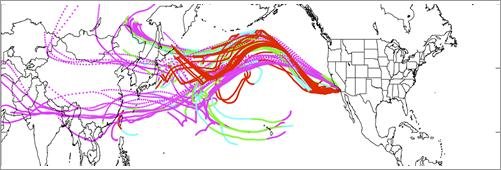
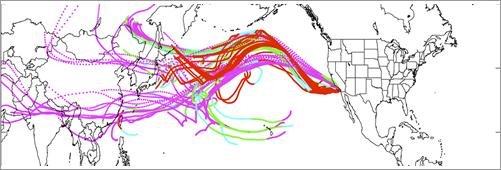
www.sciencedaily.com Measurements Reveal Extent of Leakage from Japan's Damaged Fukushima Reactor
ScienceDaily (Aug. 15, 2011) — Atmospheric chemists at the University of California, San Diego, report the first quantitative measurement of the amount of radiation leaked from the damaged nuclear reactor in Fukushima, Japan, following the devastating earthquake and tsunami earlier this year. www.sciencedaily.comby Mid Valley via Sciencedaily 8/16/2011 4:36:45 AM TEPCO to use desalinating devices in pools
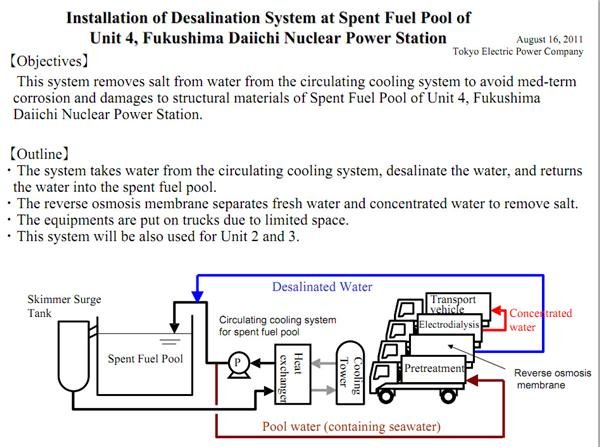
Tokyo Electric Power Company is planning to use devices to remove salt from spent nuclear fuel pools at the Fukushima Daiichi nuclear power plant.
The operator fears that saltwater used to cool reactors 2 - 4 after the March 11 disaster could corrode stainless steel pipes and pool walls.
The new devices will arrive on 5 trucks and use special membranes and electricity to desalinate water.
TEPCO plans to first use the machinery by the end of this week at the number 4 reactor, which contains the most spent fuel. The concentration of salt is expected to be reduced by 96 percent in 2 months.
It will then follow up in reactors 2 and 3.
Water temperatures at all 4 reactor pools have been relatively stable since the installation of a circulating cooling system was completed on August 10th.
Reactor facilities to purify wastewater have all been equipped with desalinating filters.
Another device that uses the mineral, zeolite, to remove radioactive substances from circulating water has been installed in the cooling system of the number 2 to 4 reactors.
Through such measures, TEPCO hopes to stably operate the plant over the long-term until all the spent fuel is removed.
Tuesday, August 16, 2011 12:23 +0900 (JST)
www3.nhk.or.jpby Edano 8/16/2011 5:29:24 AM- Bump, don'tcha know it.by bo 8/16/2011 7:32:53 AM
- and squeakby elainekirk 8/16/2011 8:53:16 AM
- by elainekirk 8/16/2011 9:28:15 AM
Waiting for Godot filmed 20 km from Fukushima on the anniversary of the Hiroshima bombing.
by bo 8/16/2011 11:01:47 AM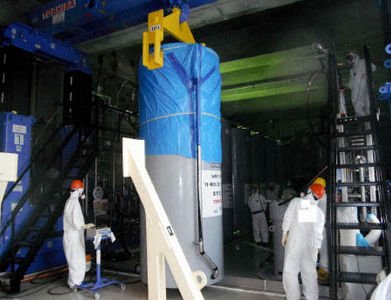
english.kyodonews.jp
Cesium-absorbing device at Fukushima Daiichi plant
Workers install a new cesium-absorbing device, which uses the mineral zeolite, into a water treatment system at the crippled Fukushima Daiichi nuclear power plant in Fukushima Prefecture on July 30, 2011. Tokyo Electric Power Co. began a test run of the device on Aug. 16, 2011. (Photo courtesy of TEPCO)(Kyodo) english.kyodonews.jpby Edano via English.kyodonews.jp 8/16/2011 11:03:17 AM- @bo :)by Edano 8/16/2011 11:04:13 AM
- All I can say is, wow.by bo 8/16/2011 11:05:33 AM
- it's a good place for absurde theater.by Edano 8/16/2011 11:06:22 AM
- TEPCO tests Japan-made decontamination unit
Tokyo Electric Power Company is conducting a trial run of a Japan-built water decontamination unit at its troubled Fukushima Daiichi nuclear power plant.
TEPCO started testing the performance of the new equipment shortly past noon on Tuesday.
The domestic-made unit uses 14 cylindrical tanks, each 3.5 meters high and 1.4 meters across, that contain minerals to absorb radioactive materials.
The utility plans to continue the trial until Wednesday night, before starting full-fledged operations.
Since late June, TEPCO has been decontaminating highly radioactive wastewater from the reactors and then injecting the cleaned water back into the reactors to cool them.
But the decontamination system --- the key part of the water circulation process --- has been plagued with trouble and its foreign-made components have repeatedly stopped operating. TEPCO says it has been running at 66 percent of capacity, failing to meet the initial target of 90 percent.
The power company hopes the new, Japan-built decontamination unit will help achieve stable circulation for cooling.
Tuesday, August 16, 2011 16:50 +0900 (JST)
www3.nhk.or.jpby Edano 8/16/2011 11:09:03 AM - True that.by bo 8/16/2011 11:09:28 AM
- by Majj 8/16/2011 11:11:05 AM
- 96% of cash in safes found after 3/11 returned
Japanese police say 96 percent of the cash found in safes in 3 northeastern prefectures after the March 11th disaster has been returned to its owners.
The National Police Agency says 5,700 safes had been recovered by or reported to police in Iwate, Miyagi and Fukushima prefectures as of July 10th.
Many of the safes had been buried in debris or mud.
They contained a total of 2.36 billion yen, or about 30 million dollars, in cash. One of them had the equivalent of more than one million dollars inside.
Police opened the safes and found bankbooks and property documents, along with the cash. This helped them identify the safe owners so they could return their property.
More than 3.7 billion yen, or about 48 million dollars, in other cash, some of it in wallets, has also been found in the 3 prefectures. Police say that about 85 percent of the money has been returned to its owners.
Tuesday, August 16, 2011 15:37 +0900 (JST)
www3.nhk.or.jpby Edano 8/16/2011 11:12:00 AM - Edanor check the link belowby Majj 8/16/2011 11:13:45 AM
- Govt to compile decontamination plan
The Japanese government says it will prepare by the end of August a basic plan for decontaminating areas near the stricken Fukushima Daiichi nuclear plant.
Prime Minister Naoto Kan on Monday asked the nuclear crisis minister, Goshi Hosono, to begin compiling the steps that must be taken.
The government is planning to lift the designation soon of the zone extending from 20 to 30 kilometers away from the nuclear plant where residents have been told they must evacuate in the event of another emergency.
The measure would allow the return of some people who have left voluntarily, although worries about radiation persist among the affected communities.
The government plans to ease such concerns by adding more manpower to a taskforce in charge of decontamination.
The basic plan could also call for closer analyses of contaminated crops and plants to find out whether the radiation came from the air or soil.
Tuesday, August 16, 2011 09:46 +0900 (JST)
www3.nhk.or.jpby Edano 8/16/2011 11:14:31 AM - @Majj yepby Edano 8/16/2011 11:14:38 AM

Japan Earthquake | Page 2160
- Who's Blogging
-
 hudebnik
 alblee
 UKVal
UKVal Oliver (ScribbleLive)
 Jonathan Keebler
 kaykodh
 PKelley
 Markfm
 Angie
Angie Deb
Deb Mid Valley
- Pedro Jesus
 Matt (ScribbleLive)
 George Gibb
- elainekirk
- lillymunster
 dean
dean- bo
- Edano
 IanGoddard