Japan Earthquake | Page 2163
 There is a common pool, but it's not in a basement shared by Units 1 - 4.by Ian 8/16/2011 3:03:54 PM
 @Ian most probably a translation error.by Edano 8/16/2011 3:10:48 PM
- I got this reply from YouTube regarding my appeal against the flagging of my video www.youtube.com by Fukushima Central Television:
#
Hi there,
Thank you for your counter-notification. It has been forwarded to the party that sent the takedown notification. If we receive no response, your material will be restored between 10 and 14 business days from today.
Regards,
The YouTube Teamby Ian 8/16/2011 3:11:15 PM  @Ian the fact that this is a major historical event should be enough to fight a takedown. If you hear back from youtube you may want to mention the censoring campaign the govt. there is doing.by lillymunster 8/16/2011 3:14:59 PM
- towards the corium question: we must not forget that tepco's official line is still "corium is in the rpv". consequently, they see no need to make efforts in locating corium. every effort would look like a confession.by Edano 8/16/2011 3:16:29 PM
- If it's melted trough all containment into groundwater, this a major. But aren't there ways we could deduce this or the contrary from the reactor data? To melt all that way, it's gotta be a huge volume of red-hot corium, so the rpv and pcv should both be almost empty wherever this would have happened. I guess the heat could still rise up into them, but shouldn't this leave some tell-tail signs in the data?by Ian 8/16/2011 3:20:14 PM
- @Ian : i would think about the pressure:
-#1 falling to atmosphere, drops on quakes
-#2 dito
-#3 torus atmospheric pressure, rest is constant/rising
www.houseoffoust.comby Edano 8/16/2011 3:24:05 PM - @Edano I thought they had admitted the melt through.by lillymunster 8/16/2011 3:24:10 PM
- @lillymunster they only admitted holes in the rpv, but still say that corium is contained in rpv.by Edano 8/16/2011 3:25:04 PM
- at least, most of the corium. maybe they admit little drops, but not more.by Edano 8/16/2011 3:26:09 PM
- @Edano someone said they were all melted through. I can't remember if it was a university, other govt. agency? I thought it was pretty well accepted info. But TEPCO does live in their own world...by lillymunster 8/16/2011 3:26:23 PM
- @Lilly, I also thought Tepco admitted melt-through of the rpv, but they deny it now:
"The plant operator, Tokyo Electric Power Co. earlier said the Nos. 1 to 3 reactors' cores are assumed to have suffered meltdowns, although the melted fuel is believed to be kept cool and solidified at the bottom of each reactor pressure vessel after water was injected into the vessel as an emergency measure." mdn.mainichi.jpby Ian 8/16/2011 3:27:19 PM - @lillymunster : tepco said recently, that if the corium would not be in the rpv anymore, why can they manipulate the temperatures so well by the amount of water being poured into the rpv. that is their argument.by Edano 8/16/2011 3:28:15 PM
- @Edano LOL. that hole in the bottom of the RPV? They admitted they can't get direct cooling on 3.by lillymunster 8/16/2011 3:29:32 PM
- they cannot deny holes in the rpv because they have no pressure anymore.by Edano 8/16/2011 3:29:42 PM
- @lillymunster didn't they send worker in to make a manual pipe connection ?by Edano 8/16/2011 3:30:36 PM
- at least in #3, i don't believe there is much left of the pressure vessel. maybe the upper part.by Edano 8/16/2011 3:32:22 PM
- Radioactive sludge piling up
Radioactive sludge from sewage facilities across Japan has been piling up in storage facilities, despite the government's plan to bury it.
NHK asked local governments in 17 prefectures in northeastern to central Japan how they are coping with sludge that's been contaminated by radioactive material from the Fukushima Daiichi nuclear plant.
Contaminated sludge from sewage facilities now totals more than 54,400 tons. 75 percent of it contains less than 8,000 becquerels per kilogram of radioactive cesium, the government-set limit for disposal by burial.
Despite this, some 27,700 tons of sludge --- 51 percent of the total --- remains in storage at water treatment plants.
Local governments say some burial projects have been rejected by residents near proposed sites.
In addition, 7 storage facilities in 4 prefectures have had to set up "no entry zones" where radiation levels have gotten too high.
Tuesday, August 16, 2011 22:51 +0900 (JST)
www3.nhk.or.jpby Edano 8/16/2011 3:33:09 PM  Interesting read: www.nirs.orgby one time 8/16/2011 3:34:08 PM
- @one time thanks for finding that. NIRS has been a reliable source of info. Do you know if they have any newer updates?by lillymunster 8/16/2011 3:36:28 PM
- "nuclear generation" is getting a new meaning:
Science teachers to cover radiation in class
Science teachers of Japanese junior high schools have discussed how to teach about radiation before the subject becomes compulsory from the next school year.
Japan's education ministry requires in its new curriculum guidelines that radiation be covered in junior high science classes starting in April. This is the first time in 30 years for the ministry to set such a requirement.
About 150 science teachers from schools in Tokyo attended a seminar on Monday.
An expert at the meeting explained features of radiation, how it is put to practical use, and its impact on the human body. The lecturer said it's important to have accurate knowledge about radiation rather than unduly fear it.
The participants then conducted an experiment in which traces of radiation were visualized by using a radioactive mineral ore and dry ice. In another experiment, the participants measured radiation levels in paints and rocks.
The teachers concluded the seminar by discussing how to teach about radiation in class. One participant said he should tell students about the nuclear accident at the Fukushima Daiichi power plant, but added that there's a lot he still doesn't know about the issue.
A 28-year-old teacher said she didn't study radiation in school and that she wants to learn about it before teaching the subject.
Tuesday, August 16, 2011 22:51 +0900 (JST)
www3.nhk.or.jpby Edano 8/16/2011 3:37:21 PM - I haven't looked but it's worth searchingby one time 8/16/2011 3:38:27 PM
- 35 killed, 7,000 treated for heatstroke in a week
Last week was the most fatal week this year for heatstroke in Japan, with the deaths of 35 people.
The Fire and Disaster management Agency says the number of people hospitalized for heatstroke during the week through Sunday was 7,071 -- the largest number by the week for this year.
More than 1,000 people per day were treated at hospitals over 3 consecutive days through Thursday, as the mercury shot up to more than 35 degrees Celsius in many parts of the country. Wednesday was particularly severe, with the number reaching 1,428.
An NHK survey shows that at least 35 people died of heatstroke in 12 prefectures during the week through Sunday, marking the largest weekly death toll this year.
People aged 65 and older accounted for 77 percent of the deaths. More than 30 percent died between 5 PM and 5 AM.
Emergency officials say the number of heatstroke cases increased because temperatures remained over 25 degrees at night last week, in addition to the intense heat during the day.
They are calling for caution against heatstroke at all times, day or night, as the hot weather is expected to continue this week.
Tuesday, August 16, 2011 22:51 +0900 (JST)
www3.nhk.or.jpby Edano 8/16/2011 3:39:26 PM - @Edano This is a good thing as long as special interests don't try to force the teachers to teach propaganda rather than the actual science.by lillymunster 8/16/2011 3:40:09 PM
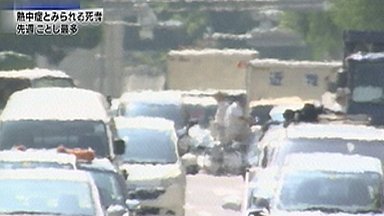
www3.nhk.or.jp
[some of them in the tohoku highway jam] ;)by Edano via Www3.nhk.or.jp 8/16/2011 3:40:15 PM- @lillymunster exactly ;) but i don't believe in santa claus. of course it is manipulated.by Edano 8/16/2011 3:41:09 PM
- @Edano are there really two guys outside smoking or is the picture just too tiny?by lillymunster 8/16/2011 3:41:10 PM
- @lillymunster i think this is where they found the high rad sludge.by Edano 8/16/2011 3:41:45 PM
- again ;)by Edano 8/16/2011 3:41:54 PM
- i am having a cinical episode.by Edano 8/16/2011 3:42:22 PM
- this i meant:
Excessive levels of radioactive cesium found 100 km from plant
FUKUSHIMA, Japan, Aug. 16, Kyodo
Excessive levels of radioactive cesium were found in sludge in a ditch at a district court branch in Fukushima Prefecture, about 100 kilometers west of the crippled Fukushima Daiichi nuclear power plant, the court said Tuesday.
The isotope in the sludge, sampled from a ditch at the Fukushima District Court's Aizuwakamatsu branch, measured about 186,000 becquerels per kilogram, the court said, adding it plans to remove the sludge after consulting with local governments.
Under government standards, sludge can be used in a landfill as long as the radioactive cesium contained in it measures 8,000 becquerels per kilogram or lower. english.kyodonews.jpby Edano 8/16/2011 3:46:01 PM - Over 40% of people did not flee to safety upon March 11 disaster
TOKYO, Aug. 16, Kyodo
Four out of every 10 people did not escape but looked for family members or returned home immediately after the magnitude-9.0 earthquake and ensuing tsunami hit the northeastern Japan region on March 11, a government survey showed Tuesday.
Activities such as searching for family members prevent prompt escapes from a massive disaster, the Cabinet Office said.
The Cabinet Office, the Fire and Disaster Management Agency and the Japan Meteorological Agency jointly interviewed 870 people taking shelter in Iwate, Miyagi and Fukushima prefectures in July, finding that 57 percent of them fled to safety upon the March catastrophe. english.kyodonews.jpby Edano 8/16/2011 3:48:01 PM - Hokkaido governor seeks commercial operation of Tomari reactor
SAPPORO, Aug. 16, Kyodo
Hokkaido Gov. Harumi Takahashi on Tuesday sought approval from the prefectural assembly for resuming commercial operation of the No. 3 reactor at the Tomari nuclear power plant in Hokkaido.
Reaching a consensus on the issue among the assembly and other local governments concerned would clear the way for the industry ministry to issue a certificate for the completion of the reactor's regular inspection, which has continued for an unusually long period of five months amid the nuclear crisis in Fukushima Prefecture. The reactor would then move to commercial operation.
The reactor is already generating electricity at full capacity under what is known as an ''adjustment operation'' in the final phase of the checkup, so there will be effectively no difference in terms of electricity output when it shifts to commercial operation. english.kyodonews.jpby Edano 8/16/2011 3:48:52 PM - btw: what happened to elaine ?by Edano 8/16/2011 3:49:14 PM
 @all Morning...not sure if this has been posted yet....I find it ridiculous they're doing this NOW!! TEPCO to use desalinating devices in pools
Tokyo Electric Power Company is planning to use devices to remove salt from spent nuclear fuel pools at the Fukushima Daiichi nuclear power plant.
The operator fears that saltwater used to cool reactors 2 - 4 after the March 11 disaster could corrode stainless steel pipes and pool walls.
The new devices will arrive on 5 trucks and use special membranes and electricity to desalinate water.
TEPCO plans to first use the machinery by the end of this week at the number 4 reactor, which contains the most spent fuel. The concentration of salt is expected to be reduced by 96 percent in 2 months.
It will then follow up in reactors 2 and 3.
Water temperatures at all 4 reactor pools have been relatively stable since the installation of a circulating cooling system was completed on August 10th.
Reactor facilities to purify wastewater have all been equipped with desalinating filters.
Another device that uses the mineral, zeolite, to remove radioactive substances from circulating water has been installed in the cooling system of the number 2 to 4 reactors.
Through such measures, TEPCO hopes to stably operate the plant over the long-term until all the spent fuel is removed.
Tuesday, August 16, 2011 12:23 +0900 (JST)
www3.nhk.or.jpby LM 8/16/2011 3:49:28 PM- @Edano I was just wondering that myself. I didn't see her mention anything about being out today and have not seen her on twitter or email since yesterday. I hope everything is ok and she is just busy...by lillymunster 8/16/2011 3:53:38 PM
- @Edano, what specifically makes you think there's not much left of the #3 rpv?by Ian 8/16/2011 3:55:55 PM
- @Ian this www.nukene.ws convinced me. i compared it to the data plots and it fits. tanabe says it dropped down march 20-24.by Edano 8/16/2011 3:57:30 PM
- @LM People were wondering when they started injecting seawater what it was going to do to the systems. They did it for so long.by lillymunster 8/16/2011 3:57:48 PM
- @Lilly True. I just find it incompetent that they've waited 5 months out to really think about corrosion. I personally think it's too late. The weaknesses are already there now. Hopefully I'm wrong.by LM 8/16/2011 3:59:55 PM
- @lillymunster still working on the data, lily.by Edano 8/16/2011 4:11:21 PM
 Five Months on: Japan’s Earthquake, Tsunami Cleanup Update (PHOTOS)
www.ibtimes.comby Panserbjorne9 8/16/2011 4:16:15 PM- @LM many things have been late in coming. The corrosion is going to cause more problems as time goes on. The reactors already had lots of old pipe problems so the salt on top of everything else isn't helping.by lillymunster 8/16/2011 4:20:08 PM
- Dispatches from the No-Go Zone
japanfocus.orgby Panserbjorne9 8/16/2011 4:20:39 PM - @Edano, thanks! I just think the rpv got melted through sooner than Tanabe assumes. This study www.osti.gov predicted melt through for the Mark I rpv in under 14 hours, and I think it had happened before the Unit-3 blast, which btw I think was largely a steam explosion and the mushroom cap was the seawater they started pumping in the day before.by Ian 8/16/2011 4:20:55 PM

Japan Earthquake | Page 2163
- Who's Blogging
-
 hudebnik
 alblee
 UKVal
UKVal Oliver (ScribbleLive)
 Jonathan Keebler
 kaykodh
 PKelley
 Markfm
 Angie
Angie Deb
Deb Mid Valley
- Pedro Jesus
 Matt (ScribbleLive)
 George Gibb
 elainekirk
- lillymunster
 dean
dean bo
bo- Edano
 IanGoddard