Japan Earthquake | Page 2556
 @lillymunster i can hardly criticise that, i would have done the same with my children.by Edano 10/25/2011 11:56:39 PM
 @Edano what irks me is that they were at the same time lying to the populace that things are fine, you will be going home very soon. That is what gets me.by lillymunster 10/25/2011 11:57:27 PM
- @elainekirk did you hear anything out of the worker tweets that talked about unit 5? I remember the staffing issues. That is going to cause a large problem down the lineby lillymunster 10/26/2011 12:01:24 AM
- @Majj let me mix myself with brazilians :)by Edano 10/26/2011 12:12:13 AM
 Radioactive second-hand cars dog Japan
RUSTING hulks disguised with new paint, and mileage clocks reset - the wiles of the second-hand car dealer are well known.
However, motorists in Japan are facing an unfamiliar peril. They are being offered used cars with low mileage, well-maintained engines and sound bodywork. The only flaw is that they are dangerously radioactive. For subscribes only....
www.theaustralian.com.auby Majj 10/26/2011 12:19:02 AM- “Just the tip of the iceberg”: Van emitting 110 uSv/hr — Ended up 370 miles from Fukushima in Kobe — “Dangerously radioactive” vehicles must be resold within Japan. The only flaw with these vehicles? They are “dangerously radioactive”, writes Richard Lloyd Parry for Australia’s The Times.
Though barred from export, used car dealers have resorted to re-registering vehicles to disguise the origin, and selling them to customers “who have no idea of the risk to which they are being exposed”.
One van was so radioactive that “sitting inside it for two hours a day will expose the occupant to more than the government’s recommended maximum dose over the course of a year”. It “emitted radiation at a level of 110 microsieverts an hour,” according to a reporter for the Asahi Shimbun. A car dealer told Asahi, “It is just the tip of the iceberg. If high radiation is detected, decontamination is too difficult. This is why such vehicles are auctioned within Japan.” enenews.comby Majj 10/26/2011 12:52:22 AM - @Majj the next industry to collapse, used cars.by lillymunster 10/26/2011 12:58:48 AM
 g'night all I very tired had lovely day with friends but all the travelling has zapped me :)by elainekirk 10/26/2011 1:00:04 AM
- @elainekirk nite Elaine, sleep well. :-)by lillymunster 10/26/2011 1:12:39 AM
 @Majj, awesome finds!by Ian 10/26/2011 1:16:13 AM
- @Ian tanks :-)by Majj 10/26/2011 1:20:51 AM
- Here's the new study : www.atmos-chem-phys-discuss.netby Ian 10/26/2011 1:22:44 AM
- More on the glowing cars jen.jiji.comby lillymunster 10/26/2011 1:23:02 AM

This guy www.cnsnews.com
has become this guy
www.welovetheiraqiinformationminister.com
www.cnsnews.comby lillymunster via Cnsnews edited by dean 10/26/2011 1:26:37 AM
has become this guy
www.welovetheiraqiinformationminister.com
www.cnsnews.comby lillymunster via Welovetheiraqiinformationminister 10/26/2011 1:26:37 AM Fukushima Nuclear Plant Released Far More Radiation than Government Said
Global radioactivity data challenge Japanese estimates for emissions and point to the role of spent fuel pools www.scientificamerican.comby Panserbjorne9 10/26/2011 1:28:42 AM- Going to write up something to post tonight. The higher radiation released stories or the radioactive cars?by lillymunster 10/26/2011 1:29:36 AM
- @lillymunster not about decon loaches ? :)by Edano 10/26/2011 1:30:26 AM
- The study says Fukushima noble-gas release was worse than Chernobyl!
"The study indicates a total release of 16.7 (uncertainty range 13.4–20.0) EBq, which is the largest radioactive noble gas release in history not related to nuclear bomb testing. The release is a factor of 2.5 higher than the Chernobyl 133Xe source term." www.atmos-chem-phys-discuss.netby Ian 10/26/2011 1:37:45 AM - @Edano A recipe for decon loach soup?by lillymunster 10/26/2011 1:45:20 AM
- Interview: Local says ‘unlisted’ Fukushima radiation workers held captive until they die, then marked as ‘missing’ — Police guards also dying (VIDEO) enenews.comby Majj 10/26/2011 1:47:09 AM
- More Tokyo hot spots - resistant to decontamination ex-skf.blogspot.comby lillymunster 10/26/2011 2:00:23 AM
 australian article on radioactive second hand cars - www.theaustralian.com.auby Mid Valley 10/26/2011 2:10:10 AM
- Japan Focus has a detailed story about the compensation mess japanfocus.orgby lillymunster 10/26/2011 2:21:31 AM
- Husqvarna robots to clean up Daiichi www.gizmag.comby lillymunster 10/26/2011 2:23:21 AM
 Hi :), today is a good day! U.S. dismantles last of powerful nuclear bombs
SAN ANTONIO, Texas (Reuters) - The United States dismantled the oldest nuclear bomb in its Cold War arsenal -- and one of the most powerful it ever built -- on Tuesday as part of President Barack Obama's nuclear security policy. A B53 bomb is seen in this handout taken October 19, 2011 and released October 20, 2011. (REUTERS/National Nuclear Security Administration/Handout) The magaton-class nuclear bomb the size of a minivan and weighing about 10,000 pounds was dismantled at a nuclear weapons storage facility outside Amarillo, Texas. "This was one of the largest bombs in the American arsenal," said Joshua McConaha, Public Affairs Director for the Department of Energy's National Nuclear Security Administration. He said the exact strength of the bomb -- known as the B53 -- remains classified, but it is believed to have been many hundreds of times more powerful than the atomic bomb that destroyed Hiroshima in 1945. Built at the height of the Cold War in the 1962, the bomb was designed to be dropped onto a target by a massive B-52 Stratofortress strategic bomber. McConaha says it contained about 300 pounds of high explosive surrounding the uranium, referred to as 'the pit.' "The world is a safer place with this dismantlement," said Thomas D'Agostino, Under Secretary of Energy and Administrator of the National Nuclear Security Administration. "The B53 was a weapon developed in another time for a different world. Today, we are moving beyond the Cold War nuclear weapons complex that built this type of weapons," he said. The process of eliminating the massive nuclear weapons, known as "the last of the big dogs," began 14 years ago. "It started with retiring a weapon from active or inactive service," McConaha said. "In this case, President Clinton did that back in the nineties, in 1997." Many B53s were retired before that, but a "significant number" had remained in the U.S. arsenal, McConaha said. In addition to challenges related to the bomb's massive size and awesome explosive punch, the dismantlement process was made more difficult by the weapon's use of older technology developed by engineers who have since died. The explosive is carefully separated from the nuclear materials, McConaha explained. Some materials will be reused, while most of the bomb will be shredded and disposed of. The number of B53s that were once in service, and the number that have been disassembled, remains classified, but McConaha confirmed that Tuesday's bomb was the final one.http://thestar.com.my/news/story.asp?file=/2011/10/26/worldupdates/2011-10-26T024541Z_01_NOOTR_RTRMDNC_0_-601232-1&sec=Worldupdatesby Liz 10/26/2011 5:22:53 AM- good morningby elainekirk 10/26/2011 9:12:20 AM
- Unit 1
At 6:10 pm on October 25, we adjusted the rate of water injection to Unit
1 reactor from approximately 3.0 m3/h to approximately 3.8 m3/h following
the alert that showed decrease of water injection at 5:48 pm on the same
day.
Unit 2
-At 6:52 pm on October 25, we adjusted water injection rate through
reactor feed water system at 3.0 m3/h, since we observed decrease in
water injection.
www.tepco.co.jpby elainekirk 10/26/2011 9:18:01 AM 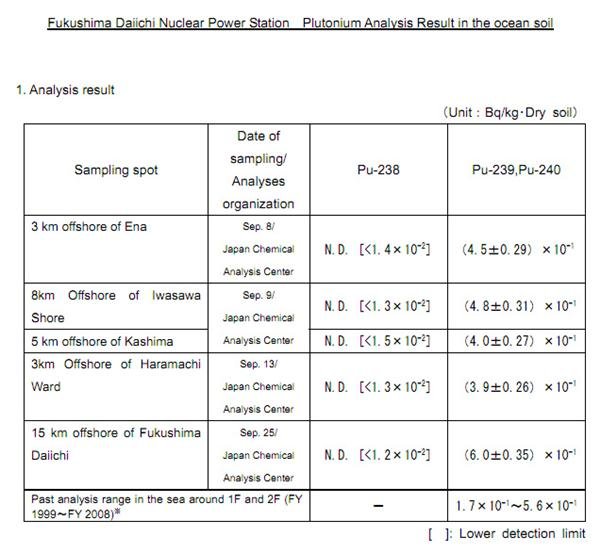
plutonium in ocean soil www.tepco.co.jp
by elainekirk 10/26/2011 9:54:49 AM- Kansai Electric to submit stress test result
Kansai Electric is likely to submit to the government on Friday the results of a safety test on one of its halted nuclear reactors.
Kansai Electric would become Japan's first power company to do so.
80 percent of nuclear reactors in Japan have been halted since the March accident at Fukushima Daiichi nuclear plant. In July, the government decided to mandate new safety assessments, called "stress tests," before the reactors could be restarted.
The tests involve computer simulations to see whether the nuclear power plants could withstand major earthquakes and tsunami.
Kansai Electric plans to submit the results of a stress test on the No.3 reactor of its nuclear plant at Oi, Fukui Prefecture.
But the move does not mean the reactor will be restarted immediately.
The government's Nuclear and Industrial Safety Agency will spend months screening the stress test results before a final go-ahead would be given by the government. Briefings for local governments and residents will also be required as part of the process.
Wednesday, October 26, 2011 18:44 +0900 (JST)
www3.nhk.or.jpby Edano 10/26/2011 10:28:53 AM - Food safety fair features radiation monitors
An annual food safety exhibition has opened in Tokyo with devices for measuring radiation on display for the first time.
Machines that use a conveyor belt to run food past a radiation sensor proved very popular on Wednesday. They can check an item's radiation level in 12 seconds, which means a number of foods can be tested in a short time.
The devices are in high demand from farmers' cooperatives, beef processors and restaurant chains, despite a minimum price tag of 56,000 dollars.
Also on display are small devices that check foods placed in a beaker for radioactive substances.
They are intended for companies and even housewives. The most inexpensive types cost about 9,000 dollars.
An official at a confectioner said the company wants to learn how to take steps to alleviate consumers' fears on its own.
An official from a manufacturer of radiation monitoring devices said the company wants to help farmers dispel rumors that their products may be contaminated.
The exhibition runs through Friday.
Wednesday, October 26, 2011 15:54 +0900 (JST)
www3.nhk.or.jpby Edano 10/26/2011 10:30:13 AM - Nuclear fuel recycling costs
Japan's Atomic Energy Commission says it may cost twice as much to recycle nuclear fuel for power generation as it would to discard the spent fuel as waste.
At a meeting on Tuesday, the commission calculated the cost of recycling spent nuclear fuel and extracting plutonium. The cost was estimated at 1.98 to 2.14 yen per kilowatt-hour of electricity generated.
The cost of discarding the spent fuel as waste was about 1 to 1.35 yen per kilowatt-hour.
This is about half the cost of recycling nuclear fuel, which has been a pillar of Japan's nuclear policy.
The government is under pressure to review its nuclear policy in the wake of the accident at the Fukushima Daiichi nuclear power plant. Tuesday's cost projections may affect the course of discussions on the matter.
The country's nuclear fuel recycling efforts are already being called into question by a series of problems at a nuclear reprocessing plant in Rokkasho village in northern Japan.
Wednesday, October 26, 2011 11:35 +0900 (JST)
www3.nhk.or.jpby Edano 10/26/2011 10:31:52 AM - aaah, this commission has made a lot of calculations.....by Edano 10/26/2011 10:33:50 AM
- @Edano many manyby elainekirk 10/26/2011 10:34:37 AM
- @elainekirk i have heard nothing about this "Japanese Atomic Energy Commission" (AEC) before. en.wikipedia.org maybe because they were calculating all the time since march ....by Edano 10/26/2011 10:38:30 AM
- they only have 5 members and no calculator. so they did it by hand.by Edano 10/26/2011 10:41:05 AM
www3.nhk.or.jp
Municipalities divided over nuke plants restart
Japanese municipalities hosting nuclear power plants are divided over whether reactors that are currently offline should resume operations.
An association of host cities and towns held a meeting in Tokyo on Tuesday. Mayors and officials from 15 communities attended.
The main issue discussed was resuming power generation at reactors which have been idle since the March accident at Fukushima Daiichi.
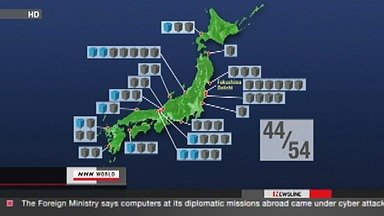
44 of 54 nuclear reactors in Japan are currently offline. They have no prospects of being restarted soon after data errors were found in safety stress tests required before bringing them back online.
Complicating the issue is the manipulation of public opinion on nuclear power at explanatory meetings for local residents that came to light in summer.
Some municipalities demanded the restart of reactors to benefit their economies after their safety is confirmed.
But others remained cautious, preventing the association from reaching a conclusion.
One representative noted the cause of the Fukushima accident has not been confirmed. Another said neither the central government nor power utilities have clarified their policies on the future of nuclear power in Japan.
Wednesday, October 26, 2011 10:41 +0900 (JST)
www3.nhk.or.jpby Edano via Www3.nhk.or.jp 10/26/2011 10:42:31 AM- @Edano oh they have many and varied agencies as is the case globally , they dilute and disperse policy extends into all aspects of nuclear. Much information is put 'technically speaking' into the public domain but, they publish it on the sites of obscure agencies that people in general are unaware of.by elainekirk 10/26/2011 10:42:38 AM
- @Edano I doubt if a genuine poll of the public, the people who have to live with the consequences, would favour a restart anywhere. The mayors as has been shown in Fukushima are able to relocate and send their families to safe countriesby elainekirk 10/26/2011 10:45:16 AM
- Ibaraki population posts sharp drop
Statistics show that the population of Ibaraki Prefecture, north of Tokyo, fell sharply after the March 11th disaster in northeastern Japan.
The prefecture sustained considerable damage in the earthquake and tsunami, and is located south of Fukushima Prefecture and the troubled nuclear power plant.
Ibaraki says its population of about 3 million fell by nearly 10,000 between March and August. The declines were concentrated in March and April.
It says the number of foreign residents fell by 2,900, accounting for nearly 30 percent of the total.
Wednesday, October 26, 2011 11:35 +0900 (JST)
www3.nhk.or.jpby Edano 10/26/2011 10:50:59 AM - Yokosuka conducts nuclear accident drill
The city of Yokosuka near Tokyo held its annual drill on Wednesday for evacuating in a nuclear accident.
The drill started 3 years ago in response to deployment of the nuclear-powered aircraft carrier USS George Washington to a US naval base in the city.
About 70 people including residents and firefighters took part in the drill. Firefighters urged residents to stay indoors, assuming abnormally high levels of radiation around the US base.
At the nuclear-related emergency response center in Yokosuka, city officials practiced using detectors to check residents for radioactive contamination.
The US Navy did not take part in the drill and denies there is any possibility of radiation leaking outside the base.
But it will hold a drill in December with Yokosuka and others to prepare for the possibility that workers on board the aircraft carrier become exposed to radiation.
Wednesday, October 26, 2011 15:08 +0900 (JST)
www3.nhk.or.jpby Edano 10/26/2011 10:52:48 AM - Tokai No. 2 plant reports radioactive water leakage
TOKYO, Oct. 26, Kyodo
Water containing radioactive substances has leaked from a reactor pressure vessel at the Tokai No. 2 power plant in Ibaraki Prefecture, although there was no release of toxic substances into the outside environment, the government's nuclear safety agency said Wednesday.
Some 64 tons of water may have escaped from the pressure vessel to the outer primary container of the plant's boiling water reactor, which is undergoing regular checkups, the agency said. The incident has not affected the cooling process of the nuclear fuel, it said.
According to plant operator Japan Atomic Power Co., workers erroneously loosened a screw located at the bottom part of the pressure vessel, resulting in the leakage of water. Water splashed onto four workers, but they were not exposed to radiation. english.kyodonews.jpby Edano 10/26/2011 10:56:18 AM - @Edano those who could leave easily did so in Ibaraki , those poor locals it must be a nightmare. I was told by our friend when I said I hoped we would meet one day that it would have to be them coming here as Japan is not a good pace to be right now :(by elainekirk 10/26/2011 11:02:17 AM
- why do i think they are lying ?by Edano 10/26/2011 11:02:29 AM
- @Edano because you know that the explanation given does not add up?by elainekirk 10/26/2011 11:06:19 AM


Japan Earthquake | Page 2556
- Who's Blogging
-
 hudebnik
 alblee
 UKVal
UKVal Oliver (ScribbleLive)
 Jonathan Keebler
 Matt (ScribbleLive)
 kaykodh
 PKelley
 Markfm
 dean
dean Angie
Angie- Edano
 Deb
Deb Mid Valley
- Pedro Jesus
 George Gibb
- elainekirk
- lillymunster
 bo
bo IanGoddard