Japan Earthquake | Page 2841
 The shotgun length of 133 cm = 44.5 inches. I'm 5'11'' and the length of my arm is 26 inches. The trigger would be some distance closer than 44.5 inches. From online pictures of shotguns the trigger would be further down the length of a shotgun than half way. Might be possible for someone my size to aim it at their chest an just reach the trigger. The long-gun's end would be pressed into the chest to reach the trigger and so would probably blow a hole through him, but the fatal injury doesn't sound that bad, but we only have words to infer from. Being an older Japanese man, chances are Uemura was smaller than me, making it even harder to point the long gun at himself and pull the trigger. ??by Ian 1/4/2012 3:52:04 PM
 BREAKING NEWS : 8400 Bq/Kg of lead-210 was measured from sample of Yokohama. Jan 04.2011
fukushima-diary.com Dr Chris Busby comments ...
'The Lead 210 concentration of 8400Bq/kg is very interesting and was unexpected. Should not be more than about 20Bq/kg.'
Polonium-210: Po-210 and is a radioactive daughter of lead-210. Uranium-238 Decay Chain
Uranium-238 decays through a series of steps to become a stable form of lead. Uranium-238 has the longest half-life, 4.5 billion years, and radon-222 the shortest, 3.8 days. The last radionuclide in the chain, polonium-210 transforms to lead-210, and eventually the stable nuclide, lead-206. www.epa.govby MaryW 1/4/2012 3:57:33 PM I have to question Busby's claim. 20 bq/kg of lead-210 something that is naturally occurring and has lots of non-nuclear sources? He does not say where he came up with that number. What is the natural background level of lead 210 in Japan? I am guessing it might be higher than 20, especially if the soil was taken somewhere that had other pollutants involved like fertilizer, coal, petroleum.
The plutonium and cesium findings make sense. His claim that the lead is all due to Fuku, he just doesn't make an argument to back it up.
world-nuclear.orgby lillymunster 1/4/2012 4:09:53 PM Futaba mayor opposes radioactive soil storage
The mayor of Futaba Town in Fukushima Prefecture says he opposes the government's plan to build a facility for storing radioactive waste soil in Futaba County.
Mayor Katsutaka Idogawa expressed for the first time his opposition to the facility in his New Year address to town employees on Wednesday.
The mayor said he cannot accept the facility because townspeople who evacuated would not be able to return once it is built.
The central government officially requested late last month that a temporary storage facility for radioactive waste soil be built in Futaba County. The county has eight municipalities, and it is also home to the Fukushima Daiichi nuclear power plant.
The entirety of Futaba Town is designated as a no-entry zone. The residents and the town office have been evacuated to a city in Saitama Prefecture, north of Tokyo.
Wednesday, January 04, 2012 19:09 +0900 (JST)
www3.nhk.or.jpby Edano 1/4/2012 5:40:14 PM- i hope he doesn't get shot now. :(by Edano 1/4/2012 5:40:34 PM
- @lillymunster I do not understand the logic here? Why do you expect Dr Busby to have get into an argument with the results of the Fukushima soil sample. I am just seeing your argument here?
by MaryW 1/4/2012 5:41:59 PM - @MaryW he claims the number for the lead is excessive. We need to know the pre disaster background level of lead for the area in order to determine if that is excessive or not. Busby claims 20 bq is acceptable but says nothing to qualify that statement and does not quote any background levels or standards. He seems to be pulling the number out of thin air.
To determine if there is an excessive lead level you need to know what the predisaster background level for lead is and if that area was something like a former industrial site. At a minimum knowing what is considered a typical background range for lead is needed because lead 210 is a naturally occurring isotope. It is in cigarettes because it is found in the soil tobacco is grown in.
by lillymunster 1/4/2012 5:56:26 PM - @Edano Futuba is likely to never be habitable again with or without the dump.by lillymunster 1/4/2012 5:57:16 PM
- Just to show how different annual exposure doses can be: Comparison of natural background dose rates for residents of the Amargosa Valley, NV, to those in Leadville, CO, and the states of Colorado and Nevada. In the latter half of 2005, the U.S. Environmental Protection Agency (U.S. EPA) published a Proposed Rule (40 CFR Part 197) for establishing a dose rate standard for limiting radionuclide releases from the proposed Yucca Mountain high-level radioactive waste repository during the time period from 10 to 10 years after closure. The proposed standard was based on the difference in the estimated dose rate from natural background in the Amargosa Valley and the "average annual background radiation" for the State of Colorado. As defined by the U.S. EPA, "natural background radiation consists of external exposures from cosmic and terrestrial sources, and internal exposures from indoor exposures to naturally-occurring radon." On the basis of its assessments, the U.S. EPA estimated that the difference in the dose rate in the two identified areas was 3.5 mSv y. The purpose of this paper is to provide an independent evaluation and review of this estimate. One of the first observations was that, because site-specific dose rate measurements for the Amargosa Valley "were not available," the dose rates for various sources of natural background in that area, used by the U.S. EPA in its assessment, were based on modifications of the average values for the State of Nevada. A second observation was that the conversion coefficient applied in estimating the dose rates due to exposures to indoor radon and its decay products was a factor of >2 higher than the currently internationally accepted value. Further review revealed that site-specific data for many natural background sources in the Amargosa Valley were available. One particularly important observation was that about 91% of the residents of that area live in mobile homes which, due to their construction and design, have indoor radon concentrations comparable to, or less than, those outdoors. For that reason, alone, the U.S. EPA estimate of the average dose rate for residents of the Amargosa Valley, due to exposures to indoor radon, was not valid. For purposes of the comparisons in this paper, site-specific dose rates were estimated for all major natural background sources of exposure to residents of the Amargosa Valley, and those in Leadville, CO. The latter community was selected for comparison because of its altitude (3,200 m) and accompanying relatively high cosmic radiation dose rate, and the fact the size of its population is comparable to that of the Amargosa Valley. Another reason for this selection was that a comparison of the average natural background dose rate in the Amargosa Valley to that for the State of Colorado is not suitable because it fails to consider those locations within the State that have dose rates that are higher than the average. Nonetheless, for completeness, and to provide a number that could be compared to the U.S. EPA estimated difference, similar comparisons of the estimated dose rate in the Amargosa Valley to those for average residents of the States of Colorado and Nevada were included in the assessments that follow. The outcome showed that the estimated dose rates in Leadville, the State of Colorado, and the State of Nevada, were higher than those in the Amargosa Valley by 3.94 +/- 1.09, 2.54 +/- 2.18, and 0.95 +/- 0.82 mSv y, respectively. Associated uncertainties were highest for the estimated dose rates due to exposures to radon and its decay products. Had the systematic errors in the radon dose conversion coefficient and the random distribution in radon concentrations been included, the overall uncertainty in the total dose rate estimates could have been as high as 150%. www.ncbi.nlm.nih.gov Only I have not found out what the dose in the Amargosa Valley is.by Peter 1/4/2012 6:13:56 PM
- The significance of this apparently trivial deposition is that the body cannot distinguish radioactive
from stable lead and since this is a bone-seeking element ... The vertebrae of children aged 3-12 months have been shown to contain 0-13pCi/gCa (Blanchard,196a) and it has been calculated that the radiation dose for the infant bones studied would have been 3-4 times greater
than that due to 90Sr. In soft tissues human kidney and liver have been reported to contain 10-4 and 14-3pCi/kg,respectively(Blanchard,196b). The cow, as might be expected, has a higher skeletal 210Pb content than man and analyses of mandibles have shown ... Milk containing lead in excess of 200 p±g/kg represents an appreciable burden to those population and the high milk intake of young children and the groups which consume large quantities of cow milk, especially young children. ...the use of lead-containing pesticides... studies of lead residuals from imported apples from countries where lead arsenate sprays are used may contain as much as 1750... pmj.bmj.com My point being, 8400 Bq/Kg of lead-210 is not only an extreme amount, but an end-result decay process of uranium-238. "uranium-238 decays through a series of steps to become a stable form of lead. The last radionuclide in the chain, polonium-210 transforms to lead-210, and eventually the stable nuclide, lead-2o6.' www.epa.gov all concludes to a MOX melt-down, melt-over, melt-through, whichever term you prefer.by MaryW 1/4/2012 6:21:54 PM - @Peter Good find. That does put things into a different perspective, doesn't it? Accurate estimation of radiation exposure is not an easy science.by Pedro Jesus 1/4/2012 6:22:34 PM
- www.theonion.com From The Onionby lillymunster 1/4/2012 6:28:05 PM
- Analysis of soil sample GA06111. (letter and diagram) Although the letter and final analysis report appear in Fukushima Diary fukushima-diary.com site, the diagram does not. www.scribd.comby MaryW 1/4/2012 6:30:14 PM
- @MaryW Busby still does NOTHING to explain why he thinks the lead level is high or how it is connected to Fuku. He says the cesium is moderate and plutonium is low. There is a large gap in his claim....by lillymunster 1/4/2012 6:32:51 PM
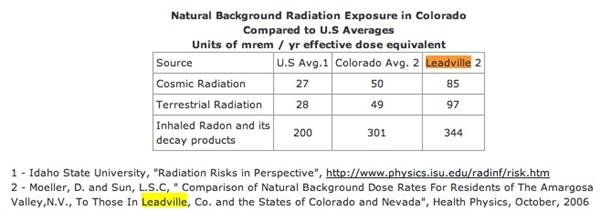
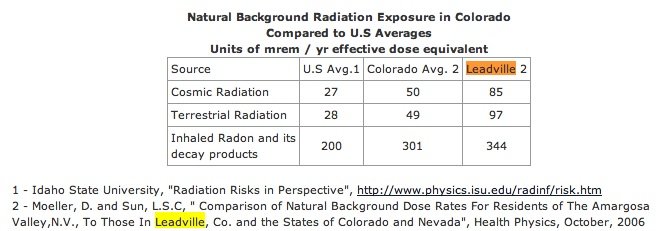
I found some more here: www.powertechuranium.com . I think some numbers in the table are from the study I cited earlier. Look at the contribution of terrestrial radiation in Leadville, CO, a place with uranium mines and plenty lead in the ground. The dose is more than three times the US average! i1214.photobucket.com
by Peter via I1214.photobucket 1/4/2012 6:33:17 PM- Sounding a bit to pro-nuke for me, I'm off for fresh air :)by MaryW 1/4/2012 6:34:42 PM
- found the Moeller study on osti for free: www.osti.govby Peter 1/4/2012 6:54:12 PM
- @MaryW It's not pro nuke, it's only a sound scientific analysis of the beautiful planet we live in. Enjoy your walk. =) Happy new year 2012 to all.by Pedro Jesus 1/4/2012 6:57:12 PM
- Talking about our beautiful planet and the burden that Leadville mines share: Toxic Mine Drainage Threatens Arkansas River www.americanwhitewater.org
Leadville is in a very beautiful spot. I hope it can be saved, :)by Peter 1/4/2012 7:04:28 PM - Not much news today. I have the start of a news archive website. I should have something ready to show later this week. Working on fixing structures and pre-loading some content so it makes sense.by lillymunster 1/4/2012 8:23:40 PM
@Peterby Ian 1/4/2012 9:50:24 PM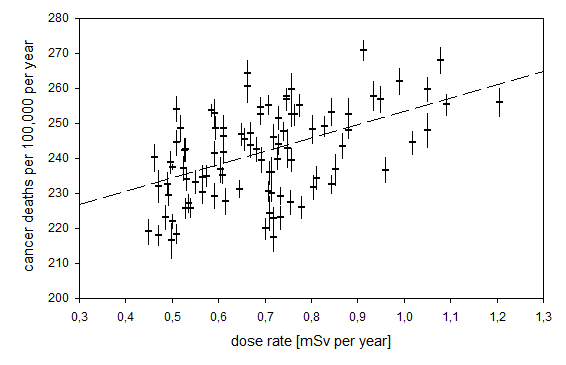
www.alfred-koerblein.de
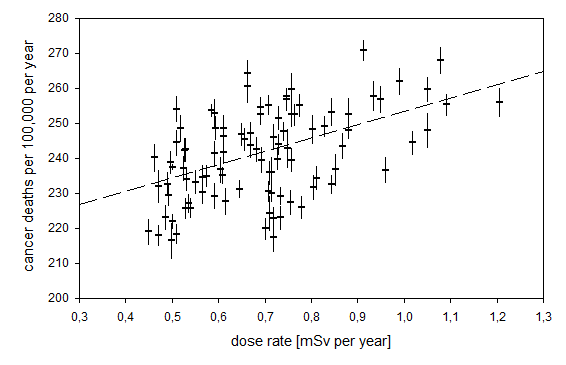
Here's a systematic study of background rad levels vs cancer mortality www.alfred-koerblein.de . Its PubMed entry : www.ncbi.nlm.nih.govby Ian via Alfred-koerblein.de 1/4/2012 9:50:31 PMdescription:
Just when we thought all the dirt had been exposed, more dirt comes out from the carpet. It seems that members of the Japan Nuclear Safety Commission accept large so-called donations from companies in the nuclear industry.
Supporting Article for this video
http://www.japantoday.com/category/national/view/nuclear-safety-panel-received-donations-from-industry-reportby Ian 1/4/2012 10:01:19 PM- This paper notes much higher annual (I believe natural) lead-210 (Pb-210) deposition in Hokkaido, Japan vs cities in other countries itia.ntua.grby Ian 1/4/2012 10:09:39 PM
- @Ian, the plot is interesting. I don't have access to this journal and do not understand how unemployment figures. Otherwise, one could try add figures from the states and see how they fit.by Peter 1/4/2012 10:29:02 PM
- @Peter, there's a link to the full paper at the link to Koerblein's site below.by Ian 1/4/2012 10:34:42 PM
Jan 2nd, South Korea, Seaweed radioactivity test (part 1)
The seaweed is called "East coast" brand kelp and is still in the factory sealed packaging. So far it has given a top reading of about 0.76 uSv/hr.
An Inspector Alert pancake GM geiger counter has been used for the test.
In part 2 the seaweed will be tested without being inside the packaging.by Ian 1/4/2012 10:35:24 PM- Japanese Don't Want a Nuclear Future: The Ticker www.bloomberg.comby lillymunster 1/4/2012 11:08:57 PM
- Japan-Ukraine nuclear pact www.yomiuri.co.jpby lillymunster 1/4/2012 11:10:02 PM
photographs! Video Description:
What does a sudden evacuation look like? After everyone is gone, what happens to the places they've abandoned? National Geographic Magazine sent Associated Press photographer David Guttenfelder to the nuclear exclusion zone around Japan's Fukushima Daiichi power plant to find out. Evacuated shortly after the March 11 earthquake and tsunami led to a nuclear radiation crisis, the area has been largely untouched, with food rotting on store shelves and children's backpacks waiting in classrooms. The area may face the same fate as the town of Pripyat, Ukraine after the Chernobyl disaster 25 years ago. This isn't the first time Guttenfelder has gotten a rare glimpse of a place few see, as The Big Picture featured his photographs of North Korea in an earlier post. Collected here are Guttenfelder's haunting images just released of a place abandoned, and of people dealing with the loss. -- Lane Turner (39 photos total)
www.boston.comby Ian edited by lillymunster 1/4/2012 11:20:07 PM- PreFuku monthly lead-210 deposition in Hokkaido, Japanese is < 111 Bq/m^2 (study uses nCi, convert @ www.drs.illinois.edu) : onlinelibrary.wiley.com Not sure how that translates to Busby's mass-weight unit measure of 8,400 Bq/Kg.by Ian 1/4/2012 11:37:51 PM
Video Description:
On the 28th of December 2011, a group of Fukushima women visited the TEPCO head office in Tokyo. Though they made an appointment in advance to visit there, TEPCO refused to meet them in the office. They had to read their appeal letters aloud and handed them to the TEPCO employees outside.
Above is an excerpt from the video below:
「このままじゃ年越せない!」福島の女たち 東京電力へ 2011.12.28by Ian 1/5/2012 12:13:09 AM- Non-government radiation stations set up in Tokyo with graph readout securitytokyo.comby lillymunster 1/5/2012 2:04:26 AM
- A woman who lives in Minamisoma has been writing about her declining health. Ex-SKF wrote about her yesterday. She does have a very bizarre set of symptoms. Her doctors can't figure out what is wrong with her. Before last spring she was healthy, 40's. She has had teeth rot out and break all in a period of months but had a perfectly fine dental check before that. Rapid hair loss, loss of toenails, various rashes. It sounds like she is going to be interviewed by the IWF channel soon.
ex-skf.blogspot.com
There is a picture gallery on her blog where she has taken photos of some of her symptoms. blogs.yahoo.co.jpby lillymunster 1/5/2012 2:14:32 AM - Koriyama official re-codes radiation map to make it look like less radiation ex-skf.blogspot.comby lillymunster 1/5/2012 2:29:04 AM
- The Fukushima Effect: France Starts to Turn Against Its Much Vaunted Nuclear Industry
Read more: globalspin.blogs.time.comby lillymunster 1/5/2012 2:37:53 AM - The thorium cult invades Japan Times www.japantimes.co.jpby lillymunster 1/5/2012 3:50:18 AM
- @lillymunster Is it me or there has been an implosion of Fukushima related news in the world press? Has Fukushima been swallowed by a black hole?by Pedro Jesus 1/5/2012 4:14:55 AM
- @Pedro Jesus yes.by lillymunster 1/5/2012 4:15:50 AM
- Not seeing much in domestic press either.by lillymunster 1/5/2012 4:16:08 AM
- @lillymunster I follow some international channels, some based in the UK, some in the USA, and a couple national channels here in Portugal and it's becoming harder to find anything that I can even remotely relate to Fukushima. That's why I haven't been posting.by Pedro Jesus 1/5/2012 4:17:40 AM
- @Pedro Jesus Most in JP news is falling back to politics again. There is now talk of snap elections because people are mad about the tax increase.by lillymunster 1/5/2012 4:19:30 AM
- On top of that, I have no idea of what happened to my avatar. It works anywhere except here in the scribble page. Curious enough, it's still up there in my pinned link.
BTW, since we're off topic here, a couple of days ago I had the chance to drive a Honda Jazz Hybrid and was amazed how car technology has changed in only 8 years (since I bought my last new brand new car which I don't even possess any more). The car almost drives by itself and spends less fuel than my diesel mini-van.by Pedro Jesus 1/5/2012 4:21:30 AM - New Fuku plant status and water whack a mole. They are still spraying purified water around the trees at the plant from what accumulates in 5 and 6 www.tepco.co.jpby lillymunster 1/5/2012 4:21:43 AM
Video Description:
Dr. Jeffrey Patterson, former president of Physicians for Social Responsibility talks with Earth Focus about the links between nuclear power and human health. What, if any, dose of radiation is safe? What kind of radiation are we exposed to? Can radiation cause genetic damage? Find out in this Earth Focus interview.by Ian 1/5/2012 4:22:44 AM
Japan Earthquake | Page 2841
- Who's Blogging
-
 hudebnik
 alblee
 UKVal
UKVal Oliver (ScribbleLive)
 Jonathan Keebler
 kaykodh
 PKelley
 Markfm
 Angie
Angie Deb
Deb Mid Valley
- Pedro Jesus
 Matt (ScribbleLive)
 George Gibb
 elainekirk
- lillymunster
 dean
dean bo
bo- Edano
 IanGoddard