Japan Earthquake | Page 990
 @MarkFM, looks like any leakage at the bellows seal would allow something to pass from the D/W directly into the reactor building air ??? D/W is showing extremely high radioactivity of 9.37 x 10 Svh. A breach there would allow all that into the outside air >>by wtm 5/5/2011 6:57:17 PM
 @Elaine K lolby UKVal 5/5/2011 6:58:07 PM
- On the other hand, if it is trapped steam, that might allow the formation of Hydrogen pocket there, and that could be setting itself up for another explosion ?by wtm 5/5/2011 7:00:08 PM
- But then there shouldn't be steam in the D/W ???by wtm 5/5/2011 7:00:41 PM
 Beats me. I'm not seeing significant changes in drywell or torus pressure, even with the pretty decent rise in DW temperatures. The TEPCO fairies might be magically transporting the extra steam away. (aren't we seeing pretty continuous steam emission from #3? -- verhaps DW is indeed venting right out)by Markfm 5/5/2011 7:07:35 PM
 (Salu on the other page noted leaking steam from both -- 3 might be from its DW, while 4 is from its sfp)by Markfm 5/5/2011 7:08:54 PM
 steam from top right side of #2 barely visibleby marie rich 5/5/2011 7:12:46 PM
 back to my #3 theory - rpv lifted thru containment cap - all seals broken - vertical explosion.by Edano 5/5/2011 7:13:14 PM
- Only way we would get steam in the D/W is because there was definitely a breach between the RPV, S/V and D/W, plus if the CAMS readings are that high, it would mean that reactor rod components are in the D/W ??by wtm 5/5/2011 7:14:44 PM
- @wtm corium ?!by Edano 5/5/2011 7:17:14 PM
- @Edano, good theory, but if that was completely the case, I would think that none of the sensors would be working inside the RPV,S/C or D/W, as they would have been torn out from the explosion. Possibly, it exploded between the top of RPV and the top concrete containment cap ???by wtm 5/5/2011 7:19:06 PM
- @Edano, corium would be the logical thought, unless it is all water from the RPV sitting there, but then it is increasing on the readings, so something is active, which goes back to the corium thought. Not a good thought, that after what ? a month and half, we still have active corium melting in a D/W. Remember reading someplace that a test of the GE units with corium melting in the D/W that it would take about 28 days for it to melt through the D/W concrete, and there was speculation that it would do like TMI did and disperse itself and stop the melting reaction. Evidently that is not the case, as it seems to still be actively melting there. Would wonder if that has been the case all along how far it has melted through the concrete, and how far it has to go before it hits the bedrock ??? Time bomb waiting to happen ??by wtm 5/5/2011 7:24:41 PM
- @wtm : i really wonder if we can trust any reading after such a combustion. hard to believe that any cable could be still intact.by Edano 5/5/2011 7:24:54 PM
- @wtm : maybe the corium melts slowly down from rpv. idk how many days it needs to drop down entirely.by Edano 5/5/2011 7:26:56 PM
- @Edano, I will agree on that, but seems that both the seal temp and the CAMS are going up in that D/W area ??? Where is superman and his x-ray eyes when you need him ????by wtm 5/5/2011 7:27:43 PM
- #Edano, that would mean that it had to melt from the bottom of the RPV, into the CV, through the bottom of the C/V and into the D/W. So the RPV and C/V are both breached and melt through. Although we are showing pressure readings in those that might indicate that has happened.by wtm 5/5/2011 7:29:36 PM
- In #2 we have the rising S/C CAMs. In 3 the CAMS in both DW and S/C are showing consistent, though slow, decrease, although temp is rising pretty fast.by Markfm 5/5/2011 7:30:06 PM
- In #2 I really do expect that something, somehow, is oozing from RPV into torus, collecting near the B sensor, then breaking off, now starting another buildup. Beats me how, physically, it is occuring.by Markfm 5/5/2011 7:31:24 PM
- @MarkFM, makes you wonder about the melt down tests they conducted, since after a month and half, we seem to still have active reactions going on in the lower half of the units !!!!by wtm 5/5/2011 7:31:46 PM
 FWIW: Physical phenomena related to surface tension breakdown, heatup, melting, ablation, crust formation and failure, core material relocation into drain pipes with simultaneous melting of pipe walls were modeled, and analyzed. The results of analysis have been used to assess the possibility of drain pipe failure and the resultant loss of pressure-suppression capability. Estimates have been made for the timing and amount of molten corium released to the wetwell. The study has revealed that significantly different melt progression sequences can result depending upon the failure characteristics of the frozen metallic crust which forms over the drain cover during the initial stages of debris pour. Another important result is that it can take several days for the molten fuel to ablate the frozen metallic debris layer— if the frozen layer has cooled below 1100 K before fuel attack.
www.informaworld.comby Rob in SF 5/5/2011 7:32:03 PM- FWIW too...
2. COOLABILITY PHENOMENOLOGY
Several heat transfer mechanisms have been identified
through experiments that can contribute to long-term
corium coolability. These mechanisms are summarized
in Table 1, while a physical illustration is provided in
Fig. 1. When water is introduced atop an MCCI, the
question of whether or not a significant amount of the
thermal energy is initially removed will depend upon
whether a stable crust is able to form that inhibits heat
transfer from the melt to the water layer. For a stable
crust to form, two necessary conditions must be met [3]:
(i) a thermal condition, viz., the melt/water interfacial
temperature must fall below the corium freezing
temperature, and (ii) a mechanical condition, viz., the
incipient crust must be stable with respect to local
mechanical loads imposed by the agitated melt. If either
of these two conditions is violated, then stable crust
formation is precluded. In this bulk cooling regime,
efficient melt/water heat transfer occurs due to conduction
and, predominately, radiation heat transfer across the
agitated (i.e., area enhanced) melt/water interface, in
addition to entrainment of melt droplets into the water
overlayer.
article.nuclear.or.krby Rob in SF 5/5/2011 7:35:45 PM - Rob, thanks for the info.by Markfm 5/5/2011 7:35:54 PM
- @Rob, thanks on that post ! What this is all confirming is that we continue to have active reactions and corium melt. The worst may not be over, if the corium is still actively melting through the D/W, and will within a period of time hit the bedrock ???by wtm 5/5/2011 7:36:16 PM
- wtm, the English NISA stuff is at: www.nisa.meti.go.jp The difficulty is that while they're good at releasing an excerpt of highlights in English, they are spotty on releasing the reactor graphs and plant parameters table (the one with all reactors listed)by Markfm edited by Markfm 5/5/2011 7:38:40 PM
- @Rob, I would agree that the corium should have started to crust over and slowly stop. But possibly could all the smaller quakes in that region be stirring the corium back up, so it does not sit long enough to form that crust ???by wtm 5/5/2011 7:39:19 PM
- @wtm I've heard if the corium were to penetrate the base pan, it should stop within the first few meters of topsoil/whatever, I believe due to groundwater. The base pan is THICK though.by Rob in SF 5/5/2011 7:39:27 PM
- @Rob, if it hits base pan, then it is into the ground water supply !!!! That would allow leakage of major radioactivity into the entire water supply in the area.by wtm 5/5/2011 7:40:57 PM
- @wtm Aftershocks sure seem like they could knock the crust of a chunk of corium. But didn't they say it would be 3 months before the tops of the fuel rods in #1 were covered/cooling? They should be burning/melting no?by Rob in SF 5/5/2011 7:41:29 PM
- Question for somebody that knows chemistry real well ? What happens when Hot corium hits Cold groundwater ???? Instant steam explosion or what ??by wtm 5/5/2011 7:42:56 PM
- #1 is the one they're at least trying to contain. They're doing an air purification exercise for 3 days, then if that works they'll proceed to checking pipes/valves in the building (having to come up with ways to deal with any radioactive hot spots), then connecting existing/repaired #1 pipes to a new external cooler, with 100 tons/hour capacity.by Markfm edited by Markfm 5/5/2011 7:43:20 PM
- @wtm Makes you wonder why they're talking about building an underground containment wall, eh?
The basemats should be 25-30 feet thick at Daiichi.
(JNES).pdfby Rob in SF 5/5/2011 7:45:21 PM - With the lineup of all the planets in this solar system to one side of the Earth, there is a massive pull against us, and judging from the way that the quake map has been going, I would venture to say that we are going to continue to see more quakes in the area for the next few months. Lets hope that they don't get bigger ones !!by wtm 5/5/2011 7:46:02 PM
- @Rob, I think it would really be risky to try to dig underneath the reactors to put in a concrete wall, especially with the on going quakes in the region. One good quake and the reactor would settle into the excavation they were digging, and that would really mess things up !!!by wtm 5/5/2011 7:54:36 PM
- BTW, if you haven't seen it, this 2010 JNES Seismic Safety study on NPPs is interesting:
(JNES).pdf
We came over heavy difficulties from NCO earthquake. Technically and scientifically, we learned many things. But the most important lesson learned is valuable collaboration with IAEA. Public respected high level authority in such emergency situation beyond national authorities. They desired whatever nuclear safety even inconvenience without NPPs. Actions of IAEA relieved this contradiction. We shall contribute to IAEA by providing our experiencesand resources. It will enhance the IAEA SS practically. On the contrary, it will return to MS as great benefits. Your contribution to ISSC is really encouraged by the lesson learned in KK.by Rob in SF 5/5/2011 7:56:08 PM - @wtm Not under, but a horseshoe around them all preventing flow to the sea.by Rob in SF 5/5/2011 7:57:05 PM
 @wtm There is not a massive pull against us, if you calculate it, it is almost infintesimal. Gravity, just like radiation and electric fields and numerous other physical phenomena decrease as the inverse square of the distance. If you don't believe that, then look at it intuitively (a dangerous thing, because many things in physics are not, but), the tides on the earth are mostly caused by the moon, not the sun--which is much more massive. The mass of the mass of the planets is much smaller and many times farther away in most cases--especially with the ones that have appreciable mass such as Jupiter and Saturn. Just because they "line up" has nothing to do with the "pull" anyway. This where something that seems intuitive is WRONG.by Jim Carver 5/5/2011 7:57:41 PM
- does anyone know what the negative pressure (40% & 12% atmosphere) in rpv #3 indicates ?by Edano 5/5/2011 8:00:49 PM
- A slight vacuum compared to ambient. Those are gauge pressures, which means relative to ambient of about 101 kPa.by Markfm 5/5/2011 8:02:01 PM
- @Edano, there was an article by one that stated that they felt it was a reaction of steam being present, as it rose from the C/V up through the breach into the RPV that it created a negative pressure in the RPV.by wtm 5/5/2011 8:04:19 PM
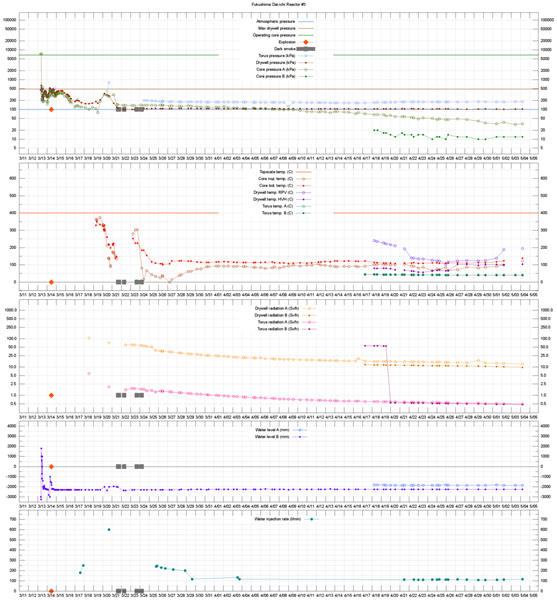
www.ic.unicamp.br slight vakuum ? i see about 40 / 12 kPa. this is not slight, ?
by Edano via Ic.unicamp.br 5/5/2011 8:04:19 PM- 40 kPa = 0.4 atm, about 6 psi. To me that's not large.by Markfm 5/5/2011 8:06:34 PM
- Enough to pull steam up, but not enough to stop corium melt from going down ??by wtm 5/5/2011 8:07:41 PM
- @Markfm The entire air-cooling process you describe I believe is the effort needed to prepare the area such that they can THEN go in with jumpers to seal around the reactor to restore liquid cooling on the rods down the road in some 3 months or so, no?by Rob in SF 5/5/2011 8:08:03 PM
- @Markfm and the B pressure is 0.12 atm.by Edano 5/5/2011 8:08:11 PM
- @Rob, if there is any rods to restore cooling too by then ??by wtm 5/5/2011 8:09:17 PM

Japan Earthquake | Page 990
- Who's Blogging
-
 hudebnik
 alblee
 UKVal
UKVal Oliver (ScribbleLive)
 Jonathan Keebler
 kaykodh
 PKelley
- Markfm
 Angie
Angie Deb
Deb Mid Valley
- Pedro Jesus
 Matt (ScribbleLive)
 George Gibb
 elainekirk
 lillymunster
 dean
dean bo
bo Edano
Edano IanGoddard